Arab Baths Palma (Banys Àrabs): A 1,000-Year-Old Slice of Islamic Mallorca
The Banys Àrabs are the only intact remnant of Palma's Islamic past, dating to the 10th or 11th century. Compact but genuinely atmospheric, this ancient hammam in the heart of the old city takes less than an hour to visit and rewards anyone with even a passing interest in history.
Quick Facts
- Location
- Carrer de Can Serra 7, 07001 Palma (Old Town)
- Getting There
- 3-min walk from La Seu Cathedral; easy on foot from most Old Town hotels
- Time Needed
- 30–45 minutes
- Cost
- €3.50 adults; free for children 10 and under; €1.50 per person for groups of 10+
- Best for
- History lovers, architecture enthusiasts, and anyone wanting a quiet contrast to Palma's busier sights
- Official website
- www.mallorca.es/en/-/arab-baths
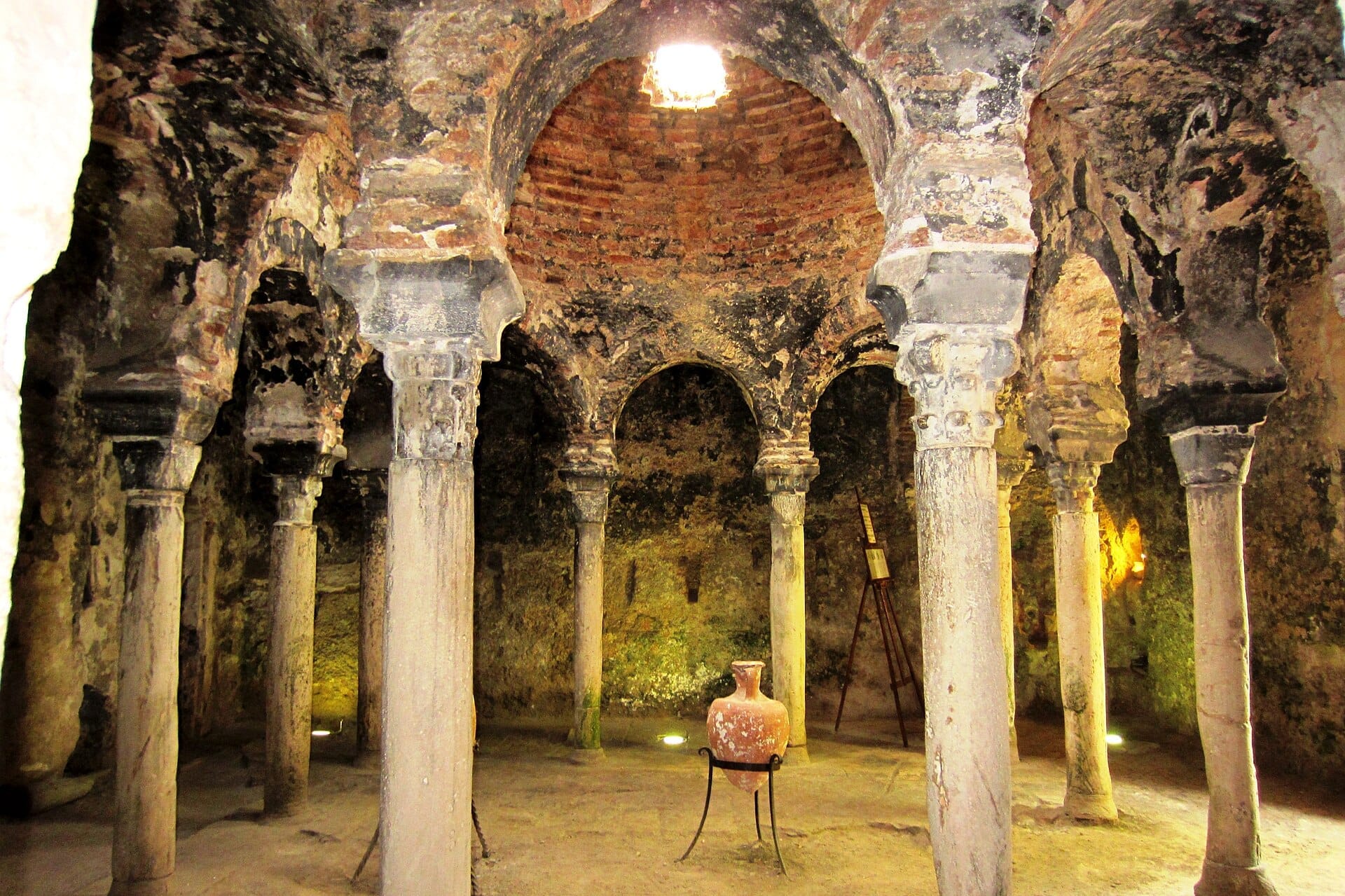
What the Banys Àrabs Actually Are
The Arab Baths, known locally as the Banys Àrabs, are the only surviving example of Islamic architecture in Mallorca. Built sometime in the 10th or 11th century during the period when the island was ruled as the Moorish city of Medina Mayurqa, the baths formed part of a wealthy private residence rather than a public facility. That distinction matters: this was not a communal hammam for the general population, but a refined domestic space for Palma's Islamic elite.
What makes the site remarkable is less its scale, which is genuinely small, and more its structural ingenuity. The centrepiece is the caldarium, the hot room, where a domed ceiling pierced by small circular skylights sits on 12 columns that were not purpose-built but collected from earlier structures. The columns are a deliberate mix: some are Roman, some Byzantine, some Islamic in origin, and they differ subtly in height and capital design. Adjusting for those differences required the builders to vary the column heights with carved stone cushions, a detail you can see clearly if you look down at the base of each column before you look up at the dome.
💡 Local tip
Stand near the centre of the caldarium and look straight up. The pattern of light through the dome's oculi changes with cloud cover and time of day — on a bright morning the room fills with soft columns of light that make the stone glow.
The Visit: What You See and How It Unfolds
You enter through a narrow doorway off Carrer de Can Serra, a quiet residential street that gives nothing away about what's inside. After paying at a small ticket desk, you pass through a horseshoe arch into a shaded garden courtyard. The garden is worth pausing in: cacti, palms, and old stonework create a genuinely peaceful pocket in a city that can feel relentlessly busy during the summer months.
From the courtyard, you move into the main bath chambers. The cold room (frigidarium) and the hot room (caldarium) are the two primary surviving spaces. The hypocaust system, the network of underground channels that once circulated hot air beneath the floor to heat the caldarium, is explained via informational panels. The panels are clear and well-translated into several languages, which matters given how much context is needed to appreciate what you're looking at.
The site is genuinely compact. A single slow circuit, reading the panels, takes around 30 minutes. There is no audio guide, and the visit is self-guided throughout. This is not a place where you'll spend half a day — it's a focused, unhurried stop that sits comfortably alongside a broader morning in the Old Town.
Tickets & tours
Hand-picked options from our booking partner. Prices are indicative; availability and final rates are confirmed when you complete your booking.
Banana Boat Experience in Mallorca
From 14 €Instant confirmationFree cancellationPalma de Mallorca 30-minute Jet Ski Tour with Visit to the Cathedral
From 99 €Instant confirmationFree cancellationSnorkel Tour in Mallorca
From 40 €Instant confirmationFree cancellationPalma de Mallorca: Small-Group Tour & Fast-Track Cathedral
From 59 €Instant confirmationFree cancellation
How the Experience Changes By Time of Day
Arriving early, around 9:30 or 10:00 AM, gives you the best chance of having the caldarium almost to yourself. The light entering through the dome's skylights is low and angled in the morning, casting clear shadows across the columns and giving the room a more dramatic quality than you get later in the day. The garden is also cooler and quieter at this hour, which in summer is not a trivial consideration.
By late morning and into the early afternoon, tour groups pass through regularly. The space is small enough that even a group of ten people makes it feel crowded. If you arrive between 11:30 AM and 2:00 PM in peak season, expect to share the caldarium. The site reopens after any lunchtime pause, and the late afternoon window, roughly 4:00 to 6:00 PM, offers another quieter period as most organised tours have moved on.
ℹ️ Good to know
Opening hours vary seasonally: Monday–Saturday 10:00 AM–6:00 PM; Sunday 10:00 AM–7:00 PM. Hours can shift without notice, so check before visiting if timing matters to your plans.
Historical and Cultural Context
Mallorca was under Islamic rule from 902 AD until the Aragonese King Jaume I took the island in 1229. During those three centuries, Palma — then called Medina Mayurqa — was a functioning Moorish city with mosques, souks, bathhouses, and a substantial Arab-speaking population. When the Christian conquest came, virtually all of that built environment was dismantled or repurposed. Churches replaced mosques. The street grid was reorganised. The Banys Àrabs survived primarily because they were embedded within a private structure that was converted to other uses rather than demolished.
The reuse of Roman and Byzantine columns in the caldarium reflects a wider Islamic architectural tradition of spoliation: incorporating materials from older structures as an aesthetic and practical choice. The capital styles range from Corinthian to Islamic geometric, and the intentional mixing is not carelessness but design. This gives the space a layered quality that is unique in the Balearics.
For anyone building a day around Palma's historical layers, the Banys Àrabs pair naturally with the nearby Palace of La Almudaina, which occupies the site of the original Moorish alcázar, and with Palma Cathedral (La Seu), built over the former main mosque. Together these three sites trace Palma's transition from Islamic to Christian rule across a walkable area of the Old Town.
Practical Walkthrough: Getting There and What to Bring
The baths are at Carrer de Can Serra 7, in the oldest part of Palma's historic centre. From La Seu Cathedral, follow the signs eastward through the medieval street grid — the walk takes around three minutes. Coming from the Passeig del Born, allow five to seven minutes on foot. There is no on-site parking; the Old Town streets here are pedestrianised or too narrow for cars, so arrive on foot or by taxi.
If you're navigating the wider Old Town, the Passeig del Born is a natural orientation point nearby, and the Palma Old Town area is compact enough that most key sights are within ten minutes on foot.
Admission costs €3.50 for adults, with free entry for children aged 10 and under. Groups of more than ten people pay a reduced rate of €1.50 per person. Payment is made at the ticket desk on arrival; bring cash as a backup, though cards are generally accepted at most Palma attractions of this type.
The site involves some uneven stone flooring and a few shallow steps, particularly through the horseshoe arch entrance. There are no elevators or ramps noted on-site, which is worth keeping in mind for visitors with significant mobility limitations. The garden courtyard is relatively level, but the interior chambers have the irregular surfaces typical of ancient stonework.
⚠️ What to skip
The caldarium floor can be slippery when damp. Wear flat, closed shoes rather than sandals or flip-flops, especially if visiting after rain.
Photography Inside the Baths
The dome in the caldarium is the single most photogenic element of the site, and it rewards patience. The circular skylights create a different pattern of light depending on cloud cover and the time of day. A morning visit with direct sun produces the sharpest light shafts; an overcast day softens the effect but makes exposing for the darker wall surfaces easier. No flash is needed, and no flash should be used — the natural light is the point.
If photography is a priority during your Mallorca trip, the Banys Àrabs are one stop among many. The Mallorca photography guide covers the island's most compelling visual subjects across different regions and light conditions.
Honest Assessment: Is It Worth Your Time?
The Banys Àrabs are sometimes described as underwhelming by visitors who arrive expecting a grand monument. That reaction is understandable and also slightly beside the point. This is a small, fragile survival from a civilisation that was comprehensively erased from Mallorca's landscape. Its value is historical and atmospheric rather than spectacular.
For travellers who enjoy reading architecture as a form of evidence, who find layered history genuinely interesting, or who want a counterweight to Palma's beaches and nightlife, this is a worthwhile 30-minute stop at a very low cost. For travellers who need scale and grandeur to feel engaged by a historical site, it may not deliver.
Families with children can certainly visit — the admission is free for the under-10s and the garden is a pleasant place to let small children move around. The historical context is, however, subtle enough that younger children are unlikely to engage deeply with the interior.
Insider Tips
- Arrive right at opening time (10:00 AM) for the best light in the caldarium and the best chance of having the dome room to yourself.
- Spend time in the garden courtyard before and after the interior rooms. It's shaded, quiet, and rarely crowded, making it a good place to sit and reorient before continuing through the Old Town.
- Look closely at the base of each column in the caldarium. The different-height stone cushions used to level the columns of varying sizes are easy to miss but are among the most technically interesting details on the site.
- The street outside, Carrer de Can Serra, is unremarkable but cuts through one of the oldest parts of Palma's urban fabric. Walking the surrounding few blocks is a useful way to get a feel for the medieval street pattern that survives here.
- If you plan to visit multiple Palma historic sites in one day, the Banys Àrabs work best as a first stop given their early opening time and the morning light advantage in the caldarium.
Who Is Arab Baths (Banys Àrabs) For?
- History and archaeology enthusiasts looking for genuine pre-Christian Mallorca
- Architecture fans interested in Islamic, Roman, and Byzantine material culture
- Travellers seeking a quiet, low-cost counterpoint to Palma's larger attractions
- Photographers wanting interior natural-light compositions
- Anyone spending a morning exploring Palma's Old Town on foot
Nearby Attractions
Other things to see while in Palma de Mallorca:
- Bellver Castle
Perched on a pine-covered hill 3 km west of Palma's city centre, Bellver Castle is one of Europe's rare circular Gothic fortresses. Built under King Jaume II and completed around 1311, it has served as a royal residence, a prison, and now houses the Palma Municipal History Museum. The views over Palma Bay alone justify the climb.
- Bishop's Garden (Jardí del Bisbe)
Tucked behind the towering walls of Palma Cathedral, the Jardí del Bisbe is a small formal garden on the grounds of the Episcopal Palace. Free to enter and often overlooked by visitors rushing between La Seu and the seafront, it offers citrus groves, herb beds, an ornamental pond, and a rare ground-level view of the cathedral's famous rose window.
- Es Baluard Museum of Modern & Contemporary Art
Es Baluard Museu d'Art Contemporani de Palma occupies a Renaissance bastion on the old city walls, combining 800-plus works of modern and contemporary art with sweeping views over Palma Bay. It is one of the most architecturally striking museum settings in the Balearic Islands, and far less crowded than the cathedral a few minutes' walk away.
- Fundació Pilar i Joan Miró
The Fundació Pilar i Joan Miró a Mallorca is where Joan Miró actually worked, and that biographical intimacy sets it apart from any conventional gallery visit. Spread across preserved studios, a Rafael Moneo-designed exhibition building, and a sculpture garden in Palma's Cala Major district, the foundation holds around 6,000 works and offers one of the most architecturally considered art spaces in Spain.