Passeig del Born: Palma's Grand Boulevard Explained
Passeig des Born is the ceremonial spine of Palma de Mallorca, a tree-lined promenade running from the old city walls to the edge of the shopping district. Free to visit at any hour, it rewards those who look past the café menus and notice the sphinxes, the lion sculptures, and the stories embedded in the stone.
Quick Facts
- Location
- Central Palma de Mallorca, between Plaça de la Reina and Plaça del Rei Joan Carles I, 07012
- Getting There
- 10-15 min walk from Palma Cathedral; city buses stop near the Centre; taxis drop off at Plaça de la Reina
- Time Needed
- 30 min to stroll end to end; 1.5-2 hrs if you visit Casal Solleric or stop for coffee
- Cost
- Free public access; Casal Solleric exhibitions vary (check Palma City Council website)
- Best for
- Architecture lovers, evening strolls, café culture, photography, and anyone using it as a base for exploring central Palma
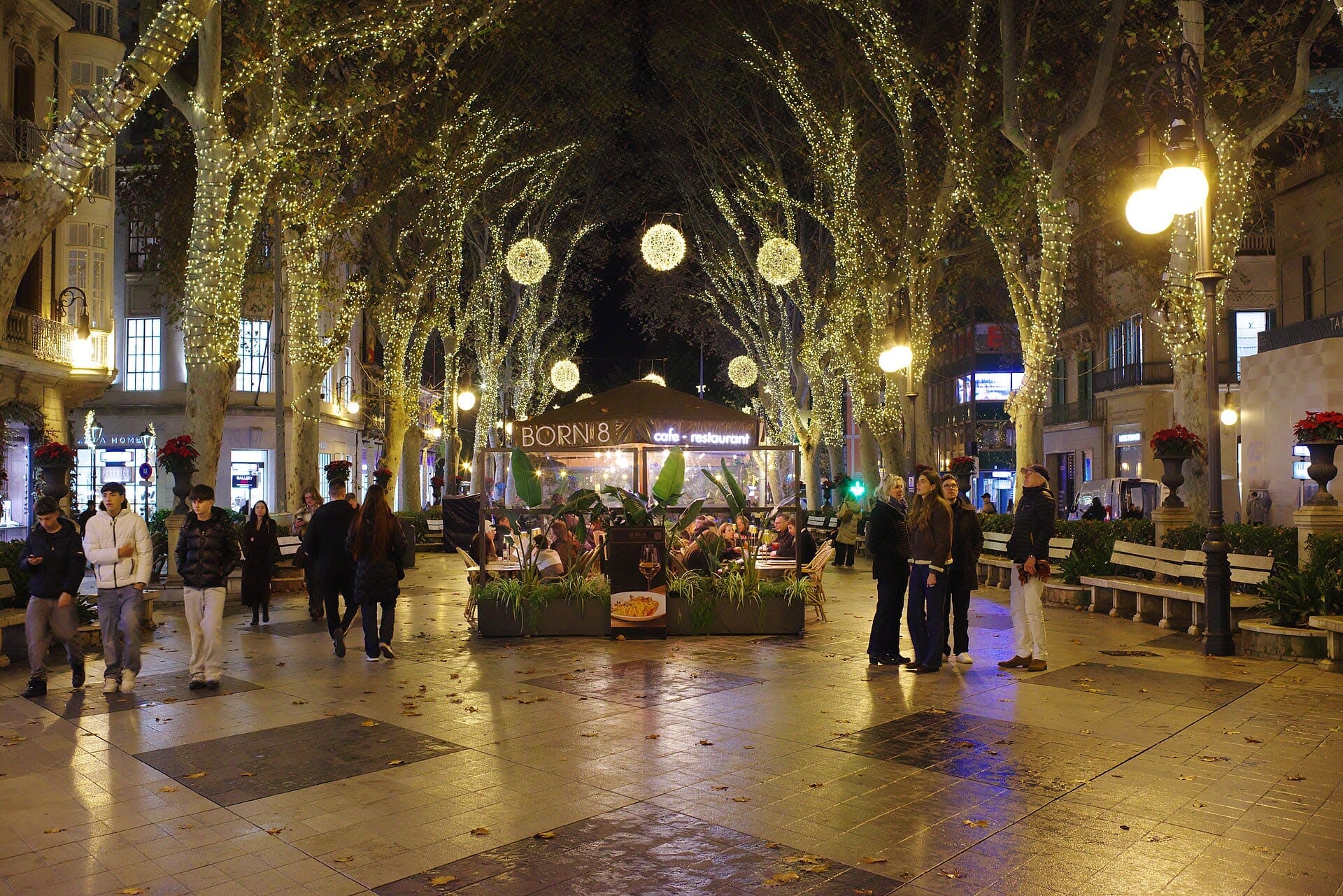
What Is Passeig del Born?
Passeig des Born is the formal name for what most visitors and locals simply call the Born: a broad, plane-tree-shaded promenade that cuts through the heart of Palma de Mallorca. Roughly 500 metres long, it connects Plaça de la Reina at the southern end, where the old city opens toward the sea, with Plaça del Rei Joan Carles I (also known as Plaça de les Tortugues, the Turtle Square) at the northern end, where Avinguda de Jaume III begins. Between these two poles sits one of the most architecturally layered streets in the Balearic Islands.
The promenade is free and open around the clock. There are no gates, no ticket windows, no queues. What it offers instead is something harder to package: a place where Palma's aristocratic past and its present commercial life coexist on the same stretch of pavement, separated only by a row of mature trees and a set of well-worn benches.
💡 Local tip
The Born is best used as a connector, not just a destination. Walk it between the Cathedral quarter and the Jaume III shopping street and you'll absorb most of what makes it worth seeing, without needing to plan a dedicated visit.
A History Written Into the Pavement
The Born's origins go back to the 16th century, when the area served as jousting grounds and a space for public ceremonies and parades. It was built over the channelled bed of the Riera torrent, which once drained the mountains behind Palma toward the sea. When the city's drainage was engineered underground, the cleared ground became one of the first planned public spaces in Palma.
The boulevard's current form dates largely from 1833, when it was redesigned with the symmetrical layout visible today. The two sphinx sculptures flanking the central obelisk, known as the central obelisk, were added as part of this 19th-century restructuring. The bronze lion statues positioned along the central path followed later, giving the promenade its distinctive ceremonial character. During the Franco era the street was officially renamed, but the name Born was always what residents used, and it was officially restored after Franco's death.
On the corner of Carrer de Jovellanos, look for the carved stone relief known as the Cap del Moro (the Moor's Head), a small architectural detail that quietly signals how long this corner of the city has been inhabited and contested. It is easy to walk past without noticing.
Tickets & tours
Hand-picked options from our booking partner. Prices are indicative; availability and final rates are confirmed when you complete your booking.
Jet Ski Tour to Los Deltas Natural Reserve
From 159 €Instant confirmationFree cancellationDinosaurland and Caves of Hams combined ticket
From 25 €Instant confirmationFree cancellationShuttle Boat from Cala Millor to Cala Ratjada
From 26 €Instant confirmationFree cancellation3-hour Es Trenc Boat Tour in Mallorca
From 39 €Instant confirmationFree cancellation
Walking the Boulevard: What You'll Actually See
The central reservation is the main event: a wide pedestrian path shaded by mature plane trees whose canopy closes over the walkway in summer, creating a tunnelled green corridor. The benches along this central strip are occupied from mid-morning onward, first by older residents reading papers, then by tourists resting between the Cathedral quarter and the shopping streets, then by couples in the evening.
On either side of the tree line, traffic lanes and narrow pavements front a run of 19th and early 20th-century facades. The ground floors are almost entirely given over to luxury fashion boutiques, jewellers, and high-end restaurants with terrace seating. The upper storeys are where the architecture actually gets interesting: ornate Modernista details, wrought-iron balconies, and carved stone surrounds that most people miss because they are looking at window displays.
At number 27, Casal Solleric is the standout building on the boulevard. This 18th-century noble palace, built for a family of olive oil merchants, now functions as a contemporary art gallery managed by Palma City Council. Entry to the courtyard is often free, and even when the exhibitions carry a charge, the interior courtyard alone is worth the detour. The proportions of the space, with its stone arches and stone staircase, give a clearer sense of how Palma's merchant aristocracy lived than most dedicated museums manage.
ℹ️ Good to know
Casal Solleric (Pg. del Born 27) is Palma's main public contemporary art space. Exhibition schedules and any entry fees are managed by Palma City Council. Check current programming before your visit if this is a priority.
How the Born Changes by Time of Day
Early morning, before 9am, the Born belongs to Palma's residents. Street cleaners work the central path, café staff arrange chairs, and dog walkers take the long way home. The light at this hour is low and warm, and the plane tree shadows fall at long angles across the stone. This is the best time for photography if you want the architecture without people in every frame.
By mid-morning the boulevard shifts to its tourist register. Terrace tables fill, luggage-pulling groups navigate toward the Cathedral, and the boutique doors open. The atmosphere is pleasant but unremarkable, the same as any well-maintained European shopping street on a sunny day.
Evening is the Born's best hour. Between 7pm and 10pm in summer, the temperature drops, the light turns amber through the trees, and the terrace restaurants come into their own. The promenade fills with a mix of dressed-up locals and tourists making their way between dinner reservations. There is a particular quality to the sound at this hour: heels on stone, cutlery, low conversation in Mallorquí, Spanish, German, and English all layered together. It is one of the more genuinely pleasant urban evenings available anywhere on the island.
If you are planning a full day in central Palma, the Born connects naturally to the Cathedral La Seu and the Palace of La Almudaina to the southeast, and to the main commercial streets to the north. It takes less than 15 minutes to walk from the Cathedral's front steps to the Turtle Fountain at the Born's northern end.
Practical Information for Visitors
The Born is entirely flat and the central pedestrian path is wide and smooth, making it straightforwardly accessible for wheelchairs and pushchairs. The lanes on either side carry traffic, so crossing at the ends requires attention, but the central reservation can be walked end to end without crossing any road.
There is no need to plan transport specifically to reach the Born. If you are staying anywhere in central Palma, you will likely cross it by accident. City buses serving the Centre stop within a few minutes' walk. Taxis and ride services can drop at Plaça de la Reina at the southern end, which is also the most photogenic approach, with the green boulevard opening up ahead of you and the old city behind.
For those arriving by car, parking in central Palma requires patience. The getting around Mallorca guide covers the practical options, including park-and-ride routes that avoid the old town's restricted zones.
Photography tip: the central path shoots well from either end in morning light. The sphinx sculptures at the obelisk make useful compositional anchors. For the Casal Solleric facade, late afternoon light hits it directly from the west. Avoid midday, when harsh overhead light flattens the stone details.
Is It Worth Your Time? An Honest Assessment
Passeig del Born will not be the highlight of anyone's trip to Mallorca. It is not dramatic, it does not require effort to see, and the luxury retail that lines it is available in dozens of European cities. Travellers who come specifically expecting a singular experience will find it ordinary.
What it does offer is context. Walk the Born and you understand something about how Palma positions itself: not as a beach resort that happens to have an old town, but as a city with a self-conscious identity and architectural confidence. The combination of medieval stonework in the surrounding streets, 19th-century boulevard design, and active contemporary culture at Casal Solleric is genuinely unusual for an island destination of this size.
It also serves as an excellent orientation point. The Born sits at the boundary between Palma's old town and the modern shopping district, making it a useful landmark for anyone structuring a day on foot. Pair it with the Arab Baths and the Cathedral quarter and you have a half-day walk that covers most of what makes Palma architecturally interesting.
⚠️ What to skip
The Born's café terraces are significantly more expensive than equivalent places two streets back. If you want to sit and have coffee, walk one block toward Carrer de la Unió for better value without sacrificing atmosphere.
Travellers focused entirely on beaches, hiking, or rural Mallorca can skip the Born entirely without missing anything essential. It is a feature of Palma as a city, not of Mallorca as an island. Those who are not especially drawn to urban walking will find their time better spent elsewhere.
Insider Tips
- The Casal Solleric courtyard is often accessible even when no exhibition is running. Walk in off the street and look up at the stone staircase. Most visitors walk past the entrance entirely.
- The sphinx sculptures at the central obelisk are easy to overlook. Stop and examine them closely: they are among the more eccentric pieces of 19th-century public sculpture in Palma and read as slightly absurdist in the best possible way.
- For evening dining, the terraces on the Born itself carry a premium for the address. The parallel street of Carrer Apuntadors, a short walk away through the old town, has restaurants with comparable quality at noticeably lower prices.
- The Cap del Moro carved relief on the corner of Carrer de Jovellanos is one of those small urban details that rewards curiosity. It is at approximately head height on the corner stone: a carved Moorish head that has been marking that corner for centuries.
- If you visit in January or February, the plane trees are bare and the boulevard looks entirely different: spare, almost Nordic, with the building facades fully exposed. It is a good time to read the architecture without the summer foliage softening everything.
Who Is Passeig del Born For?
- First-time visitors to Palma who want to understand the city's layout and scale before exploring further
- Architecture and history enthusiasts willing to look above the shopfronts
- Evening walkers and those who want a pleasant outdoor setting for a drink or dinner in the city
- Photographers working early morning light in central Palma
- Anyone visiting Casal Solleric for its contemporary art programme
Nearby Attractions
Other things to see while in Palma de Mallorca:
- Arab Baths (Banys Àrabs)
The Banys Àrabs are the only intact remnant of Palma's Islamic past, dating to the 10th or 11th century. Compact but genuinely atmospheric, this ancient hammam in the heart of the old city takes less than an hour to visit and rewards anyone with even a passing interest in history.
- Bellver Castle
Perched on a pine-covered hill 3 km west of Palma's city centre, Bellver Castle is one of Europe's rare circular Gothic fortresses. Built under King Jaume II and completed around 1311, it has served as a royal residence, a prison, and now houses the Palma Municipal History Museum. The views over Palma Bay alone justify the climb.
- Bishop's Garden (Jardí del Bisbe)
Tucked behind the towering walls of Palma Cathedral, the Jardí del Bisbe is a small formal garden on the grounds of the Episcopal Palace. Free to enter and often overlooked by visitors rushing between La Seu and the seafront, it offers citrus groves, herb beds, an ornamental pond, and a rare ground-level view of the cathedral's famous rose window.
- Es Baluard Museum of Modern & Contemporary Art
Es Baluard Museu d'Art Contemporani de Palma occupies a Renaissance bastion on the old city walls, combining 800-plus works of modern and contemporary art with sweeping views over Palma Bay. It is one of the most architecturally striking museum settings in the Balearic Islands, and far less crowded than the cathedral a few minutes' walk away.