Sa Calobra & Torrent de Pareis: Mallorca's Most Dramatic Canyon
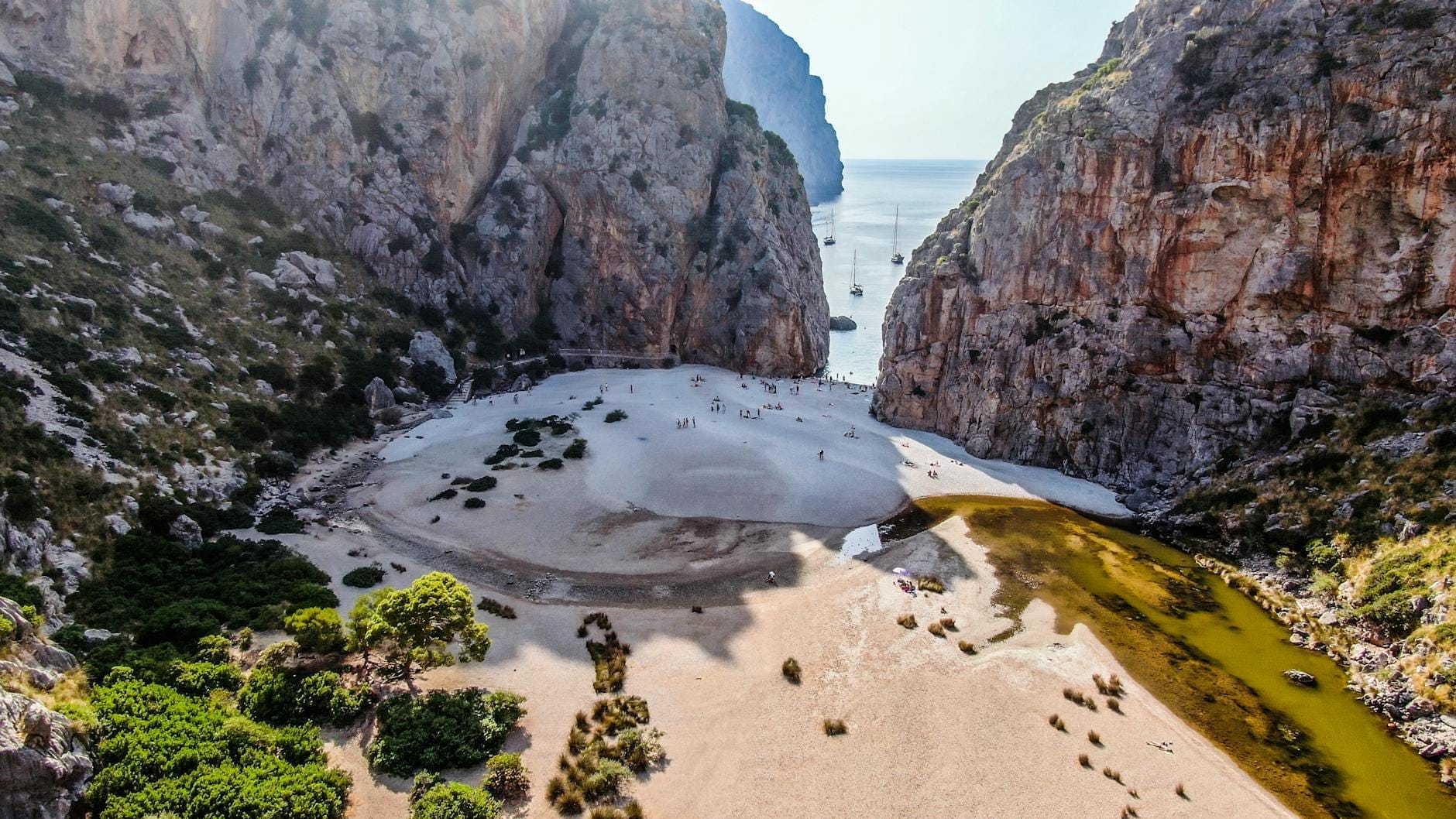
Sa Calobra and the Torrent de Pareis form one of the most striking natural landscapes in the western Mediterranean: a 300-metre-deep limestone gorge that opens onto a sheltered pebble beach. The journey to reach it, whether by the legendary corkscrew road or by boat from Sóller, is half the experience.
Quick Facts
- Location
- Escorca municipality, Serra de Tramuntana, northwest Mallorca
- Getting There
- By car via Ma-10 (12km descent with hairpin turns) or by boat from Port de Sóller (approx. 40 min)
- Time Needed
- 2–3 hours for the cove and tunnel walk; 4–5 hours for the full canyon hike from Escorca
- Cost
- Free entry to the cove and canyon. Boat transfers from Port de Sóller are ticketed; check current prices locally.
- Best for
- Nature lovers, photographers, hikers, and anyone who wants to see the Tramuntana beyond the postcard
What Sa Calobra Actually Is
Sa Calobra is a small cove on the northwest coast of Mallorca, tucked into the base of the Serra de Tramuntana. On its own, it would be a quiet spot: a short stretch of grey-white pebbles, clear turquoise water, and steep limestone walls rising on three sides. What makes it significant is what lies immediately behind it: the Torrent de Pareis, the second deepest karst canyon in the Mediterranean.
The Torrent de Pareis is classified as a Natural Monument (2003) and forms part of the Serra de Tramuntana UNESCO World Heritage Site. The gorge runs for approximately 5 kilometres, with walls reaching 300 to 400 metres high and, at its narrowest, only 30 metres wide. The torrent itself stretches 3,300 metres and rises 180 metres above sea level. From the sea, you reach the canyon entrance through a 200-metre tunnel cut directly through the rock, which opens into a vast natural amphitheatre of polished boulders and shadowed cliffs.
ℹ️ Good to know
No admission fee is charged to visit Sa Calobra or enter the Torrent de Pareis. However, the road down is narrow and parking is extremely limited in summer. Arriving before 9am or after 4pm makes a significant difference.
The Road Down: Why the Journey Matters
The 12-kilometre descent from the Ma-10 to Sa Calobra is one of the most engineered stretches of road in Spain. It drops 800 metres in altitude through a series of tight switchbacks, including the famous 'Knotted Tie' loop: a 270-degree spiral where the road passes under itself. Cyclists treat it as a pilgrimage; drivers treat it with caution. In summer, coaches use it too, which means oncoming traffic on blind corners is a real consideration.
The road was designed by Antonio Parietti in the 1930s and is considered an engineering achievement of its era. For travellers covering the Tramuntana by car, it fits naturally into a broader Mallorca road trip that also takes in Sóller, Deià, and the northern coast. The views on the descent, across scrubland and down to the glittering inlet, are genuinely striking.
An alternative worth serious consideration is arriving by boat from Port de Sóller. The crossing takes around 40 minutes and approaches Sa Calobra from the sea, giving you the full scale of the cliffs before you step ashore. It also sidesteps the parking problem entirely. Check current schedules and fares with the Sóller boat operators directly, as these vary by season.
Tickets & tours
Hand-picked options from our booking partner. Prices are indicative; availability and final rates are confirmed when you complete your booking.
Dinosaurland and Caves of Hams combined ticket
From 25 €Instant confirmationFree cancellationShuttle Boat from Cala Millor to Cala Ratjada
From 26 €Instant confirmationFree cancellation3-hour Es Trenc Boat Tour in Mallorca
From 39 €Instant confirmationFree cancellationShuttle Boat Roundtrip from Cala Bona to Cala Ratjada
From 29 €Instant confirmationFree cancellation
The Cove and the Tunnel Walk
Most visitors spend their time at Sa Calobra's beach and the tunnel approach to Torrent de Pareis. The beach itself is pebbly rather than sandy, which keeps it from feeling like a typical resort cove. The water is clean and exceptionally clear, sheltered enough for swimming on most days. In July and August, it fills with day-trippers and those arriving by boat, and the narrow access path gets congested around midday.
The 200-metre tunnel is the real draw for most visitors. Cut through the base of the cliff, it leads from the beach area into the canyon's mouth: the point where the two gorge tributaries, the Torrent de Lluc and the Torrent de Pareis, converge. The tunnel is low in places and unlit, so a torch or phone light is useful. What you emerge into is difficult to prepare for: an enclosed cathedral of limestone, 300-400 metres of rock above you, the walls polished smooth by centuries of winter floods, and at your feet a chaos of huge pale boulders.
💡 Local tip
Bring sturdy shoes even if you only plan to walk through the tunnel. The boulders at the canyon mouth are uneven and wet in shaded areas. Flip-flops are genuinely problematic here.
The Full Canyon Hike: What to Know Before You Go
The complete traverse of Torrent de Pareis, from Escorca down to Sa Calobra, is one of the most demanding hikes in Mallorca. The route covers approximately 5 kilometres of canyon and takes 4 to 5 hours depending on conditions. It involves scrambling over large boulders, some sections requiring the use of both hands, and navigation through narrow passages where the walls press in close.
This hike is only suitable for experienced walkers with appropriate footwear, physical fitness, and ideally some scrambling experience. It is explicitly not recommended for children. The route is passable in summer when the torrent is dry, but becomes dangerous after heavy rain in autumn and winter, when flash floods can fill the gorge with little warning. For a broader sense of what hiking in this region involves, the hiking in Mallorca guide covers difficulty ratings and seasonal conditions across the Tramuntana.
The canyon is home to endemic species found nowhere else in the world, including the Ferreret toad (Alytes muletensis), a Balearic endemic rediscovered in the 1970s after being thought extinct. Several endemic plant species also cling to the canyon walls. This ecological significance is one reason the area carries both Natural Monument designation and UNESCO protection.
⚠️ What to skip
Do not attempt the full canyon hike without checking weather forecasts for the entire Tramuntana range, not just the coast. Rain falling kilometres away can cause flash flooding in the gorge with no warning at ground level.
When to Visit and How Crowds Behave
Sa Calobra is genuinely popular, and that popularity is concentrated hard into the summer months. In July and August, the beach fills by mid-morning, the car park overflows, and the tunnel walk becomes a shuffling queue in both directions. The site's drama does not disappear in these conditions, but the solitude does.
The best time to visit is May to early June, or late September to October. Temperatures are manageable, the water is swimmable, and the coaches are largely absent. Early morning arrivals, before 9am, can experience the canyon mouth in near-silence, with the light cutting down through the gorge walls at a low angle. Autumn visits carry more atmosphere: the rock is damp from recent rain, the colours are deeper, and the gorge feels more serious. For broader context on timing, when to visit Mallorca covers the trade-offs across all seasons.
One exception to the usual visitor pattern: the first Sunday of July each year, the Torrent de Pareis hosts an outdoor classical music concert inside the canyon amphitheatre. Hundreds of people gather on the boulders at the gorge mouth for a performance that uses the natural acoustics of the rock walls. It is one of the more unusual concert settings in Europe. Check local listings for current programme details.
Photography and Practical Walkthrough
Sa Calobra and the Torrent de Pareis appear consistently in lists of the best views in Mallorca, and for once the reputation is earned. The light inside the canyon is best in the middle of the day, when the sun is high enough to reach the canyon floor. Early morning and late afternoon produce deep shadow at ground level, which can make the boulders dramatic but the beach flat. For the descent road, golden-hour light from the west catches the switchbacks beautifully in late afternoon.
A wide-angle lens handles the canyon walls well. For the beach and water, the clarity means you can shoot from the rocks at the water's edge and capture depth without a polariser, though one helps in midday light. The tunnel itself is dark enough to need a slow shutter or high ISO; the transition from darkness to the lit boulder field beyond makes for a strong compositional frame.
Accessibility at Sa Calobra is limited. The cove requires a walk along an uneven path from the car park, and the beach is pebbled rather than flat. The tunnel has low sections and rough ground. The full canyon hike has no accessibility provisions. Visitors with mobility limitations can reach the beach and view the canyon entrance from outside the tunnel, which still gives a strong impression of the scale involved.
Who Should and Should Not Come
Sa Calobra rewards patience and timing. If you arrive at midday in August expecting a quiet communion with nature, you will be disappointed. But the geological scale of the place is real regardless of crowd levels, and the combination of drive, boat crossing, tunnel, and canyon is genuinely unlike anything else on the island.
Visitors who want a straightforward beach day should look elsewhere. The beach at Sa Calobra is part of a complex site, not a place to set up for the afternoon with a parasol. For beaches that offer both beauty and practical comfort, the best beaches in Mallorca guide covers options across the island. Sa Calobra is for those who want to understand why the Tramuntana carries UNESCO status, not those looking for a sun lounger.
Families with young children can visit the beach and tunnel without difficulty, but should not attempt the canyon interior. The boulder field beyond the tunnel mouth is not suitable for small children or anyone who is not steady on their feet. The hike itself is explicitly described in multiple sources as unsuitable for children.
Insider Tips
- Arrive before 9am or after 4pm in summer. The road down is the same road back up, and afternoon departure times align with boat schedules, so the car park clears noticeably after 5pm.
- The boat from Port de Sóller is not just a backup option: it gives you a sea-level view of the cliffs that road arrivals never see, and removes the stress of the descent entirely. Book in advance in peak season.
- Bring a head torch for the tunnel, not just a phone light. Both hands are sometimes needed on the boulders just inside the canyon mouth, and juggling a phone torch makes it harder.
- If you want the classical concert experience on the first Sunday of July, plan to arrive very early. The boulder field fills with hundreds of people and the approach path gets backed up well before the performance starts.
- The water at the cove stays colder than open beaches in the same region because the canyon shades the bay for much of the morning. Factor this in if you are swimming early in the season.
Who Is Sa Calobra & Torrent de Pareis For?
- Hikers and scramblers looking for the Tramuntana's most technical canyon experience
- Photographers wanting dramatic limestone geology and unusual light conditions
- Road-trip drivers who want to experience the 'Knotted Tie' descent as part of a northwest coast loop
- Nature and wildlife enthusiasts interested in endemic Balearic species
- Travellers seeking something structurally different from Mallorca's beach resorts
Nearby Attractions
Other things to see while in Serra de Tramuntana:
- Deià
Perched above olive groves on the northwestern cliffs of Mallorca's Serra de Tramuntana, Deià has drawn artists, writers, and travelers for decades. The honey-colored stone houses, the smell of wild rosemary on the lane up to the church, and the long views over the Mediterranean make it genuinely special. But it rewards slow visitors, not quick stop-and-snap day-trippers.
- Fornalutx
Perched in the Serra de Tramuntana above Sóller, Fornalutx is a compact stone village of about 700 people that has won national recognition for how well it has been preserved. The streets are steep, the buildings are honey-coloured, and the orange groves press in close on every side. Entry is free, the walk takes one to two hours, and it pairs naturally with a day in Sóller.
- Jardines de Alfabia
Set against the Serra de Tramuntana mountains, Jardines de Alfabia is a layered estate with roots in 13th-century Moorish Mallorca. Its terraced gardens, vaulted cistern, famous water pergola, and Baroque manor house make it one of the island's most rewarding half-day visits for anyone interested in history, botany, or architecture.
- Mallorca Cycling (Sa Calobra & Tramuntana Routes)
The Sa Calobra climb is the centerpiece of road cycling in Mallorca, winding 9.5 km through 26 hairpin bends into the heart of the UNESCO-listed Serra de Tramuntana. Whether you're a seasoned climber chasing Strava times or a touring cyclist exploring one of Europe's most dramatic mountain landscapes, these routes deliver scenery and challenge in equal measure.