Judenplatz & the Holocaust Memorial: Vienna's Place of Remembrance
At the center of one of Vienna's oldest squares stands a concrete monument designed by British artist Rachel Whiteread, commemorating the approximately 65,000 Austrian Jews murdered in the Holocaust. Free to visit at any hour, Judenplatz combines medieval history, Jewish heritage, and quiet civic reflection in the heart of the Innere Stadt.
Quick Facts
- Location
- Judenplatz, 1010 Wien (1st District, Innere Stadt)
- Getting There
- U3 Herrengasse, U1/U3 Stephansplatz, or Bus 1A/3A to Schwertgasse
- Time Needed
- 30–60 min for the square; add 1–1.5 hrs for Museum Judenplatz
- Cost
- Memorial: free. Museum Judenplatz (combined with Jewish Museum): €15
- Best for
- History travelers, memorial visits, architecture, Jewish heritage
- Official website
- www.jmw.at/en/museum-judenplatz
What Is Judenplatz?
Judenplatz is a small cobblestoned square in Vienna's 1st District, a few minutes' walk northwest of Stephansplatz. Its name, meaning 'Jews' Square,' traces back to the medieval period when this was the center of Vienna's Jewish quarter. Today the square is defined by two things above all: the Judenplatz Holocaust Memorial, unveiled on 25 October 2000, and the remains of a 13th-century synagogue excavated beneath the paving stones. The combination makes it one of the most historically layered sites in central Vienna.
The square itself is compact and often quiet, surrounded by Baroque-era townhouses and the entrance to Museum Judenplatz at number 8. Unlike the grand imperial monuments elsewhere in the city, Judenplatz imposes itself through restraint. It is not a dramatic space. That understatement is, in many ways, the point.
The Memorial: Rachel Whiteread's Nameless Library
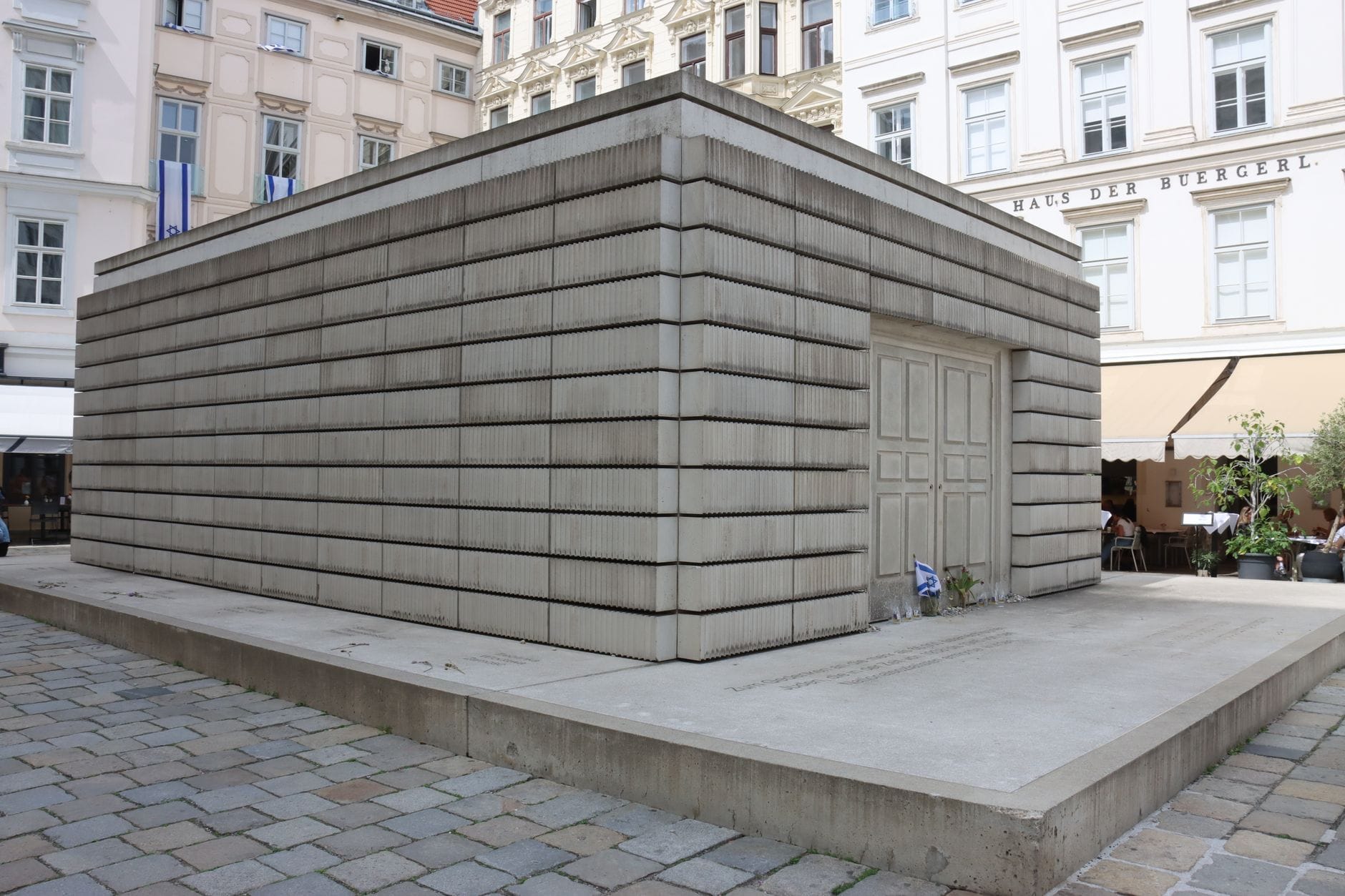
The Judenplatz Holocaust Memorial, formally named 'Memorial for the Austrian Jewish Victims of the Shoah,' is a concrete rectangular block measuring approximately 9.8 metres long, 7 metres wide, and 3.7 metres high. Its surface is covered in the outward-facing spines of books, rows of them pressed into the cast concrete, all anonymous and unreachable. The doors are sealed. The handles face inward.
The artist Rachel Whiteread is known for casting the interior voids of objects: the inside of a room, the space under a staircase. Here she has cast a library in reverse, the books legible as form but stripped of title or author. The reference is deliberate. Jews are sometimes called the 'People of the Book.' The 65,000 names this monument represents are as unreadable as the spines facing outward.
ℹ️ Good to know
The memorial is publicly accessible 24 hours a day, 365 days a year. There is no entrance, no ticket, and no staff on site. You approach it directly from the cobblestones of the square.
Around the base of the block, the names of the concentration camps and killing sites where Austrian Jews were murdered are inscribed in stone. Reading them requires you to circle the monument slowly, which most visitors do, almost instinctively. The act of circling, reading camp names one by one, is part of the experience. No signage instructs you to do it.
The design process was not without controversy. Whiteread won the commission in 1995, but construction was delayed for five years due to disagreements over the discovery of medieval synagogue remains beneath the square and disputes over the memorial's relationship to the broader Jewish Museum Vienna. The debates themselves reflect something true about Austria's complicated relationship with this history.
Tickets & tours
Hand-picked options from our booking partner. Prices are indicative; availability and final rates are confirmed when you complete your booking.
Imperial Vienna 72-hour hop-on hop-off bus
From 55 €Instant confirmationFree cancellationSkip-the-Line Entrance with Guide to Schonbrunn Palace and Gardens
From 45 €Instant confirmationFree cancellationLuggage Storage in Vienna
From 6 €Instant confirmationFree cancellationStrauss Dinner Show
From 99 €Instant confirmationFree cancellation
How the Square Feels at Different Times
In the early morning, before the coffee shops around the square open and before tourist groups arrive from Stephansplatz, Judenplatz is genuinely still. The cobblestones are damp in most seasons, the surrounding facades pale and unassuming. The memorial sits in the center of the square under open sky, and in that quiet it reads differently than it does at midday: larger, more confrontational, more difficult to absorb quickly and move on from.
By late morning the square receives moderate foot traffic, with visitors passing through from the Schottentor direction or arriving after visiting the Hofburg. Small groups stop, take photographs, read the inscriptions. Some people sit on the benches at the square's edge. The atmosphere is contemplative rather than crowded. Judenplatz does not get the same volume of visitors as Stephansplatz or the Ringstrasse, which means you are rarely jostling for space at the monument itself.
Evening is worth considering, especially in summer when daylight lingers past 8pm. The monument is not dramatically lit, but ambient light from the surrounding buildings gives the concrete a different texture. The square empties out, and the presence of the sealed library doors becomes more pronounced in the lower light.
💡 Local tip
Weekday mornings before 10am offer the quietest experience. Weekend afternoons, particularly in summer, bring tour groups that can make extended reflection harder.
Museum Judenplatz: The Underground Synagogue
Beneath the square, accessible through Museum Judenplatz at Judenplatz 8, are the excavated remains of the Or Sarua synagogue, one of the largest medieval synagogues in the German-speaking world. It was destroyed in 1421 during the 'Wiener Gesera,' a pogrom in which Vienna's Jewish community was expelled and its members either killed or forced to convert. The building's stones were later used in the construction of the University of Vienna.
The museum uses the excavated footprint of the synagogue as its central exhibit, displayed beneath a glass floor and supplemented with multimedia installations explaining medieval Jewish life in Vienna and the events of 1421. The combined ticket (€15 as of current pricing, verify before visiting) also includes admission to the main Jewish Museum Vienna at Dorotheergasse 11, a five-minute walk away. Together the two sites form a coherent, substantial itinerary on Viennese Jewish history.
Museum Judenplatz is open Monday through Thursday and Sunday from 10:00 to 18:00, Friday from 10:00 to 14:00 (extended to 17:00 in summer). These hours should be confirmed before your visit, as they are subject to change around Jewish holidays and public events.
⚠️ What to skip
The underground synagogue excavation area within Museum Judenplatz is not wheelchair accessible due to steps. The square itself and the memorial are level and accessible from the street.
If you are building a broader itinerary around Jewish Vienna, the Jewish Museum Vienna at Dorotheergasse is the natural next stop. The combined ticket covers both, and the 15-minute walk between them passes through some of the most historically significant streets in the Innere Stadt.
Historical Context: Vienna and Its Jewish Community
Vienna's Jewish history is long, layered, and marked by repeated cycles of inclusion and expulsion. Jews lived in the Judenplatz area from at least the 12th century, occupying a defined quarter with a synagogue, cemetery, and communal institutions. The 1421 Gesera ended that medieval community entirely. Jewish settlement resumed in the 17th century under Habsburg tolerance, then expanded dramatically in the 19th century as Jews gained full legal equality in the Austro-Hungarian Empire.
By 1910, Vienna had one of the largest Jewish populations in Europe, approximately 175,000 people, representing around 8.6 percent of the city. The community produced figures central to 20th-century intellectual and cultural life: Sigmund Freud, Gustav Mahler, Arthur Schnitzler, and many others. The Anschluss of 1938 ended this era violently. Between 1938 and 1945, approximately 65,000 Austrian Jews were murdered. That number is the foundation of the Whiteread memorial, encoded in both its official title and its base inscription.
For deeper context on Vienna's Habsburg history and its relationship to the city's minority communities, the Habsburg imperial history guide provides useful background. The wartime period itself is covered in the Vienna World War history guide.
Getting There and Practical Notes
Judenplatz sits roughly midway between Stephansplatz and Schottentor. The most direct U-Bahn approach is U3 to Herrengasse, from which the square is a four-minute walk north. From Stephansplatz (U1/U3) the walk takes around eight minutes. Bus lines 1A and 3A stop at Schwertgasse, which deposits you within a minute of the square.
The square is open-air and cobblestoned. Flat-soled shoes are advisable, particularly in wet weather when the stones can be slick. There are no facilities directly at the memorial, but the Museum Judenplatz building has toilets, and several cafes operate on adjacent streets including Wipplingerstrasse and Am Hof.
Photography of the memorial is permitted and very common. The north face of the monument, with the sealed double doors, is the most frequently photographed angle. In overcast light the concrete reads more clearly than in direct sunlight, which can flatten the texture of the cast book spines. There are no restrictions on photography.
💡 Local tip
The square is small enough that a wide-angle lens or a phone camera can capture the full monument from about 10 metres back. Stand near the Lessing statue at the square's north end for the best full-frontal view of the memorial.
Insider Tips
- The square contains a statue of Gotthold Ephraim Lessing, the 18th-century German philosopher associated with religious tolerance. The original statue was melted down by the Nazis in 1939; the current version is a 1981 reconstruction. It is easy to walk past without registering its significance.
- The combined ticket for Museum Judenplatz and the Jewish Museum Vienna (€15) is valid across two separate days, so you do not need to visit both sites on the same afternoon.
- Friday afternoons have reduced Museum Judenplatz hours (closing at 14:00, or 17:00 in summer). Plan accordingly if you want to include the underground synagogue excavation.
- The streets immediately around Judenplatz, particularly Parisergasse and Kurrentgasse, are among the quietest in the 1st District and worth walking after the memorial as a form of palate-clearing. The contrast with the nearby tourist density of Stephansplatz is notable.
- If you are visiting Vienna in the context of its Jewish heritage more broadly, the Sigmund Freud Museum in the 9th District and the Zentralfriedhof's Jewish sections represent two further points of significant historical weight.
Who Is Judenplatz & Holocaust Memorial For?
- Travelers interested in 20th-century European history and Holocaust remembrance
- Architecture and public art visitors exploring Whiteread's work in context
- Those building a Jewish Vienna itinerary combining Judenplatz, the Jewish Museum, and related sites
- Visitors who want a quiet, unhurried counterpoint to the busier imperial sights nearby
- Educators and students engaging with the material history of the Shoah in Austria
Nearby Attractions
Other things to see while in Innere Stadt (1st District):
- Albertina Museum
Housed in a former Habsburg palace at the edge of the Ringstrasse, the Albertina holds one of the largest and finest graphic art collections in the world. With over one million drawings and prints alongside rotating exhibitions of modern masters, it rewards both the casual visitor and the serious art traveler.
- Austrian National Library (Prunksaal State Hall)
The Prunksaal, or State Hall of the Austrian National Library, is a Baroque masterpiece built for Emperor Charles VI between 1723 and 1726. At roughly 80 metres long and crowned by Daniel Gran's sweeping ceiling frescoes, it is one of the most visually arresting interiors in central Europe, and still holds around 200,000 historic volumes in its carved walnut shelves.
- Burgtheater
The Burgtheater is Austria's national theatre and one of the most significant German-language stages in the world. Its Neo-Renaissance building on Vienna's Ringstraße dates to 1888, and its institutional history stretches back to the court of Empress Maria Theresa. Whether you come for a performance or a guided tour, it rewards attention.
- Café Central
Housed inside the Palais Ferstel in Vienna's historic first district, Café Central has been serving coffee and conversation since 1876. Once the gathering point for Freud, Trotsky, and a constellation of Central European intellectuals, it remains one of the most architecturally remarkable coffeehouses in the world.