Café Central Vienna: Inside the City's Most Storied Coffeehouse
Housed inside the Palais Ferstel in Vienna's historic first district, Café Central has been serving coffee and conversation since 1876. Once the gathering point for Freud, Trotsky, and a constellation of Central European intellectuals, it remains one of the most architecturally remarkable coffeehouses in the world.
Quick Facts
- Location
- Herrengasse 14, 1010 Vienna (Innere Stadt, corner of Herrengasse and Strauchgasse)
- Getting There
- U3 Herrengasse station (2-minute walk)
- Time Needed
- 45 minutes to 1.5 hours depending on whether you eat
- Cost
- No entry fee; expect to pay for food and drinks (coffee from around €5–7)
- Best for
- Architecture enthusiasts, first-time Vienna visitors, solo travelers, history lovers
- Official website
- cafecentral.wien/en
What Café Central Actually Is
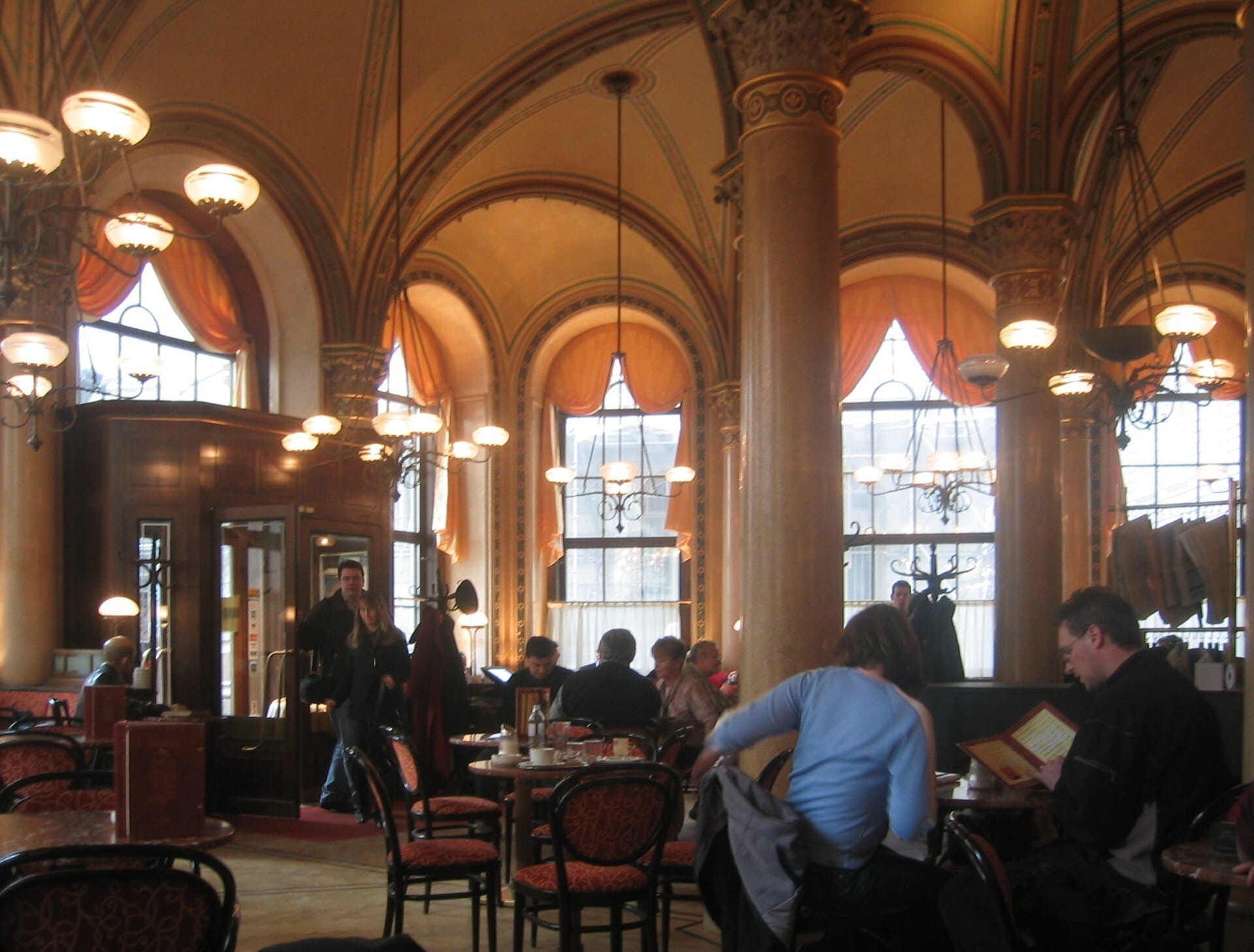
Café Central is not just a coffee stop. It is a working coffeehouse inside a 19th-century palace that also functions as one of Vienna's most significant architectural interiors. Established in 1876, it occupies the ground floor of the Palais Ferstel, a Neo-Gothic and Neo-Renaissance building designed by Heinrich von Ferstel. The vaulted stone arcades, soaring ceilings, and marble pillars create a space that feels somewhere between a cathedral and a grand railway station concourse, except the air smells of espresso and fresh Apfelstrudel.
The café sits at the heart of Vienna's Innere Stadt, the historic first district. It is close enough to the Hofburg that 19th-century officials, writers, and political agitators could walk over from their offices and argue for hours over a single Melange. That proximity to power and culture is a large part of why the café attracted the clientele it did, and why it retains a particular gravity even today.
💡 Local tip
The café is open Monday–Saturday 08:00–22:00 and Sunday and public holidays 10:00–22:00. Arriving before 09:30 on weekdays gives you the best chance of a quiet table without a wait.
The Architecture: What You're Looking At
The Palais Ferstel was completed in 1860 and originally housed the National Bank of Austria and the Vienna Stock Exchange, before sections of it were converted for other uses. Café Central occupies the central arcade, a long barrel-vaulted hall flanked by smaller arched side rooms. The ribbed vaulting runs the full length of the café in pale stone, and pendant gas-style lamps now electrified hang at intervals along the arcade.
Near the entrance, you will notice a papier-mâché figure seated at a small table: this is Peter Altenberg, the Viennese writer and bohemian who was so reliably present at Café Central that the café reportedly used his address as his mailing address. The figure is a standing joke and a piece of genuine local lore. Look also at the wrought ironwork at the tops of the arches, and the tiled floor patterns, which are original to the reconstruction after the café reopened in the 1980s following a long period of closure.
If you are already interested in Vienna's architectural legacy, Café Central fits naturally into a broader itinerary. The Ringstrasse boulevard, which showcases the full sweep of Vienna's imperial-era building program, begins just a few minutes' walk away and gives essential context to what Ferstel was working within.
Tickets & tours
Hand-picked options from our booking partner. Prices are indicative; availability and final rates are confirmed when you complete your booking.
Mauthausen Concentration Camp Memorial daytrip from Vienna
From 148 €Instant confirmationFree cancellationImperial Vienna 72-hour hop-on hop-off bus
From 55 €Instant confirmationFree cancellationSkip-the-Line Entrance with Guide to Schonbrunn Palace and Gardens
From 45 €Instant confirmationFree cancellationLuggage Storage in Vienna
From 6 €Instant confirmationFree cancellation
The Historical Weight of the Room
From the 1870s through the 1930s, Café Central was one of the primary gathering places for Vienna's intellectual and political class. Sigmund Freud was a regular. Leon Trotsky, who lived in Vienna for years before the Russian Revolution, reportedly played chess here. The novelist Arthur Schnitzler and the poet Hugo von Hofmannsthal were known to frequent the café. When this particular cohort of minds passed through Vienna in the late Habsburg period, the coffeehouse was often where they did it.
There is a frequently repeated story that when the Austrian government was warned in 1917 that a revolution was possible in Russia, an official dismissed the concern by saying the revolutionaries were just coffeehouse people, reportedly referring to Trotsky's presence at Café Central. Whether the exact exchange occurred precisely as described is contested, but the story captures something real about the social function of the café: it was a warm, affordable, and tolerant space where people of different political persuasions sat in close proximity for hours.
This tradition is not unique to Café Central. Vienna's coffeehouse culture is a UNESCO-recognized intangible cultural heritage, and the city has dozens of historic examples. If you want to understand the broader tradition and how to navigate it, the Vienna coffeehouse guide gives the full picture, including which cafés suit different moods and budgets.
How the Experience Changes Through the Day
Early morning, before 10:00 on weekdays, Café Central is as close to peaceful as it gets. The morning light filters down through the high windows at the ends of the arcade, the pastry cases are freshly stocked, and the staff move through a quieter rhythm. This is when the space feels most like what it historically was: a place for reading, thinking, or a slow breakfast.
By 11:00, tour groups begin arriving, and by midday the café is typically full, with a queue extending onto the Herrengasse pavement. The noise level rises considerably. Tables turn quickly at lunch because the kitchen serves full meals, including Wiener Schnitzel, Gulasch, and a rotating selection of Viennese lunch plates. The food is reliable and appropriately priced for what the space is, though you are not coming here primarily for the food.
Afternoons between 14:00 and 16:00 bring a second wave of visitors, mostly for coffee and cake. The Apfelstrudel here is made in-house and served warm with vanilla sauce. Late afternoons, around 17:00–18:00, see a partial lull before the dinner crowd arrives. Evenings are quieter than midday but still well attended. On weekday evenings, there is occasionally live piano music, which adds atmosphere without overwhelming conversation.
⚠️ What to skip
On weekends and public holidays, queues outside can reach 30–45 minutes between 11:00 and 15:00. Reservations are accepted and strongly recommended for weekend visits or groups. Walk-ins during peak hours may wait on a standing queue outdoors regardless of weather.
Ordering and Navigating the Menu
The menu is in German with English translations. Coffee is the main event. A Melange, the Viennese equivalent of a cappuccino, is the default order for most visitors. A Schwarzer is a small black espresso. A Verlängerter is a lengthened espresso, closer to an Americano. A Kapuziner, made with a small amount of cream, is one of the historic Viennese styles that predates the Italian terminology most people use today.
Coffee at Café Central is served with a small glass of water, which is the traditional Viennese coffeehouse custom. Refills of water are expected to be offered without asking. Service staff are professional and correct but not warm in the tourist-friendly sense. This is not a slight: it is consistent with Viennese coffeehouse tradition, where guests are expected to settle in and not be interrupted. Lingering over a single coffee for an hour is entirely normal and will not earn you any pointed looks.
If you want to understand the full range of Viennese cake culture before you order, the guide to Vienna's classic cakes and chocolate covers the options across the city's historic cafés.
Getting There and Practical Logistics
Café Central is at Herrengasse 14, on the corner of Herrengasse and Strauchgasse. The U3 metro line stops at Herrengasse station, a two-minute walk from the entrance. From St. Stephen's Cathedral (Stephansplatz), the walk takes around seven to eight minutes through the medieval street grid of the Innere Stadt. Trams running along the Ringstrasse stop near Volkstheater and Burgring, both within a ten-minute walk.
The main entrance on Herrengasse opens into the primary arcade. For visitors requiring step-free access, the official process is to ring the bell at the Arkadenhof entrance, at which point a member of staff will escort you to the barrier-free entrance on Herrengasse. A barrier-free toilet is available inside. If accessibility is a concern, contacting the café in advance is advisable.
The surrounding neighbourhood is extremely walkable and rich in stops. The Hofburg Palace is about four minutes on foot, and the Augustinerkeller and the imperial institutions along the Ringstrasse are all within a short walk. If you are planning a structured route through the first district, the Innere Stadt walking tour integrates Café Central naturally into a half-day itinerary.
Who Should Temper Their Expectations
Café Central is famous, and its fame brings crowds that can diminish the contemplative quality it is known for. If you arrive between 11:00 and 15:00 on a weekend expecting to read quietly at a marble table, you will probably be disappointed. The space is large enough to absorb visitors, but on busy days the ambient noise is significant and the pace feels less like a 19th-century salon and more like an upscale tourist attraction operating at capacity.
Travelers who are primarily interested in authentic, locals-only café culture may find other historic Viennese coffeehouses less theatrically attended. Café Hawelka, Café Schwarzenberg, or Café Landtmann each offer a somewhat different atmosphere and clientele. That said, dismissing Café Central entirely because of its popularity would be unfair: the architecture alone is worth the price of a coffee, and the historical significance is real rather than manufactured.
Insider Tips
- Book a table for Sunday mornings through the official website if you want the vaulted arcade to yourself. The café opens at 10:00 on Sundays and the first hour is noticeably calmer than any point on a Saturday.
- The side rooms off the main arcade, particularly toward the back, are quieter than the central hall and give a better sense of the space without the full weight of foot traffic moving past your table.
- Ask for a Kapuziner rather than a Melange if you want to order something with a distinct Viennese historical character. It is a smaller, stronger coffee with a touch of cream and far less commonly ordered by tourists.
- The papier-mâché figure of Peter Altenberg near the entrance is an easy photo subject, but take a few minutes to look at the ironwork at the tops of the arches and the tile floor patterns, which are often missed by visitors focused on their phones.
- If you are visiting in winter, arriving around 08:30 on a weekday means you may get one of the marble tables along the main arcade with natural light, warmth, and almost no queue. It is a genuinely different experience from the midday visit.
Who Is Café Central For?
- First-time Vienna visitors who want to anchor their trip in the city's intellectual and architectural history
- Solo travelers comfortable sitting with a book for an hour without distraction (best during early weekday mornings)
- Architecture and design enthusiasts interested in 19th-century Viennese interior spaces
- Travelers doing a half-day walk through the Innere Stadt who need a mid-morning or mid-afternoon pause
- Anyone curious about the social world of fin-de-siècle Vienna and the culture that produced Freud, Schnitzler, and the Viennese Secession
Nearby Attractions
Other things to see while in Innere Stadt (1st District):
- Albertina Museum
Housed in a former Habsburg palace at the edge of the Ringstrasse, the Albertina holds one of the largest and finest graphic art collections in the world. With over one million drawings and prints alongside rotating exhibitions of modern masters, it rewards both the casual visitor and the serious art traveler.
- Austrian National Library (Prunksaal State Hall)
The Prunksaal, or State Hall of the Austrian National Library, is a Baroque masterpiece built for Emperor Charles VI between 1723 and 1726. At roughly 80 metres long and crowned by Daniel Gran's sweeping ceiling frescoes, it is one of the most visually arresting interiors in central Europe, and still holds around 200,000 historic volumes in its carved walnut shelves.
- Burgtheater
The Burgtheater is Austria's national theatre and one of the most significant German-language stages in the world. Its Neo-Renaissance building on Vienna's Ringstraße dates to 1888, and its institutional history stretches back to the court of Empress Maria Theresa. Whether you come for a performance or a guided tour, it rewards attention.
- Hofburg Palace
Hofburg Palace is one of the largest palace complexes in Europe, covering 24 hectares in Vienna's historic First District. From the Sisi Museum to the Spanish Riding School, this is where Habsburg power played out for over six centuries, and where the Austrian president still works today.