Austrian National Library Prunksaal: Vienna's Most Spectacular Baroque Hall
The Prunksaal, or State Hall of the Austrian National Library, is a Baroque masterpiece built for Emperor Charles VI between 1723 and 1726. At roughly 80 metres long and crowned by Daniel Gran's sweeping ceiling frescoes, it is one of the most visually arresting interiors in central Europe, and still holds around 200,000 historic volumes in its carved walnut shelves.
Quick Facts
- Location
- Josefsplatz 1, 1010 Vienna (Innere Stadt, 1st District)
- Getting There
- U1/U3 Stephansplatz; U3 Herrengasse; Trams 1, 2, 71, D to Burgring
- Time Needed
- 45 minutes to 1.5 hours
- Cost
- €12 standard / €10.50 reduced (verify before visiting)
- Best for
- Baroque architecture, history lovers, photography, first-time Vienna visitors
- Official website
- www.onb.ac.at/en/museums/state-hall
What Is the Prunksaal?
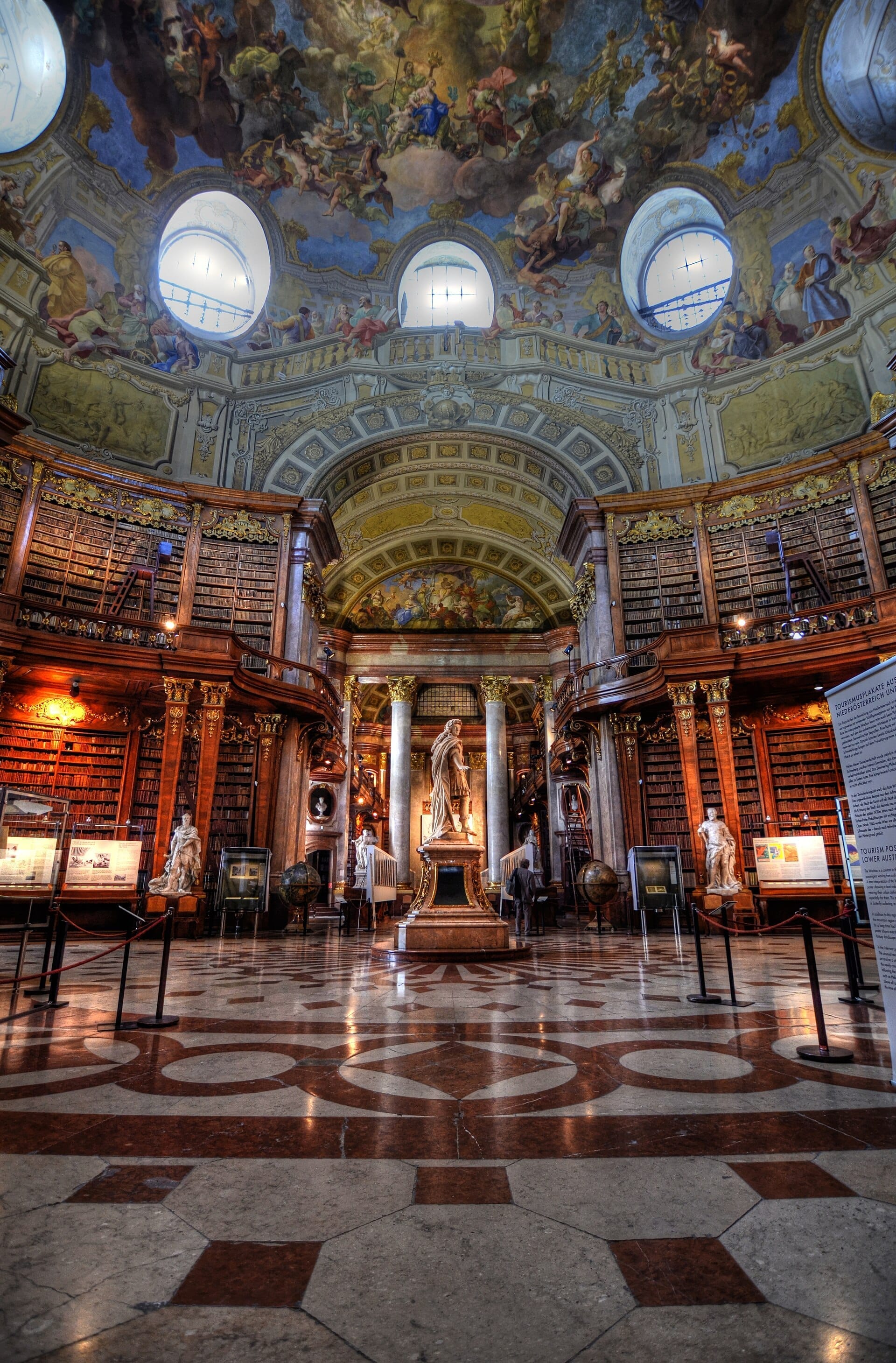
The Prunksaal der Österreichischen Nationalbibliothek, known in English as the State Hall of the Austrian National Library, is the showpiece room of what was once the imperial court library of the Habsburg dynasty. Completed in 1726 on Josefsplatz, a quiet square tucked directly behind the Hofburg Palace complex, it is considered one of the finest examples of Baroque interior architecture in the world. The hall stretches approximately 80 metres from end to end, rises through two galleried tiers, and is capped by a vast oval fresco painted by Daniel Gran. Around 200,000 volumes dating from the early modern period to the 19th century line the carved walnut shelves, giving the space a texture and smell that no photograph can fully communicate.
Despite being a genuine library with genuine books, the Prunksaal functions today as a museum hall open to the public. It sits within a broader complex of Austrian National Library museums, and if you are planning a broader cultural itinerary in Vienna's first district, it pairs naturally with visits to the Hofburg Palace or the Kunsthistorisches Museum, both within easy walking distance.
The Architecture and Its Makers
The Prunksaal was commissioned by Emperor Charles VI, the last male ruler of the Habsburg line, and construction ran from 1723 to 1726. The project was initiated by Johann Bernhard Fischer von Erlach, the foremost Baroque architect in the Habsburg lands, and completed after his death by his son Joseph Emanuel Fischer von Erlach. The result is a calculated piece of imperial propaganda as much as a functional building: the hall was designed to project Habsburg power through sheer architectural grandeur.
The ceiling fresco by Daniel Gran, painted between 1726 and 1730, depicts the apotheosis of Charles VI, with allegorical figures representing the arts, sciences, and virtues of imperial governance spreading across the oval vault. Gran was one of the leading fresco painters of the Austrian Baroque, and this commission represents his most important surviving work. Standing in the centre of the hall and looking directly upward, the perspective lines of the painted architecture extend the real space into an illusionistic vault, a technique known as trompe-l'oeil that was characteristic of the period.
The hall is divided into a central oval section and two rectangular wings. Marble busts of Habsburg emperors occupy the wall niches, and a standing marble statue of Charles VI himself occupies a central position, framed by the shelves. The walnut cabinetry throughout was crafted with a precision that still impresses on close inspection: the grain patterns are matched across adjacent panels, and the gilt detailing on the gallery railings catches light differently depending on where you stand.
Tickets & tours
Hand-picked options from our booking partner. Prices are indicative; availability and final rates are confirmed when you complete your booking.
Imperial Vienna 72-hour hop-on hop-off bus
From 55 €Instant confirmationFree cancellationSkip-the-Line Entrance with Guide to Schonbrunn Palace and Gardens
From 45 €Instant confirmationFree cancellationLuggage Storage in Vienna
From 6 €Instant confirmationFree cancellationStrauss Dinner Show
From 99 €Instant confirmationFree cancellation
What the Visit Actually Feels Like
You enter from Josefsplatz through a relatively modest doorway, which makes the interior impact considerably more pronounced. The hall opens ahead of you in its full length, and the first thing most visitors notice is the smell: old paper, dry wood, and something faintly mineral from the stone floor and plaster. It is the smell of a place that has not fundamentally changed in three centuries.
The books are not for reading. They are original volumes, many bound in vellum or leather, arranged on shelves that reach from floor to gallery level. Looking up from the floor, the progression of shelves, then the arched gallery walkway, then the frescoed ceiling creates a layered visual rhythm that rewards slow attention. Most visitors spend their time in the centre of the hall, but walking the length of the space and examining the wall niches at either end gives a better sense of its proportions.
💡 Local tip
Bring or rent an audio guide if available. Without context, the ceiling fresco can seem decorative but opaque. Knowing that the central figure represents the apotheosis of Charles VI, and identifying the surrounding allegorical groups, transforms what you see from 'impressive old painting' into a specific argument about power and learning.
Lighting inside the hall is relatively warm and even, sufficient for comfortable viewing but not ideal for handheld photography at higher ISOs. A wide-angle lens or the widest available setting on a phone camera is essentially required to capture the full height. The gallery level is not accessible to general visitors, so all photography is done from the ground floor.
Time of Day and Crowd Patterns
The hall opens at 09:00 Tuesday through Sunday. Arriving in the first hour, particularly on weekday mornings, gives you a noticeably quieter experience. By late morning, especially on weekends, group tours begin arriving, and the acoustic quality of the space means conversations echo significantly. Midday on weekends is the noisiest period.
Thursday is the one extended day, with the hall open until 21:00. An evening visit after 18:00 offers an unusually calm atmosphere. The artificial lighting at that hour is softer than the diffuse daylight filtering through the windows during the day, and the change in quality emphasizes the gilding and fresco colors differently. If your schedule permits, a Thursday evening visit is worth planning around.
ℹ️ Good to know
The Prunksaal is closed on Mondays. From October through May, opening hours are Tuesday to Wednesday 09:00–18:00, Thursday 09:00–21:00, Friday to Sunday 09:00–18:00. On 24 December, closing time is 15:00. Summer hours may differ; check the official site before visiting.
Getting There and Practical Notes
The address is Josefsplatz 1, 1010 Vienna. Josefsplatz is a small square directly adjacent to the Hofburg complex, accessed via a passage from Augustinerstrasse or through the Michaelerplatz side. It is not difficult to find, but first-time visitors sometimes walk past the entrance while navigating the Hofburg's various courtyards. Look for the arch that leads from Augustinerstrasse onto the square; the library entrance is on the east side.
By U-Bahn, the closest stations are Stephansplatz (lines U1 and U3), approximately a 10-minute walk through the pedestrian zone, and Herrengasse (U3), which is marginally closer by a different route. Trams 1, 2, 71, and D stop at Burgring, a short walk along the Ringstrasse. Bus line 1A serves Habsburgergasse nearby. The area is entirely walkable from most of the 1st district's major sights.
Admission is €12 standard, €10.50 reduced (prices verified March 2026; confirm current pricing at the official site). The Prunksaal is included on the Vienna Pass. Bag storage is available near the entrance, which is useful since large bags are not permitted inside the hall. The ticket also typically grants access to the Globe Museum and the Papyrus Museum within the same building complex, though confirm this at time of purchase.
💡 Local tip
For accessibility: sign language-interpreted tours are offered on the first Friday of every second month at 15:00. For physical accessibility questions, wheelchair access, and lift information, contact the library directly at +43 1 534 10-394 or kommunikation@onb.ac.at before your visit.
Honest Assessment: Is It Worth Your Time?
For anyone with an interest in Baroque architecture, the history of the Habsburg Empire, or the aesthetics of historic libraries, the Prunksaal is a genuine highlight in a city full of highlights. The quality of the space is not exaggerated by its reputation. It is a very large, very complete Baroque interior that has survived in exceptional condition, and there is nothing quite like it elsewhere in Vienna.
That said, the visit is limited in scope. The hall itself takes most visitors 30 to 45 minutes to explore properly, and while the ticket may include adjacent museum spaces, the Prunksaal is the only room with the full visual impact. If you are visiting Vienna on a short schedule and have to choose between this and, say, the Kunsthistorisches Museum or Upper Belvedere, factor in that those offer far more floor space and collection breadth for a similar or lower price point. The Prunksaal is a short but potent experience, not a half-day one.
Visitors primarily interested in functional libraries, interactive exhibits, or hands-on museums may find the format passive. Children under around 10 tend to find it less engaging than destinations like the Tiergarten Schönbrunn or the Prater. The hall is a contemplative space, and it works best for those willing to stand still and look carefully.
Photography Tips
Photography for personal use is permitted without flash. The main challenge is the vertical scale: capturing the ceiling fresco and the floor-level shelves in a single frame requires either a very wide lens or a deliberate decision to shoot in sections. The oval central section of the hall is the most photographed spot, standing under the dome and shooting upward. Early morning light through the windows on the east side of the hall creates mild directional light across the marble busts, which can add texture to portrait-orientation shots of the niches.
The gallery level, visible from the floor, gives the hall much of its vertical interest but cannot be photographed from above. Smartphone stitching panoramas can work for wide horizontal shots along the hall's length, though distortion at the edges is significant. For the ceiling alone, a vertical panorama from the center of the oval is the most reliable approach without specialist equipment.
Insider Tips
- Visit on a Thursday evening after 18:00. Almost no tour groups are present, the warm artificial lighting emphasizes the gilding in a way daylight does not, and the hall's acoustic properties become meditative rather than noisy.
- The hall is visible from the exterior through tall windows on the Josefsplatz side if you stand at the right angle. This gives you a preview of scale before entering, and also offers an unusual exterior photograph of the fresco visible through the glass.
- The ticket often includes access to the Globe Museum one floor up, which holds one of the largest historic globe collections in the world. Most visitors skip it entirely and walk straight back out; it is genuinely worth the extra 20 minutes.
- Josefsplatz itself is one of the more architecturally intact Baroque squares in central Vienna, framed by the library's facade, the Augustinian Church, and the Pallavicini Palace. Spend five minutes walking the perimeter before entering; it sets the spatial context for what you are about to see inside.
- The marble statue of Charles VI in the central oval is by Peter Strudel and his workshop. It is the same emperor whose personal book collection formed the nucleus of what became the national library. The connection between the man portrayed and the institution around him is direct and worth noting as you look at it.
Who Is Austrian National Library (Prunksaal State Hall) For?
- Architecture and design enthusiasts drawn to the Baroque period
- Habsburg history and imperial Vienna itineraries
- Photography of historic interiors
- First-time visitors wanting to understand the visual language of imperial Vienna
- Travelers with 45 to 90 minutes to spare in the Hofburg neighborhood
Nearby Attractions
Other things to see while in Innere Stadt (1st District):
- Albertina Museum
Housed in a former Habsburg palace at the edge of the Ringstrasse, the Albertina holds one of the largest and finest graphic art collections in the world. With over one million drawings and prints alongside rotating exhibitions of modern masters, it rewards both the casual visitor and the serious art traveler.
- Burgtheater
The Burgtheater is Austria's national theatre and one of the most significant German-language stages in the world. Its Neo-Renaissance building on Vienna's Ringstraße dates to 1888, and its institutional history stretches back to the court of Empress Maria Theresa. Whether you come for a performance or a guided tour, it rewards attention.
- Café Central
Housed inside the Palais Ferstel in Vienna's historic first district, Café Central has been serving coffee and conversation since 1876. Once the gathering point for Freud, Trotsky, and a constellation of Central European intellectuals, it remains one of the most architecturally remarkable coffeehouses in the world.
- Hofburg Palace
Hofburg Palace is one of the largest palace complexes in Europe, covering 24 hectares in Vienna's historic First District. From the Sisi Museum to the Spanish Riding School, this is where Habsburg power played out for over six centuries, and where the Austrian president still works today.