Burgtheater: Vienna's National Theatre on the Ringstraße
The Burgtheater is Austria's national theatre and one of the most significant German-language stages in the world. Its Neo-Renaissance building on Vienna's Ringstraße dates to 1888, and its institutional history stretches back to the court of Empress Maria Theresa. Whether you come for a performance or a guided tour, it rewards attention.
Quick Facts
- Location
- Universitätsring 2, 1010 Wien (Innere Stadt), opposite Vienna City Hall
- Getting There
- Tram 1, 71, D to Rathausplatz/Burgtheater; or U2 Schottentor / U2 Rathaus / U3 Herrengasse (5-10 min walk)
- Time Needed
- 1.5 hrs for a guided tour; 2.5-3 hrs for an evening performance
- Cost
- Guided tours: check current prices at burgtheater.at. Performance tickets vary widely by production and seat category.
- Best for
- Architecture lovers, theatre enthusiasts, classical culture seekers
- Official website
- www.burgtheater.at
What the Burgtheater Actually Is
The Burgtheater is not merely a theatre. It is the institutional centre of German-language dramatic culture, with a continuous history stretching back to 1741, when Empress Maria Theresa established a court theatre adjacent to the Hofburg palace. For nearly three centuries, it has shaped how Austria understands its own literary and theatrical identity.
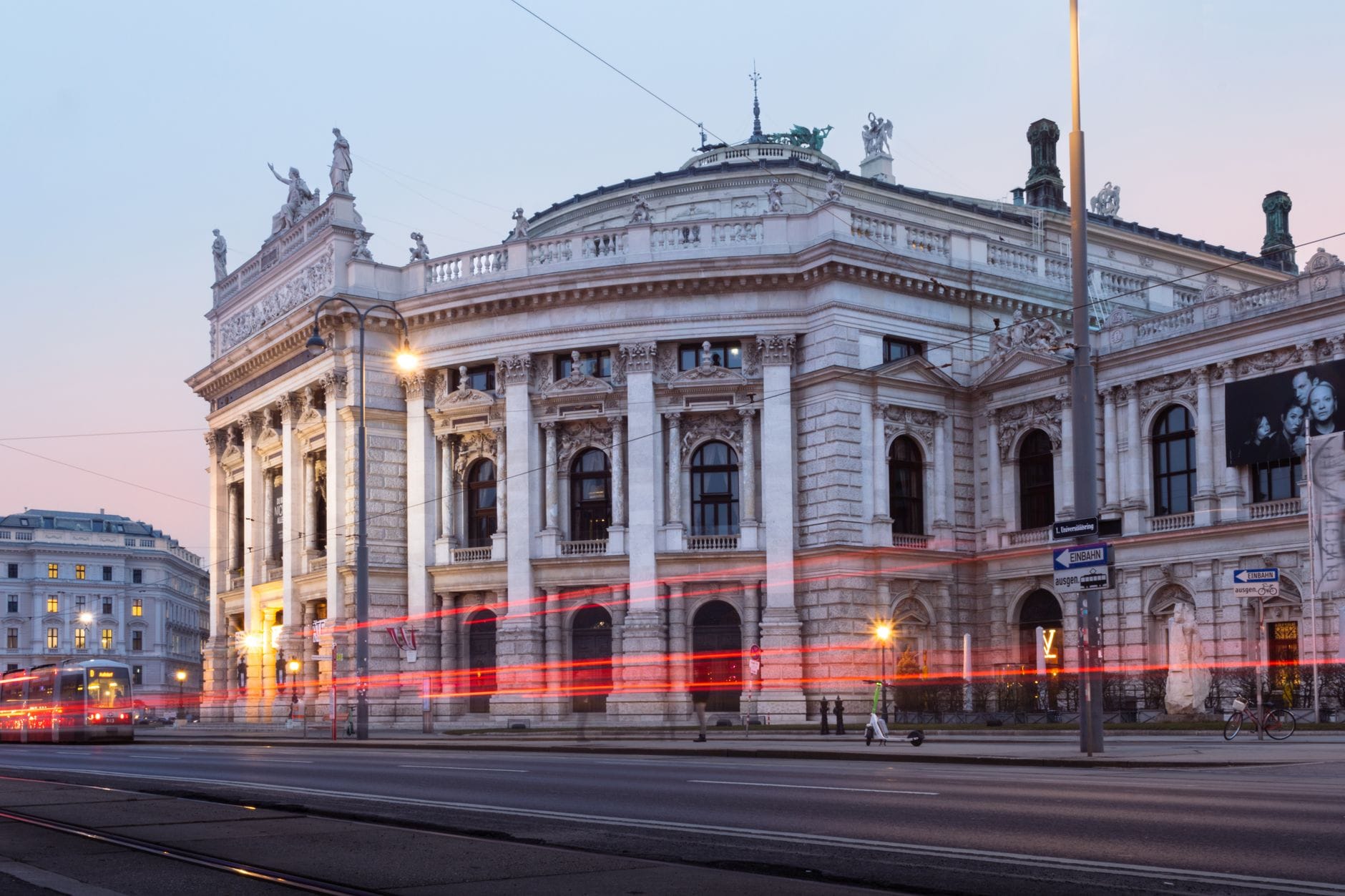
The building standing today is a product of the Ringstraße era, Vienna's great 19th-century urban project in which Emperor Franz Joseph I rebuilt the city's inner boulevard with monumental public institutions. The Burgtheater's Neo-Renaissance facade, designed by Gottfried Semper and Carl von Hasenauer, was constructed between 1874 and 1888 and inaugurated on 14 October 1888. It sits directly opposite the Vienna City Hall, the two buildings facing each other across the Ringstraße in a deliberate assertion of civic and cultural authority.
The auditorium seats up to 1,140 spectators and is one of the largest spoken-word theatres in Europe. Unlike Vienna's opera houses, which draw international visitors regardless of language, the Burgtheater is primarily a destination for German-speaking audiences. Performances are not subtitled as a rule, which is worth knowing before you book.
The Building: What to Look For
Even from the outside, the Burgtheater demands a slow look. The facade is symmetrical and formal, with a central projecting section flanked by curved wings. Two ramp-like staircases lead up to the entrance on the Universitätsring side, wide enough to accommodate the crowd that assembles before curtain. The stonework is pale and detailed, and on a clear day the building photographs well from across the Ringstraße, particularly in the late afternoon when the light falls directly on the front.
Inside, the foyers and grand staircase are among the finest interiors in Vienna. The ceiling paintings in the staircase halls were completed in the 1880s by a team of artists that included the young Gustav Klimt, his brother Ernst Klimt, and Franz Matsch. These early Klimt works, painted before his mature Secessionist style developed, show mythological and theatrical scenes in a highly academic register. They are easy to miss if you are rushing to your seat, but on a guided tour they are given proper attention.
💡 Local tip
Guided tours are typically held on Mondays, Thursdays, and Fridays at 4 pm, and on Sundays and public holidays at 11 am, with adjusted times in summer. Tours are not held on Christmas Eve or Good Friday. Always confirm the current schedule directly at burgtheater.at before visiting, as times change seasonally.
The Burgtheater's interior aesthetic sits within the broader Ringstraße tradition that shaped so many of Vienna's landmark institutions. If the architectural context interests you, the Vienna architecture guide covers the Ringstraße programme in detail, including the Kunsthistorisches Museum and the Vienna State Opera, both built in the same era.
Tickets & tours
Hand-picked options from our booking partner. Prices are indicative; availability and final rates are confirmed when you complete your booking.
Imperial Vienna 72-hour hop-on hop-off bus
From 55 €Instant confirmationFree cancellationSkip-the-Line Entrance with Guide to Schonbrunn Palace and Gardens
From 45 €Instant confirmationFree cancellationLuggage Storage in Vienna
From 6 €Instant confirmationFree cancellationStrauss Dinner Show
From 99 €Instant confirmationFree cancellation
Attending a Performance
The Burgtheater's season runs from September through June. The repertoire covers classical drama, contemporary plays, and major new commissions, performed in German. Productions range from Goethe and Schiller to Elfriede Jelinek and international playwrights in translation. The programming is serious and often ambitious; this is not a venue that plays it safe.
Ticket prices vary considerably by production and seat category. Standing room tickets (Stehplätze) are available at significantly reduced prices and are a genuine option for anyone on a budget who wants to experience the atmosphere. These go on sale at the box office on performance days. Booking in advance through the official website is strongly recommended for weekend performances and popular productions.
Dress code is not formally enforced, but audiences at the Burgtheater tend to dress with some care, particularly for premieres and gala evenings. Smart casual is appropriate for most evenings. The performance atmosphere is attentive and quiet; late arrivals are typically not admitted until a suitable break.
⚠️ What to skip
Performances are conducted in German without English subtitles as standard. If you do not speak German, attending a performance without preparation is unlikely to be satisfying unless you have read the play beforehand. The guided architectural tour, by contrast, is available in English and is the better option for non-German speakers.
The Guided Tour Experience
For most international visitors, the guided tour is the practical way to experience the Burgtheater's interior. Tours run for roughly one hour and take in the main foyer, the grand staircases, the auditorium itself when it is not in rehearsal use, and the celebrated ceiling paintings. Guides explain the building's history, the significance of the Klimt paintings, and the theatre's role in Austrian cultural life.
The tour feels unhurried, and the scale of the building becomes more apparent from the inside. The auditorium, seen from the stage level or from the upper galleries, is genuinely impressive: multiple tiers of gilded boxes curve around a deep stage, and the sightlines are surprisingly good across most of the house. Acoustics in a spoken-word theatre of this size are engineered differently from an opera house, and the room has a particular clarity to it even when empty.
Photography is generally permitted in the foyer and staircase areas. The ceiling paintings benefit from a phone with a good zoom or a camera with a telephoto lens, as the painted surfaces are overhead and at some distance. Natural light in the staircase areas is variable depending on the time of day and season, so morning tours on sunny days tend to produce better interior photographs.
The Ringstraße Setting and the Surrounding Area
The Burgtheater sits at the northern end of the Ringstraße, on the edge of the Innere Stadt. The area around it is relatively calm compared to the dense tourist corridors near the Stephansdom. The Volksgarten park runs immediately alongside the theatre to the south, and is a pleasant place to walk before an evening performance. On summer evenings, people sit on the park benches with takeaway coffee, and the space between the theatre and the Hofburg has a particular quality at dusk, when the street lighting comes on and the facades take on a warmer tone.
The Rathaus sits directly opposite, and the broad open space of the Rathausplatz between them hosts the Vienna Christmas Market in December and an open-air film festival in summer. If your visit falls in winter, the Vienna Christmas Markets guide has the practical details on timing and what to expect at the Rathausplatz market specifically.
The broader Ringstraße deserves at least a partial walk even if you are short on time. The stretch from the Burgtheater south toward the Kunsthistorisches Museum passes the Parliament building and several other Neo-Renaissance and Neo-Gothic landmarks within ten minutes on foot. This is one of the more coherent monumental urban sequences in Europe, and it reads best at a walking pace.
Historical Weight: 1741 to 1955
The Burgtheater's founding under Maria Theresa in the 1740s placed it at the centre of Vienna's Enlightenment-era cultural life. Mozart's librettist Lorenzo Da Ponte was associated with the court theatre complex, and the institution's repertoire shaped what was considered artistically legitimate in the Habsburg capital for generations.
The building on the Ringstraße was damaged by fire in 1945, near the end of World War Two. Reconstruction took a decade, and the theatre reopened in 1955, the same year Austria regained full sovereignty with the signing of the State Treaty. The symbolic timing was not accidental; the reopening of the Burgtheater was understood as part of the cultural reconstruction of the Austrian Republic.
This postwar chapter is part of a broader story about Vienna's relationship with its own recent history, which the Vienna World War history guide addresses in more depth, including other sites connected to that period across the city.
Practical Notes for Your Visit
The Burgtheater is straightforward to reach. Tram lines 1, 71, and D all stop at Rathausplatz/Burgtheater, directly outside the main entrance. If you prefer the U-Bahn, both U2 Schottentor and U2 Rathaus are within a 5-10 minute walk, as is U3 Herrengasse.
For accessibility: the theatre is part of Austria's national theatre system (Bundestheater Holding), which provides dedicated support for visitors with access requirements. Contact the ticket office directly by phone (+43 1 514 44 4545) or email (tickets@burgtheater.at) to arrange wheelchair access, adapted seating, or other specific needs. The official website also carries current accessibility information.
Vienna's winters can be cold, and evening performances mean returning home after dark in temperatures that often sit around freezing from December through February. A warm coat and indoor-appropriate shoes are practical considerations for evening visits. Summer tour visits are comfortable; the interior is cool even on warm days.
Insider Tips
- Standing room tickets (Stehplätze) for performances go on sale at the box office on the day of the performance. They offer excellent value and give you the full experience of the Burgtheater's atmosphere at a fraction of the seat price.
- The early Klimt ceiling paintings in the staircase halls are a genuine art historical curiosity: they show how his style looked before the Secession. Bring something with a zoom to photograph the overhead panels properly.
- The Volksgarten park directly south of the theatre is underused by visitors. Arrive 30-40 minutes before an evening performance and walk through it rather than waiting in the foyer.
- Tour frequency drops and times shift in the summer months when the theatre is not in its main season. If a tour is your primary goal, check the schedule before you commit to a specific travel day.
- The Rathausplatz between the Burgtheater and City Hall hosts different events across the year: a large Christmas market in December, an ice rink in winter, and a free open-air film festival in summer. Timing your visit to coincide with one of these adds another layer to the neighbourhood.
Who Is Burgtheater For?
- Architecture enthusiasts interested in Ringstraße-era design and early Klimt works
- Theatre-goers who speak German and want to experience one of Europe's most prestigious stages
- Cultural travellers building an itinerary around Vienna's imperial and 19th-century heritage
- Visitors combining a Ringstraße walk with interior access via a guided tour
- Travellers interested in postwar Austrian history and national cultural institutions
Nearby Attractions
Other things to see while in Innere Stadt (1st District):
- Albertina Museum
Housed in a former Habsburg palace at the edge of the Ringstrasse, the Albertina holds one of the largest and finest graphic art collections in the world. With over one million drawings and prints alongside rotating exhibitions of modern masters, it rewards both the casual visitor and the serious art traveler.
- Austrian National Library (Prunksaal State Hall)
The Prunksaal, or State Hall of the Austrian National Library, is a Baroque masterpiece built for Emperor Charles VI between 1723 and 1726. At roughly 80 metres long and crowned by Daniel Gran's sweeping ceiling frescoes, it is one of the most visually arresting interiors in central Europe, and still holds around 200,000 historic volumes in its carved walnut shelves.
- Café Central
Housed inside the Palais Ferstel in Vienna's historic first district, Café Central has been serving coffee and conversation since 1876. Once the gathering point for Freud, Trotsky, and a constellation of Central European intellectuals, it remains one of the most architecturally remarkable coffeehouses in the world.
- Hofburg Palace
Hofburg Palace is one of the largest palace complexes in Europe, covering 24 hectares in Vienna's historic First District. From the Sisi Museum to the Spanish Riding School, this is where Habsburg power played out for over six centuries, and where the Austrian president still works today.