Vienna City Hall (Wiener Rathaus): The Neo-Gothic Giant at the Heart of the City
The Wiener Rathaus is one of Vienna's most recognizable landmarks, a monumental neo-Gothic town hall completed in 1883 that still functions as the seat of city and state government. Free guided tours grant access to its grand interiors, while the square in front transforms with the seasons — from a film festival in summer to one of Europe's most atmospheric Christmas markets in winter.
Quick Facts
- Location
- Friedrich-Schmidt-Platz 1, 1010 Vienna (Innere Stadt / 1st District)
- Getting There
- U2 to Rathaus; Trams 1, D, 71 to Rathausplatz/Burgtheater; Tram 2 to Rathaus
- Time Needed
- 45–90 minutes for a guided tour; allow extra time to explore Rathausplatz
- Cost
- Free entry; guided tours free of charge, no registration required
- Best for
- Architecture lovers, history enthusiasts, seasonal events, photography
- Official website
- www.wien.gv.at/en/administration/city-hall
What Is the Wiener Rathaus?
The Vienna City Hall, known locally as the Wiener Rathaus or Neues Rathaus, is far more than a government office. It is one of the defining monuments of the Ringstrasse era, the great 19th-century urban project that lined Vienna's inner ring road with palaces of culture, politics, and civic life. Standing at Friedrich-Schmidt-Platz 1 in the Innere Stadt, the building serves simultaneously as the seat of the City of Vienna's municipal administration and the government of Vienna as a federal state, one of Austria's nine Bundesländer.
Architecturally, the Rathaus belongs to the same generation of landmark buildings as the Burgtheater directly across the boulevard and the Parliament building a short walk away. Together they form a sequence that was deliberately planned to project civic confidence. The Rathaus is the most Gothic of the group, and the most vertical.
The Architecture: Friedrich von Schmidt's Neo-Gothic Vision
The building was designed by Friedrich von Schmidt, a German-Austrian architect who had already made his name restoring Gothic cathedrals, including the Dom in Cologne. His choice of neo-Gothic for a secular town hall was controversial at the time. The Imperial court preferred Renaissance or Baroque. Schmidt pushed through his vision, and the result is a building that reads almost like a northern European cathedral transplanted into Central Europe.
Construction ran from 1872 to 1883. The central tower reaches 97.9 metres and is topped by the Rathausmann, a 3.4-metre cast-iron knight in armour that has become one of the city's emblems. Behind the main facade, the complex opens into seven inner courtyards and stretches across six floors plus two basement levels, totalling 1,575 rooms. The scale becomes fully apparent only once you step inside.
For those tracing the Ringstrasse from end to end, the Ringstrasse boulevard itself is worth understanding as a concept before you arrive. The Rathaus is one of its most photogenic stops, particularly in the early morning when the facade catches low golden light from the east.
💡 Local tip
For the clearest, least obstructed photographs of the facade, arrive before 9:00 in the morning on a weekday. The park pathways in front of Rathausplatz fill with joggers and commuters by mid-morning, and tour groups cluster near the entrance from late morning onward.
Tickets & tours
Live prices and dates from our booking partner. If you book, we may earn a commission at no extra cost to you.
Imperial Vienna 72-hour hop-on hop-off bus
From 55 €Instant confirmationFree cancellationLuggage Storage in Vienna
From 6 €Instant confirmationFree cancellationStrauss Dinner Show
From 99 €Instant confirmationFree cancellationJewish Museum Vienna tickets
From 15 €Instant confirmationFree cancellation
Visiting the Interior: Free Guided Tours
Access to the interior is available through free guided tours, which typically run on Mondays, Wednesdays, and Fridays at 13:00. Tours do not run on council meeting days or public holidays, so it is worth checking the current schedule before building your day around a visit. No registration is required: you simply arrive at the main entrance. Audio guides in English are available with a form of ID.
The tour moves through the state rooms and ceremonial halls, spaces used for official receptions and municipal functions. The Festsaal, the main banqueting hall, is the centrepiece: a long, high-ceilinged room with painted vaulting and wrought ironwork that makes clear how much money and ambition went into this project. Side galleries display portraits of Habsburg-era mayors and maps of the city at various points in its history.
The corridors themselves reward close attention. Floors shift between stone and parquet. Staircases spiral upward in tight Gothic curves. The light inside changes depending on which courtyard a particular corridor faces, with some rooms feeling almost cloister-like in their quietness. For those with an interest in how civic architecture communicates power, this building is unusually legible.
⚠️ What to skip
The building is an active government office open Monday to Friday, 07:30 to 17:00. Tours are not available on weekends, and portions of the building may be closed on council sitting days. Always verify the tour schedule at wien.gv.at before visiting.
Rathausplatz: The Square That Changes with Every Season
The broad park-lined square in front of the Rathaus, Rathausplatz, is arguably where most visitors actually spend their time. The square itself is open at all hours and is used year-round as one of Vienna's main event spaces.
From late June through August, the square hosts the Vienna Film Festival (Wiener Filmfestival, colloquially known as Film am Rathaus), a free open-air screening series that projects opera, classical concerts, and ballet performances onto a large screen facing the illuminated facade. Seating on the grass is informal, and food stalls from Vienna's restaurants set up around the perimeter. It is a genuinely pleasant way to spend a summer evening, and entry is free. For a broader sense of what the city offers outdoors in the warmer months, see the guide to Vienna in summer.
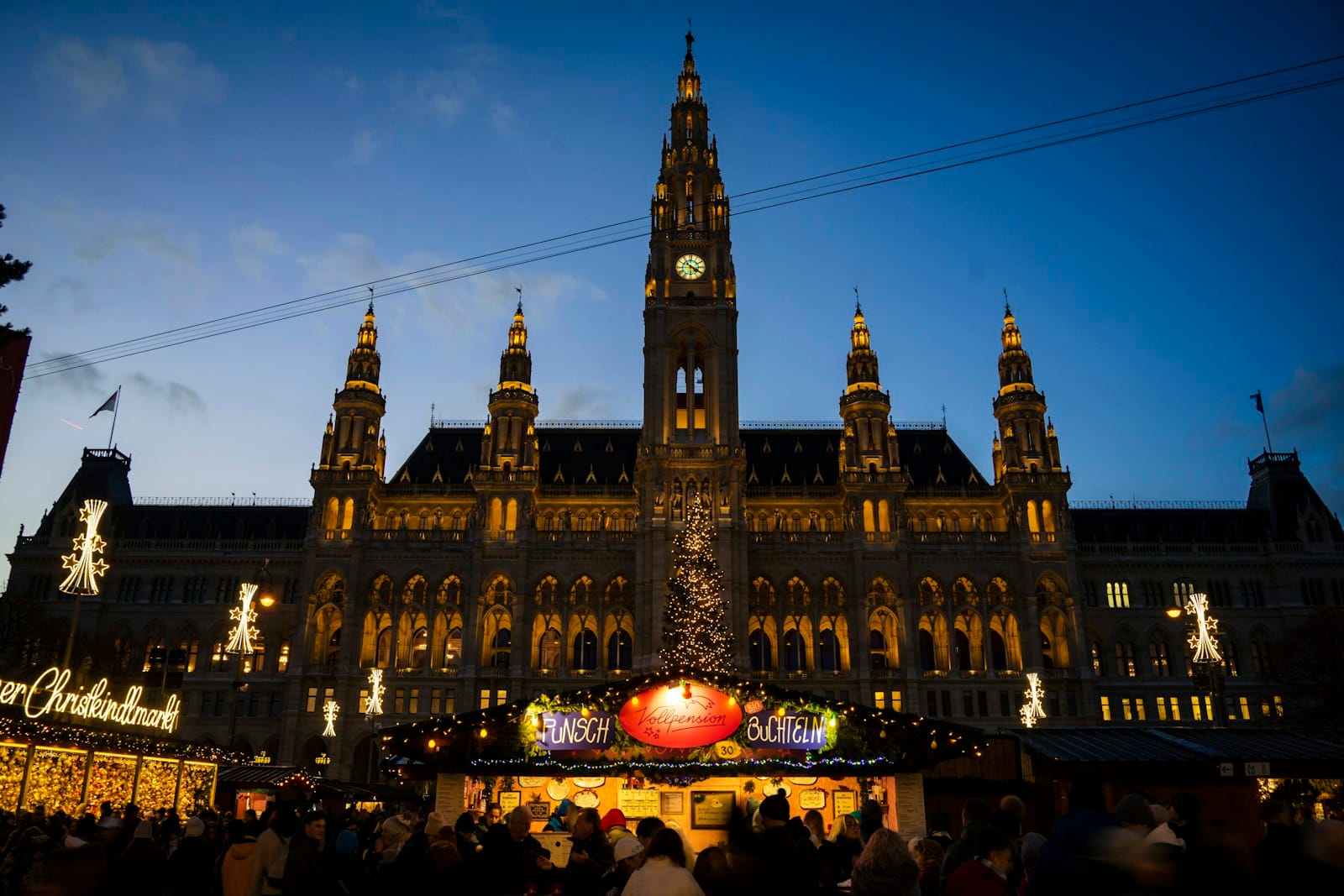
In late November and December, Rathausplatz becomes home to one of the most visited Christmas markets in the German-speaking world. The illuminated Gothic facade forms a backdrop that is hard to match anywhere else in Europe at that time of year. If you are planning a winter trip, the guide to Vienna's Christmas markets covers opening dates, stall highlights, and practical logistics.
Even outside event periods, the square is pleasant to walk through. The central park section has mature trees, benches, and a fountain. On warm afternoons, office workers from the surrounding government buildings eat lunch here. In the early morning, it is nearly empty.
How It Fits into a Walking Route
The Rathaus sits at a natural midpoint on any walking route through central Vienna. From Rathausplatz, the Burgtheater is directly across the Ringstrasse. The Volksgarten and the Hofburg complex are a few minutes' walk to the south, while the university and the Votivkirche are within easy reach to the north. The U2 stop directly beneath the square makes it a logical starting or finishing point for a longer day.
For a structured route through this part of the city, the Innere Stadt walking tour guide maps out an efficient sequence that includes the Rathaus, the Ringstrasse monuments, and the streets behind them.
ℹ️ Good to know
The area around Rathausplatz is entirely flat and straightforward to navigate with a wheelchair or pushchair. The U2 station has lift access. Accessibility inside the Rathaus for guided tours should be confirmed directly with the city administration before visiting, as the building contains several staircase-dependent sections.
Photography and Practical Considerations
The Rathaus is at its most dramatic after dark, when the facade is lit with a warm amber glow that makes the Gothic stonework appear almost theatrical. Evening shots from the park axis, framed by the trees on either side, are a reliable composition. During the Film Festival, the coloured light projections create more dynamic images but make architectural details harder to read.
Daytime photography works best in morning light from the east, or on overcast days when even illumination reduces harsh shadows in the deep window recesses. A wide-angle lens is essential given the building's scale; stepping back into the park is the only way to get the full tower in frame from street level.
There is no coat check or storage inside the building for tours. Comfortable shoes are advisable given the hard stone floors and the length of some of the corridors. The tour is conducted at a steady pace and involves a fair amount of standing, so visitors with limited mobility should enquire in advance about adapted arrangements.
Who Should Reconsider
The Rathaus is not for everyone. Visitors primarily interested in Habsburg imperial history will find the content here less rich than at the Hofburg or Schönbrunn, since the Rathaus represents civic rather than dynastic power. Those expecting a museum experience with exhibits, labels, and interactive displays will find the guided tour more formal and less curated than a dedicated heritage institution.
If you have limited time and your priority is art or imperial history, the Kunsthistorisches Museum or the Hofburg Palace complex will likely reward that time more directly. The Rathaus earns its place on the itinerary most clearly for architecture enthusiasts, those visiting during Rathausplatz events, or anyone who simply wants to understand what a 19th-century European city looked like when it was determined to announce itself to the world.
Insider Tips
- Tours are held at 13:00 sharp and do not wait for latecomers. Arrive at least 10 minutes early at the main entrance on Friedrich-Schmidt-Platz to ensure you join from the start.
- The seven interior courtyards are accessible outside of tour hours during standard weekday opening times. Walking through them on your own gives a quieter, less guided sense of the building's scale.
- The Rathausmann figure on the tower spire is a popular silhouette for architectural photographers shooting from across the Ringstrasse. The observation deck of the Natural History Museum, on the opposite side of the Ring, provides an elevated vantage point worth considering.
- During the Christmas market, the section directly in front of the main entrance tends to be less crowded than the market's outer edges. The best mulled wine stalls are reported to be toward the Burgtheater side of the square, where dwell times are shorter.
- On council meeting days, guided tours are cancelled entirely. The city's official website publishes council sitting dates in advance. Cross-reference before planning your visit around the interior tour.
Who Is Vienna City Hall (Rathaus) For?
- Architecture and design enthusiasts tracing the Ringstrasse's neo-Gothic landmark
- Travellers visiting during the summer Film Festival or the winter Christmas market
- History-minded visitors interested in Vienna's civic and municipal identity beyond the Habsburg court
- Photographers seeking dramatic evening or early-morning facade shots
- Budget-conscious travellers looking for a high-quality, fully free experience
Nearby Attractions
Other things to see while in Innere Stadt (1st District):
- Albertina Museum
Housed in a former Habsburg palace at the edge of the Ringstrasse, the Albertina holds one of the largest and finest graphic art collections in the world. With over one million drawings and prints alongside rotating exhibitions of modern masters, it rewards both the casual visitor and the serious art traveler.
- Austrian National Library (Prunksaal State Hall)
The Prunksaal, or State Hall of the Austrian National Library, is a Baroque masterpiece built for Emperor Charles VI between 1723 and 1726. At roughly 80 metres long and crowned by Daniel Gran's sweeping ceiling frescoes, it is one of the most visually arresting interiors in central Europe, and still holds around 200,000 historic volumes in its carved walnut shelves.
- Burgtheater
The Burgtheater is Austria's national theatre and one of the most significant German-language stages in the world. Its Neo-Renaissance building on Vienna's Ringstraße dates to 1888, and its institutional history stretches back to the court of Empress Maria Theresa. Whether you come for a performance or a guided tour, it rewards attention.
- Café Central
Housed inside the Palais Ferstel in Vienna's historic first district, Café Central has been serving coffee and conversation since 1876. Once the gathering point for Freud, Trotsky, and a constellation of Central European intellectuals, it remains one of the most architecturally remarkable coffeehouses in the world.
Planning a trip? Discover personalized activities with the Nomado app.