Vienna Ringstrasse: The Imperial Boulevard That Remade a City
The Wiener Ringstrasse is a 5.3 km ceremonial boulevard that Emperor Franz Joseph I commissioned in 1857 to transform Vienna into a modern imperial capital. Lined with some of Europe's most ambitious 19th-century public buildings, it remains the architectural spine of the city and one of the few great urban promenades you can explore entirely for free.
Quick Facts
- Location
- Encircling the Innere Stadt (1st District), Vienna
- Getting There
- Tram lines 1 and 2 run its full length; U2 (Museumsquartier, Rathaus), U3 (Volkstheater)
- Time Needed
- 1.5–3 hours on foot; 20 minutes by tram for the full loop
- Cost
- Free (public boulevard); tram fare applies if using public transport
- Best for
- Architecture lovers, first-time visitors, evening walkers, photography
- Official website
- www.wien.info/en/art-culture/architecture/ringstrasse-356762
What the Ringstrasse Actually Is
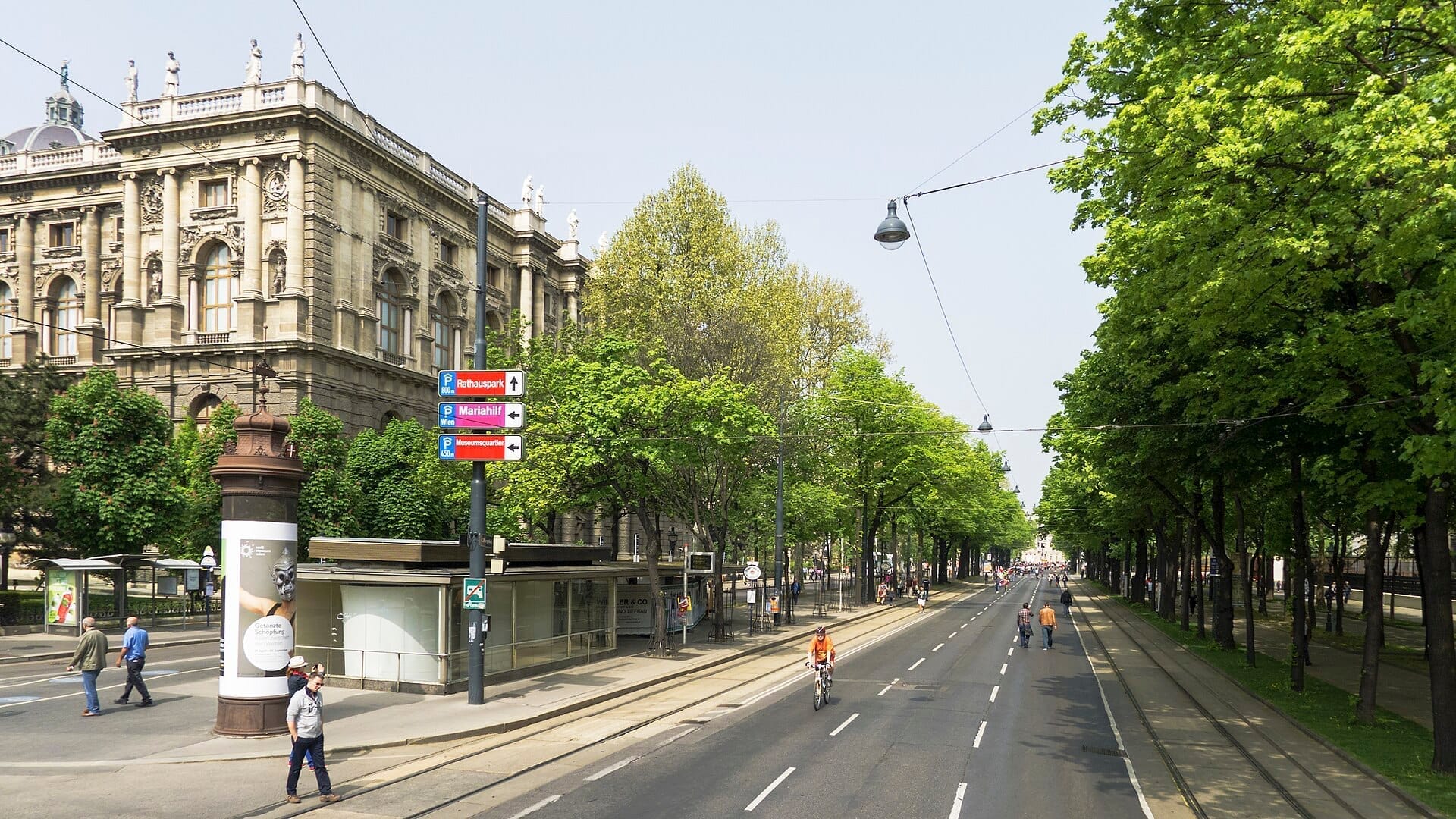
The Wiener Ringstrasse is not a single sight you enter and exit. It is a 5.3 km circular boulevard, roughly 57 metres wide, that wraps around Vienna's historic first district. Think of it as an open-air museum of 19th-century civic ambition: the opera house, the parliament building, the city hall, two world-class art museums, the university, the Burgtheater, and several palace-scale government ministries all arranged along a single continuous promenade.
Emperor Franz Joseph I signed the decree to demolish the old city walls and build the Ring in 1857. Construction began almost immediately, and the boulevard was officially opened on 1 May 1865, though individual monuments continued to be completed through the 1880s. The project was one of the largest urban redesigns in 19th-century Europe, rivalling Haussmann's simultaneous transformation of Paris.
💡 Local tip
Tram line 1 traces the Ring from Schwedenplatz around the southern and western arc. Tram line 2 covers the northern arc. Together they form a complete loop, and a single tram ticket covers either. Riding the full circuit takes around 20 minutes and gives you a low-effort overview before you decide where to get off and explore on foot.
The Architecture: A Deliberate History Lesson in Stone
Nothing on the Ringstrasse was designed by accident. Franz Joseph and his urban planners assigned each major building a historical style thought appropriate to its function. The Parliament building was given a Greek Revival facade, because ancient Athens was considered the birthplace of democracy. The Rathaus (City Hall) was built in the Gothic style, referencing the era of free medieval city-states. The Burgtheater and the Kunsthistorisches Museum received Renaissance forms, connecting theatre and art to the Italian golden age of culture.
The two monumental art history museums facing each other across Maria-Theresien-Platz are among the finest examples of this approach. The Kunsthistorisches Museum and the Naturhistorisches Museum are near-identical in facade, built as mirror images to create one of Vienna's most photographed symmetrical perspectives. Between them stands the Maria Theresa monument, completed in 1888, which anchors the composition like a full stop.
The Vienna State Opera, at the southern end of the Ring, was the first major building completed, opening in 1869. It set the tone for everything that followed: monumental scale, elaborate ornamentation, and a self-conscious theatricality that was very much the point. Franz Joseph was constructing an imperial image in stone, and visitors arriving in Vienna were meant to feel they had entered the capital of a great power.
Tickets & tours
Hand-picked options from our booking partner. Prices are indicative; availability and final rates are confirmed when you complete your booking.
Imperial Vienna 72-hour hop-on hop-off bus
From 55 €Instant confirmationFree cancellationSkip-the-Line Entrance with Guide to Schonbrunn Palace and Gardens
From 45 €Instant confirmationFree cancellationLuggage Storage in Vienna
From 6 €Instant confirmationFree cancellationStrauss Dinner Show
From 99 €Instant confirmationFree cancellation
Walking the Ring: What You See and When
The Ringstrasse changes character depending on where you are and what time you visit. The southern stretch, from the Opera toward the Burgring, is the grandest and most photographed section. The wide central lane has mature plane trees that filter the light in summer, and the footpath on the inner side of the boulevard runs close enough to the buildings to let you read the details on their facades.
Early morning is the most rewarding time to walk this stretch. By 7:30 AM on a weekday the Ring carries commuter traffic but the pavements are still quiet. The light from the east catches the cream-coloured stone of the Kunsthistorisches Museum and the Parliament's Athena fountain in a way that afternoon photographs never quite replicate. Tour groups typically do not arrive in force until after 9:30 AM.
The northern arc, passing the Rathaus and the Burgtheater, feels different in character: broader green spaces, a larger gap between buildings, and a more civic rather than imperial atmosphere. In summer this section in front of the Rathaus hosts a film festival and food market that runs through July and August, turning the square into an outdoor cinema by evening.
ℹ️ Good to know
The Ring is divided into named segments: Opernring, Burgring, Dr.-Karl-Renner-Ring, Dr.-Karl-Lueger-Ring, Schottenring, Börsenring, and others. Maps sometimes list these separately, which can be confusing. They are all part of the same continuous boulevard.
The Golden Hour and Evening Experience
At dusk the Ringstrasse earns its grandest reputation. The buildings are lit externally, and the Opera in particular glows against a dark sky in a way that is worth timing your evening around. The stretch between the Opera and the Kunsthistorisches Museum sees a steady flow of opera-goers in formal dress between roughly 6:30 and 7:30 PM on performance nights, which adds an atmosphere that no daytime visit can replicate.
Winter evenings bring a different quality. The leafless trees allow clearer sightlines to the lit facades, and if there is light snow, the Ring becomes one of the more striking urban scenes in Central Europe. Foot traffic is lower, cafes along the side streets are warm and full, and the Christmas market at the Rathaus extends into the boulevard's northern arc from mid-November through late December.
Practical Walkthrough: How to Approach It
Most visitors start at the Vienna State Opera, which sits at the junction of the Ring and the Kärntner Strasse pedestrian zone, making it a natural entry point from the Stephansdom area. From here, walking counterclockwise along the Burgring puts the major museums on your left within the first ten minutes.
If your priority is architecture and you have two to three hours, walking the full southern and western arc on foot (Opera to Schottenring) covers all of the most significant buildings. The northern arc back to the Danube Canal is less architecturally dense and can be covered by tram. For a deeper dive into Vienna's building heritage, the Vienna architecture guide provides context on the individual monuments you'll pass.
The Ringstrasse has wide pavements and is largely flat, making it accessible for wheelchair users and pushchairs along most of its length. Tram stops are spaced regularly and serve as useful orientation markers. Note that crossing the Ring on foot requires using designated pedestrian crossings, as the central lane carries fast-moving traffic even on Sundays.
⚠️ What to skip
The Ring is primarily a traffic artery and not a pedestrianised zone. Cyclists should use the designated cycle lanes rather than the main carriageway. Be careful crossing between the inner and outer pavement lanes at non-signalled points.
Photography Tips and Honest Limitations
The Ringstrasse is a challenge to photograph well precisely because it is so large. Wide-angle lenses work better than standard focal lengths for capturing the full facade of any single building. The best single composition for photographers is the Maria-Theresien-Platz view, standing at the midpoint between the two symmetrical museums with the monument in the foreground. This works in almost any light and at almost any time of day because it is facing roughly south.
One limitation worth stating clearly: the Ring's grandeur is more apparent from inside the buildings and at ground level than from any elevated viewpoint. There is no single overlook that puts the whole boulevard in frame. Its scale is meant to be experienced as a pedestrian moving through it, not as a panoramic photograph. Visitors expecting an Instagram-friendly single image often feel the reality requires more patience than anticipated.
The Ringstrasse is also context for a much broader story about Vienna's imperial history. For that context, the Habsburg imperial history guide fills in the political backdrop behind Franz Joseph's grand redesign and explains why the buildings look the way they do.
Who Should Skip the Ring (and Who Should Not)
Travelers with very limited time who are primarily interested in interiors rather than exteriors may find the Ring less rewarding as a standalone activity. The boulevard itself contains no single sit-down attraction: it connects places rather than being one. Those visiting for just one day and prioritising collections should walk a portion of it in transit rather than devoting a full half-day to the exterior circuit.
For anyone with a genuine interest in 19th-century urban planning, civic architecture, or European history, the Ringstrasse is one of the most instructive places in the city. Paired with the Innere Stadt walking tour, it provides a coherent two to three hour orientation to how Vienna looks and why.
Insider Tips
- Tram line 1 and 2 together complete the full Ring loop, but they run in opposite directions. Check the direction before boarding or you may end up going the long way around.
- The Rathaus fountain and building facade are lit until around midnight year-round, making the northern arc of the Ring worth a late-evening walk even after other sights have closed.
- The pedestrian underpass at the Opera (Opernpassage) connects the Ring to the Naschmarkt side streets without crossing traffic and contains a few small shops. Useful if it is raining.
- On opera performance nights (most evenings September through June), a small crowd gathers outside the State Opera under the loggia where the performance is projected live on a screen for free. It is not widely advertised but consistently draws an audience.
- The pavement on the inner side of the Ring (closest to the Innere Stadt) is generally quieter and shaded by the tree lines, making it more comfortable for walking in summer heat than the outer pavement.
Who Is Ringstrasse For?
- First-time visitors wanting a free, comprehensive introduction to Vienna's architectural scale
- Architecture and urban history enthusiasts interested in 19th-century European city planning
- Evening walkers and couples who want atmosphere without an admission fee
- Photographers working in the early morning before crowds arrive
- Visitors using the tram network who want to understand Vienna's layout quickly
Nearby Attractions
Other things to see while in Innere Stadt (1st District):
- Albertina Museum
Housed in a former Habsburg palace at the edge of the Ringstrasse, the Albertina holds one of the largest and finest graphic art collections in the world. With over one million drawings and prints alongside rotating exhibitions of modern masters, it rewards both the casual visitor and the serious art traveler.
- Austrian National Library (Prunksaal State Hall)
The Prunksaal, or State Hall of the Austrian National Library, is a Baroque masterpiece built for Emperor Charles VI between 1723 and 1726. At roughly 80 metres long and crowned by Daniel Gran's sweeping ceiling frescoes, it is one of the most visually arresting interiors in central Europe, and still holds around 200,000 historic volumes in its carved walnut shelves.
- Burgtheater
The Burgtheater is Austria's national theatre and one of the most significant German-language stages in the world. Its Neo-Renaissance building on Vienna's Ringstraße dates to 1888, and its institutional history stretches back to the court of Empress Maria Theresa. Whether you come for a performance or a guided tour, it rewards attention.
- Café Central
Housed inside the Palais Ferstel in Vienna's historic first district, Café Central has been serving coffee and conversation since 1876. Once the gathering point for Freud, Trotsky, and a constellation of Central European intellectuals, it remains one of the most architecturally remarkable coffeehouses in the world.