Vienna State Opera (Wiener Staatsoper): The Complete Visitor Guide
The Wiener Staatsoper is not just Vienna's most celebrated performance venue. It is a living monument to the city's identity, built in 1869 on the Ringstrasse and still staging over 50 productions per season. Whether you attend a full performance or join a guided tour, the building alone rewards the visit.
Quick Facts
- Location
- Opernring 2, 1010 Wien (Innere Stadt, 1st District)
- Getting There
- Karlsplatz (U1, U2, U4); tram lines D, 1, 2, 71 stop at Oper/Karlsplatz
- Time Needed
- 1 hour for a guided tour; 2.5–5 hours for a full performance
- Cost
- Standing tickets from a few euros; premium seats can exceed €200. Tour prices vary — check official site.
- Best for
- Classical music lovers, architecture enthusiasts, first-time Vienna visitors, couples
- Official website
- www.wiener-staatsoper.at/en
What Is the Vienna State Opera, Exactly?
The Wiener Staatsoper sits on the Ringstrasse, the grand boulevard Emperor Franz Joseph commissioned in the 1850s to reshape Vienna's imperial image. Among all the monuments that line that road — the Parliament, the Rathaus, the Kunsthistorisches Museum — the opera house carries a particular weight. It was the first major building completed on the Ring, opening on 25 May 1869 with a performance of Mozart's Don Giovanni. The architects were August Sicard von Sicardsburg and Eduard van der Nüll, and their building drew immediate criticism from the press and public alike, the neo-Renaissance facade considered too low, too flat. Van der Nüll died by suicide before the opening; Sicardsburg died of a heart attack two months later. The tragedy, and the building, became part of Vienna's civic mythology.
Today the Staatsoper stages more than 50 different operas and ballets per season, running from September to June, with a total audience across the year that reaches into the hundreds of thousands. The house has around 1,709 seats and 567 standing places, making it one of the higher-capacity opera venues in Europe. It is not a museum piece. It is a working institution, rehearsing and performing almost every night of the season.
ℹ️ Good to know
The opera house closes for July and August each season. If you are visiting Vienna in summer, you can still tour the building, but there will be no live performances.
The Building: What to Look For
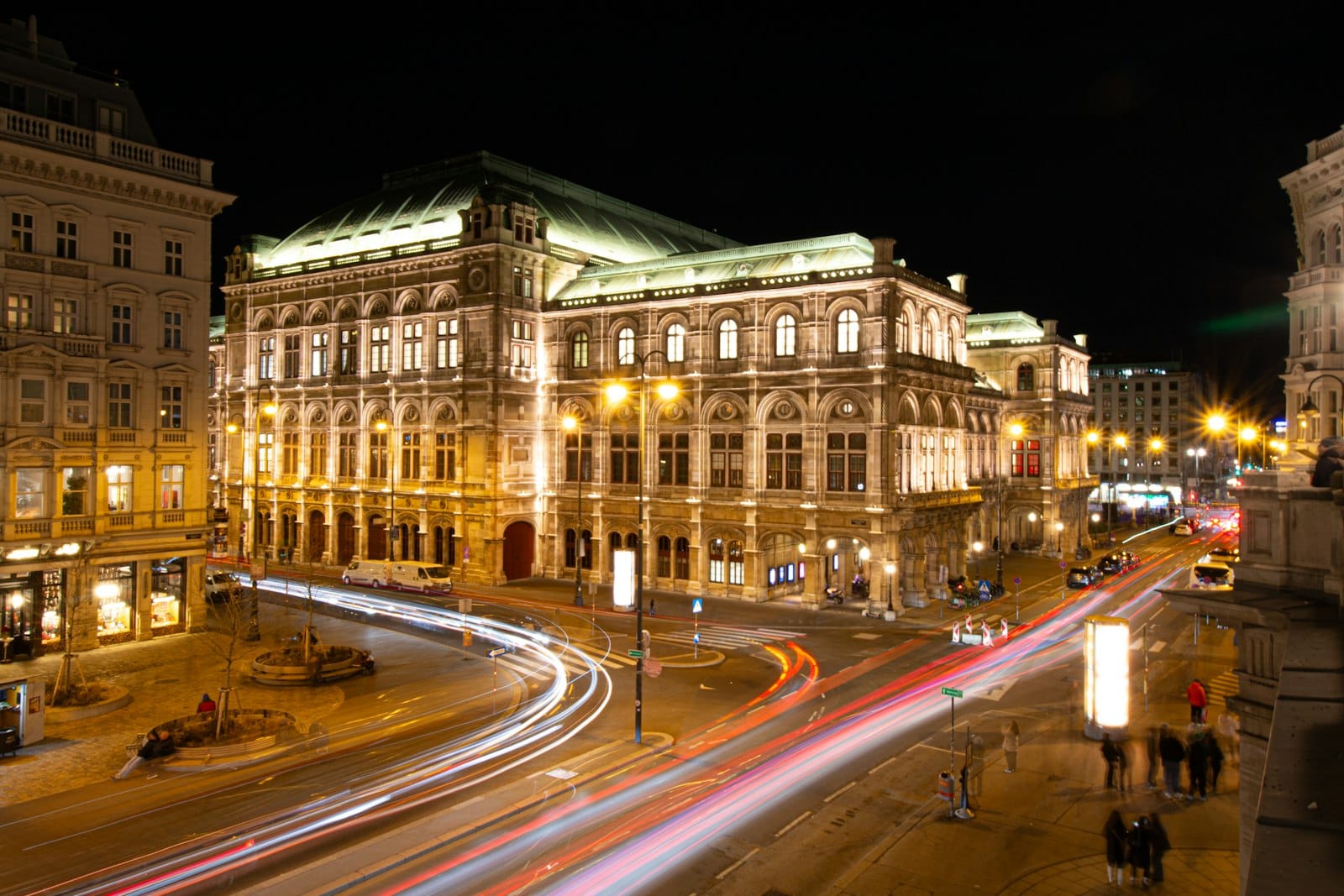
The exterior is dressed in honey-colored limestone, with arched loggia across the facade and bronze equestrian statues flanking the entrance. Standing in front of it on a winter evening, with the tram wires overhead and the glow from the lobby windows, the building has an almost theatrical quality even before you step inside. The stone holds the cold. The smell of the surrounding streets is damp limestone and exhaust, cut occasionally by roasting chestnuts from a nearby vendor.
Inside, the foyer sequence builds slowly. A grand staircase of white Carrara marble rises under ceiling frescoes depicting scenes from opera history. The Tea Salon, the Gustav Mahler Hall, and the marble-columned Schwind Foyer, decorated with frescoes by Moritz von Schwind illustrating scenes from Mozart's Magic Flute, are the visual high points of any tour. The auditorium itself, rebuilt after the 1945 bombing, is more restrained than the surviving public rooms: five tiers of horseshoe seating in cream and gold, focused entirely on the stage.
The bombing in March 1945 destroyed the stage and much of the auditorium, while the grand staircase and several foyer rooms survived largely intact. The rebuilding took ten years. The house reopened on 5 November 1955 with Beethoven's Fidelio, an occasion that coincided almost exactly with the Austrian State Treaty restoring national sovereignty. That pairing — opera, architecture, and political identity — is not accidental. It captures how Viennese culture is lived.
Tickets & tours
Hand-picked options from our booking partner. Prices are indicative; availability and final rates are confirmed when you complete your booking.
Vienna private walking tour with the State Opera
From 264 €Instant confirmationFree cancellationTickets for The Phantom Of The Opera at Raimund Theater
From 99 €Instant confirmationFree cancellationHallstatt day trip from Vienna
From 129 €Instant confirmationFree cancellationImperial Vienna 72-hour hop-on hop-off bus
From 55 €Instant confirmationFree cancellation
Attending a Performance: What to Expect
Booking in advance is strongly recommended for any premiere or popular title. The Staatsoper's own website (wiener-staatsoper.at) is the most reliable source for current programming and tickets. For first-time visitors, a mid-week performance of a well-known opera in the main repertoire — a Verdi, a Puccini, a Strauss — gives the best balance of accessibility and atmosphere. If budget is a constraint, standing tickets (Stehplatz) are available from a very low price and go on sale at the box office on the day of the performance. The standing area at the rear of the stalls and in the upper galleries fills quickly; regulars know to arrive well before opening.
Dress code is worth thinking about. There is no strict enforcement, and audiences range from black-tie to smart casual on most evenings. For premieres and gala nights, formal dress is genuinely common. For regular repertoire performances, a jacket and smart shoes for men, or an equivalent level of polish for women, reads correctly. Showing up in sportswear is unusual enough to draw looks, though you will not be turned away.
Inside the auditorium, the sightlines from the stalls are excellent. Upper tier boxes offer the classic visual framing of an opera house but can have partially obstructed views depending on position. The acoustic in the rebuilt house is considered good rather than exceptional by international standards, though this is a minority critical view. Most listeners find the sound full and warm, particularly in the stalls and lower circles.
💡 Local tip
The interval bar on the second floor runs quickly out of seating. Head there immediately when the curtain falls for the first break. Coffee, wine, and Sekt (Austrian sparkling wine) are the standards. The pre-interval crush at the cloakroom is real — arrive 30 minutes early and check your coat before the performance.
Guided Tours: Seeing the Building Without a Ticket
Daily guided tours run through the public rooms of the building, including the grand staircase, the Schwind Foyer, and often the auditorium itself. Tour schedules vary by season and day, and on performance days the auditorium access may be restricted. Check the official website for the current tour timetable before visiting. The tour lasts approximately 40 to 50 minutes and covers the history of the building, the 1945 bombing, and the postwar reconstruction.
Tours are conducted in German and English. Group sizes are manageable. If you want the cleanest photographs of the auditorium, tours on non-performance days earlier in the week tend to allow the most time in the stalls. Morning light through the side windows gives the cream-and-gold interior a different warmth than the full house lighting used during evening performances.
Wheelchair users and visitors with mobility requirements should contact the house directly in advance. The phone contact listed by the Vienna Tourist Board for accessibility inquiries is +43 1 514 44-2606. The building's historic structure means some areas require stairs, but arrangements can be made with prior notification.
When to Go and How It Changes Through the Day
The area around the Staatsoper shifts character across the day. In the morning, Opernring is a commuter corridor, the pavement busy with people cutting through to Karlsplatz, the U-Bahn entrance just a short walk away. By mid-afternoon, tourists stop to photograph the facade. By early evening on performance nights, the building becomes the center of a specific kind of Viennese formality: people in coats arriving in pairs, taxis lining up, a low murmur of anticipation on the steps. The contrast with the daytime street is sharp enough to feel like a change of scene. This is the time to see the Staatsoper as it was intended to function.
If you are planning a wider evening in the city, the Staatsoper's location on the Ringstrasse places it in easy walking distance of the Kunsthistorisches Museum and the Musikverein. The Naschmarkt is roughly ten minutes on foot for lunch before a matinee. The Hofburg Palace complex is a 15-minute walk along the Ring, making a logical pairing for a full cultural day in the 1st District.
The Vienna classical music scene extends well beyond the Staatsoper. The Volksoper, further into the 9th District, stages operetta and more accessible repertoire at lower average prices. For travelers specifically focused on music, understanding both venues helps with scheduling.
Is It Worth the Hype?
For anyone with even a passing interest in classical music or European architectural history, the answer is straightforwardly yes. The building is genuinely extraordinary, the programming is world-class, and the experience of attending a performance here has a gravity that is hard to replicate elsewhere. The Staatsoper is not an institution that coasts on reputation. The standard of production is taken seriously in a city where audiences have strong opinions and long memories.
That said, it is worth being realistic about limitations. A guided tour without a performance is engaging but brief. If architecture is your primary interest and you have limited time, prioritize a full evening. If your interest is more casual and you are on a tight schedule, the tour provides a reasonable overview without the evening commitment.
Travelers who actively dislike opera and are not drawn to 19th-century European historical architecture will find the tour mildly interesting but unlikely to be a highlight of their Vienna visit. For them, time might be better spent at the Naschmarkt or exploring the MuseumsQuartier on the other side of the Ringstrasse.
Insider Tips
- Standing tickets (Stehplatz) are sold at the box office on the day of performance only, starting 80 minutes before curtain. Arrive at least 30 minutes before the box office opens to secure a spot. The rear stalls standing area has the best sound.
- The Schwind Foyer frescoes, depicting scenes from The Magic Flute, are one of the genuinely underrated visual experiences in Vienna. Most tour visitors walk past them quickly. Slow down and look at the individual panels.
- On performance evenings, the surrounding cafes and restaurants fill early. Book dinner before the performance rather than after, or be prepared for a wait post-curtain.
- Opera streaming: the Staatsoper broadcasts select performances live and on demand via its digital platform. If you cannot attend in person, this is a legitimate alternative, and the camera work gives access to the stage details you cannot see from the upper tiers.
- The Vienna Opera Ball, held annually in February, transforms the auditorium into a ballroom. Tickets are expensive and book out far in advance, but the spectacle of the opening ceremony, broadcast live on Austrian television, can be watched from any bar in the city.
Who Is Vienna State Opera (Wiener Staatsoper) For?
- Classical music and opera enthusiasts seeking world-class live performance
- Architecture travelers interested in 19th-century Ringstrasse historicism and postwar reconstruction
- Couples looking for a genuine Viennese evening with formal atmosphere
- First-time visitors to Vienna wanting to experience the city's defining cultural institution
- Travelers on a flexible budget: the gap between a standing ticket and a premium seat is exceptional value at the lower end
Nearby Attractions
Other things to see while in Innere Stadt (1st District):
- Albertina Museum
Housed in a former Habsburg palace at the edge of the Ringstrasse, the Albertina holds one of the largest and finest graphic art collections in the world. With over one million drawings and prints alongside rotating exhibitions of modern masters, it rewards both the casual visitor and the serious art traveler.
- Austrian National Library (Prunksaal State Hall)
The Prunksaal, or State Hall of the Austrian National Library, is a Baroque masterpiece built for Emperor Charles VI between 1723 and 1726. At roughly 80 metres long and crowned by Daniel Gran's sweeping ceiling frescoes, it is one of the most visually arresting interiors in central Europe, and still holds around 200,000 historic volumes in its carved walnut shelves.
- Burgtheater
The Burgtheater is Austria's national theatre and one of the most significant German-language stages in the world. Its Neo-Renaissance building on Vienna's Ringstraße dates to 1888, and its institutional history stretches back to the court of Empress Maria Theresa. Whether you come for a performance or a guided tour, it rewards attention.
- Café Central
Housed inside the Palais Ferstel in Vienna's historic first district, Café Central has been serving coffee and conversation since 1876. Once the gathering point for Freud, Trotsky, and a constellation of Central European intellectuals, it remains one of the most architecturally remarkable coffeehouses in the world.