Musikverein Vienna: Inside the World's Most Acoustically Perfect Concert Hall
The Musikverein is Vienna's most celebrated concert venue, home to the legendary Golden Hall where the Vienna Philharmonic performs its famous New Year's Concert. Built in 1870 by architect Theophil Hansen, the building combines imperial grandeur with acoustics that music lovers travel across the world to experience.
Quick Facts
- Location
- Musikvereinsplatz 1, 1010 Vienna (Innere Stadt, near Karlsplatz)
- Getting There
- Karlsplatz U-Bahn (U1, U2, U4) — 3-minute walk
- Time Needed
- 2–3 hours for an evening concert; 45 minutes for a daytime tour
- Cost
- No general entry fee; concert tickets vary by event and seat category — check the official site for current prices
- Best for
- Classical music fans, architecture lovers, special-occasion evenings
- Official website
- musikverein.at
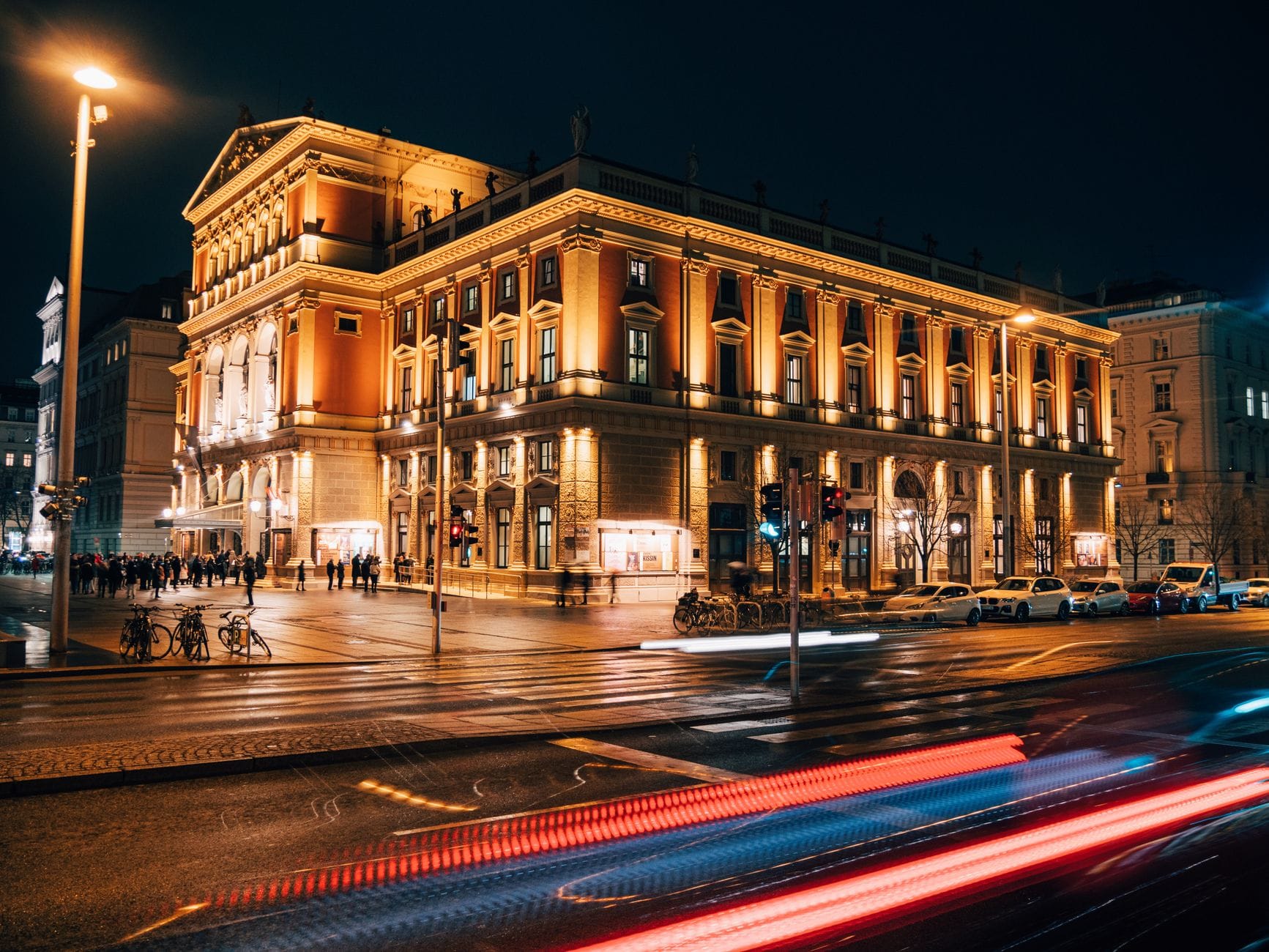
What the Musikverein Actually Is
The Musikverein is the home of the Gesellschaft der Musikfreunde in Wien, a private music association founded in 1812. The building that most visitors know today was inaugurated on 6 January 1870, on land granted by Emperor Franz Joseph I. Its architect, Theophil Hansen, a Danish-born classicist who also designed the Austrian Parliament building, drew on ancient Greek forms to create something that looked simultaneously monumental and intimate.
The building contains six concert halls. The largest, the Großer Saal, is universally known as the Goldener Saal or Golden Hall. It seats 1,744 people and has standing room for approximately 300 more. The other five halls, including the Brahms Hall, Metal Hall, Wooden Hall, Glass Hall, and Stone Hall, host chamber concerts, recitals, and smaller events throughout the season.
The Musikverein sits a short walk from the Vienna State Opera and is within easy reach of the Karlskirche and Karlsplatz. The surrounding area is calm in the early evening, with trams passing along Bösendorferstraße and concertgoers gradually arriving on foot from the U-Bahn.
The Golden Hall: Why Acoustics Matter Here
The Golden Hall is widely regarded as one of the finest concert halls on earth, and not because of reputation alone. Its acoustic properties follow what engineers call a shoebox design: a long rectangular room with a flat ceiling, shallow side galleries, and a reflective wooden floor. The sound does not just travel from stage to ear — it builds, reflects, and layers in a way that adds warmth and presence to orchestral music without blurring detail.
The hall is also physically beautiful. Gilded caryatid columns run along both sides of the room, the ceiling is painted with classical motifs, and the chandeliers cast a yellow warmth that shifts the mood before a single note is played. When the Vienna Philharmonic takes the stage, the visual and acoustic experience combine in a way that even hardened concertgoers describe as unexpectedly emotional.
ℹ️ Good to know
The Golden Hall is the venue for the Vienna Philharmonic's New Year's Concert, broadcast to over 90 countries each year. Tickets for that specific event are allocated by lottery, typically applied for months in advance. For regular season concerts, tickets are available through the Musikverein's online shop, often releasing several months before the performance date.
Vienna's concert culture runs deep, and understanding it benefits from some context. The Vienna classical music guide covers the full landscape of venues, orchestras, and how to navigate a season here.
Tickets & tours
Hand-picked options from our booking partner. Prices are indicative; availability and final rates are confirmed when you complete your booking.
Mozart concert tickets at the Golden Hall of the Vienna Musikverein
From 59 €Instant confirmationFree cancellationImperial Vienna 72-hour hop-on hop-off bus
From 55 €Instant confirmationFree cancellationSkip-the-Line Entrance with Guide to Schonbrunn Palace and Gardens
From 45 €Instant confirmationFree cancellationLuggage Storage in Vienna
From 6 €Instant confirmationFree cancellation
How to Get Tickets and What to Expect
The Musikverein does not charge a general admission fee. You attend by purchasing a ticket to a specific concert or event. Prices vary considerably depending on the orchestra, the program, the seat category, and whether the concert is organized by the Musikverein itself or by an external promoter. Standing-room tickets are typically among the most affordable options and give access to the rear of the Golden Hall.
The box office is located at Bösendorferstraße 12. During the main season from September to June, it is open Monday to Friday from 09:00 to 19:00 and Saturday from 09:00 to 13:00. In July and August, hours shorten to Monday to Friday, 09:00 to 12:00. For any concert organized by the Musikverein, the box office also opens one hour before the performance begins. These hours can change, so verify directly with the venue before your visit.
Visitors with reduced mobility should note that the accessible entrance is on Bösendorferstraße 12: ring the bell and staff will come to assist with ticketing. For specific seating arrangements or lift access, contacting the box office in advance is recommended.
💡 Local tip
If you want to hear a world-class orchestra in the Golden Hall without the planning required for a main-season concert, look at the Mozart concerts and similar evening programs organized by external promoters. These run regularly throughout the year, require less advance booking, and still take place in the Golden Hall itself — though they are distinct from the Vienna Philharmonic's own season.
Arriving at the Venue: What to Notice
The Musikverein's exterior is best seen from Musikvereinsplatz in the early evening, when the limestone facade catches the last light before dark and the red-carpet entrance is lit. Arriving around 30 to 45 minutes before the performance gives you time to collect tickets, find your seat, and take in the hall before it fills.
The main lobby and staircase are dressed in the same classical style as the exterior: marble, gilding, and a sense of deliberate formality. The cloakroom fills quickly on cold nights, so arriving early avoids queuing at interval. The Golden Hall itself smells faintly of old wood and something hard to name — the accumulated presence of a room that has been in continuous use for over 150 years.
Dress code is not strictly enforced at all events, but the Viennese concert audience tends toward formal or smart dress, particularly for Vienna Philharmonic performances. For evening concerts by major orchestras, treat it as you would a formal dinner: you will not be turned away in clean casual clothes, but you will notice that most of the room has dressed up.
⚠️ What to skip
Photography is typically not permitted during performances. Some concerts allow photos before the music begins — check with the venue or your specific event organizer. Applause between movements of a symphony is considered poor form in this hall, and the audience will notice.
Architecture in Context: Theophil Hansen's Vision
Hansen designed the Musikverein in the Historicist style that defines much of the Ringstrasse, Vienna's grand 19th-century boulevard. He drew explicitly from ancient Greek precedents — the facade's pilasters and the hall's column arrangements echo Athenian temple architecture — while scaling everything for the civic ambitions of Habsburg Vienna at its imperial peak.
The building stands at a transition point between the inner city and the Ringstrasse institutions. A short walk along the ring takes you to the Kunsthistorisches Museum and the wider Ringstrasse ensemble, all built within the same period of imperial Vienna's self-conscious cultural expansion.
The acoustic design, though not fully understood in engineering terms until the 20th century, was partly intuitive and partly derived from established hall proportions. Hansen worked with the dimensions that had proven successful in earlier European concert halls. The result happened to combine visual grandeur with near-perfect sound reflection — a combination that subsequent concert hall designers have spent decades trying to replicate.
Who Should Consider Skipping This
If classical music holds no interest for you and you are looking for a daytime tourist attraction, the Musikverein offers little outside of concert hours. It is a working venue, not a museum, and there is no permanent exhibition about its history that you can walk through independently. Guided tours are sometimes available, but these are not the primary purpose of the building.
Travelers hoping for a casual or spontaneous experience may also find the ticket procurement process more structured than expected. The best concerts sell out weeks or months in advance. Same-day availability exists for some events, particularly standing-room spots, but prime seats for major orchestras require planning. If you are in Vienna for only a day or two and did not book ahead, check the same-day window at the box office — it occasionally yields good seats returned by subscribers.
For a broader picture of how to spend limited time in Vienna efficiently, the Vienna 2-day itinerary maps out how an evening at the Musikverein can fit alongside daytime attractions.
Insider Tips
- Standing-room tickets for the Golden Hall are sold at the box office on the day of the performance. Arrive when the box office opens one hour before the concert and you have a reasonable chance of securing one for even well-attended events. The view from the back standing area is partially obstructed, but the acoustics are excellent.
- The Brahms Hall, the second-largest space in the building, is where chamber concerts and recitals take place. It is smaller, less famous, and easier to get tickets for — and it sounds extraordinary. Many regular Musikverein visitors prefer it for intimacy.
- If you are attending an evening concert, the Naschmarkt area and the streets around Karlsplatz have several restaurants and cafes suitable for a pre-concert dinner. Book ahead on concert nights, particularly Friday and Saturday.
- Concert programs sold at the venue are printed in German and English. Taking one home is a practical souvenir and provides program notes that deepen the listening experience if you read them before the performance begins.
- The Musikverein season runs September through June, with reduced programming in July and August. If you are visiting in summer, check the current schedule carefully — the building does not go entirely dark, but major orchestra concerts are significantly fewer.
Who Is Musikverein (Golden Hall) For?
- Classical music enthusiasts who want to hear a world-class orchestra in historically significant surroundings
- Architecture and design travelers interested in 19th-century Historicist building and acoustic engineering
- Couples looking for a high-quality, distinctly Viennese special-occasion evening
- Travelers with a flexible itinerary who can plan concert attendance weeks in advance
- Anyone who has watched the Vienna Philharmonic New Year's Concert on television and wants to see the hall in person
Nearby Attractions
Other things to see while in Belvedere & Landstraße (3rd District):
- Albertina Modern
Opened in 2020 inside the landmark Künstlerhaus building at Karlsplatz, Albertina Modern is Vienna's dedicated space for modern and contemporary art. Across 2,500 square metres, it offers a counterpoint to the Habsburgs-and-Old-Masters narrative that dominates so many of the city's museums.
- Belvedere Gardens
Stretching between two palaces built for Prince Eugene of Savoy, the Belvedere Gardens form one of Central Europe's finest Baroque garden compositions. Entry to the main gardens is free, and the grounds shift dramatically in character from early morning calm to afternoon crowds and golden evening light.
- Heeresgeschichtliches Museum (Museum of Military History)
Housed in a striking Moorish-Byzantine arsenal building from the 1850s, the Heeresgeschichtliches Museum is one of the oldest purpose-built military history museums in the world. At just €3.50 admission, it offers an unexpectedly deep dive into Austria's military and political past, including the actual car in which Archduke Franz Ferdinand was assassinated in 1914.
- Hundertwasserhaus
Hundertwasserhaus is a municipal apartment block in Vienna's 3rd district that looks like it was painted by a child and designed by a forest. The exterior is free to view any time, and the adjacent Hundertwasser Village gives you a place to linger. Here is what a visit actually involves.