Karlskirche (St. Charles's Church): Vienna's Baroque Landmark Worth the Climb
Karlskirche stands at the edge of Karlsplatz as one of the most architecturally ambitious churches in Central Europe. Built by imperial commission after a devastating plague, it rewards visitors with extraordinary ceiling frescoes, twin triumphal columns, and a panoramic lift ride to the base of its 70-metre dome. This guide covers what to expect, when to go, and how to make the most of your visit.
Quick Facts
- Location
- Karlsplatz 10, 1040 Vienna (Wieden/4th District, on the Karlsplatz)
- Getting There
- U1, U2, U4 to Karlsplatz; trams 1, 2, D, 71 stop at Karlsplatz/Oper
- Time Needed
- 45–90 minutes (longer if you take the dome lift and browse the treasury)
- Cost
- Adults €9.50 | Groups (6+) €7.50 | Students €5 | Under 10 free (verify before visiting)
- Best for
- Baroque architecture, art history, panoramic city views, photography
- Official website
- www.karlskirche.at/en
What Karlskirche Actually Is (and Why It Looks So Unusual)
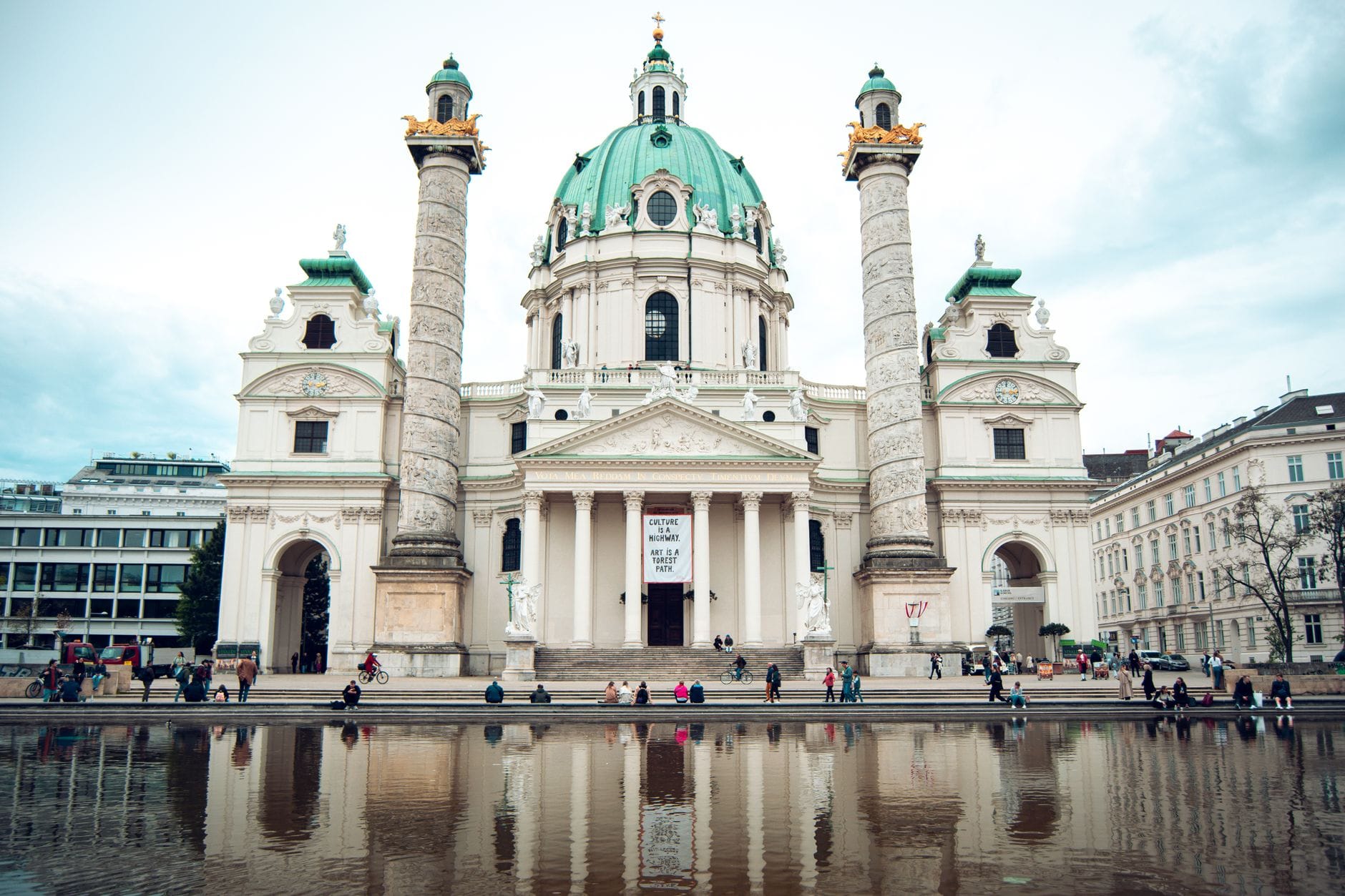
Karlskirche, formally known as the Rektoratskirche St. Karl Borromäus, is a Baroque church commissioned by Emperor Charles VI following the catastrophic plague of 1713 that killed roughly 8,000 Viennese. The emperor vowed to build a church in honor of St. Charles Borromeo, the patron saint of plague victims, if the epidemic subsided. Construction began around 1716 under architect Johann Bernhard Fischer von Erlach and was completed after his death by his son Joseph Emanuel Fischer von Erlach, with the church consecrated in 1738.
What makes the building visually jarring at first glance is its deliberately hybrid design. Fischer von Erlach fused a Roman Pantheon-style portico, a dome modelled on St. Peter's Basilica, and two enormous freestanding columns based on Trajan's Column in Rome, all flanked by smaller Baroque towers. The result is less a unified style than an imperial statement: Charles VI was asserting his authority as heir to Rome, Spain, and the Holy Roman Empire simultaneously. Whether you find it harmonious or theatrical depends on your taste, but it is impossible to ignore.
ℹ️ Good to know
The two columns, each about 33 metres tall, are wrapped in spiralling relief carvings depicting scenes from the life of St. Charles Borromeo. You can see them from outside for free, but the detail only becomes apparent up close or through a long lens.
Arriving at Karlsplatz: First Impressions and Orientation
The church sits on the southern edge of Karlsplatz, one of Vienna's largest and most transport-heavy squares. The area around the square can feel fragmentary: there are pedestrian underpasses, tramlines, the Naschmarkt a few blocks to the west, and the Vienna State Opera visible to the north. The church itself stands back from the road behind a shallow reflecting pool that was added in the 20th century, giving a clean sightline to the facade in daylight hours.
Morning light (before 10:00) hits the facade from the east and gives the stone a warm, almost copper tone that's worth photographing. By midday the light is flat and less interesting for exterior shots. Late afternoon, particularly in summer, produces long shadows from the columns that cut dramatically across the plaza. Visitors arriving by U-Bahn should use the Resselpark exit from Karlsplatz station, which deposits you directly in front of the church. Those arriving by tram on the Ringstrasse side will walk past the Otto Wagner Pavilions at Karlsplatz, two exquisite Art Nouveau metro pavilions that deserve a brief stop before or after.
Tickets & tours
Hand-picked options from our booking partner. Prices are indicative; availability and final rates are confirmed when you complete your booking.
Vivaldi's Four Seasons concert at Vienna's Karlskirche
From 38 €Instant confirmationFree cancellationImperial Vienna 72-hour hop-on hop-off bus
From 55 €Instant confirmationFree cancellationSkip-the-Line Entrance with Guide to Schonbrunn Palace and Gardens
From 45 €Instant confirmationFree cancellationLuggage Storage in Vienna
From 6 €Instant confirmationFree cancellation
Inside the Church: Frescoes, Space, and the Dome Lift
Entry is through the main portal. The interior is a single large oval nave with side chapels, finished in pale stucco, gilded ornament, and marble. The scale reads differently from inside than from outside: the dome, 70 metres at its apex, creates a vertical pull that draws your eye upward almost immediately.
The ceiling fresco in the dome was painted by Johann Michael Rottmayr and depicts the Apotheosis of St. Charles Borromeo surrounded by allegorical figures. At ground level the detail is difficult to read. This is where the panoramic lift becomes genuinely useful rather than merely touristic: the enclosed glass gondola travels up through the interior scaffolding structure to a platform just beneath the fresco, close enough to see individual brushstrokes and the scale of individual figures. It is one of the few places in Europe where you can examine a major Baroque ceiling painting at close range. The experience is worth the ticket price on its own terms.
The lift platform also offers a view out over Vienna through small windows, though the Gloriette at Schönbrunn or the Donauturm provide more expansive panoramas. What you get here is specific: rooftops of the 4th district, the green dome of the Musikverein to the north, and an unusual angle on the Ringstrasse. Visitors with a fear of heights or enclosed spaces should know that the gondola is compact and the upper platform is railed but open to the dome interior above.
💡 Local tip
The combined ticket covers the church, dome lift, treasury, and organ gallery. If you only want to see the interior frescoes from ground level and skip the lift, check at the entrance whether a reduced-rate option is available. Prices and ticket combinations are subject to change, so verify at karlskirche.at before visiting.
Historical and Cultural Context
The church sits at an interesting intersection in Vienna's architectural history. It was commissioned at the height of Habsburg imperial ambition, at a moment when Charles VI was attempting to legitimise his rule across a sprawling, contested empire. Fischer von Erlach, who also designed parts of the Hofburg Palace and the great hall of the Austrian National Library, brought a cosmopolitan architectural literacy to Vienna that drew on Italian, French, and classical Roman sources. Karlskirche was conceived as much as a political monument as a devotional space.
The plague connection is worth dwelling on. The epidemic of 1713 followed earlier outbreaks that had killed large portions of the Viennese population in the 17th century. St. Charles Borromeo, the 16th-century Archbishop of Milan, was associated with heroic ministry to plague victims, which made him a natural patron. The church's dedication thus carried both personal and civic meaning for the emperor. For a broader sense of how the Habsburg dynasty shaped Vienna's built environment, the Habsburg imperial history guide provides useful context.
The surrounding Karlsplatz has changed significantly over the centuries. What is now a broad urban square was once the site of the Wien River before it was channelled underground in the late 19th century as part of a major city engineering project. The river's culverting transformed the area and enabled the construction of the Ringstrasse-era buildings that now frame the square's northern edge.
Practical Walkthrough: How to Structure Your Visit
A focused visit runs about 45 minutes. If you take the dome lift, add 20 to 30 minutes for queuing and the ascent. The church is active as a parish, meaning religious services do take place; during services, tourist access to parts of the interior may be restricted. It is worth checking the schedule on the official site if you plan to visit on a Sunday morning, when visitor access opens at 12:00 rather than 09:00.
The treasury is compact but contains liturgical objects, vestments, and historical artifacts connected to the church's history. Unless you have a particular interest in ecclesiastical art, most visitors spend five to ten minutes there. The organ gallery offers a different angle on the nave, and the organ itself is used for regular concerts; the church hosts evening concerts fairly frequently, which can be a worthwhile way to experience the acoustics in a different mode from a daytime tourist visit.
The Karlsplatz area rewards a longer itinerary. The Musikverein is a five-minute walk north, and the Naschmarkt food market is a short walk to the west along the Linke Wienzeile. If you are combining Karlskirche with the Belvedere, the Lower Belvedere entrance is about 15 minutes on foot heading southeast.
Photography, Weather, and What to Bring
Interior photography is generally permitted without flash. The dome fresco is the primary challenge: from ground level, a wide-angle lens helps but the fresco is still distant. From the lift platform, a standard focal length works well since you are only a few metres from the painted surface. Tripods are not practical inside the gondola.
Weather matters primarily for the exterior. The reflecting pool in front of the church produces a clean symmetrical reflection on still, overcast days, which can be more photogenic than bright direct sun. Rain does not affect the interior visit at all. In winter, the square around the church can be part of a Christmas market circuit, and evening lighting on the facade is particularly effective in the shorter days of November through January.
⚠️ What to skip
The area around Karlsplatz can feel noisy and congested, particularly during rush hours when commuters pour through the underground passages. Plan to arrive either before 09:30 or after 14:00 to avoid the worst of the through-traffic crowd on the square.
Who This Attraction Suits — and Who Might Skip It
Karlskirche is well-suited to visitors with an active interest in Baroque architecture, art history, or the Habsburg period. The dome lift experience is genuinely unusual and hard to replicate elsewhere. Visitors who enjoy understanding a city's built environment will find it one of the most rewarding single-building experiences in Vienna.
Travelers who find religious architecture less engaging, or who are working through a tight itinerary focused on galleries and palaces, may find Karlskirche a lower priority than the Kunsthistorisches Museum or the Upper Belvedere. The church's interior, while beautiful, is not as densely packed with paintings and objects as a major art museum. If you have already visited Rome's major Baroque churches, the interior may feel familiar in type, though the dome lift access is uncommon.
Visitors with limited mobility should note that while the church floor is accessible at ground level, the dome lift involves a platform with a step and the gondola is small. The upper viewing area involves a degree of physical confidence. Contact the parish directly if mobility access is a specific concern.
Insider Tips
- Arrive right at opening (09:00 on weekdays) to have the nave largely to yourself before the first tour groups arrive, usually around 10:00.
- The reflecting pool in front of the church is rarely crowded before 09:30 and gives the cleanest unobstructed exterior shot without other visitors in frame.
- Evening concerts held inside the church are a worthwhile alternative to the daytime tourist visit: the acoustic envelope of the oval nave is impressive, and the candlelit atmosphere changes the space entirely. Check the official site for current concert schedules.
- The two triumphal columns are openable to the public on some occasions during cultural events; if you see them open, go inside — the interior spiral staircase winds up through the carved relief scenes in a way that is completely invisible from the outside.
- If you are visiting with the Vienna City Card or a similar pass, confirm in advance whether it covers Karlskirche entry, as the church operates independently from the main municipal museum network and ticket arrangements can differ from what passes advertise.
Who Is Karlskirche (St. Charles's Church) For?
- Architecture and art history enthusiasts who want to understand Vienna's Baroque building tradition at close range
- Photographers seeking an unusual interior vantage point via the dome lift platform
- Travelers following the Habsburg imperial history trail through the city
- Classical music visitors who want to combine a daytime architectural visit with an evening concert in an authentic historic setting
- Visitors with an afternoon in the Karlsplatz area who want to anchor a walk that also takes in the Naschmarkt and the Ringstrasse
Nearby Attractions
Other things to see while in Belvedere & Landstraße (3rd District):
- Albertina Modern
Opened in 2020 inside the landmark Künstlerhaus building at Karlsplatz, Albertina Modern is Vienna's dedicated space for modern and contemporary art. Across 2,500 square metres, it offers a counterpoint to the Habsburgs-and-Old-Masters narrative that dominates so many of the city's museums.
- Belvedere Gardens
Stretching between two palaces built for Prince Eugene of Savoy, the Belvedere Gardens form one of Central Europe's finest Baroque garden compositions. Entry to the main gardens is free, and the grounds shift dramatically in character from early morning calm to afternoon crowds and golden evening light.
- Heeresgeschichtliches Museum (Museum of Military History)
Housed in a striking Moorish-Byzantine arsenal building from the 1850s, the Heeresgeschichtliches Museum is one of the oldest purpose-built military history museums in the world. At just €3.50 admission, it offers an unexpectedly deep dive into Austria's military and political past, including the actual car in which Archduke Franz Ferdinand was assassinated in 1914.
- Hundertwasserhaus
Hundertwasserhaus is a municipal apartment block in Vienna's 3rd district that looks like it was painted by a child and designed by a forest. The exterior is free to view any time, and the adjacent Hundertwasser Village gives you a place to linger. Here is what a visit actually involves.