Otto Wagner Pavilion Karlsplatz: Vienna's Most Beautiful Bus Stop
Built in 1898 as a Stadtbahn station and designed by Otto Wagner with Joseph Maria Olbrich, the Karlsplatz Pavilion is one of Vienna's most striking examples of Art Nouveau architecture. Today the western pavilion operates as a small museum managed by Wien Museum, documenting Wagner's life and influence. It is easy to miss if you don't know to look for it, and worth every minute if you do.
Quick Facts
- Location
- Karlsplatz, 1040 Vienna, Austria
- Getting There
- U1, U2, U4 to Karlsplatz; Tram 1 or 62; Bus 4A
- Time Needed
- 30 to 60 minutes
- Cost
- €5 standard, €4 reduced; free under 19 and first Sunday of the month
- Best for
- Architecture lovers, Art Nouveau enthusiasts, design history fans
- Official website
- www.wienmuseum.at/otto_wagner_pavillon_karlsplatz_en
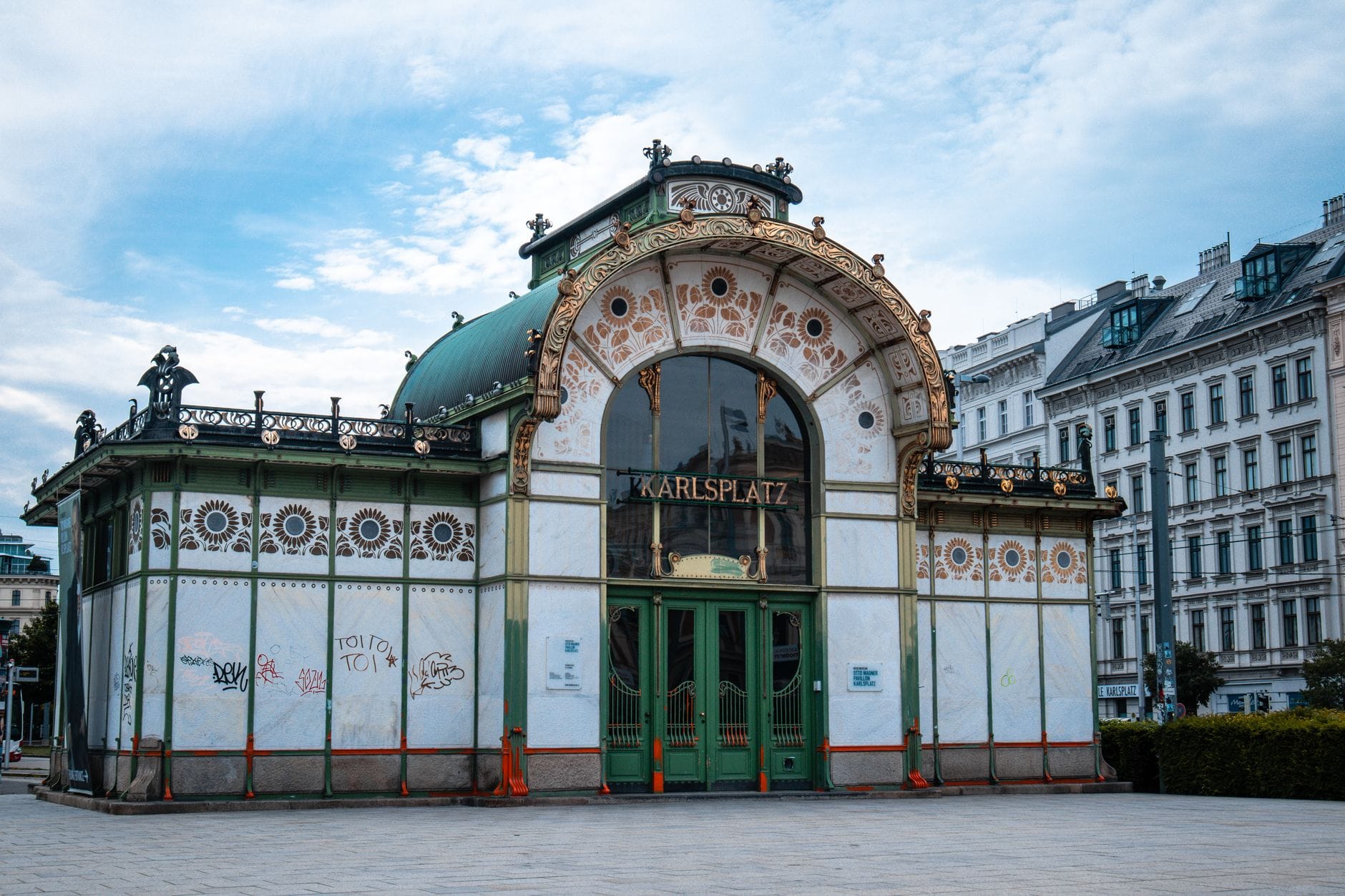
What You're Actually Looking At
Standing on Karlsplatz, it is easy to walk past the Otto Wagner Pavilion Karlsplatz without registering what it is. The two small white and green structures flanking the square look almost too delicate to be functional buildings, more like decorative props than a working transit station. That tension between beauty and utility is exactly what Otto Wagner intended.
Wagner designed these pavilions between 1898 and 1899 as station buildings for the Vienna Stadtbahn, the city's first urban rail network. The western pavilion, which now serves as the museum, was the departure point for trains heading toward Hütteldorf. The eastern pavilion still functions as a café. Both are protected monuments and together they form one of the most photographed architectural pairings in the city.
The structures represent a transitional moment in European design history. Wagner was trained in the classical tradition but grew increasingly convinced that architecture had to respond to modern life. The Stadtbahn commissions gave him the chance to prove it at scale. For a broader view of how this moment shaped Vienna, the Vienna architecture guide traces the full arc from Ringstrasse historicism through the Secession and into the twentieth century.
ℹ️ Good to know
The pavilion is open seasonally: Friday to Sunday, 10:00–13:00 and 14:00–17:00, from mid-March through the end of October. It is closed on May 1 and from November through mid-March. Verify current hours at wienmuseum.at before visiting.
The Architecture Up Close
Approach the pavilion slowly. The exterior rewards careful attention. The structure is built on a steel frame and clad in white marble slabs, each panel edged with thin green painted iron. The sunflower motifs pressed into the metalwork recur across the surface in a rhythm that feels organic rather than mechanical. Wagner collaborated with Joseph Maria Olbrich on the detailing, and Olbrich's influence is visible in the ornamental density of the ironwork.
The roof is the showpiece. A gently curved green copper canopy sweeps upward to a central finial, giving the building a profile that is simultaneously functional and theatrical. In strong morning light, the contrast between the white marble panels and the oxidized copper reads almost like a painting. In overcast conditions the whole structure takes on a quieter, more melancholy tone. Both versions are worth seeing.
Wagner's decorative vocabulary here anticipates the Wiener Secession building completed by Olbrich in 1898, just a short walk away. Visiting both on the same afternoon gives you a clear sense of how the Secession movement translated into built form across different building types and briefs.
Tickets & tours
Hand-picked options from our booking partner. Prices are indicative; availability and final rates are confirmed when you complete your booking.
Vienna Art Nouveau and Otto Wagner walking tour with a historian
From 114 €Instant confirmationFree cancellationImperial Vienna 72-hour hop-on hop-off bus
From 55 €Instant confirmationFree cancellationSkip-the-Line Entrance with Guide to Schonbrunn Palace and Gardens
From 45 €Instant confirmationFree cancellationLuggage Storage in Vienna
From 6 €Instant confirmationFree cancellation
Inside the Museum
The interior is compact. The original station floor plan was never large, and the museum respects that scale rather than trying to overload the space. The permanent exhibition focuses on Otto Wagner's life and architectural output, using drawings, photographs, models, and documents drawn from the Wien Museum collection. Given the small footprint, expect to spend around 30 to 45 minutes inside, possibly longer if you read every panel.
The exhibition positions Wagner within the broader context of fin-de-siècle Vienna, a city undergoing rapid expansion and identity crisis simultaneously. His famous maxim, that nothing impractical can be beautiful, runs through the displays as both a design principle and a provocation. The building itself is the best illustration of that argument: every ornamental element is also a structural or functional one.
The original station fittings that survive inside are worth examining. The ticket windows, ironwork grilles, and tiled surfaces all carry the same design logic as the exterior. Standing inside, you can begin to understand how Wagner conceived the Stadtbahn system as a unified visual environment rather than a collection of individual buildings.
💡 Local tip
Admission is free on the first Sunday of each month. If your visit coincides with that date, arrive when the doors open at 10:00. By midday the square fills with weekend foot traffic and the pavilion gets noticeably busier.
Karlsplatz as a Setting
Karlsplatz itself is one of Vienna's most architecturally layered squares. The pavilion sits in a stretch of green that runs along the former Wienfluss channel, now covered. To the south the baroque dome of the Karlskirche anchors the skyline. To the north the Resselpark provides a loose buffer of trees between the pavilion and the surrounding traffic.
The square is also one of Vienna's major transport hubs, with three U-Bahn lines converging underground. This means constant pedestrian movement throughout the day. In the morning the commuter flow dominates and the pavilion is largely ignored by passers-by. By mid-afternoon on weekends, small clusters of architecture students and tourists slow down in front of the facade. The Karlskirche is directly south and well worth combining into the same visit, particularly for anyone interested in the contrast between high baroque and early modernist approaches to public buildings.
Photographers should note that the pavilion faces roughly northeast. The best light on the white marble exterior falls in the morning, when direct sunlight catches the metalwork and brings the surface decoration into sharp relief. By late afternoon the facade falls into shade, which flattens the detail considerably.
How to Get There and When to Visit
Access is straightforward. U-Bahn lines U1, U2, and U4 all stop at Karlsplatz, making it one of the most connected points in the city. Trams 1 and 62 also stop at the square, and Bus 4A serves the area. From the Karlsplatz U-Bahn exits the pavilion is visible within a few minutes of walking.
The pavilion is open Friday through Sunday only, from mid-March to the end of October. If you are planning a short visit to Vienna, factor this limited schedule into your itinerary. A two-day Vienna itinerary that includes a weekend day makes it much easier to catch the pavilion alongside other nearby sites without backtracking.
Spring and early autumn are the most comfortable seasons to visit Karlsplatz on foot. Summer afternoons can be warm on the open square with limited shade, though the pavilion visit itself is brief. In wet weather the square loses much of its appeal, but the pavilion interior is unaffected.
⚠️ What to skip
The pavilion is a historic structure with stairs and original floor surfaces. Visitors with mobility limitations should contact Wien Museum directly before visiting to confirm current access arrangements, as detailed step-free access information is not prominently published.
Is It Worth Your Time?
At €5 and under an hour, the Otto Wagner Pavilion Karlsplatz asks very little of you. What it offers in return is specific: a chance to stand inside a building that changed how European architects thought about cities. That is a narrower proposition than the grand museums nearby, and it is worth being honest about it. If architectural history holds no interest for you, the exterior is free to look at and takes five minutes. If it does interest you, the interior is genuinely instructive.
Visitors with a broader interest in Otto Wagner's output should also consider his other surviving work in Vienna, particularly the Kirche am Steinhof in the western suburbs, which represents his mature Art Nouveau style at full scale. The Karlsplatz pavilion is the accessible, central introduction to that body of work.
Visitors who tend to feel underwhelmed by small museums focused on a single figure may find the pavilion too limited. The exhibition does not attempt comprehensive coverage of Wagner's entire career and is better understood as a focused document rather than a survey. Manage expectations accordingly and you are unlikely to be disappointed.
Insider Tips
- The first Sunday of each month brings free admission to all Wien Museum sites, including this pavilion. It is also when Karlsplatz is most lively, so go early to avoid queuing at the small entrance.
- The eastern pavilion, directly across from the museum, operates as a café. It is a good place to sit after the visit and look back at the museum pavilion from the outside, which is where most of the architectural experience actually happens.
- Combine this visit with the Wiener Secession building, a 10-minute walk away. The two buildings were designed in the same year by collaborators from the same movement and together make a coherent half-day architecture walk.
- For the best exterior photographs, arrive on a weekday morning when commuter flow has dropped and the square is not crowded. The marble surface reads most clearly in direct morning light from the northeast.
- The Wien Museum main building, recently reopened after extensive renovation, holds a much larger collection of Wagner drawings and models. If the pavilion sparks your interest, the main museum is the logical next step.
Who Is Otto Wagner Pavilion Karlsplatz For?
- Architecture students and professionals with an interest in European modernism
- Art Nouveau enthusiasts visiting Vienna's Secession-era sites
- Travelers building a half-day cultural walk around Karlsplatz and the 4th district
- Design historians researching the transition from historicism to functionalism
- Vienna first-timers who want a concentrated dose of the city's fin-de-siècle moment without spending a full day in a large museum
Nearby Attractions
Other things to see while in Belvedere & Landstraße (3rd District):
- Albertina Modern
Opened in 2020 inside the landmark Künstlerhaus building at Karlsplatz, Albertina Modern is Vienna's dedicated space for modern and contemporary art. Across 2,500 square metres, it offers a counterpoint to the Habsburgs-and-Old-Masters narrative that dominates so many of the city's museums.
- Belvedere Gardens
Stretching between two palaces built for Prince Eugene of Savoy, the Belvedere Gardens form one of Central Europe's finest Baroque garden compositions. Entry to the main gardens is free, and the grounds shift dramatically in character from early morning calm to afternoon crowds and golden evening light.
- Heeresgeschichtliches Museum (Museum of Military History)
Housed in a striking Moorish-Byzantine arsenal building from the 1850s, the Heeresgeschichtliches Museum is one of the oldest purpose-built military history museums in the world. At just €3.50 admission, it offers an unexpectedly deep dive into Austria's military and political past, including the actual car in which Archduke Franz Ferdinand was assassinated in 1914.
- Hundertwasserhaus
Hundertwasserhaus is a municipal apartment block in Vienna's 3rd district that looks like it was painted by a child and designed by a forest. The exterior is free to view any time, and the adjacent Hundertwasser Village gives you a place to linger. Here is what a visit actually involves.