Belvedere Gardens: Vienna's Grand Baroque Landscape, Free to Explore
Stretching between two palaces built for Prince Eugene of Savoy, the Belvedere Gardens form one of Central Europe's finest Baroque garden compositions. Entry to the main gardens is free, and the grounds shift dramatically in character from early morning calm to afternoon crowds and golden evening light.
Quick Facts
- Location
- Prinz-Eugen-Straße 27, 1030 Wien (3rd district, Landstraße)
- Getting There
- Tram D to Schloss Belvedere (Upper) or U1 to Südtiroler Platz then tram; tram 71 to Unteres Belvedere (Lower)
- Time Needed
- 45–90 minutes for the gardens alone; allow a half-day if combining with either palace
- Cost
- Main Baroque gardens: free. Privy Garden (Lower Belvedere side): adults €4, under-19s €3. Verify current rates before visiting.
- Best for
- Baroque garden enthusiasts, photographers, couples, architecture lovers, anyone needing a central green escape
- Official website
- www.belvedere.at/en/belvedere/gardens
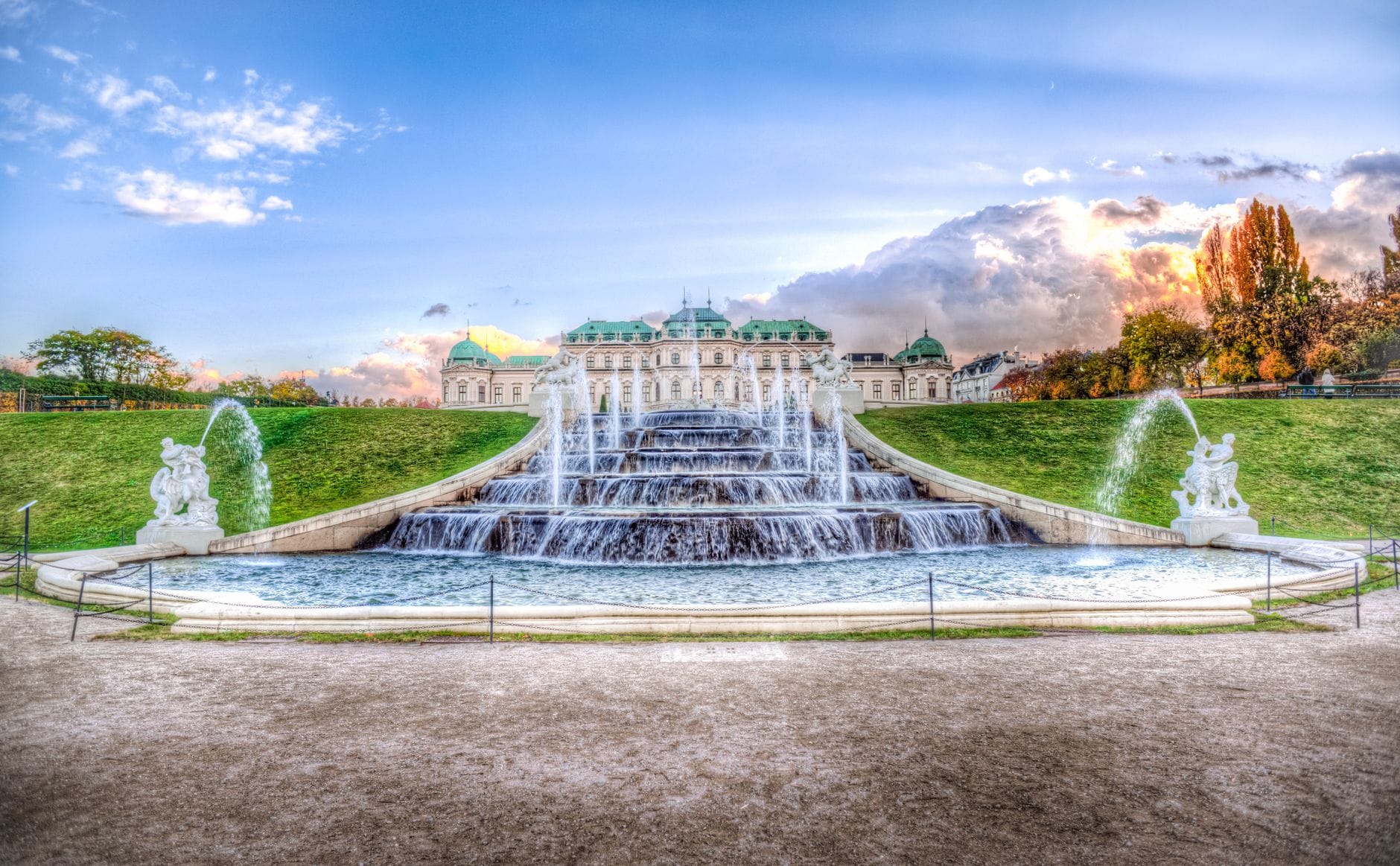
What the Belvedere Gardens Actually Are
The Belvedere Gardens are the formal Baroque landscape that runs between the Upper Belvedere and Lower Belvedere palaces in Vienna's 3rd district. Conceived as an integral part of the palace ensemble designed for Prince Eugene of Savoy in the early 18th century, the gardens are not a park in the loose, English-landscape sense. They are a composed, symmetrical outdoor room, with terraced levels, central water features, clipped hedgerow borders, and axial sightlines calculated to impress from both ends.
The Lower Belvedere palace was completed in 1716, the Upper in 1723. The garden between them was laid out as a single architectural statement, sloping gently downhill from the Upper palace toward the Lower. Standing at the Upper Belvedere's rear facade and looking north, you see the full geometry of the design: the main parterre, a central cascade and reflecting pool, and the Lower Belvedere framed at the far end. This is a view that has essentially not changed in 300 years.
ℹ️ Good to know
The entire Belvedere complex, including the gardens, is part of the Historic Centre of Vienna UNESCO World Heritage Site. This status restricts major changes to the landscape, which is part of why the garden's 18th-century character survives so completely.
The gardens sit within Vienna's broader imperial legacy. If you want context on how this fits into the city's palace culture, the Vienna palaces guide covers the full picture, including comparisons with Schönbrunn and the Hofburg.
The Garden Layout: What You're Walking Through
The main Baroque gardens are divided into three terraced sections descending from the Upper Belvedere downward. The uppermost section directly behind the palace is the most formal, with symmetrical parterres of low hedging and geometric beds. In spring and summer these beds are planted with seasonal flowers; in winter the bare geometry is visible as a kind of horticultural blueprint, and arguably more legible as a result.
The central section contains the cascade, a stepped water feature running along the central axis, and large reflecting pools that mirror the sky and the palace facade. On still mornings with no wind, the reflection of the Upper Belvedere in the lower pool is one of the most photographed views in Vienna. By midday in summer, tour groups are concentrated around this area and the reflection is harder to capture clean. The gravel paths that flank the cascade are the main pedestrian routes through the gardens.
The lower section connects to the area around the Lower Belvedere and the Orangery. This end of the garden is slightly less visited on a typical day, particularly by people who enter from the Upper Belvedere side and don't walk the full length. The Privy Garden, a separately enclosed section associated with the Lower Belvedere, requires a small admission fee (adults €4, under-19s €3 at time of writing; verify before visiting). It is a more intimate, enclosed space compared to the sweeping geometry of the main garden.
Tickets & tours
Hand-picked options from our booking partner. Prices are indicative; availability and final rates are confirmed when you complete your booking.
Belvedere Palace and Garden Skip-the-Line Ticket and Guided Tour
From 49 €Instant confirmationFree cancellationSkip-the-Line Entrance with Guide to Schonbrunn Palace and Gardens
From 45 €Instant confirmationFree cancellationSchonbrunn Palace and gardens guided tour
From 43 €Instant confirmationFree cancellationSkip-the-Line Sisi Museum, Hofburg and Gardens Tour Vienna in French
From 52 €Instant confirmationFree cancellation
How the Gardens Change Through the Day
Early morning is the most rewarding time to visit, and the gap between early and midday is substantial. The gardens open at 6:30 or 7:00 depending on the season, and in the first hour or two the only people present tend to be local joggers and dog walkers. The light is low and directional, ideal for photography. The fountain basins are still, the gravel paths are raked, and the hedgerows have a particular depth of shadow that disappears once the sun climbs higher.
Between roughly 10:00 and 16:00, especially in summer, the gardens absorb significant visitor numbers. Groups arriving for the Upper Belvedere museum pour through the rear gate and into the upper parterre before queuing to enter. This is when the gardens feel most like a transit corridor rather than a destination. If your primary interest is the garden itself rather than the palaces, avoid this window when possible.
Late afternoon shifts the quality of light back toward the interesting end of the spectrum. The low western sun catches the gilded accents on the Upper Belvedere's facade and the stone figures along the terraces take on sharp definition. By early evening the crowds thin considerably. In summer (May to July), the gardens stay open until 21:00, which gives a genuine two-hour window of evening calm that most visitors miss entirely.
💡 Local tip
For the best photographs of the Upper Belvedere reflected in the central pool, arrive before 8:30 on a weekday. Wind picks up as the day warms and the reflection breaks. Tour groups start arriving around 9:30–10:00.
Seasonal Character: What to Expect Across the Year
Spring, specifically April and May, is when the formal parterres come fully into bloom. The geometric beds are planted in patterns that make most sense viewed from the palace terraces above. The garden's Baroque design was always meant to be appreciated from an elevated vantage point, and standing on the steps of the Upper Belvedere looking down is the intended perspective. At ground level in the garden you're inside the composition; from the terrace above you can read it.
Summer means full foliage on the clipped hedges, which creates green corridors and semi-enclosed rooms within the formal layout. The fountains are typically operational. Heat accumulates in the central parterre by early afternoon, as there is limited shade in the main formal areas. Visitors who want shade should explore the wooded walks at the garden's edges.
Autumn is underrated here. The trees at the perimeter change color in October, providing contrast against the clipped green hedgerows of the parterre. Visitor numbers drop noticeably after the September school season resumes across Europe. The gardens remain open until 19:00 through October, giving adequate daylight for an unhurried visit.
Winter is the most honest test of the garden's architectural merit. Without flowers or foliage to soften it, the Baroque geometry is exposed in pure form: gravel, hedgerow skeletons, stone, and water. On days with snow, the garden has a stillness and formal severity that no amount of summer planting can replicate. The opening hours shorten to 7:00–17:30 from November through February, so plan accordingly.
⚠️ What to skip
Weather significantly affects the experience. The main parterre has very limited shade. On hot summer afternoons, temperatures in the open central sections can feel significantly hotter than in shaded side paths. Bring water in warm months.
Combining the Gardens with the Palaces
The gardens are effectively the connective tissue between two distinct museum experiences. The Upper Belvedere houses the permanent collection that includes Klimt's "The Kiss" and major works of Austrian Symbolism and Expressionism, making it one of the city's most visited museums. The Lower Belvedere focuses on Baroque and medieval art and tends to be quieter on most days.
If you're combining gardens and museum, the logical approach is to enter at the Upper Belvedere, visit the collection, then walk the full length of the garden down to the Lower Belvedere and Orangery. This takes you with the slope rather than against it. From the Lower Belvedere end you can exit toward the tram stop on Rennweg or continue into the surrounding neighborhood.
People with limited mobility should note that the gardens slope across their full north-south length. The gravel paths are manageable for most mobility aids but the slope is consistent and the surface is loose in places. There are also steps at several of the terrace transitions. The Belvedere complex has documented accessibility provisions for the palaces themselves; visitors with specific mobility needs should check the official site before visiting.
Getting There and Opening Hours
The Upper Belvedere entrance, at Prinz-Eugen-Straße 27 in Vienna's 3rd district, is the most common starting point. Tram D runs directly to the Schloss Belvedere stop. From the city center, tram 71 reaches the Unteres Belvedere stop near the Lower Belvedere and Orangery, which is the less-visited entry point. The U1 metro line at Südtiroler Platz-Hauptbahnhof connects to tram routes for both ends.
The 3rd district sits southeast of the historic center. If you're staying in the Innere Stadt and want context on navigating between these areas, the guide to getting around Vienna covers tram, U-Bahn, and walking connections across districts.
Opening hours for the main Baroque gardens vary by month: March 7:00–19:00; April 6:30–20:00; May through July 6:30–21:00; August and September 6:30–20:00; October 6:30–19:00; November through February 7:00–17:30. These hours are for the gardens only, not the palaces or museums. Admission to the main gardens is free. Verify current hours at the official Belvedere website before visiting, as seasonal schedules can shift.
Photography: The Practical Reality
The central pool reflection shot is the dominant image associated with these gardens, and it requires some patience and timing to execute without other visitors in frame. A wide-angle lens from the edge of the lower pool, oriented toward the Upper Belvedere, captures the full axis. Polarizing filters reduce glare on the water surface in bright conditions.
The stone sphinxes and mythological figures placed along the terraces reward closer attention. Many are original 18th-century sculptures and show significant weathering detail. In late afternoon light these figures cast long shadows across the gravel and create strong compositional anchors for detail shots.
The garden's Baroque architectural context also connects to broader discussions of the city's built heritage. Vienna's architecture guide explains how the Belvedere ensemble relates to the Habsburg building tradition and later civic projects along the Ringstrasse.
Insider Tips
- The view from inside the Upper Belvedere museum's rear windows, looking down the full garden axis, is worth taking a moment to absorb before you exit into the garden. It shows you exactly how the garden was meant to be read from above, and reorients your experience once you're at ground level.
- The garden's edges contain wooded walks that most visitors ignore entirely while concentrating on the central parterre. These peripheral paths are shaded, quieter, and give a sense of the garden's scale that you lose in the main geometric sections.
- If you enter from the Lower Belvedere end on Rennweg, you avoid the main queue of Upper Belvedere museum visitors and approach the garden from its quieter, less photographed side. Walking uphill toward the Upper Belvedere gives you a different experience of the cascade.
- The Orangery next to the Lower Belvedere hosts temporary exhibitions that are often less crowded than the Upper Belvedere's permanent collection. Check what's on; the building itself is a significant Baroque structure and worth a look even when the exhibition is not a priority.
- Winter mornings after a light snowfall transform the garden into something genuinely unusual for a major European capital. The combination of Baroque geometry, snow-covered hedgerows, and near-empty paths is worth braving the 17:30 closing time and shorter daylight hours.
Who Is Belvedere Gardens For?
- Baroque architecture and garden history enthusiasts who want to see a near-intact 18th-century design
- Photographers seeking the classic Upper Belvedere reflection shot or detail work on historic stone sculpture
- Travelers who want a substantial green space close to the city center without paying museum admission
- Couples looking for a formal but relaxed outdoor walk before or after visiting the Klimt collection
- Visitors combining a half-day of gallery time with outdoor time in the same complex
Nearby Attractions
Other things to see while in Belvedere & Landstraße (3rd District):
- Albertina Modern
Opened in 2020 inside the landmark Künstlerhaus building at Karlsplatz, Albertina Modern is Vienna's dedicated space for modern and contemporary art. Across 2,500 square metres, it offers a counterpoint to the Habsburgs-and-Old-Masters narrative that dominates so many of the city's museums.
- Heeresgeschichtliches Museum (Museum of Military History)
Housed in a striking Moorish-Byzantine arsenal building from the 1850s, the Heeresgeschichtliches Museum is one of the oldest purpose-built military history museums in the world. At just €3.50 admission, it offers an unexpectedly deep dive into Austria's military and political past, including the actual car in which Archduke Franz Ferdinand was assassinated in 1914.
- Hundertwasserhaus
Hundertwasserhaus is a municipal apartment block in Vienna's 3rd district that looks like it was painted by a child and designed by a forest. The exterior is free to view any time, and the adjacent Hundertwasser Village gives you a place to linger. Here is what a visit actually involves.
- Karlskirche (St. Charles's Church)
Karlskirche stands at the edge of Karlsplatz as one of the most architecturally ambitious churches in Central Europe. Built by imperial commission after a devastating plague, it rewards visitors with extraordinary ceiling frescoes, twin triumphal columns, and a panoramic lift ride to the base of its 70-metre dome. This guide covers what to expect, when to go, and how to make the most of your visit.