Hundertwasserhaus Vienna: The Building That Broke Every Rule
Hundertwasserhaus is a municipal apartment block in Vienna's 3rd district that looks like it was painted by a child and designed by a forest. The exterior is free to view any time, and the adjacent Hundertwasser Village gives you a place to linger. Here is what a visit actually involves.
Quick Facts
- Location
- Kegelgasse 34–38 / Löwengasse 41–43, 1030 Wien (3rd district, Landstraße)
- Getting There
- Tram 1 to Hetzgasse (steps away); U3 to Rochusgasse or Wien Mitte–Landstraße (short walk)
- Time Needed
- 20–40 minutes for the exterior; up to 1 hour if you visit Hundertwasser Village next door
- Cost
- Free — exterior viewing requires no ticket; Hundertwasser Village is also free to enter
- Best for
- Architecture lovers, photography, fans of 20th-century art, curious walkers
What Hundertwasserhaus Actually Is
Hundertwasserhaus is not a museum, gallery, or tourist attraction in the conventional sense. It is a working residential apartment building, completed between 1983 and 1985, commissioned by the City of Vienna as public housing. Real people live here. The postboxes are full, the curtains move, and someone is always arriving with groceries. That context matters, because it changes how you engage with the place.
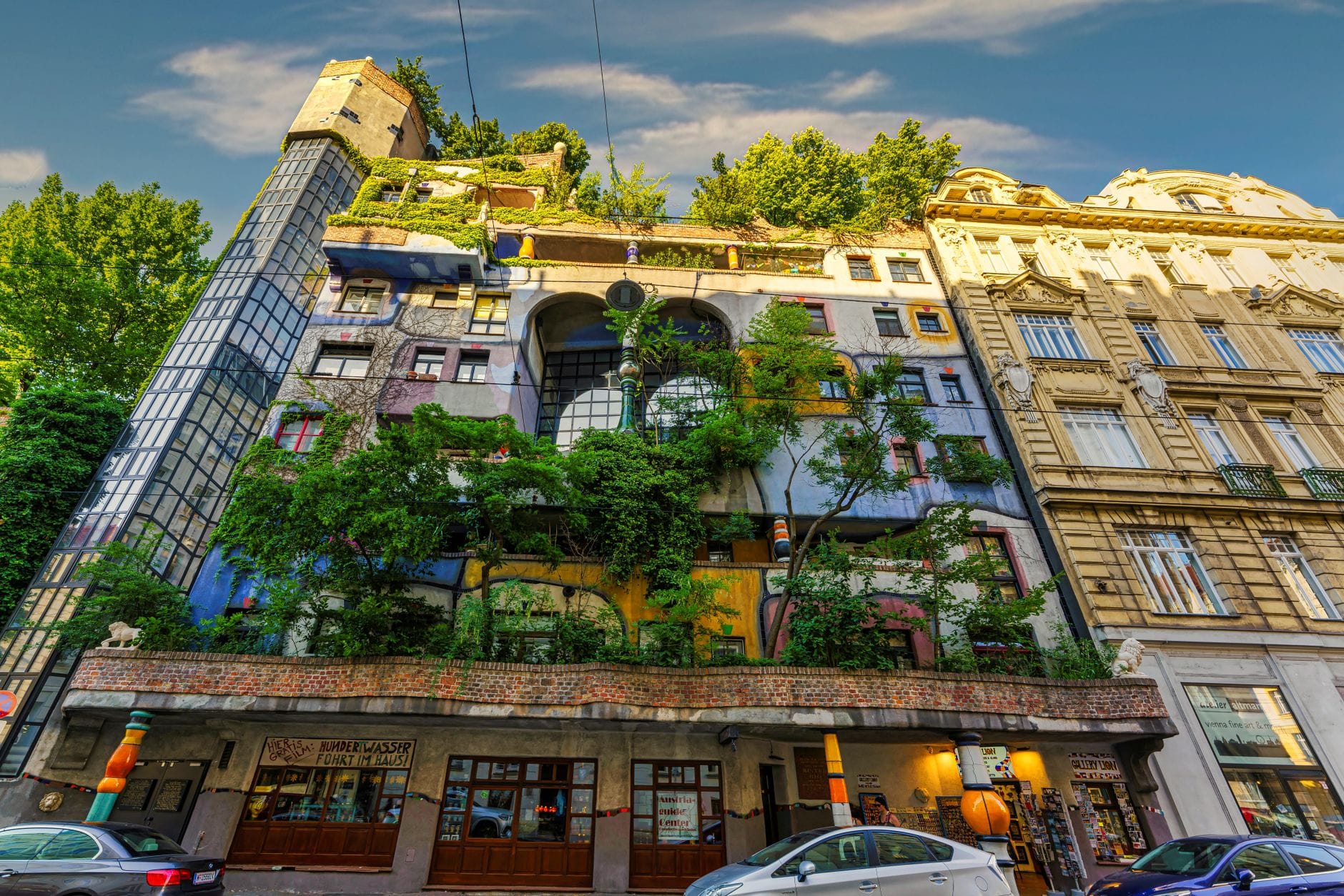
The concept and design came from Friedensreich Hundertwasser, the Austrian artist and architect best known for his rejection of straight lines and uniform surfaces, with architectural collaboration from Josef Krawina and Peter Pelikan. The result is one of the most photographed facades in central Europe: irregular windows of different sizes and colours, undulating floors, onion-topped towers, trees growing from the roof and out of window ledges, and a checkerboard of ceramic tiles in gold, white, red, and blue. No two sections of the wall are the same colour. No floor is level. The whole structure reads like a building that grew rather than was built.
ℹ️ Good to know
The interior is not open to visitors. This is a private residence, and access is limited to the public pavement along Kegelgasse and Löwengasse. Do not attempt to enter the building or its courtyards.
The Experience at Street Level
Standing on Löwengasse, the building fills your field of vision in a way that photographs do not prepare you for. The facade is three-dimensional in its layering: protruding balconies draped in plants, recessed arched windows, sections of rough render next to smooth glazed tiles. In sunlight, the colours are sharp and almost jarring against Vienna's predominantly beige and grey streetscape. On overcast days, the tones soften into something closer to folk art.
Walk slowly along both street faces. The Kegelgasse side tends to get less foot traffic and reveals different details: the integration of mature trees into the structure, small ceramic features near ground level, and the way the roofline shifts unpredictably. Children often stop cold in front of it. Adults tend to photograph first and look second. Try reversing that order.
The sound environment is ordinary residential Vienna: trams passing nearby, pigeons, occasional voices from windows above. There is no audio guide, no interpretive signage at the building itself, and no gift shop attached to the facade. The experience is purely visual and entirely unmediated, which is either its strength or its limitation depending on what you are looking for.
Tickets & tours
Hand-picked options from our booking partner. Prices are indicative; availability and final rates are confirmed when you complete your booking.
Imperial Vienna 72-hour hop-on hop-off bus
From 55 €Instant confirmationFree cancellationSkip-the-Line Entrance with Guide to Schonbrunn Palace and Gardens
From 45 €Instant confirmationFree cancellationLuggage Storage in Vienna
From 6 €Instant confirmationFree cancellationStrauss Dinner Show
From 99 €Instant confirmationFree cancellation
Timing Your Visit: Crowds and Light
Hundertwasserhaus draws a steady flow of visitors throughout the day, peaking roughly between 10:00 and 14:00 when tour groups arrive and the narrow pavements become crowded. Groups move quickly, which means the congestion clears in cycles rather than building steadily. If you want the facade to yourself for photographs, arriving before 09:00 or after 17:00 is the most reliable strategy.
For photography, morning light hits the Löwengasse facade at a low angle that picks out the texture of the tiles and renders the colours with more depth. Afternoon light works better on the Kegelgasse side. Overcast conditions actually suit this building well because they eliminate the harsh shadows that can flatten the facade details at midday.
💡 Local tip
The building can be viewed any time of day or night, but evening visits after dark offer a very different experience: the facade is not dramatically lit, so nighttime visits add little unless you are specifically interested in the quieter atmosphere.
Hundertwasser Village: The Useful Annex
Directly opposite the house is the Hundertwasser Village, a small commercial arcade designed in the same visual language as the apartment building. It houses souvenir shops, a cafe, and a few specialist retailers. Entry is free and the space is open daily from 09:00 to 19:00. It is worth a brief visit, partly to see the interior courtyard and partly because it gives you a reason to linger in the area after you have finished photographing the main building.
Be clear-eyed about what the Village is: it is a commercial space trading on Hundertwasser's aesthetic, not a cultural institution. The souvenirs are what you would expect. The cafe is convenient but not exceptional. The value is in the architecture of the space itself, specifically the tiled floors, the irregular ceiling surfaces, and the way natural light enters the central courtyard.
Historical and Artistic Context
Hundertwasser spent decades writing manifestos against what he called 'the tyranny of the straight line.' He argued that the smooth, repetitive surfaces of modernist architecture were psychologically damaging, that humans needed irregular, organic environments. His 1958 Mould Manifesto Against Rationalism in Architecture laid out these ideas formally, and Hundertwasserhaus represents their most visible urban application.
The commission was unusual: the City of Vienna, which runs one of Europe's largest social housing programs, approved a building that directly contradicted the functional aesthetic of most municipal housing. The project was controversial at the time and remains divisive among architects. For visitors interested in the broader story of Viennese architecture across the centuries, the Vienna architecture guide provides useful context on how Hundertwasserhaus fits into a city shaped by Habsburg baroque, Ringstrasse historicism, Jugendstil, Red Vienna social housing, and postwar modernism.
Hundertwasser's other work in Vienna, including the KunstHausWien museum dedicated to his paintings, gives a fuller picture of his practice. The KunstHausWien is a short walk away and is the logical next stop for anyone who wants to move beyond the facade and understand the artist behind it. The museum houses a permanent Hundertwasser collection and temporary exhibitions, with paid admission.
Getting There and Practical Details
The most direct approach by public transport is Tram 1 to the Hetzgasse stop, which leaves you within a short walk of the main facade. From the U3 line, alight at Rochusgasse and walk roughly ten minutes east, or use Wien Mitte–Landstraße for a slightly longer but straightforward route. The area is well served by Vienna's tram network, which runs frequently throughout the day.
The building sits in the 3rd district (Landstraße), grouped here under the broader Belvedere area for editorial purposes. The surrounding streets are quiet and residential, with a handful of cafes and small restaurants within a few minutes' walk. It is not a heavily touristed neighbourhood beyond the Hundertwasserhaus itself, which is part of what makes the visit feel less processed than attractions in the 1st district.
The building is viewable from level pavements along both street faces, making the exterior accessible for wheelchair users and visitors with limited mobility. No steps are required to view the facade from the street. For visitors seeking a fully accessible exhibition experience covering Hundertwasser's work, the KunstHausWien museum should be contacted directly for current accessibility information.
Is It Worth Your Time?
If you are already in the Belvedere area or the 3rd district, Hundertwasserhaus is absolutely worth a detour of 20 to 30 minutes. It costs nothing, requires no planning, and delivers a genuinely singular visual experience that is unlike anything else in the city. The building is not overhyped in the sense that it really does look extraordinary in person, more textured and alive than any photograph suggests.
However, if you are building an itinerary from scratch and weighing it against, say, the Upper Belvedere or the Wiener Secession, be realistic: the Hundertwasserhaus visit is short by design. You look at a facade, walk around it, and leave. There is no interior experience, no exhibition, and no deeper layer unless you combine it with KunstHausWien. Plan accordingly.
Visitors who travel specifically to photograph unusual architecture will find it highly rewarding. Those who expect an interactive or immersive experience will be underwhelmed. Anyone bothered by crowds at close quarters should go early in the morning, when the narrow pavement outside the building is manageable and the light is best.
Insider Tips
- Walk the full perimeter of the building before you photograph anything. The Kegelgasse side is less photographed and shows details, including roof trees and ceramic ground-level features, that most visitors miss entirely because they stop at the main Löwengasse facade.
- The cafe in Hundertwasser Village opens at 09:00 and is rarely full before 10:00. If you visit early for the light and the empty pavement, the Village cafe is a practical place to have coffee before the area fills up.
- Tram 1 connects Hundertwasserhaus with Schwedenplatz in one direction and the Ringstrasse area in the other, making it easy to combine with a visit to the 1st district without backtracking by metro.
- KunstHausWien, which houses Hundertwasser's paintings and prints in a museum he also designed, is roughly a five-minute walk from the apartment building. Combining both into a single half-day visit makes the trip significantly more worthwhile than the facade alone.
- Residential privacy matters here. Residents occasionally use the ground-floor entrance areas, and photographers sometimes crowd doorways or peer into windows. Stay on the public pavement and be aware that people live in this building.
Who Is Hundertwasserhaus For?
- Architecture and design enthusiasts who want to see Hundertwasser's philosophy applied at urban scale
- Photographers looking for a free, visually distinctive subject with strong colour and texture
- Visitors combining a walk through the 3rd district with the Belvedere gardens or KunstHausWien
- Families with children, who tend to respond immediately and enthusiastically to the building's visual language
- Travellers on a tight budget who want a high-impact experience without admission costs
Nearby Attractions
Other things to see while in Belvedere & Landstraße (3rd District):
- Albertina Modern
Opened in 2020 inside the landmark Künstlerhaus building at Karlsplatz, Albertina Modern is Vienna's dedicated space for modern and contemporary art. Across 2,500 square metres, it offers a counterpoint to the Habsburgs-and-Old-Masters narrative that dominates so many of the city's museums.
- Belvedere Gardens
Stretching between two palaces built for Prince Eugene of Savoy, the Belvedere Gardens form one of Central Europe's finest Baroque garden compositions. Entry to the main gardens is free, and the grounds shift dramatically in character from early morning calm to afternoon crowds and golden evening light.
- Heeresgeschichtliches Museum (Museum of Military History)
Housed in a striking Moorish-Byzantine arsenal building from the 1850s, the Heeresgeschichtliches Museum is one of the oldest purpose-built military history museums in the world. At just €3.50 admission, it offers an unexpectedly deep dive into Austria's military and political past, including the actual car in which Archduke Franz Ferdinand was assassinated in 1914.
- Karlskirche (St. Charles's Church)
Karlskirche stands at the edge of Karlsplatz as one of the most architecturally ambitious churches in Central Europe. Built by imperial commission after a devastating plague, it rewards visitors with extraordinary ceiling frescoes, twin triumphal columns, and a panoramic lift ride to the base of its 70-metre dome. This guide covers what to expect, when to go, and how to make the most of your visit.