Kunst Haus Wien (Hundertwasser Museum): What to Expect Before You Go
Kunst Haus Wien is Vienna's dedicated Hundertwasser museum, housed in a former furniture factory that the artist transformed into a living artwork. Across 1,600 square metres of wavy floors and mosaic-tiled columns, the museum holds the world's largest permanent collection of Hundertwasser's paintings, graphics, and architectural projects. It is an experience unlike any other museum in the city.
Quick Facts
- Location
- Untere Weißgerberstraße 13, 1030 Vienna (3rd District, Landstraße)
- Getting There
- Tram 1 or O to Radetzkyplatz, then a short walk
- Time Needed
- 1.5 to 2.5 hours
- Cost
- Standard ticket €16; verify current pricing before visiting
- Best for
- Art lovers, architecture enthusiasts, families with older children
- Official website
- www.kunsthauswien.com/en/about-the-kunsthauswien
What Kunst Haus Wien Actually Is
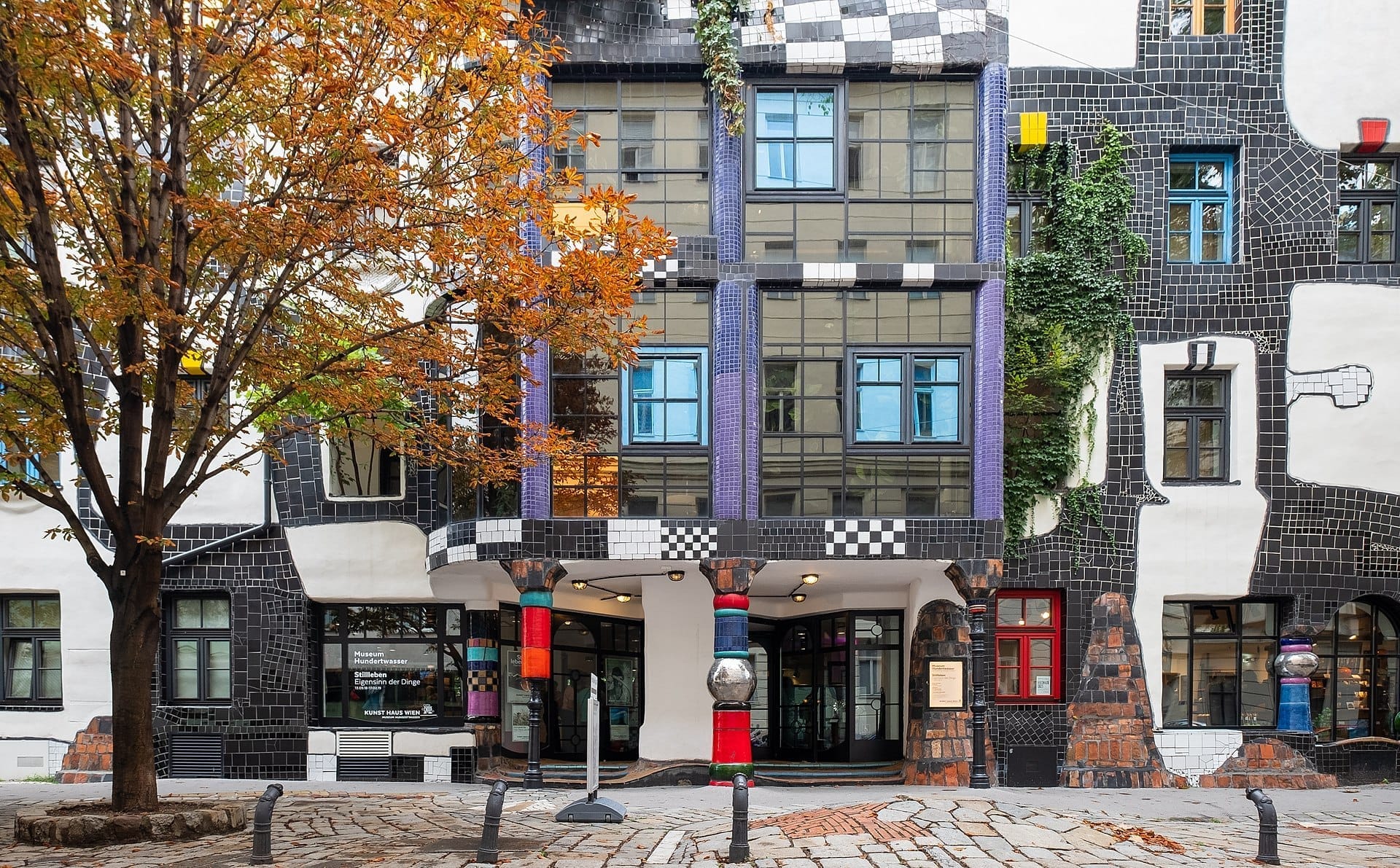
Kunst Haus Wien, officially known as KunstHausWien, is a purpose-built art museum dedicated to the Austrian artist Friedensreich Hundertwasser (1928–2000). It opened in 1991 inside a converted furniture factory in Vienna's 3rd district, and the building itself is as much an exhibit as anything hanging on its walls. Hundertwasser oversaw the entire transformation, turning a flat-floored industrial space into an environment of undulating ceramic floors, mismatched windows, roof gardens, and column work encrusted with glass tiles and mosaics.
This is not a typical white-cube gallery. The architecture pushes back at you constantly. The floors slope and dip underfoot. Columns interrupt corridors unexpectedly. Natural light enters from angles that shift as you move through the rooms. It takes a few minutes to adjust before you start looking at the art rather than the building that holds it.
The museum sits in a quiet residential stretch of Untere Weißgerberstraße, a street that most visitors arrive at specifically to see this building rather than stumbling across it. It is close to the more famous Hundertwasserhaus residential building on Kegelgasse, which is roughly a ten-minute walk away and worth combining into the same visit.
💡 Local tip
The Hundertwasserhaus residential building is free to view from the outside and is a natural pairing with Kunst Haus Wien. Walk there first before the museum opens, photograph the facade, then double back for your timed visit.
The Permanent Collection: Paintings, Graphics, and Architecture Models
The permanent collection occupies roughly half of the museum's 1,600 square metres and represents the broadest holding of Hundertwasser's work anywhere in the world. The paintings are dense with colour: spiraling forms, organic outlines, and recurring motifs of the onion dome, the spiral, and the tree. Hundertwasser spent decades refining a visual language that rejected straight lines as a form of godlessness, which sounds like a philosophical flourish until you stand in front of a large-format painting and realize there genuinely is not a single hard geometric edge anywhere.
Beyond the paintings, the collection includes an extensive archive of prints, tapestries, and architectural models. The architectural work is often overlooked by casual visitors, but it rewards attention. Hundertwasser designed real buildings across Austria, Germany, Japan, New Zealand, and elsewhere, and the models and drawings displayed here make clear that his philosophy was consistent across scales: the same horror of the straight line that appears in a postcard-sized gouache also appears in the design of a wastewater treatment plant in Osaka.
The changing exhibition programme occupies the other half of the museum space, with rotating shows that bring in international artists who connect thematically to Hundertwasser's concerns, particularly ecology, ornament, and the relationship between nature and the built environment. The quality and relevance of these shows varies, so check the museum's website before your visit to see what is currently running.
Tickets & tours
Live prices and dates from our booking partner. If you book, we may earn a commission at no extra cost to you.
What the Visit Feels Like, Hour by Hour
The museum opens at 10:00 daily, and the first hour is genuinely the calmest period. Natural light enters the building more directly in the morning, which makes the ceramic surfaces catch and scatter differently than they do in the afternoon. The entry-level rooms, which handle the architectural context and Hundertwasser's biography, are straightforward and easy to move through quickly. The paintings begin on the upper floors and that is where most visitors slow down.
By midday, particularly on weekends and during summer months, the building fills with tour groups. The narrow corridors and uneven floors create natural bottlenecks, and the experience becomes less contemplative. If you arrive between 13:00 and 15:00 on a weekend in July or August, expect to share the painting rooms with significant numbers of people. The museum's size means there is no easy overflow solution.
Late afternoons from around 15:30 onward tend to thin out again as tour groups move on. The last entry is at 17:00 and the museum closes at 18:00, which gives enough time for a focused second look at any work you want to revisit. The building's courtyard, open to visitors, is a reasonable place to pause in fine weather.
⚠️ What to skip
The floors throughout the museum are intentionally uneven. This is part of Hundertwasser's design philosophy. Visitors with mobility limitations or balance difficulties should be aware of this before purchasing a ticket. Check the museum's accessibility information directly at kunsthauswien.com before visiting.
Getting There and the Surrounding Area
The most practical approach is Tram 1 or Tram O to Radetzkyplatz, a stop that serves both lines and puts you about five minutes on foot from the museum entrance. The walk takes you through a calm residential neighbourhood that shows little of the tourist density found closer to the Ringstrasse or the 1st district. The building announces itself before you arrive: the facade of Kunst Haus Wien shares the same mosaic tile and irregular window language as Hundertwasser's other projects, and it is easy to spot from the street.
The 3rd district location places Kunst Haus Wien within reasonable distance of the Belvedere area, making it possible to combine both in a single day if you pace yourself. The Upper and Lower Belvedere palaces are about 20 minutes on foot, or a short tram connection away. A day that begins at Kunst Haus Wien in the morning and moves to the Upper Belvedere in the afternoon is a natural pairing, though it is a full day of museum-going and requires genuine stamina.
There is a small museum café on the ground floor. It is functional rather than remarkable, and better options exist in the surrounding streets if you want to eat properly before or after your visit.
How This Museum Compares to the Hundertwasserhaus
First-time visitors sometimes confuse Kunst Haus Wien with the Hundertwasserhaus, a social housing block a short walk away. The residential building is freely viewable from the outside and draws large numbers of people to photograph its facade, but it has no interior access for the public. Kunst Haus Wien is the place where you actually learn about Hundertwasser's ideas, see his paintings in depth, and understand the ecological and philosophical position behind the architectural projects.
If your interest is specifically in Hundertwasser's Vienna and the broader tradition of unconventional architecture in the city, the Vienna architecture guide covers both buildings alongside Otto Wagner's Secession-era work and other major architectural landmarks across the city.
ℹ️ Good to know
Kunst Haus Wien is open daily 10:00–18:00, including public holidays. Standard admission is €16. These details are accurate at time of writing but should be verified at kunsthauswien.com before your visit.
Who Should Think Twice
Visitors who prefer the classical Viennese art experience, old masters, Habsburg portraiture, Art Nouveau in the Klimt tradition, may find Kunst Haus Wien a frustrating detour. Hundertwasser's visual world is dense, repetitive in its motifs, and deliberately anti-classical. It is either compelling or alienating depending on your tolerance for that kind of sustained decorative intensity.
If your time in Vienna is short and you are trying to prioritize, the Kunsthistorisches Museum or the Upper Belvedere with its Klimt collection will feel more representative of mainstream Viennese art history. Kunst Haus Wien is specifically for visitors who already know they respond to Hundertwasser's work, or who are genuinely curious about the architecture regardless of the paintings. It is also not ideal for very young children, who tend to find the uneven floors confusing rather than charming and who cannot engage with the painting collection at any meaningful level.
Photography and Practical Notes
Photography for personal use is generally permitted throughout the museum, though policies can change with temporary exhibitions and flash is not appropriate near the works on paper and prints. The building itself makes for interesting compositional material: the mosaic columns, the irregular window frames, and the floor undulations create geometry that is unlike anything else in a Viennese context. Wide-angle shots in the cramped corridors require patience when other visitors are present.
Wear comfortable shoes with grip. The wavy floors are a real consideration, not a metaphor. Bags are checked at the entrance and a cloakroom is available. The museum shop near the exit stocks a wide range of Hundertwasser prints, posters, and books at prices that are reasonable by museum-shop standards.
If you are visiting Vienna on a structured itinerary, the Kunst Haus Wien pairs naturally with the broader museum landscape covered in the best museums in Vienna guide, which helps prioritize according to your available time and interests.
Insider Tips
- The museum café sells reasonable coffee at ground-floor prices. Drink it in the courtyard rather than inside when the weather allows: the building's exterior details are easier to take in from outside than from the entry lobby.
- If you want the uneven floors to yourself, arrive as close to 10:00 as possible on a weekday. The corridor spaces between the painting rooms feel entirely different when they are empty.
- The gift shop at the exit stocks oversized Hundertwasser print catalogues that are significantly cheaper than equivalent volumes in the Innere Stadt bookshops. If you plan to buy one, do it here.
- Combine your visit with the Hundertwasserhaus exterior (free, ten minutes on foot) and photograph it early before the souvenir stalls set up. The building faces east and the light on the facade is at its best before 10:00.
- The museum's online ticket system is worth using if you are visiting in peak summer months. There is no timed-entry slot system, but avoiding the cash queue at the door saves meaningful time.
Who Is Kunst Haus Wien (Hundertwasser Museum) For?
- Visitors with a specific interest in Hundertwasser's paintings, prints, or architectural philosophy
- Architecture and design enthusiasts curious about anti-rational approaches to building
- Travellers who have already covered Vienna's classical art institutions and want something genuinely different
- Photographers looking for interior geometry unlike any other museum in the city
- Adults and older teenagers who can engage with a sustained decorative and philosophical visual argument
Nearby Attractions
Other things to see while in Belvedere & Landstraße (3rd District):
- Albertina Modern
Opened in 2020 inside the landmark Künstlerhaus building at Karlsplatz, Albertina Modern is Vienna's dedicated space for modern and contemporary art. Across 2,500 square metres, it offers a counterpoint to the Habsburgs-and-Old-Masters narrative that dominates so many of the city's museums.
- Belvedere Gardens
Stretching between two palaces built for Prince Eugene of Savoy, the Belvedere Gardens form one of Central Europe's finest Baroque garden compositions. Entry to the main gardens is free, and the grounds shift dramatically in character from early morning calm to afternoon crowds and golden evening light.
- Heeresgeschichtliches Museum (Museum of Military History)
Housed in a striking Moorish-Byzantine arsenal building from the 1850s, the Heeresgeschichtliches Museum is one of the oldest purpose-built military history museums in the world. At just €3.50 admission, it offers an unexpectedly deep dive into Austria's military and political past, including the actual car in which Archduke Franz Ferdinand was assassinated in 1914.
- Hundertwasserhaus
Hundertwasserhaus is a municipal apartment block in Vienna's 3rd district that looks like it was painted by a child and designed by a forest. The exterior is free to view any time, and the adjacent Hundertwasser Village gives you a place to linger. Here is what a visit actually involves.
Planning a trip? Discover personalized activities with the Nomado app.