Albertina Modern: Vienna's Contemporary Art Showcase at Karlsplatz
Opened in 2020 inside the landmark Künstlerhaus building at Karlsplatz, Albertina Modern is Vienna's dedicated space for modern and contemporary art. Across 2,500 square metres, it offers a counterpoint to the Habsburgs-and-Old-Masters narrative that dominates so many of the city's museums.
Quick Facts
- Location
- Karlsplatz 5, 1010 Vienna (Künstlerhaus building, Belvedere area)
- Getting There
- U1, U2, U4 to Karlsplatz; trams 1, 2, D, 62, 71 to Oper/Karlsplatz
- Time Needed
- 1.5 to 2.5 hours depending on current exhibitions
- Cost
- Adults €17.90; ages 19–25 and 65+ €15.90; under 18 free. Verify current rates before visiting.
- Best for
- Contemporary art lovers, architecture enthusiasts, repeat Vienna visitors seeking something beyond the imperial circuit
- Official website
- www.albertina.at/en
What Is Albertina Modern?
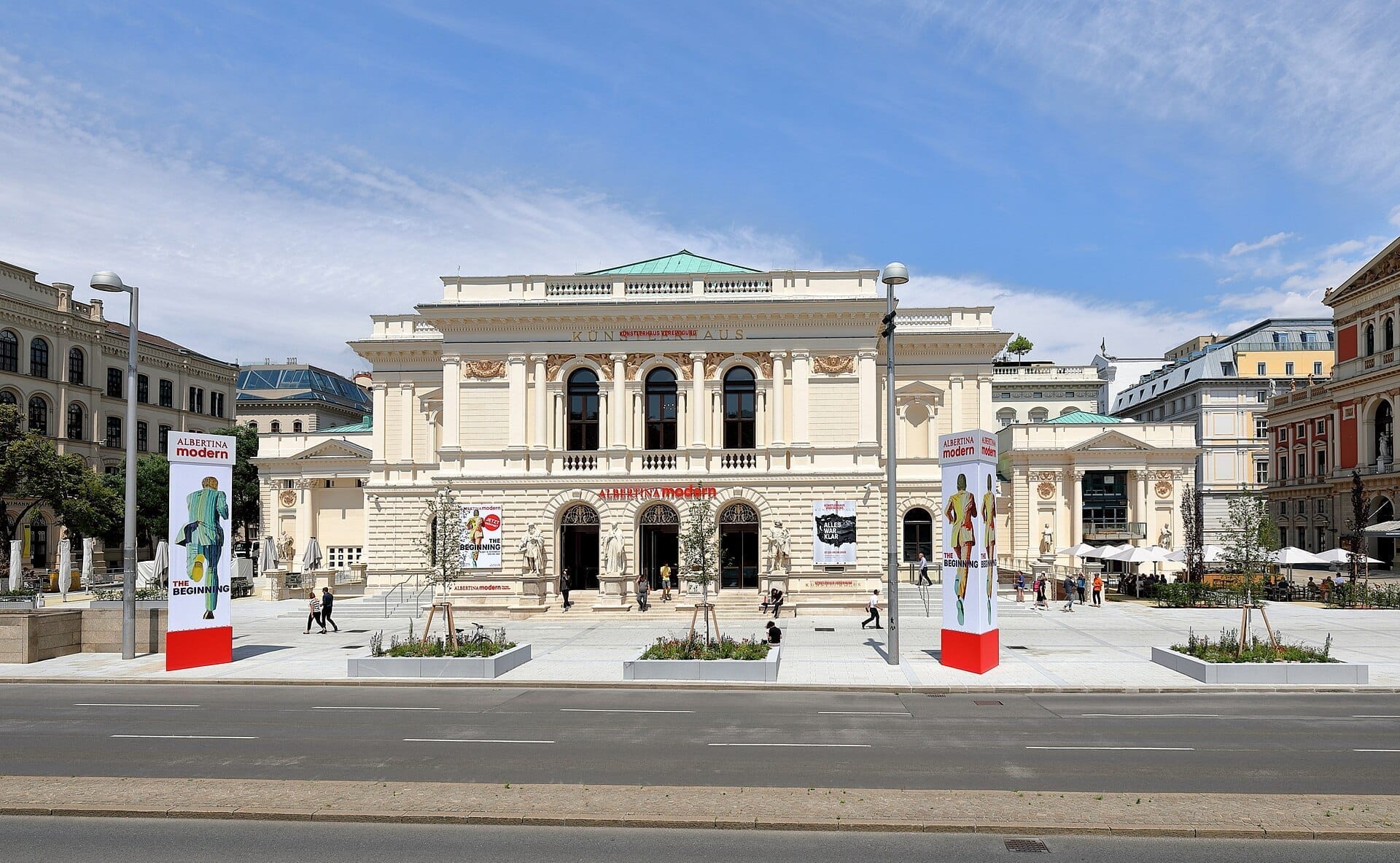
Albertina Modern is the second location of the Albertina Museum, opened on 27 May 2020 inside the Künstlerhaus, a 19th-century exhibition hall on Karlsplatz that had long been a fixture of Vienna's artistic life. Where the original Albertina on the Ringstrasse holds one of the world's great collections of graphic art and Old Masters, this satellite venue focuses entirely on modern, postmodern, and contemporary work. The shift in tone is immediate and deliberate.
The gallery occupies roughly 2,500 square metres of exhibition space across multiple floors, dedicated to art from the post-World War II period through to the present day. Exhibitions rotate regularly, so the experience on any given visit differs from the last. That rotation is part of the point: Albertina Modern positions itself as a living, changing space rather than a repository of permanent fixtures.
💡 Local tip
Check the official Albertina website before you go. Because exhibitions change frequently, what you find inside can differ significantly from one season to the next. The permanent collection provides a backbone, but visiting blockbuster shows book up fast.
The Building: Künstlerhaus at Karlsplatz
The Künstlerhaus was completed in 1868 and designed in the Italian Renaissance Revival style by August Weber. For over a century it served as the home of the Gesellschaft bildender Künstler Österreichs, the association of Austrian fine artists. The building itself is significant: it was here that a generation of young Austrian artists, frustrated with the conservative exhibiting politics of the association, broke away in 1897 to form the Vienna Secession. That founding act of rebellion shaped the course of Austrian modernism.
Arriving at the Künstlerhaus, you step into a space that carries that historical weight without announcing it loudly. The facade is stately but not overwhelming, and the transition from the traffic noise of Karlsplatz into the museum's interior feels like a deliberate compression. The building sits a short walk from the Karlskirche and within easy reach of the broader cultural cluster around the Musikverein. Few visitors fully clock the architectural heritage they are standing inside before heading upstairs.
Tickets & tours
Hand-picked options from our booking partner. Prices are indicative; availability and final rates are confirmed when you complete your booking.
ALBERTINA and ALBERTINA modern combo ticket
From 25 €Instant confirmationFree cancellationAlbertina Modern ticket and Vienna self-guided audio tour
From 32 €Instant confirmationALBERTINA modern Vienna entrance ticket
From 16 €Instant confirmationFree cancellationImperial Vienna 72-hour hop-on hop-off bus
From 55 €Instant confirmationFree cancellation
What You Will Actually See Inside
The collection at Albertina Modern draws heavily on Austrian and international art of the 20th and 21st centuries. Works by artists associated with the Vienna School of Fantastic Realism, the Viennese Actionism movement, and major postwar European and American movements are all represented. Visitors who have done homework on Austrian modernism will find touchpoints throughout; those who have not will still encounter work that is visually striking and frequently confrontational.
The museum's focus on modern and contemporary work makes it a useful counterpart to the Albertina Museum on the Ringstrasse. If you have time for both, they complement each other well: the original Albertina for depth and historical range, Albertina Modern for the 20th century forward. But if you are short on time, the choice depends on what you came to Vienna for. The Albertina Modern is the better fit for anyone who finds pre-20th-century European painting less engaging.
Gallery rooms are well-lit and generally uncrowded compared to the major imperial museums elsewhere in the city. Labels are in German and English throughout, which is practical for international visitors without requiring an audio guide.
Time of Day and Crowd Patterns
Albertina Modern opens at 10:00 and closes at 18:00, seven days a week, with no variation for public holidays listed in standard sources. The morning slot, particularly on weekdays before noon, tends to be the quietest. Karlsplatz itself is one of Vienna's main transit interchanges, which means foot traffic around the building is constant throughout the day, but that does not translate into the same visitor density you find at, say, the Kunsthistorisches Museum.
Midday on weekends can be noticeably busier, especially when a major temporary exhibition is running. If you are visiting Vienna with limited time and the museum is on your list, arriving at opening on a weekday morning gives you the galleries essentially to yourself for the first hour. Late afternoon, around 16:00 to 17:00, is another quieter window as day-trippers and tour groups begin to leave the area.
ℹ️ Good to know
Karlsplatz station is one of Vienna's busiest underground interchanges. During peak hours the area outside the museum can feel chaotic, with commuters, tourists, and street activity all converging. Budget a few extra minutes to navigate from the station exit to the museum entrance.
Practical Walkthrough: Getting There, Tickets, and Accessibility
The most direct public transport connection is via U-Bahn lines U1, U2, or U4 to Karlsplatz station. The museum entrance on Karlsplatz 5 is a short walk from any of the station's exits. If you are coming from the Innere Stadt, trams running along the Ring also stop at Oper/Karlsplatz. By foot from St. Stephen's Cathedral, the walk takes around 12 to 15 minutes along Kärntner Strasse and past the Opera House.
Tickets can be purchased at the door or through the official Albertina website in advance. The standard adult ticket is €17.90 as of the most recent publicly available pricing. Visitors under 18 enter free. Discounts apply for ages 19 to 25 and 65 and over (€15.90), and various card holders including ICOM members and Kulturpass holders may be eligible for reduced or free entry. Visitors with disabilities and appropriate documentation may also qualify for free admission. Prices are subject to change, so verify the current rate on the official website before your visit.
The building has barrier-free access throughout. Lifts connect the floors and the entrance is step-free from street level. For visitors using wheelchairs or those with limited mobility, the layout of the Künstlerhaus works reasonably well, though the 19th-century building means some areas are narrower than in purpose-built contemporary venues.
Photography, What to Bring, and Honest Caveats
Photography policies in contemporary art museums vary by exhibition and by specific works, depending on artist licensing agreements. As a general rule, temporary exhibitions at Albertina Modern may restrict photography more heavily than the permanent collection areas. Look for posted notices in each room rather than assuming a blanket rule applies throughout. Bringing your own audio or a downloaded guide app is worth considering if you want deeper context on specific works.
One honest caveat: if your primary interest in Vienna is the imperial grandeur of the Habsburgs, the Ringstrasse, and the city's 18th- and 19th-century heritage, Albertina Modern may not reward the visit as strongly as alternatives nearby. The Upper Belvedere or the original Albertina would both be more fitting in that case. Albertina Modern is at its most compelling for visitors who actively want to engage with the modernist and postmodernist tradition, particularly as it developed in Austria after 1945.
For visitors interested in how Vienna's contemporary art scene fits into a broader cultural picture, a visit pairs well with a stop at the Wiener Secession, which is walkable from Karlsplatz in under ten minutes. Together they give a coherent arc from the 1897 rebellion against academic art through to where Austrian and international contemporary practice stands today.
Insider Tips
- The Künstlerhaus building also contains a separate cultural venue and cafe space run independently of the museum. If you want coffee before or after your visit without the museum ticket, you can access parts of the ground floor without paying admission.
- Combination tickets covering both the Albertina on the Ringstrasse and Albertina Modern are sometimes available and can represent better value than buying separately, especially if you plan to visit both in the same trip. Check the official Albertina site for current bundle options.
- The area around Karlsplatz is architecturally rich beyond the museum itself. The Otto Wagner-designed Stadtbahn pavilions at the station are worth a close look before or after your visit. They are a short walk and admission is separate but minimal.
- If you are visiting in winter, the interior of the Künstlerhaus is well-heated and the galleries offer a comfortable break from the cold. The museum is a sensible addition to a winter itinerary precisely because the experience is entirely indoors and unhurried.
- Audiovisual works and installations in temporary exhibitions can require sitting or standing for extended periods. Wearing comfortable shoes matters more here than at static-painting museums, particularly if a major immersive show is running during your visit.
Who Is Albertina Modern For?
- Visitors who have already covered Vienna's imperial circuit and want engagement with 20th- and 21st-century art
- Architecture enthusiasts interested in the Künstlerhaus building and its role in the Secession story
- Repeat visitors to Vienna looking for something that changes between trips
- Travelers on a focused arts itinerary who want to move between Albertina Modern, the Secession, and the MuseumsQuartier in a single day
- Younger travelers and students who find the contemporary program more accessible than traditional museum collections
Nearby Attractions
Other things to see while in Belvedere & Landstraße (3rd District):
- Belvedere Gardens
Stretching between two palaces built for Prince Eugene of Savoy, the Belvedere Gardens form one of Central Europe's finest Baroque garden compositions. Entry to the main gardens is free, and the grounds shift dramatically in character from early morning calm to afternoon crowds and golden evening light.
- Heeresgeschichtliches Museum (Museum of Military History)
Housed in a striking Moorish-Byzantine arsenal building from the 1850s, the Heeresgeschichtliches Museum is one of the oldest purpose-built military history museums in the world. At just €3.50 admission, it offers an unexpectedly deep dive into Austria's military and political past, including the actual car in which Archduke Franz Ferdinand was assassinated in 1914.
- Hundertwasserhaus
Hundertwasserhaus is a municipal apartment block in Vienna's 3rd district that looks like it was painted by a child and designed by a forest. The exterior is free to view any time, and the adjacent Hundertwasser Village gives you a place to linger. Here is what a visit actually involves.
- Karlskirche (St. Charles's Church)
Karlskirche stands at the edge of Karlsplatz as one of the most architecturally ambitious churches in Central Europe. Built by imperial commission after a devastating plague, it rewards visitors with extraordinary ceiling frescoes, twin triumphal columns, and a panoramic lift ride to the base of its 70-metre dome. This guide covers what to expect, when to go, and how to make the most of your visit.