Kirche am Steinhof: Otto Wagner's Jugendstil Church Above Vienna
Completed in 1907 atop a forested hill in Vienna's 14th district, the Kirche am Steinhof is one of the most important works of Viennese Secession architecture. Designed by Otto Wagner as a functional chapel for a psychiatric hospital, it is now a Wien Museum site open seasonally to the public. The gilded copper dome alone is worth the journey out.
Quick Facts
- Location
- Baumgartner Höhe 1, 1140 Vienna, Austria
- Getting There
- U3 to Ottakring, then bus 48A to Otto-Wagner-Areal; or U4 to Unter St. Veit, then bus 47A
- Time Needed
- 1–1.5 hours
- Cost
- Approx. €5 adult (verify current price with Wien Museum)
- Best for
- Architecture lovers, Secession art enthusiasts, photography
- Official website
- www.wienmuseum.at/otto_wagner_kirche_am_steinhof
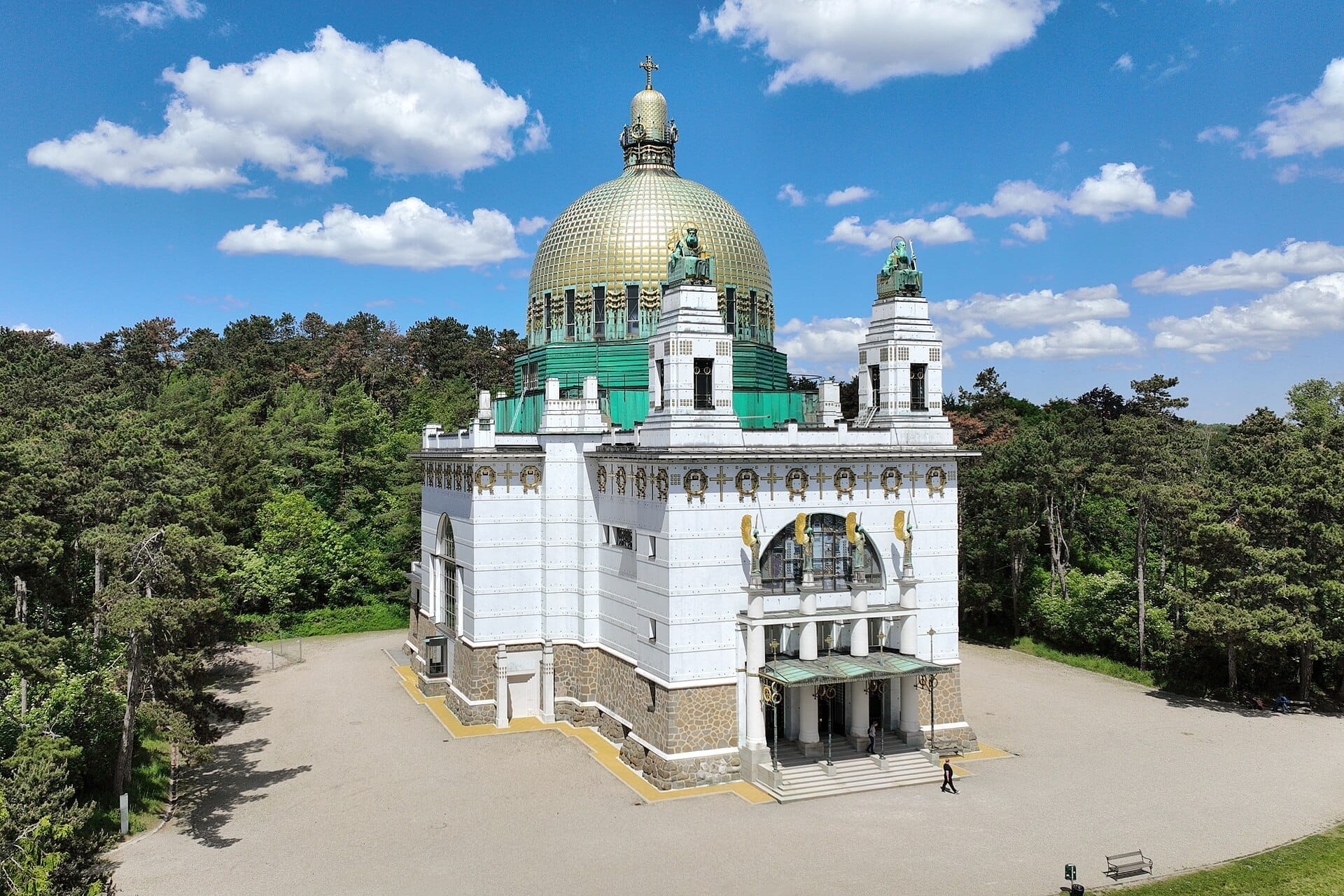
What the Kirche am Steinhof Actually Is
The Kirche am Steinhof, formally known as the Church of St. Leopold, is not a parish church or a tourist church in the conventional sense. Otto Wagner designed it between 1904 and 1907 as the chapel of the Lower Austrian State Sanatorium and Nursing Home, a large psychiatric complex on a wooded hillside in Vienna's 14th district. Every design decision, from the rounded corners of the pews to the sloped floor that drains toward a drain near the altar, was made with the institution's patients in mind. This is architecture shaped by both radical aesthetics and pragmatic function simultaneously.
Wagner was already in his 60s when he received the commission, and the church represents the full maturity of his Jugendstil vision. The white Carrara marble cladding on the facade, the gilded copper dome visible for kilometers across the western Vienna skyline, the mosaic-filled interior by Koloman Moser, and the stained glass by Rudolf Jettmar all combine into a unified Gesamtkunstwerk. No element is accidental. Since 7 May 2022, the church has been operated as an official Wien Museum site, making it accessible to visitors with an admission ticket during the seasonal open period.
ℹ️ Good to know
The church is open Tuesday through Friday 10:00–17:00 and Saturday through Sunday 11:00–17:00, from early May to early October only. It is closed on Mondays and is not open during winter months. Always confirm current hours with Wien Museum before visiting.
The Exterior: What You See Before You Step Inside
Approaching from the Otto-Wagner-Areal bus stop, the church reveals itself gradually above the administrative buildings of the former sanatorium complex. The copper dome, now oxidized to a pale green-gold, sits above a facade of white marble panels secured with decorative copper bolts, a detail that scandalized conservative critics in 1907 who expected mortar and plaster on a religious building. Wagner's point was that the bolts were honest: the marble was cladding, not load-bearing structure, and he saw no reason to pretend otherwise.
The two flanking bell towers frame the entrance portal, and above the doorway you will find figurative sculptures by Richard Luksch. The marble reflects light differently depending on the time of day. In the morning, the facade reads as crisp and almost clinical. In afternoon light, especially in late spring, the surface takes on a warmer tone and the gilded accents on the dome catch the sun at angles that make photographs almost too easy. If you can choose, arriving between 14:00 and 16:00 on a clear day gives the best exterior light.
Tickets & tours
Hand-picked options from our booking partner. Prices are indicative; availability and final rates are confirmed when you complete your booking.
Vivaldi's Four Seasons concert at Vienna's Karlskirche
From 38 €Instant confirmationFree cancellationImperial Vienna 72-hour hop-on hop-off bus
From 55 €Instant confirmationFree cancellationSkip-the-Line Entrance with Guide to Schonbrunn Palace and Gardens
From 45 €Instant confirmationFree cancellationLuggage Storage in Vienna
From 6 €Instant confirmationFree cancellation
The Interior: Moser's Mosaics and the Logic of Beauty
The interior is a single nave under the dome, flooded with diffused colored light from the Moser windows on both sides. The glass uses yellows, greens, and golds that shift the quality of light throughout the day without ever becoming oppressive. Koloman Moser, one of the founding figures of the Wiener Werkstätte, designed the windows, the altar mosaic, and much of the decorative program, and the coherence between architectural shell and interior decoration is total. This is not a building where furniture was added later. Every element was conceived together.
The floor slopes gently downward toward the altar, a feature designed to aid wheelchair access for patients and to allow the interior to be hosed down, a practical sanatorium requirement that Wagner solved without compromising the spatial dignity of the room. The pews have rounded ends rather than sharp corners, again for patient safety. These decisions are invisible as aesthetic choices; they read simply as elegance. That is what makes the building remarkable. The functional constraints were absorbed so completely into the design language that they became part of its beauty.
The dome interior features a shallow golden coffering that concentrates light downward onto the nave. Stand at the back of the church and look forward toward the apse mosaic: the composition pulls your eye through a sequence of light, color, and form that feels orchestrated. Photography inside is generally permitted for personal use, though the colored glass makes metering tricky. Shoot in RAW if you can, and avoid flash entirely.
Historical Context: Wagner, the Secession, and a Radical Commission
Otto Wagner was among the central figures of Viennese modernism, a generation of architects and designers who broke from the historicist conventions of the Ringstrasse era. The Wiener Secession, founded in 1897, was the institutional expression of that break, and Wagner was closely aligned with it. His Postal Savings Bank on Georg-Coch-Platz, completed in 1906, and the Steinhof church, completed in 1907, represent his two most ambitious realized projects of the period.
The commission to design the chapel came from the Lower Austrian regional government, which was building an entirely new psychiatric hospital campus on the Baumgartner Höhe. Wagner was given unusual creative freedom. The result was the first major church in Austria to fully adopt Jugendstil principles, not just in ornament but in structural logic. It was controversial from the moment it opened. The use of exposed metal fixings, the non-traditional spatial arrangement, and the secular modernity of the aesthetic made it a lightning rod for debate about what religious architecture could or should be.
Understanding Wagner's broader architectural vision is easier with the context of the Vienna architecture guide, which covers the Ringstrasse development and the Secession movement that Wagner's work both responded to and helped define.
Getting There: The Practical Reality
The church sits within the Otto-Wagner-Areal, a large former psychiatric hospital complex in Vienna's 14th district (Penzing). It is not in the central tourist zone, and reaching it requires a deliberate trip. The most straightforward route is U3 to Ottakring, then bus 48A to the Otto-Wagner-Areal stop. Alternatively, take U4 to Unter St. Veit and bus 47A to the same stop. A third option using bus 46B from Ottakring drops you at Feuerwache Am Steinhof, from where you walk through the Steinhofgründe park, a pleasant forested approach if the weather is good and you do not mind a 15-minute walk uphill.
⚠️ What to skip
Accessibility is limited. The church interior has no steps, but the approach to the entrance involves 12 steps with no ramp alternative currently in place. Wien Museum advises that access is not currently possible for wheelchair users or visitors with significant mobility difficulties. Check with Wien Museum directly for any updates before planning your visit.
The surrounding Otto-Wagner-Areal has its own architectural interest, with Wagner-designed pavilions and administrative buildings from the same period. Allow extra time to walk the grounds. The complex has been partially repurposed as a creative and medical campus, and the juxtaposition of the original Jugendstil buildings against contemporary functions gives the whole site an unusual, layered atmosphere.
Timing Your Visit and Managing Expectations
Because the church is small and the visitor numbers are modest compared to central Vienna attractions, there is rarely a significant crowd problem. Weekday mornings after 10:00 tend to be the quietest. Weekend afternoons, particularly on sunny Saturdays in summer, attract more visitors, but even then the space does not feel overwhelmed. The church holds perhaps 300 people at capacity, and on a typical open afternoon, you might share it with a few dozen others at most.
The seasonal closing is a genuine limitation. If you are visiting Vienna outside May through October, the church cannot be seen from the interior. The exterior is still accessible year-round as part of the Otto-Wagner-Areal grounds, and the dome and facade are visible in all seasons. Visitors interested in combining the trip with broader exploration of the city's outer districts might pair it with a visit to Kunst Haus Wien in the same day, though the two sites are not walking distance from each other.
If Jugendstil and the Secession movement are your primary interest in Vienna, this church is the counterpart to the Secession building in the 4th district. The two together make a coherent half-day program for anyone focused on fin-de-siècle architecture. For a wider map of the city's architectural landmarks, the Vienna architecture guide provides useful orientation.
Who Should Consider Skipping This
Travelers on a short Vienna itinerary of one or two days focused on the major central landmarks will likely find the travel time to the 14th district hard to justify. The church is genuinely excellent, but it requires 45 to 60 minutes of transit time round-trip and is not combinable with central sights on foot. If your priorities are the Kunsthistorisches Museum, the Belvedere, or the Hofburg, the Steinhof church will probably need to wait for a return visit.
Visitors with mobility difficulties should read the accessibility note carefully before making the trip, as the current situation with the entrance steps means the interior may not be reachable. And anyone visiting between November and April will find the church closed, even if the exterior grounds are accessible. In none of these cases is the destination at fault; it simply requires the right conditions to reward the effort.
Insider Tips
- The Steinhofgründe park surrounding the complex is a designated nature reserve and one of Vienna's less-visited green spaces. Arriving via bus 46B and walking uphill through the park adds about 15 minutes but gives a quieter, more atmospheric approach than stepping off a bus directly at the entrance.
- Late afternoon light on a clear day strikes the copper dome at an angle that makes the gilding visible from outside. If your primary goal is exterior photography, arrive no later than 15:30 in summer to catch this light before shadows from the surrounding trees shift.
- The Wien Museum periodically offers guided tours of the church at specific times. Check the Wien Museum website for current tour schedules before your visit, as these provide architectural detail that is not available from the standard self-guided visit.
- The Otto-Wagner-Areal pavilions immediately below the church are Wagner-designed buildings from the same period. They are not always open to visitors, but walking the grounds is free and gives context to the scale of Wagner's commission, which covered the entire hospital campus, not just the chapel.
- Bring a pair of binoculars or use your phone's zoom camera to examine the Koloman Moser window details from the nave. The distance from the pews to the upper windows makes the fine detailing hard to appreciate with the naked eye.
Who Is Kirche am Steinhof (Otto Wagner Church) For?
- Architecture enthusiasts with a specific interest in Jugendstil, Vienna Secession, or early modernism
- Visitors spending three or more days in Vienna who have covered the main central sights
- Photographers seeking Vienna subjects outside the typical tourist circuit
- Travelers with an interest in the history of psychiatry and institutional design
- Art historians and students interested in the Gesamtkunstwerk concept as realized in a religious space
Nearby Attractions
Combine your visit with:
- Zentralfriedhof (Central Cemetery)
The Wiener Zentralfriedhof is one of Europe's largest cemeteries by area, covering 2.5 square kilometres and housing around 330,000 graves. Free to enter, it holds the tombs of Beethoven, Brahms, Schubert, and Strauss, alongside an extraordinary neoclassical church and a landscape that shifts dramatically by season and time of day.