Zentralfriedhof Vienna: What to Expect at Europe's Most Storied Cemetery
The Wiener Zentralfriedhof is one of Europe's largest cemeteries by area, covering 2.5 square kilometres and housing around 330,000 graves. Free to enter, it holds the tombs of Beethoven, Brahms, Schubert, and Strauss, alongside an extraordinary neoclassical church and a landscape that shifts dramatically by season and time of day.
Quick Facts
- Location
- Simmeringer Hauptstraße 234, 1110 Vienna (11th District, Simmering)
- Getting There
- Tram 71 or 11 to 'Zentralfriedhof 2. Tor'; S7 train to 'Zentralfriedhof' station
- Time Needed
- 1.5 to 3 hours depending on how deeply you explore
- Cost
- Free entry to cemetery grounds
- Best for
- History lovers, music pilgrims, architecture admirers, quiet walkers
- Official website
- www.friedhoefewien.at/wiener-zentralfriedhof
What the Zentralfriedhof Actually Is
The Wiener Zentralfriedhof is not a morbid curiosity or a niche dark-tourism stop. It is a functioning public cemetery of enormous scale, covering roughly 2.5 square kilometres, with approximately 330,000 graves and an estimated 3 million total interments. Opened in 1874 after city planners decided Vienna's existing churchyard cemeteries could no longer accommodate the city's dead, it has been extended seven times, the last in 1921. Today it is one of the largest cemeteries in Europe by both area and number of burials.
What sets it apart from other European garden cemeteries is the concentration of cultural gravity. The musicians' section alone contains the tombs of Ludwig van Beethoven, Johannes Brahms, Franz Schubert, Johann Strauss II, and Antonio Salieri. Walking that stretch on a quiet weekday morning, with birdsong overhead and gravel underfoot, delivers a sense of time compressed in a way that no concert hall or museum quite replicates.
For context on how this fits into Vienna's broader classical music culture, the guide to classical music in Vienna traces the living tradition that these graves anchor.
Opening Hours and Getting There
The cemetery operates on a seasonal schedule. From November 3 through the end of February, gates open daily at 08:00 and close at 17:00. In March, hours extend to 07:00 to 18:00. From April through September, the cemetery is open 07:00 to 19:00, and from October through November 2, it closes at 18:00. During May through August, every Thursday sees extended hours until 20:00, which is worth noting if you want late-afternoon golden-hour light in summer.
The main entrance is Gate 2 (Tor 2) on Simmeringer Hauptstraße 234. Tram lines 71 and 11 stop directly at 'Zentralfriedhof 2. Tor', making this the most straightforward approach from the city centre. The S7 suburban rail also stops at 'Zentralfriedhof' station. Gate 2 is the logical entry point because it deposits you on the central avenue leading directly to the church and the musicians' graves.
⚠️ What to skip
The grounds are large enough that if you lose track of time, you may find the gates closing around you. There is a one-way emergency exit in the wall east of Gate 2 for visitors who get locked in after closing, but it is better to check the time well before dusk.
Tickets & tours
Hand-picked options from our booking partner. Prices are indicative; availability and final rates are confirmed when you complete your booking.
Imperial Vienna 72-hour hop-on hop-off bus
From 55 €Instant confirmationFree cancellationSkip-the-Line Entrance with Guide to Schonbrunn Palace and Gardens
From 45 €Instant confirmationFree cancellationLuggage Storage in Vienna
From 6 €Instant confirmationFree cancellationStrauss Dinner Show
From 99 €Instant confirmationFree cancellation
The Landscape: What You See When You Walk In
Entering through Gate 2, a broad central avenue stretches ahead, flanked by horse chestnut trees that form a dense canopy in summer. The scale is immediately apparent: the avenue seems to vanish into the distance, and the surrounding sections disappear into tree lines on either side. Early morning visitors are often greeted by mist sitting low over the paths between November and March, with frost crystals on older headstones and the sound of footsteps unusually loud on the gravel.
The sections are clearly divided. There are Catholic, Protestant, Jewish, Islamic, and Orthodox sections, as well as dedicated areas for soldiers and city officials. The older parts of the cemetery, away from the main avenue, feel genuinely different: paths narrow, graves press closer together, and some monuments lean at angles accumulated over a century and a half. The newer sections nearer the edges are more uniform and less atmospherically interesting for most visitors.
Autumn is the most visually dramatic season here. From late October through November, the combination of leaf colour, low light, and the particular stillness of a cemetery this size creates something genuinely affecting. It is also the most crowded period, as All Saints Day on November 1 draws tens of thousands of Viennese who come to place candles on family graves.
The Dr. Karl Lueger Memorial Church
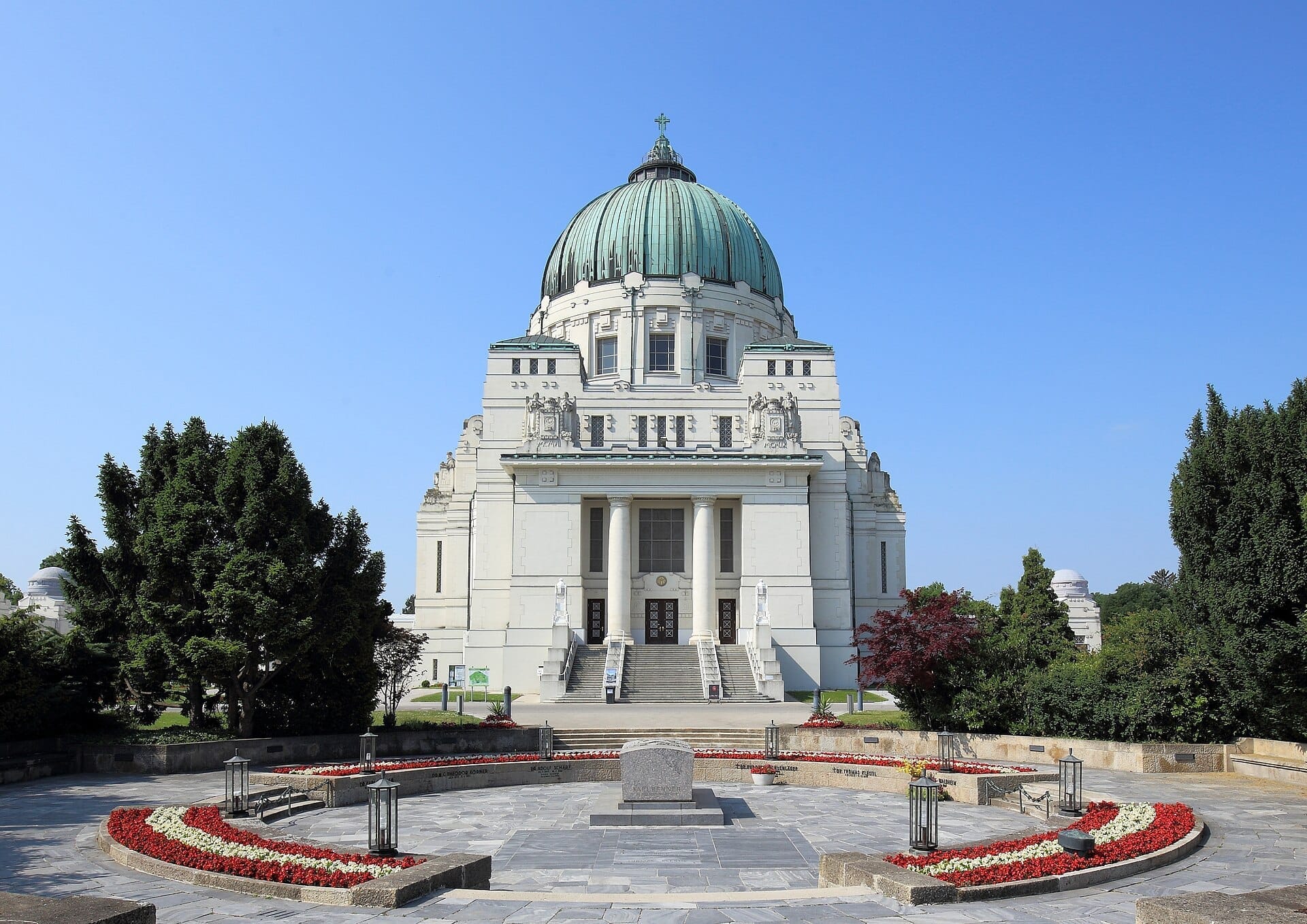
The dominant structure at the centre of the cemetery is the Dr. Karl Lueger Memorial Church, designed by the Viennese architect Max Hegele and completed in 1910. It is a striking exercise in Jugendstil-influenced neoclassicism, with a copper dome that reads as dark green against the sky and a facade that blends geometric severity with ornamental restraint. The building was named after Vienna's mayor at the time, a complex and historically contested figure, though the church itself is widely admired on architectural grounds.
The interior is worth a brief visit. The Memorial Church is open March through October from 08:00 to 17:00, and November through February from 08:00 to 16:00. The proportions inside are calm rather than imposing, with mosaic work and filtered natural light. It is not lavish in the way that St. Stephen's Cathedral is lavish, but the restraint feels appropriate to its setting.
If church architecture is a focus of your Vienna trip, the guide to Vienna's churches covers a range of styles across the city, from Gothic to Baroque to early modernist.
The Musicians' Graves: A Practical Walkthrough
The honorary graves (Ehrengräber) are located in Group 32A, close to the central church and clearly signposted from the main avenue. The most visited cluster includes the tombs of Beethoven, Schubert, Brahms, and Strauss II arranged within walking distance of each other. These are genuine burial sites: Beethoven and Schubert were originally interred elsewhere in Vienna and reburied here in 1888 as part of the cemetery's effort to concentrate the city's cultural heritage.
The graves themselves are well-maintained but not showy. Schubert's monument is a white obelisk. Brahms has a darker, more severe stone. Beethoven's grave often has fresh flowers left by visitors. The atmosphere in this section is quiet and considered: people lower their voices without being asked. Even on busier weekend afternoons, it rarely feels congested, partly because the paths between graves are generous and the surrounding trees absorb sound.
💡 Local tip
Pick up a free map at Gate 2 before walking in. The cemetery is clearly laid out but large enough that navigating by instinct wastes time. Section numbers are marked on posts throughout, and the map cross-references the honorary graves by group number.
The composers buried here are central figures in the story told at the House of Music, Vienna's interactive museum of sound, which provides useful biographical context before or after a cemetery visit.
Crowd Patterns and Best Times to Visit
Weekday mornings between 08:00 and 10:00 are consistently the quietest. At this hour, the cemetery is largely occupied by Viennese residents visiting family graves, gardeners maintaining the paths, and a small number of tourists. The light in spring and autumn at this time is soft and low, ideal for photography without the need to work around other visitors.
Weekend afternoons from April through September bring noticeably more visitors, particularly around the central avenue and musicians' section. All Saints Day (November 1) and the days immediately before and after are the single busiest period of the year, when the cemetery fills with locals lighting candles on family plots. It is a genuinely moving experience but not one suited to a leisurely exploration. If you want atmosphere without crowds, the week after All Saints is ideal: candles still glow on many graves, the light is low and golden, and visitor numbers drop sharply.
Summer Thursday evenings, when the cemetery stays open until 20:00, offer a unique window: long daylight, warm air, and the kind of quiet that a city of two million rarely provides. This is a genuinely underused visiting slot.
Photography, Accessibility, and Practical Logistics
Photography is permitted throughout the grounds and is practiced openly. The combination of old stonework, mature trees, and seasonal light makes this one of the most photogenic sites in Vienna, though it rarely appears on the standard tourist photography circuit. Overcast days in autumn and winter produce some of the most atmospheric conditions: flat light eliminates harsh shadows on carved stone and moss-covered surfaces read with excellent detail.
The cemetery is largely flat, which helps for visitors with limited mobility, but the distances involved are substantial. From Gate 2 to the far ends of the grounds is a walk of over a kilometre each way. Comfortable, weather-appropriate shoes are genuinely necessary: the paths are gravel and stone, not paved, and can be slippery after rain or in winter.
There are no cafes or food stalls inside the cemetery grounds. A small number of florists and vendors operate near the main gate, primarily selling flowers and candles for grave visits. Bring water for visits in warmer months.
ℹ️ Good to know
Entry to the cemetery grounds is free of charge. Paid guided tours are available through third-party operators, but the free map from Gate 2 is sufficient for most independent visitors navigating to the main sections.
Is It Worth Your Time?
For visitors with a genuine interest in music history, Viennese architecture, or funerary culture, the Zentralfriedhof is one of the most rewarding sites in the city, precisely because it demands something from you. It is not a spectacle you absorb passively. You walk, you navigate, you read stone inscriptions in German. The reward is a sense of the city's cultural depth that a museum visit does not quite replicate.
Visitors who find cemeteries inherently uncomfortable, or who are on a tight itinerary focused on Vienna's inner districts, may reasonably skip it. The Zentralfriedhof is located in the 11th district, a tram or train ride from the centre, and a dedicated visit takes a minimum of 90 minutes to do it properly. It is not a quick stop between the Kunsthistorisches Museum and a concert.
If you are planning how to use your time across the city, the three-day Vienna itinerary can help you decide whether a Zentralfriedhof visit fits your schedule, and the guide to visiting Vienna on a budget notes the free entry as one of the city's better-value cultural experiences.
Insider Tips
- The free printed map at Gate 2 uses group numbers that match the posts on every path. Pick one up before you start walking; trying to navigate by app or instinct on the first visit adds significant time.
- Thursday evenings in summer (May through August) the cemetery stays open until 20:00. At 19:00 on a clear July evening, the low light through the chestnut canopy on the central avenue is extraordinary and you will likely have it largely to yourself.
- Beethoven and Schubert were not originally buried here. They were reinterred in 1888 from other Vienna cemeteries. If the transfer of remains matters to you as a biographical detail, Schubert's original grave is in the Währinger Ortsfriedhof, now the Schubert Park.
- The Jewish section (Section 1, near Gate 1 on Simmeringer Hauptstraße) contains some of the oldest and most architecturally remarkable graves in the entire cemetery. It is visited by far fewer tourists than the musicians' section and rewards a detour.
- November 1 and 2 bring candlelit graves across the entire cemetery, creating an atmosphere unlike any other time of year. Come at dusk for maximum effect, but arrive at least 90 minutes before closing so you have time to walk.
Who Is Zentralfriedhof (Central Cemetery) For?
- Classical music enthusiasts who want to stand at the actual graves of Beethoven, Brahms, Schubert, and Strauss
- Architecture admirers interested in Max Hegele's Jugendstil-inflected Memorial Church
- Slow travellers who prefer walking and observation over queuing for ticketed attractions
- Photographers looking for stone, light, and seasonal colour away from the tourist circuit
- Visitors interested in Viennese social history and how the city commemorates its dead
Nearby Attractions
Combine your visit with:
- Kirche am Steinhof (Otto Wagner Church)
Completed in 1907 atop a forested hill in Vienna's 14th district, the Kirche am Steinhof is one of the most important works of Viennese Secession architecture. Designed by Otto Wagner as a functional chapel for a psychiatric hospital, it is now a Wien Museum site open seasonally to the public. The gilded copper dome alone is worth the journey out.