Guijie Ghost Street: Beijing's Legendary Late-Night Dining Strip
Guijie, officially Dongzhimennei Dajie, is a 1.4-kilometer stretch of more than 100 restaurants in Dongcheng District that comes alive after dark. Known for spicy crawfish, hot pot, and hundreds of red lanterns, it is one of the few places in Beijing where serious eating happens well past midnight. Entry is free.
Quick Facts
- Location
- Dongzhimennei Dajie, Dongcheng District, Beijing
- Getting There
- Beixinqiao Station (Line 5) or Dongzhimen Station (Lines 2 & 13)
- Time Needed
- 1.5 to 3 hours, depending on how long you linger over a meal
- Cost
- Free to enter; meal costs vary by restaurant
- Best for
- Late-night dining, spicy food lovers, atmosphere seekers, solo travelers
- Official website
- s.visitbeijing.com.cn/attraction/117279
What Guijie Actually Is
Guijie, written 簋街 and pronounced roughly 'Gway-jee-eh', is Beijing's most concentrated restaurant corridor. Formally named Dongzhimennei Dajie, Formally named Dongzhimennei Dajie, it runs for approximately 1.4 kilometers from the Dongzhimen overpass eastward area to the Jiaodaokou East Street intersection in Dongcheng District. The “Ghost Street” nickname is associated with older late-night markets and “ghost fairs,” when vendors traded from midnight until dawn under dim oil or gas lamps. In the late 1980s, food shops began transforming the street into a food destination, and the characters were later changed from 鬼街 to 簋街 while retaining the same pronunciation.
Today the street is home to dozens of restaurants packed shoulder to shoulder, most of them focused on a handful of beloved Chinese dishes: spicy crayfish (麻辣小龙虾), ma la hot pot, grilled lamb skewers, and various forms of Sichuan-influenced cooking. The cuisine leans boldly toward the numbing and the fiery. If your heat tolerance is low, you can still find plenty to eat here, but the spirit of the street is unapologetically spicy.
💡 Local tip
The street is open 24 hours and free to walk. Individual restaurants set their own hours, but most are open from late afternoon until well after midnight, with some running through the night.
The Experience After Dark
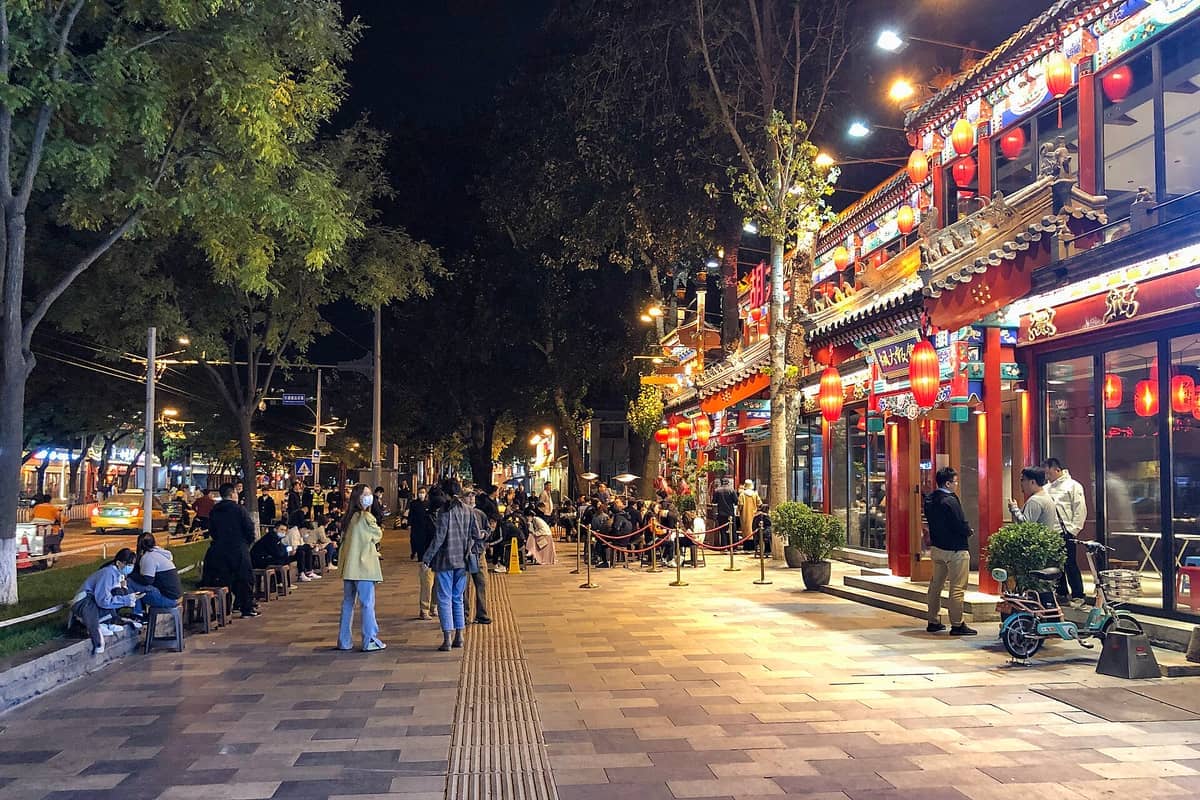
Visiting Guijie in daylight is functional but ordinary. The restaurants look like any other commercial street in Beijing, and the atmosphere is flat. Come back after 8 pm and the transformation is immediate. Strings of deep-red paper lanterns stretch the full length of the street, several rows thick overhead, casting a warm amber light that makes the whole corridor glow. The lanterns are not decorative afterthoughts. There are reportedly over 1,000 of them lining the street, and their combined effect at night is genuinely striking.
The sound shifts too. By 9 pm, restaurant staff are calling out to pedestrians from doorways, kitchen exhaust fans push waves of chili oil and cumin into the street, and the clatter of beer bottles and crayfish shells is audible from the sidewalk. Tables spill onto the pavement in warmer months, April through October, when half the dining happens outdoors. This is when Guijie earns its reputation as one of Beijing's most atmospheric streets, even if 'atmosphere' here means noise, smoke, and competitive eating rather than quiet sophistication.
Peak hours run from roughly 8 pm to midnight, particularly on weekends. Queues form outside the more popular crayfish restaurants from about 7:30 pm onward. If you arrive before 7 pm, you can usually walk straight in anywhere. After 1 am, the crowd thins considerably, and the street takes on a quieter, grittier character closer to its original identity.
Tickets & tours
Hand-picked options from our booking partner. Prices are indicative; availability and final rates are confirmed when you complete your booking.
Small group tour of Tian'anmen Square and the Forbidden City
From 43 €Instant confirmationFree cancellationBeijing Summer Palace Entrance Ticket
From 7 €Instant confirmationFree cancellationMutianyu Great Wall and Summer Palace small-group tour from Beijing
From 171 €Instant confirmationFree cancellationPrivate Guided Tour to Temple of Heaven, Panda House and Summer Palace
From 67 €Instant confirmationFree cancellation
What to Eat and How to Order
The crayfish is the signature dish of Guijie and has been since at least the early 2000s. Ordering involves choosing a preparation style (most commonly ma la, or numbing-spicy, with Sichuan peppercorns and dried chilies) and a spice level. Medium spicy on Guijie is genuinely hot by most international standards. The crayfish are sold by the half-jin or jin (roughly 250g or 500g increments), and prices fluctuate seasonally. Late spring through summer is peak season when the quality is highest.
Beyond crayfish, most restaurants offer hot pot, braised frog, spicy duck neck, and cold appetizer platters as standard. A few restaurants specialize in other regional Chinese cuisines, giving you options if you are eating with a group that has varying preferences. Most menus have photographs, and some establishments near the Dongzhimen end have English translations. Pointing and holding up fingers still works reliably if language is a barrier.
Payment is almost universally by WeChat Pay or Alipay in smaller restaurants. Larger establishments accept UnionPay cards and occasionally international cards, but carrying some cash (CNY) as a backup is practical. For more on navigating Beijing's food scene broadly, the what to eat in Beijing guide covers regional dishes and ordering basics that apply across the city.
Getting There and Finding Your Bearings
The most straightforward approach is Beixinqiao Station on Metro Line 5. Exit and walk south along Beixinqiao South Street for about two minutes until you reach the western part of Dongzhimennei Dajie. This puts you near the quieter, slightly more local end of the strip. Alternatively, Dongzhimen Station on Lines 2 and 13 deposits you at the eastern end, near the overpass, which is the busier entrance point with more foot traffic and larger restaurant frontages.
Bus routes serving Dongneixiaojie, Dongzhimennei, Dongzhimen, and Beixinqiao Lukou Xi stops also reach the street and can be useful if you are arriving from the north or east of the city. Taxis and DiDi drop-offs are possible along the street, but traffic on weekend evenings is slow and the driver may ask you to step out short of your destination.
ℹ️ Good to know
Guijie sits in Dongcheng District, roughly midway between the Lama Temple area and Dongzhimen transport hub. It is walkable from both if you are already in the neighborhood.
If you are combining this with a broader Dongcheng evening, the Lama Temple is about 15 minutes on foot to the northwest, and Nanluoguxiang is roughly 20 minutes on foot to the west, making a logical progression through the district in a single evening.
Practical Details: What to Know Before You Go
There is no entry fee and no ticketing. The street is public and open around the clock. The practical cost is whatever you spend in a restaurant. A shared meal of crayfish, a few side dishes, and beer for two people typically runs somewhere in the range of ¥150 to ¥300 CNY, though this can vary widely depending on the restaurant and how much you order. Higher-end establishments on the strip charge more.
Clothing matters more than people expect. Eating crayfish is a physical activity involving shells, chili oil, and splashing broth. Avoid anything you would be upset to stain. Most restaurants provide plastic gloves for crayfish eating, which is a good sign. If a restaurant does not offer gloves, ask, or reconsider.
Accessibility along the street varies. The sidewalks are generally usable but uneven in places, and the outdoor seating areas can be crowded and obstructed. Specific step-free access, accessible restrooms, and wheelchair assistance are not documented for the street as a whole. Individual restaurants should be checked directly if this is a concern.
⚠️ What to skip
Air quality on the street during peak hours can be intense due to open-air grilling and kitchen exhaust. Those with respiratory sensitivities should be aware that the outdoor stretches in particular carry persistent smoke and chili fumes.
How Guijie Fits into a Beijing Itinerary
Guijie works best as a dinner destination rather than a standalone visit. It pairs naturally with daytime sightseeing in Dongcheng, which contains some of Beijing's most historically dense areas. A day visiting the Forbidden City and Jingshan Park followed by an evening on Guijie makes geographic and logistical sense, with Dongzhimen Metro connecting the areas.
For travelers planning a longer stay, the Beijing 5-day itinerary suggests how to slot food-focused evenings alongside the city's major sights without feeling rushed.
It is worth being honest about what Guijie is not. It is not a place for quiet conversation or a romantic dinner unless you seek out one of the smaller, enclosed restaurants deliberately. It is not a food market where you wander and sample. It is a street of sit-down restaurants oriented around group dining, beer, and dishes that reward communal sharing. Solo travelers can eat here perfectly well, but the format strongly favors groups of two or more.
Photography and Documentation
The lantern-lit corridor is genuinely photogenic between 8 pm and 10 pm, when the sky still holds some residual light and the lanterns are fully illuminated. A wide lens captures the full tunnel effect of the overhead red canopy. Later in the evening, the street becomes harder to photograph clearly due to the density of people and the haze from kitchens and grills. The crayfish piles themselves photograph well under the warm interior lighting of most restaurants.
For photographers working across Beijing, the Beijing photography guide covers timing and technique for the city's other visually distinctive locations.
Insider Tips
- Arrive before 7 pm on weekends to avoid queues at the most popular crayfish restaurants. By 8:30 pm, waits of 30 to 45 minutes are common outside the busiest spots.
- Ask for your spice level to be reduced by one step from your instinct. 'Medium' on Guijie is calibrated for regulars who eat Sichuan food frequently, not for occasional visitors.
- The restaurants at the western (Beixinqiao) end of the street tend to be slightly less crowded and more local in character than those near the Dongzhimen overpass end, which see higher tourist and younger bar-going traffic.
- Some restaurants close for a few hours in the early afternoon between lunch and dinner service, roughly 2 pm to 5 pm. If you want a late lunch, call ahead or check signs outside.
- Plastic gloves for crayfish eating should be provided automatically, but if they are not, ask before you start. Eating crayfish barehanded with chili oil involved is an experience most people do not want to repeat.
Who Is Guijie Ghost Street For?
- Groups of friends looking for a loud, convivial late dinner with beer
- Spicy food enthusiasts who want a concentrated Sichuan-influenced dining experience
- Night owls and travelers whose schedules push dinner past 9 pm
- First-time visitors to Beijing wanting to experience a side of the city that is entirely local in character
- Photographers interested in atmospheric urban night scenes with strong color and texture
Nearby Attractions
Other things to see while in Dongcheng District:
- Ancient Observatory (Guguanxiangtai)
Built in 1442 during the Ming dynasty, it holds a remarkable collection of Qing-era bronze instruments and offers a rare window into imperial Chinese astronomy in central Beijing.
- Bell Tower and Drum Tower
Standing at the northern end of Beijing's ancient central axis, the Bell Tower and Drum Tower have marked time for the city since the Ming dynasty. This guide covers what to see, when to go, how to get there, and whether the climb is worth your while.
- Confucius Temple and Guozijian
The Confucius Temple and Guozijian Museum preserves two of Beijing's most historically significant sites: a Yuan dynasty Confucian temple and the Imperial College that trained China's governing elite for six centuries. Quieter than most major attractions, it rewards visitors who want genuine historical depth alongside calm, tree-shaded courtyards.
- Forbidden City (Palace Museum)
The Forbidden City, officially the Palace Museum, is the world's largest surviving imperial palace complex and Beijing's most significant cultural landmark. Built between 1406 and 1420 under Ming emperor Zhu Di, it served as the ceremonial and political heart of China for nearly five centuries. This guide covers everything you need to visit confidently.