Nanluoguxiang: Beijing's Most Famous Hutong Lane
Nanluoguxiang (南锣鼓巷), or South Gong and Drum Lane, is a historic lane in Dongcheng District dating to the Yuan Dynasty. Free to enter and open around the clock, it draws visitors with its traditional courtyard architecture, street food, independent shops, and 16 intersecting side hutongs that reveal quieter layers of old Beijing.
Quick Facts
- Location
- Dongcheng District, between East Gulou Street (north) and Di'anmen East Street (south)
- Getting There
- Beijing Subway Line 6 or Line 8 to Nanluoguxiang Station; Bus 107 or 124 (Nanluoguxiang or Baochao Hutong stops)
- Time Needed
- 1–2 hours for the main lane; 3+ hours if exploring side hutongs and stopping to eat
- Cost
- Free entry (¥0 CNY); individual shops and food stalls charge separately
- Best for
- First-time visitors to Beijing, architecture enthusiasts, street food lovers, afternoon and early-evening strolls
- Official website
- s.visitbeijing.com.cn/attraction/101328
What Nanluoguxiang Actually Is
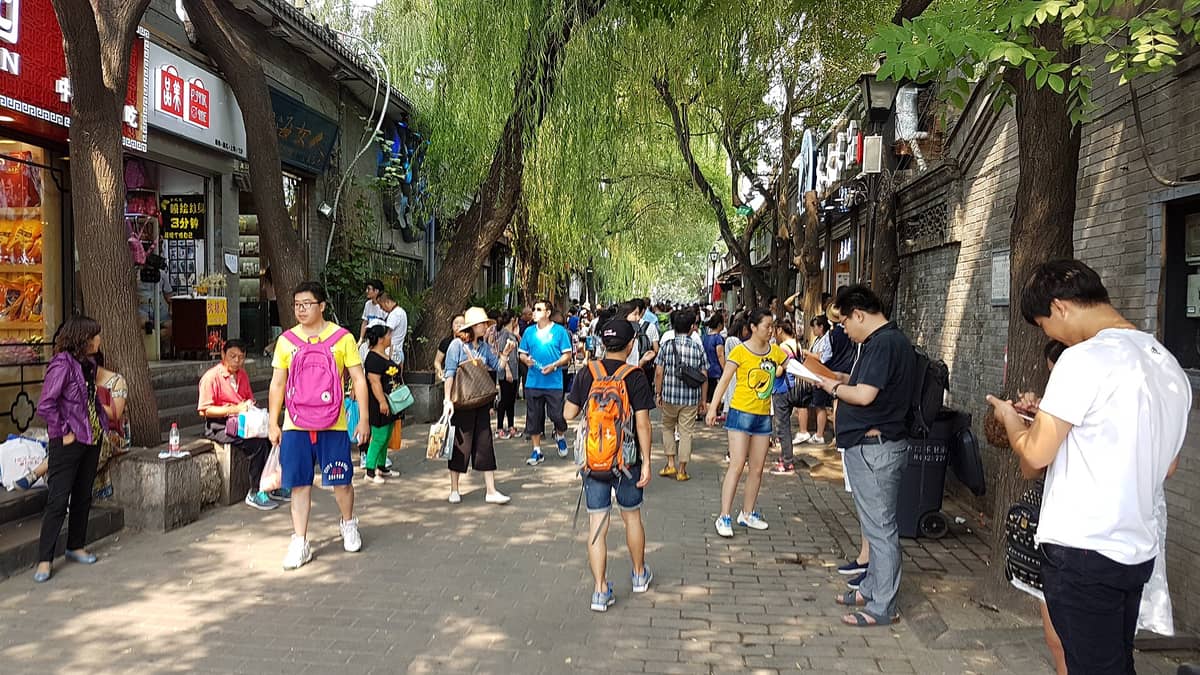
Nanluoguxiang is a historic pedestrian lane running north to south through the heart of Dongcheng District. Its official Chinese name, 南锣鼓巷, translates literally as South Gong and Drum Lane, though you will hear it called simply 'Nanluogu' or 'NLGX' by younger Beijingers and expats. The lane itself is the backbone of a historic grid: sixteen hutongs branch off it at right angles, forming a fishbone pattern associated with Beijing’s Yuan-Dynasty urban layout. The grid was later formalised during the Qing Dynasty.
The street is free to walk and is generally open during daytime and evening visiting hours. What you are paying for are the things along it: fried skewers, craft beer, handmade jewellery, ceramic souvenirs, and the occasional overpriced bowl of noodles. Entry costs nothing; restraint may cost more.
ℹ️ Good to know
Admission: Free (¥0 CNY). No ticket, no reservation, no gate. The listed visiting hours are generally 10:00–21:00; individual shops set their own hours.
Nanluoguxiang sits inside Beijing's historic hutong belt. To understand the broader layout of these neighbourhoods, the Beijing hutong guide gives useful context on how the alley grid developed around imperial Beijing's outer residential rings.
The Architecture: What You Are Actually Looking At
The lane's value is not the shops. It is the physical fabric underneath them. Nanluoguxiang contains some of the best-preserved siheyuan (四合院, traditional courtyard compounds) still accessible in central Beijing. These rectangular enclosures, where rooms face inward around a central yard, were the standard residential form for Qing-era Beijing households of all classes, from common residents to court officials. A number of historic mansions along the side hutongs belonged to Qing princes and high officials, and their grey-brick gates, carved lintels, and drum-shaped doorstep stones remain largely intact.
The main lane itself has been heavily renovated since the mid-2000s, and many facades are reconstructions or cosmetic treatments rather than original structures. The real architectural substance is on the side hutongs: Mao'er Hutong, Bangzhu Hutong, and Qiangu Hutong, among others, still have stretches of unaltered courtyard walls, narrow brick pavements, and old wooden doors with iron ring handles. Step off the main lane and the crowds thin within thirty seconds.
💡 Local tip
For serious architecture and history, spend at least 30 minutes on the side hutongs rather than staying on the main lane. Mao'er Hutong to the east has several well-preserved Qing-era gates worth finding.
Tickets & tours
Hand-picked options from our booking partner. Prices are indicative; availability and final rates are confirmed when you complete your booking.
Small group tour of Tian'anmen Square and the Forbidden City
From 43 €Instant confirmationFree cancellationBeijing Summer Palace Entrance Ticket
From 7 €Instant confirmationFree cancellationMutianyu Great Wall and Summer Palace small-group tour from Beijing
From 171 €Instant confirmationFree cancellationPrivate Guided Tour to Temple of Heaven, Panda House and Summer Palace
From 67 €Instant confirmationFree cancellation
How the Lane Changes Through the Day
Morning, before 10:00, is when Nanluoguxiang belongs to its residents. Older locals wheel out bicycles, sweep doorsteps, or carry breakfast home from nearby markets. Deliveries arrive. A few cafes open early. The lane smells of dust and bread rather than grilled meat. If you want photographs with relatively open sightlines and soft northern light, this is the window.
By midday, tour groups and individual visitors begin filling the main lane. Foot traffic peaks between roughly 13:00 and 18:00 on weekends and public holidays, when the lane becomes genuinely difficult to walk without stopping frequently. Stalls selling grilled squid, fried glutinous rice rolls (nian gao), yogurt drinks in ceramic bottles, and tanghulu (candied hawthorn on a skewer) all come to life. The smell of charcoal and sesame drifts across the lane.
Early evening, between 17:00 and 19:00, offers a useful middle ground: shops are still open, the food stalls are fully stocked, but the midday crowd has thinned. The lane is lit by shop signs and the warm glow from cafe windows, which gives it a different look entirely from the daytime. This is also when local residents reappear for evening walks, creating a more layered scene than the purely tourist atmosphere of the afternoon.
⚠️ What to skip
On major Chinese public holidays (National Day Golden Week in October, Spring Festival) and summer weekends, the main lane can become so congested that forward movement slows to a shuffle. If your visit falls on a holiday, plan to arrive before 09:30 or after 19:00.
Food and Drink Along the Lane
The street food at Nanluoguxiang has a reputation for being expensive by Beijing standards, and that reputation is accurate. A cup of yogurt in a ceramic pot, historically priced at a few yuan, has in recent years cost multiples of what the same product costs in a nearby supermarket. The quality varies by stall. Some of the grilled items are genuinely good; others are manufactured-for-tourists versions of Beijing snacks that bear little relation to what locals actually eat.
That said, the concentration of options is useful for visitors who want to try several things in one place. Look for tanghulu, traditional sugarcoated hawthorn fruit on bamboo skewers; baidu yogurt in sealed ceramic bottles; and various fried or grilled skewers. If you want a proper sit-down meal, the cafes and small restaurants on the side hutongs generally offer better value and a calmer setting than the main-lane stalls.
For a broader orientation on what Beijing food is worth seeking out beyond tourist streets, the Beijing food guide covers local specialities with more depth, including where to find genuine versions of dishes often sold in simplified form on lanes like this one.
Practical Walkthrough: Getting There and Moving Around
The most direct access is Nanluoguxiang Station on Beijing Subway Line 6 or Line 8. Exit the station and the lane entrance is within a short walk. Bus routes 107 and 124 stop nearby at Baochao Hutong. Taxis and ride-hailing apps (DiDi is the primary platform) can drop at either the north or south end of the lane, though traffic in the surrounding hutong streets can be slow during peak hours.
The lane runs roughly 800 metres and is flat. At an easy pace without stopping, end to end takes about ten minutes. Realistically, with food stalls and window shopping, most visitors take 45 minutes to an hour on the main lane. The surface is mostly paved but can be uneven in places; the side hutongs have older, rougher paving and some sections with raised thresholds. Wheelchair access is limited by narrow passages, occasional steps, and crowding. There are no official accessibility facilities verified at the lane itself.
Photography is unrestricted on the public lane. The best light for the grey-brick architecture is either morning (soft, directional) or the hour before sunset (warm tones against the old walls). Midday light is harsh and flat. For tighter shots of architectural details, the quieter side hutongs offer fewer background distractions.
💡 Local tip
If you are combining Nanluoguxiang with the Drum Tower or Houhai area, the northern end of the lane exits near East Gulou Street, a short walk from both. This makes a logical sequence: lane in the afternoon, towers around sunset, lakeside at dusk.
The nearby Bell Tower and Drum Tower are a ten-minute walk from the north entrance, and the Houhai and Shichahai lakes are similarly close, making this corner of Dongcheng a natural half-day circuit.
How to Think About Nanluoguxiang Honestly
Nanluoguxiang is one of the most heavily commercialised historic streets in Beijing. Since its renovation and promotion in the mid-2000s, it has attracted enormous visitor numbers, and that has changed its character substantially. Much of what lines the main lane today is tourist merchandise: phone cases, character-themed snacks, mass-produced 'traditional' crafts. The independent bookshops, music venues, and original small businesses that once gave the lane a neighbourhood feel have largely been displaced by higher rents.
This is worth stating plainly because Nanluoguxiang is still genuinely worthwhile, just not for the reasons some guides suggest. The architecture of the side hutongs is real and largely intact. The basic experience of walking a Yuan-dynasty street grid in central Beijing is not nothing. And for first-time visitors with limited time, it provides an accessible, safe, and centrally located introduction to what a historic Beijing hutong feels like, without requiring navigation or language skills.
Visitors seeking a quieter, less commercialised hutong experience might find more satisfaction on nearby streets. Those looking for a deeper dive into Beijing's alley culture will benefit from reading about the broader hutong neighbourhood context before arriving.
For travellers who want to explore hutong areas that see fewer tour groups, the Wudaoying Hutong near the Lama Temple offers a similar mix of cafes and architecture with considerably less foot traffic. The Beijing hidden gems guide has further alternatives for those willing to travel slightly off the main circuit.
Who Should Skip It
Repeat visitors to Beijing who have already walked Nanluoguxiang will find little new here unless the side hutongs are their focus. Travellers who strongly dislike commercial tourist streets, or who find dense pedestrian crowds unpleasant, may want to allocate their hutong time elsewhere. On major holiday weekends the congestion on the main lane is significant enough to undercut any sense of atmosphere. And anyone specifically hoping to see authentic everyday Beijing life rather than a version of it packaged for visitors should set expectations accordingly before arriving.
Insider Tips
- Turn off the main lane almost immediately. The sixteen side hutongs, particularly Mao'er Hutong, Bangzhu Hutong, and Qiangu Hutong, have the real architectural character. Most visitors never leave the main lane, which means the sidestreets are noticeably quieter even on busy days.
- Ceramic yogurt bottles sold on the lane are returnable for a small deposit at the stall where you bought them. Return the bottle to get the deposit back rather than carrying it around.
- The north entrance near East Gulou Street tends to be slightly less crowded than the south entrance from Di'anmen East Street, which is closer to the subway exit for some visitors. If you want a less congested start, enter from the north.
- Weekday mornings before 10:30 offer the closest thing to a quiet Nanluoguxiang. Most shops have not opened yet, residents are going about their routines, and the lane is walkable without constant stopping.
- If you are visiting in autumn (September to October), the light on the grey-brick walls in the late afternoon is excellent for photography. The temperature is also the most comfortable of the year for an extended walk.
Who Is Nanluoguxiang For?
- First-time visitors to Beijing who want an accessible introduction to hutong architecture and street life
- Travellers with limited time who want one concentrated location to try Beijing street food
- Architecture and photography enthusiasts willing to explore the side hutongs rather than just the main lane
- Families with children comfortable with crowds and interested in trying Chinese street snacks
- Travellers building a half-day circuit around Dongcheng, combining the lane with the Drum Tower and Houhai lakes
Nearby Attractions
Other things to see while in Beijing Hutong Neighborhoods:
- Wudaoying Hutong
Wudaoying Hutong is a 632-metre east-west lane in Dongcheng District, a short walk from the Lama Temple. Free to enter and open around the clock, it trades crowds for character, mixing grey-brick courtyard houses with independent cafes, bookshops, and small restaurants.
- Yandaixie Street
Yandaixie Street (烟袋斜街) is one of Beijing's oldest surviving commercial hutongs, stretching 232 meters from Di'anmenwai Street to Yinding Bridge. With more than 800 years of history and a Qing-era name associated with its tobacco shops, it now offers a compact, free-to-enter walk through layers of Beijing history alongside small boutiques, tea houses, and snack stalls.