Yandaixie Street: Beijing's Ancient Tobacco Lane
Yandaixie Street (烟袋斜街) is one of Beijing's oldest surviving commercial hutongs, stretching 232 meters from Di'anmenwai Street to Yinding Bridge. With more than 800 years of history and a Qing-era name associated with its tobacco shops, it now offers a compact, free-to-enter walk through layers of Beijing history alongside small boutiques, tea houses, and snack stalls.
Quick Facts
- Location
- No. 50, Di'anmenwai Street, Xicheng District, Beijing
- Getting There
- Shichahai Station, Line 8, Exit A2; walk west then north ~6 minutes. Buses 5, 60, 82, 107, 124, 635 stop at Gulou (Drum Tower).
- Time Needed
- 30–60 minutes for the street itself; 2–3 hours if combining with Shichahai lakeside
- Cost
- Free entry. Individual shop and food prices vary.
- Best for
- History walkers, photographers, first-time Beijing visitors, and anyone curious about hutong life
- Official website
- english.visitbeijing.com.cn
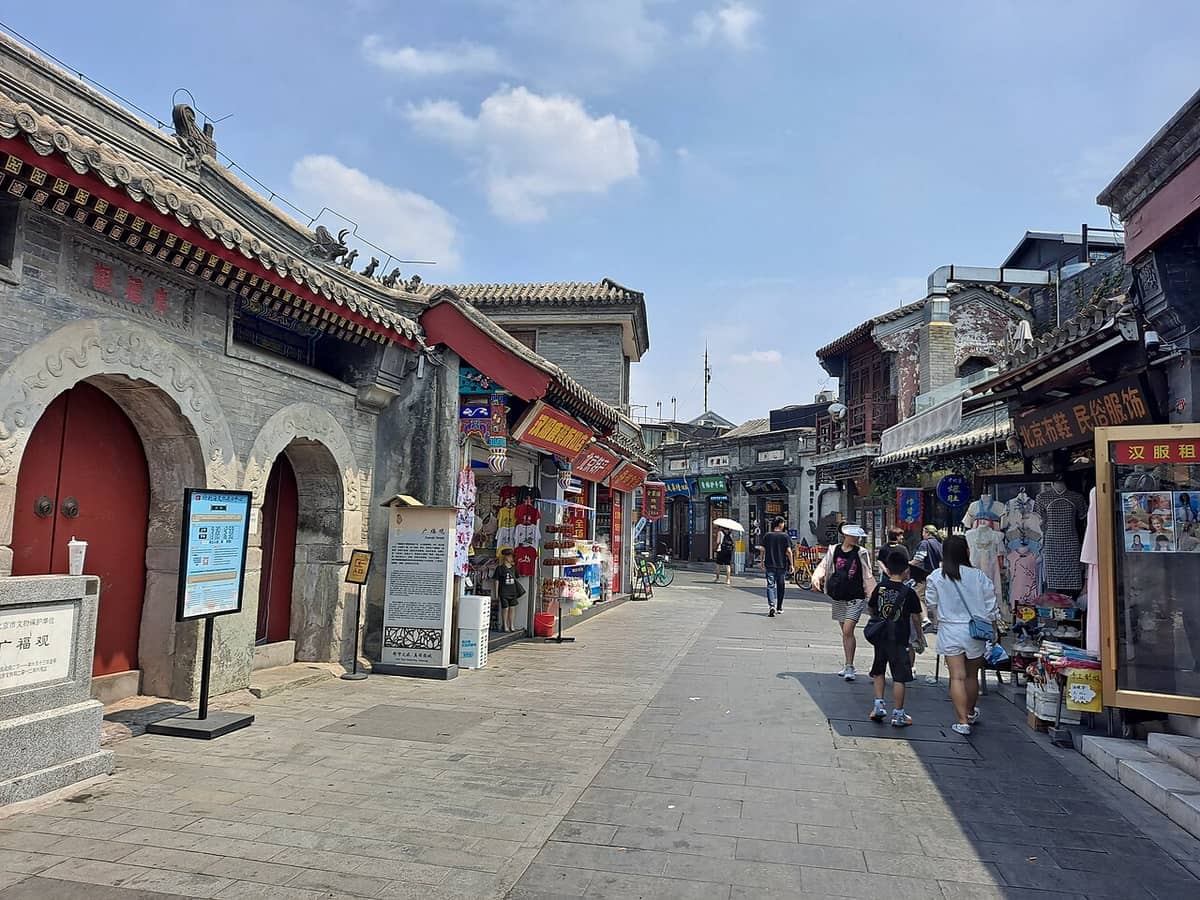
What Is Yandaixie Street?
Yandaixie Street, written in Chinese as 烟袋斜街 and sometimes romanized as Yandai Xiejie or Yandai Byway, is a historic commercial hutong in Beijing's Xicheng District. At 232 meters long and roughly 5 to 6 meters wide, it is one of the shorter walking streets in the capital, but its depth of history is disproportionate to its size. The street connects Di'anmenwai Street at its southern end to the Yinding Bridge, which arches over the narrow channel between Qianhai and Houhai lakes, part of the Shichahai lake district to the north.
The lane runs at a slight diagonal, which is unusual for Beijing's otherwise grid-like hutong system. That angle, reflected in the character 斜 (xié, meaning oblique or slanting), has been part of its identity for centuries. The street was formed during the Yuan Dynasty, when the area around Shichahai was developing as an important transport and commercial district. By the late Qing Dynasty, the street had become associated with shops selling tobacco pouches, pipes, and smoking accessories, giving it the name it carries today: yandai (烟袋), meaning tobacco pipe or pouch. By the late Qing Dynasty, the street had become associated with shops selling tobacco pouches, pipes, and smoking accessories, giving it the name it carries today: yandai (烟袋) meaning tobacco pipe or pouch.
ℹ️ Good to know
Entry to Yandaixie Street is free at all hours. There is no gate, no ticket booth, and no closing time. Individual shops set their own hours, typically opening mid-morning and closing late evening.
The Experience: Walking the Lane
Coming from Shichahai Station on Line 8, the approach from the south gives the clearest introduction. You pass through the wider, traffic-carrying Di'anmenwai Street and step onto a surface that immediately narrows and quiets. The lane is paved and the buildings on either side are low, traditional hutong structures with small shop fronts and hanging signs.
The shops along Yandaixie Street are a mix. Some lean into the hutong-tourism market with postcards, painted fans, silk accessories, and miniature cloisonné pieces. Others are more specific: a small frame shop, a handful of tea sellers, a bar or two that operate under unmarked wooden facades and only come alive after dark. There are food vendors, particularly toward the northern end near the bridge, selling snacks like tanghulu (candied hawthorn on a skewer) and stinky tofu. The smells shift as you walk: sweet candied fruit, a faint fry-oil drift, then fresh air again as you near the open water of Houhai.
The northern exit is the payoff. The northern and western end leads toward Yinding Bridge and the Shichahai lakes. From the bridge and nearby lakeside paths, visitors can look across the water toward the surrounding historic district. On clear autumn days, the light on the water in the late afternoon is genuinely striking.
Tickets & tours
Hand-picked options from our booking partner. Prices are indicative; availability and final rates are confirmed when you complete your booking.
Small group tour of Tian'anmen Square and the Forbidden City
From 43 €Instant confirmationFree cancellationBeijing Summer Palace Entrance Ticket
From 7 €Instant confirmationFree cancellationMutianyu Great Wall and Summer Palace small-group tour from Beijing
From 171 €Instant confirmationFree cancellationPrivate Guided Tour to Temple of Heaven, Panda House and Summer Palace
From 67 €Instant confirmationFree cancellation
How the Street Changes by Time of Day
Arriving before 10am gives you the quietest version of Yandaixie Street. Most shops are still shuttered or just opening, and the few people on the lane are local residents cutting through on foot or bicycle. The grey stone and brick absorb the morning light and the whole lane feels almost monochrome. This is the best time for photographs: clean sight lines, no crowds blocking the architectural details, and an authenticity the midday scene cannot match.
By late morning and into the afternoon, the street fills steadily. Weekend foot traffic can make the narrow width feel genuinely cramped, with visitors stopping to photograph storefronts and vendors calling out from doorways. This is still a manageable crowd by the standards of Beijing's most-visited streets, but the 5 to 6 meter width means there is not much room to pause without blocking others. Weekday afternoons are noticeably calmer.
After dark, Yandaixie Street takes on a different character. The lanterns above the shop entrances glow orange, the bars open their doors, and the lane narrows further in the perceived sense because the surrounding grey recedes into shadow while lit windows pull the eye. If you are combining this with an evening walk along Houhai's lakefront, entering from the northern Yinding Bridge end at dusk and walking south is a good approach.
💡 Local tip
For photography, arrive before 9:30am on a weekday. The lane runs roughly northeast–southwest, and early morning generally offers softer light and fewer visitors; by midday, parts of the narrow lane may be shaded by surrounding buildings.
Historical and Cultural Context
The Yuan Dynasty origins of this lane place it in a period when Beijing, then called Khanbaliq or Dadu, was being built as the Mongol imperial capital. The Shichahai lakes formed part of a canal system that was vital for transporting grain and goods into the city. A commercial lane running from the lakeside toward the city center was a practical infrastructure choice, not a decorative one. Understanding this makes the slight diagonal of the street legible: it follows a route, not a grid. For more context on how this period shaped Beijing's urban fabric, the Beijing imperial history guide covers the dynastic sequence in detail.
The tobacco association came later. By the Qing Dynasty, the street had become a center for shops selling smoking pipes, tobacco pouches, and related accessories, The tobacco association came later. By the Qing Dynasty, the street had become a center for shops selling smoking pipes, tobacco pouches, and related accessories. The name Yandaixie, combining the word for tobacco pipe with the word for diagonal or slanting, was established by the late Qing period and remains in use today.
Yandaixie Street sits at the edge of the broader hutong district that stretches through much of Xicheng and Dongcheng. It is worth understanding that this is not a reconstruction or a theme park version of a hutong: the lane and its surrounding courtyard houses are a surviving historic district, though commercial development has changed the nature of many ground-floor uses. The Beijing hutong guide provides useful background on what distinguishes living hutong neighborhoods from more heavily restored areas.
Practical Walkthrough: Getting There and Around
The most straightforward route is via Beijing Subway Line 8 to Shichahai Station. From the station, walk toward Di'anmenwai Street and continue to the southern/eastern entrance of Yandaixie Street; the walk is flat and passes shops and food vendors. The walk from the station is flat, uncomplicated, and passes through a stretch of Di'anmenwai Street with shops and food vendors if you need breakfast before exploring.
If you are coming from the Bell Tower and Drum Tower area, which sits a short walk to the east, buses 5, 60, 82, 107, 124, and 635 stop at the Gulou (Drum Tower) stop. From there, the walk to Yandaixie Street takes around ten minutes heading southwest.
The street itself requires no planning beyond showing up. Walk it south to north for the logical progression from entrance to the Yinding Bridge view. If you have more time, the Yinding Bridge at the northern end places you directly on the edge of the Shichahai lakes, and from there you can connect to the broader lakefront walk, which stretches for several kilometers and passes bars, willow-lined paths, and older residential lanes. The Bell Tower and Drum Tower are visible to the northeast and worth combining into the same half-day.
⚠️ What to skip
The lane's historic stone surface can be uneven and slippery in wet weather. Wear shoes with grip if visiting during or after rain. Wheelchair access is not formally accommodated: the narrow width, uneven paving, and absence of step-free facilities make independent wheelchair navigation difficult.
Honest Assessment: Is It Worth Your Time?
For most visitors, Yandaixie Street is worth thirty minutes, particularly if it is combined with the Shichahai lakefront rather than treated as a standalone destination. At 232 meters, you will walk the full length in under ten minutes, so the depth of experience depends on how much you slow down: looking at shopfronts, stopping for a snack, or sitting at one of the small cafe tables that appear near the northern end. If you are trying to understand what Beijing's traditional commercial lanes looked and felt like before modernization, this is one of the more accessible surviving examples in the city center. Compare it to Nanluoguxiang, which is longer and more developed for tourism but also significantly more crowded on weekends.
Visitors who find heavily commercialized heritage streets frustrating may be underwhelmed. The shops lean toward tourist-oriented goods, and some sections of the lane feel closer to a boutique market than a lived street. If you are hoping to see hutong life as it is actually lived by Beijing residents, the side lanes branching off the main strip and the surrounding residential blocks give a more unmediated picture. Yandaixie Street itself is, at its core, a commercial lane: it has always been one, from its Qing-era tobacco shops to its present-day souvenir boutiques.
Travelers who prioritize architectural authenticity over shopping will find more reward in the early morning visit, when the buildings themselves are readable without the commercial activity in front of them. For those building a broader itinerary, this pairs well with the Beijing walking tours that cover the Shichahai and Drum Tower areas as a half-day circuit.
Insider Tips
- Enter from the southern Di'anmenwai Street end, not from Yinding Bridge. The gradual reveal from a busy main road into a quiet historic lane is part of the experience, and walking north means you arrive at the lake view as a reward rather than a starting point.
- The small bars and cafes near the northern end of the lane have outdoor seating on the bridge side. A coffee or tea here, with a view across Houhai, costs no more than ¥30–50 and gives you a reason to linger without shopping.
- Tanghulu vendors near the Yinding Bridge end are usually present from mid-morning onward. The candied hawthorn skewers are a classic Beijing street snack and cost around ¥10–15. Buy from vendors with visible fresh fruit rather than pre-bagged versions.
- Weekday mornings between 8:30am and 10am are the least crowded window. If you are visiting on a national holiday or Golden Week, expect significant congestion in the early afternoon; arrive before 9am or after 6pm to avoid the peak.
- The Yinding Bridge at the northern exit is a well-known photography spot and gets crowded. For a cleaner shot of the bridge and the lake channel, walk a few meters along the western lakeside bank rather than standing on the bridge itself.
Who Is Yandaixie Street For?
- First-time Beijing visitors who want a quick, accessible introduction to hutong architecture without a guided tour
- Photographers looking for early-morning street scenes with traditional shopfronts and Qing-era building details
- Travelers building a half-day Shichahai and Drum Tower itinerary who want a historic lane as part of the walk
- History-minded visitors interested in the Yuan and Qing Dynasty urban fabric of central Beijing
- Travelers who enjoy street snacks and casual browsing in a compact, flat, walkable setting
Nearby Attractions
Other things to see while in Beijing Hutong Neighborhoods:
- Nanluoguxiang
Nanluoguxiang (南锣鼓巷), or South Gong and Drum Lane, is a historic lane in Dongcheng District dating to the Yuan Dynasty. Free to enter and open around the clock, it draws visitors with its traditional courtyard architecture, street food, independent shops, and 16 intersecting side hutongs that reveal quieter layers of old Beijing.
- Wudaoying Hutong
Wudaoying Hutong is a 632-metre east-west lane in Dongcheng District, a short walk from the Lama Temple. Free to enter and open around the clock, it trades crowds for character, mixing grey-brick courtyard houses with independent cafes, bookshops, and small restaurants.