Wudaoying Hutong: Beijing's Most Relaxed Historic Lane
Wudaoying Hutong is a 632-metre east-west lane in Dongcheng District, a short walk from the Lama Temple. Free to enter and open around the clock, it trades crowds for character, mixing grey-brick courtyard houses with independent cafes, bookshops, and small restaurants.
Quick Facts
- Location
- Andingmen, Dongcheng District, Beijing
- Getting There
- Yonghegong Lama Temple Station (Lines 2 & 5), Exit G; or Andingmen Station (Line 2), Exit B for the western end
- Time Needed
- 1–2 hours for a relaxed walk; longer if you stop to eat or browse
- Cost
- Free (CNY ¥0) to enter; individual shops and cafes charge separately
- Best for
- Slow afternoon walks, independent coffee shops, photography, pairing with the Lama Temple
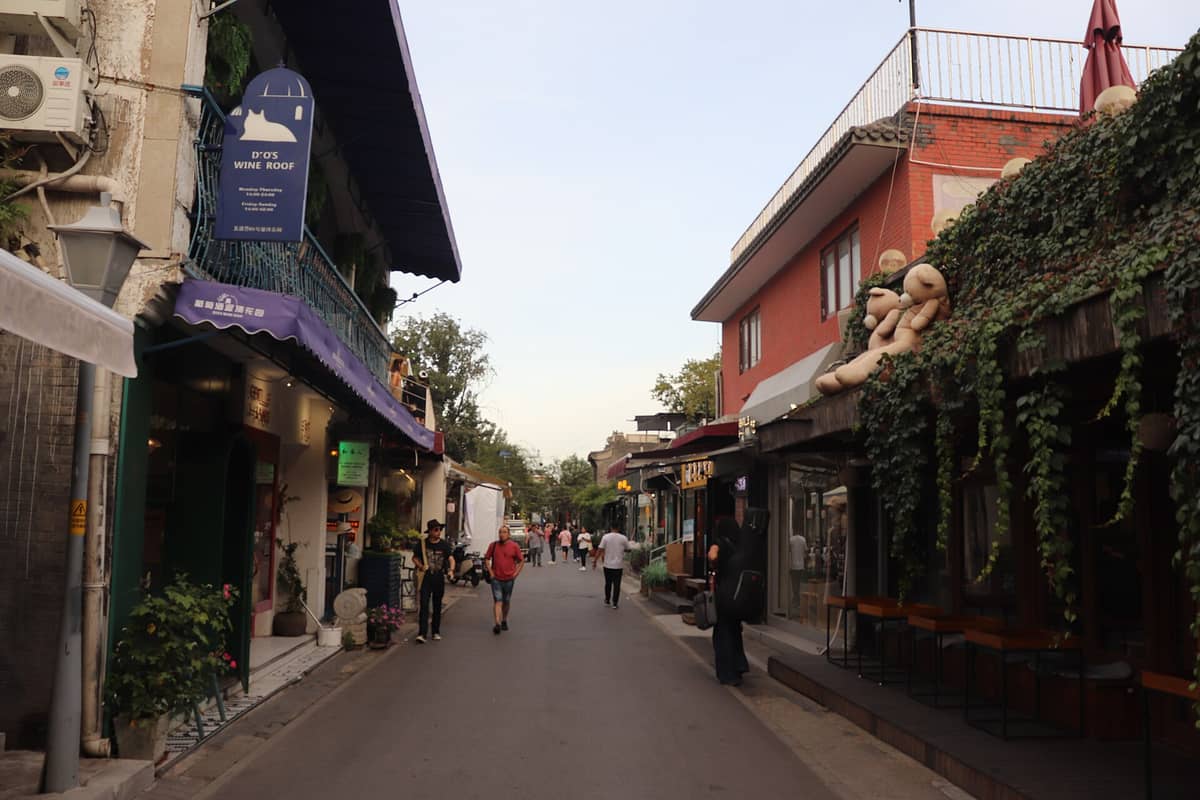
What Wudaoying Hutong Actually Is
Wudaoying Hutong (五道营胡同, Wǔdàoyíng Hútòng) is a public lane in Dongcheng District, running roughly east to west between Yonghegong Avenue and Andingmen Inner Street. At approximately 632 metres long and 6 metres wide, it is compact enough to walk end to end in under ten minutes, but interesting enough to hold your attention for considerably longer. The street is free to enter, open 24 hours, and requires no ticket or reservation of any kind.
For context: Nanluoguxiang, the hutong that most first-timers visit, draws enormous weekend crowds and has drifted toward souvenir shops and franchise snack stalls. Wudaoying has so far kept a more grounded feel. You will find independent cafes, small restaurants serving everything from Yunnanese noodles to craft beer, a smattering of lifestyle boutiques and the occasional bookshop. The mix is curated but not sterile. Residents still live here, and delivery scooters and bicycles share the lane with tourists.
💡 Local tip
To visit Wudaoying and the Lama Temple on the same morning, start at the temple when it opens, then walk roughly five minutes south to the eastern entrance of Wudaoying. That sequence avoids backtracking and keeps crowds manageable at both stops.
A Brief History of the Lane
The name Wudaoying derives from the former Wude Wei military camp associated with this area during the Ming dynasty. Military garrisons were a common feature of imperial Beijing, and the lane was later renamed Wudaoying during the Qing dynasty. When the garrison system dissolved after the fall of the Qing, the land gradually transitioned into ordinary residential use and the hutong that had grown up around the camp remained.
The place name was officially standardized as Wudaoying in 1965, part of a broader rationalization of Beijing's street names during that period. The lane did not receive significant outside attention until the 2000s, when rising rents in other hutong neighbourhoods pushed independent businesses to look for quieter, more affordable alternatives. Its proximity to the Lama Temple and the Confucius Temple and Guozijian gave it a natural tourist adjacency without requiring it to compete directly with those attractions for footfall.
Tickets & tours
Hand-picked options from our booking partner. Prices are indicative; availability and final rates are confirmed when you complete your booking.
Private Beijing Street Food Tasting Tour in Hutong
From 126 €Instant confirmationFree cancellationSmall group tour of Tian'anmen Square and the Forbidden City
From 43 €Instant confirmationFree cancellationBeijing Summer Palace Entrance Ticket
From 7 €Instant confirmationFree cancellationMutianyu Great Wall and Summer Palace small-group tour from Beijing
From 171 €Instant confirmationFree cancellation
What to Expect When You Walk It
The eastern entrance, closest to Yonghegong Lama Temple Station, is the more photogenic starting point. The grey brick walls of the courtyard houses line both sides of the lane, broken by wooden doors painted in muted reds and greens, hand-lettered signs, and the occasional potted plant arrangement spilling onto the pavement. On cooler mornings you may notice the smell of coal-briquette heating from residential courtyards, a detail that connects the lane to a way of urban life that is disappearing quickly across Beijing.
Underfoot, the surface is mostly flat asphalt with some older stone sections near private entrances. It is generally manageable for most visitors, though the uneven older paving near doorways can be tricky, and there are no dedicated accessibility facilities. Cyclists and scooters use the lane throughout the day, so walk with some awareness of your surroundings.
The commercial activity is concentrated in the middle third of the lane. Cafes tend to occupy converted courtyard spaces, which means the interiors are often larger than their narrow street frontages suggest. Some have courtyard seating; others have rooftop areas that are worth asking about. Restaurants here skew toward smaller independent operations: hand-pulled noodles, Japanese curry, craft beer bars, and a few spots with outdoor seating that work particularly well in autumn when the temperature drops and the sky is clear.
How the Atmosphere Changes Through the Day
Early morning, before around 9 a.m., Wudaoying is almost entirely a residential street. You may see older residents doing morning exercises, a shop owner arranging their frontage, or a deliveryman navigating the lane on an electric bicycle. Most of the cafes and restaurants do not open until mid-morning. This hour is genuinely quiet and worth experiencing if you are in the neighbourhood for the Lama Temple, which opens at 9 a.m.
The lane hits its commercial rhythm between roughly 10 a.m. and 8 p.m. Weekday afternoons are the most relaxed: shops are open, there is seating available at cafes, and you will not be fighting through a crowd to move. Weekends, particularly Saturday and Sunday afternoons in spring and autumn, see noticeably more visitors, though the numbers remain modest compared to more famous hutongs. By early evening the food and drink options open up further, and the lane takes on a slightly more social character, with people lingering over dinner rather than passing through.
ℹ️ Good to know
Weekday mid-morning to early afternoon (roughly 10 a.m. to 2 p.m.) is the calmest window for photography. Light enters the lane from the south at midday, which is useful for illuminating doorways and shopfronts on the north side.
Photography in Wudaoying
The lane's east-west orientation means morning light falls on the south-facing walls and afternoon light on the north-facing ones. If you are interested in photography in Beijing, early morning on weekdays offers the cleanest shots of the grey-brick architecture without crowds or delivery vehicles cluttering the frame. The wooden gates with their brass fittings, the overhead wiring strung between buildings, and the contrast between old courtyard walls and newer shop signs all make for layered street photography.
Keep in mind that this is a residential and commercial street. Photographing into private courtyards when gates are open is not appropriate. Shop owners are generally relaxed about being photographed from the lane. If you want a portrait or to photograph inside a private space, asking first is the right call.
Combining Wudaoying with the Surrounding Area
Wudaoying sits at the centre of one of Beijing's most historically layered neighbourhoods. The Lama Temple is a five-minute walk to the east, one of the most significant Tibetan Buddhist sites in China and well worth a morning visit before the hutong gets going. The Confucius Temple and the adjacent Guozijian (Imperial Academy) are a short walk south and make a coherent pair with the Lama Temple as a study of Qing-dynasty religious and educational institutions side by side. For the broader hutong context, the hutong neighbourhoods guide lays out how Wudaoying compares with other lanes across Dongcheng and Xicheng.
Further west, the Andingmen area connects to the Bell Tower and Drum Tower and the Shichahai lake district, both accessible without backtracking to the metro if you are walking. A half-day itinerary that takes in the Lama Temple, Wudaoying for lunch, and then walks west toward Houhai works well in spring or autumn when the weather is cooperative.
Practical Details and Honest Expectations
Wudaoying is a public street with no entrance gate, ticket booth, or formal visitor infrastructure. There are no luggage storage facilities, no official information desk, and no guided tour structure. Shops and restaurants set their own hours, which vary by season and individual business. If you are planning to eat at a specific place, check their hours before visiting rather than assuming they follow standard times.
Payment in shops and restaurants is almost universally handled through WeChat Pay or Alipay. Some places accept cash, but do not assume it. A few international-friendly cafes may take cards. Foreign visitors who have not set up a Chinese payment app should look into options before arriving, as this is a practical constraint across most of Beijing's smaller independent businesses, not just in Wudaoying.
Weather matters here more than at a sheltered indoor attraction. In summer (June to August), the lane offers little shade and can feel oppressive by midday. Winter visits are possible and have their own quiet appeal, but most cafe seating is indoors and the lane is less active. Spring and autumn are the most comfortable seasons, with October in particular offering clear skies and temperatures in the 8 to 20 degree range.
⚠️ What to skip
If you are expecting a curated heritage experience with English signage, historical interpretation boards, or formal visitor facilities, Wudaoying will disappoint. It is a working street, not a museum. That is its strength for some visitors and its limitation for others.
Insider Tips
- The western entrance near Andingmen Inner Street is quieter and less photographed than the eastern end. Start from the west if you want the lane largely to yourself in the first half of your walk.
- Several of the courtyard cafes have interior spaces that extend well beyond what you can see from the street. If a place looks small from outside, it is worth stepping in to check.
- Wudaoying is at its most atmospheric on weekday mornings in October and November, when autumn light is strong, crowds are thin, and the air is clear. Plan accordingly if dates are flexible.
- The lane runs directly east to the Yonghegong Lama Temple station area, making it easy to combine with the Lama Temple without any additional metro journey. Exit G from the station puts you at the eastern end of the hutong in under five minutes on foot.
- If you are doing a wider hutong walk, Wudaoying connects naturally to Guozijian Street, which has a different character: quieter, more scholarly, lined with old scholars' shops and one of Beijing's rare tree-canopied hutong streetscapes.
Who Is Wudaoying Hutong For?
- Independent travellers who want a slower, less commercialised hutong experience than Nanluoguxiang
- Food and coffee enthusiasts looking for small independent operators rather than chains
- Photographers interested in everyday Beijing street texture and traditional architecture
- Visitors combining a morning at the Lama Temple with a leisurely lunch and walk
- Repeat visitors to Beijing who have already covered the major sights and want neighbourhood-level discovery
Nearby Attractions
Other things to see while in Beijing Hutong Neighborhoods:
- Nanluoguxiang
Nanluoguxiang (南锣鼓巷), or South Gong and Drum Lane, is a historic lane in Dongcheng District dating to the Yuan Dynasty. Free to enter and open around the clock, it draws visitors with its traditional courtyard architecture, street food, independent shops, and 16 intersecting side hutongs that reveal quieter layers of old Beijing.
- Yandaixie Street
Yandaixie Street (烟袋斜街) is one of Beijing's oldest surviving commercial hutongs, stretching 232 meters from Di'anmenwai Street to Yinding Bridge. With more than 800 years of history and a Qing-era name associated with its tobacco shops, it now offers a compact, free-to-enter walk through layers of Beijing history alongside small boutiques, tea houses, and snack stalls.