Lama Temple (Yonghe Gong): Beijing's Living Tibetan Buddhist Sanctuary
Yonghe Gong, widely known as the Lama Temple, is one of the largest and most significant Tibetan Buddhist monasteries outside Tibet. Built in 1694, it remains an active place of worship in central Dongcheng, drawing both devout pilgrims and curious visitors to its incense-filled courtyards and towering gilded halls.
Quick Facts
- Location
- No. 12 Yonghegong Street, Dongcheng District, Beijing
- Getting There
- Yonghegong Station, Lines 2 or 5 (direct exit to temple gate)
- Time Needed
- 1.5 to 2.5 hours
- Cost
- CNY 25 full price / CNY 12 half price (verify before visiting)
- Best for
- Architecture enthusiasts, Buddhist culture, photography, history
- Official website
- www.yonghegong.cn
What Is Yonghe Gong and Why Does It Matter?
The Lama Temple, officially named Yonghe Gong (雍和宫), began its life not as a religious institution but as a residential palace. Built in 1694 during the Qing Dynasty, it served as the private residence of Yinzhen, the fourth son of Emperor Kangxi. When Yinzhen ascended the throne in 1722 as the Yongzheng Emperor, the property was elevated to imperial palace status. After Yongzheng's death, his son the Qianlong Emperor converted the compound into a Tibetan Buddhist lamasery in 1744, a strategic move designed to strengthen ties with Mongolian and Tibetan peoples across the empire.
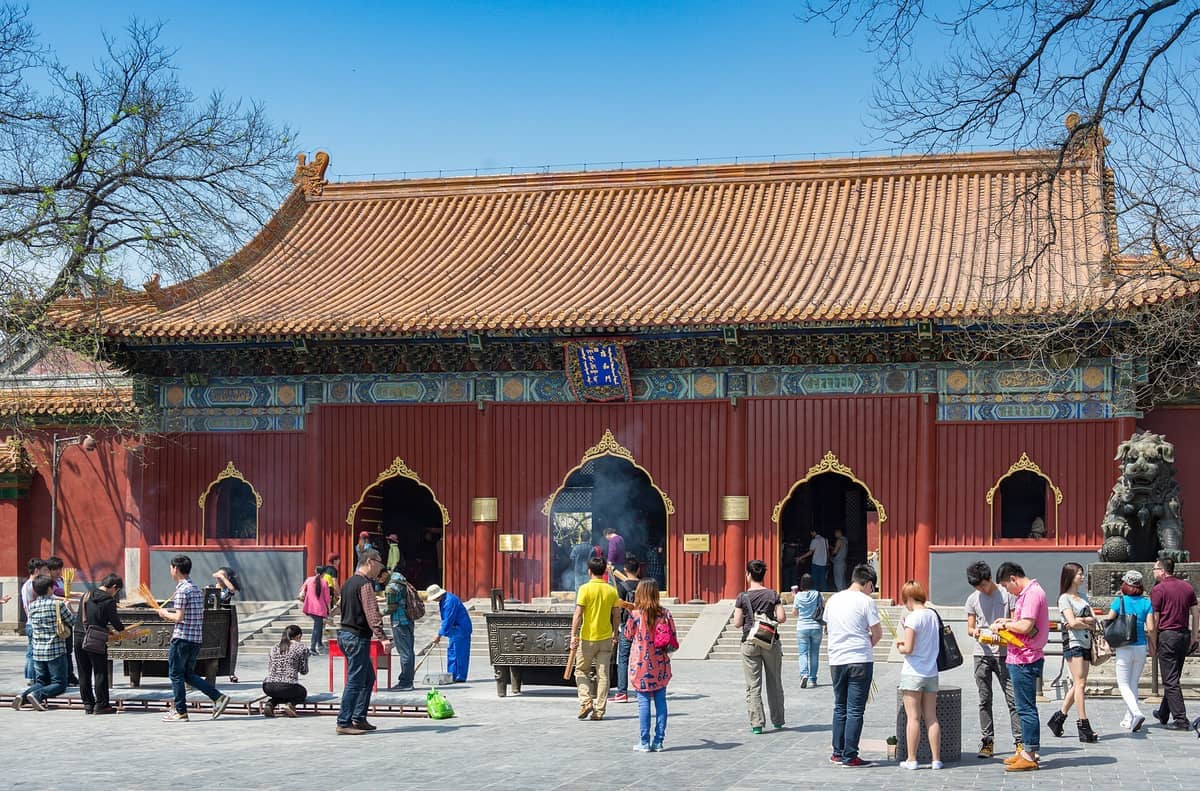
That political calculation produced one of the most architecturally layered religious complexes in East Asia. The site blends Han Chinese, Tibetan, Mongolian, and Manchu design traditions along a single north-south axis stretching roughly 480 meters. Today Yonghe Gong is both a functioning monastery, home to resident monks from Inner Mongolia, and a protected national landmark. That dual identity gives the site an atmosphere you will not find at purely museumified temples: the incense smoke is real, the chanting is real, and so is the devotion.
ℹ️ Good to know
Opening hours: April 1 to October 31, 09:00–17:00 (last ticket 16:30). November 1 to March 31, 09:00–16:30 (last ticket 16:00). Verify hours with the official website before your visit.
Arriving and First Impressions
The walk from Yonghegong subway station to the temple gate takes under five minutes. You will smell the complex before you see it: thick, sweet clouds of sandalwood incense from the vendors lining the approach road. The gate area fills quickly on weekend mornings, particularly on the first and fifteenth days of the lunar calendar, when local Buddhist worshippers arrive in large numbers. If you arrive around 09:00 on a weekday, the courtyard light is soft and angled, and the crowds are manageable.
The entry process is straightforward: purchase your ticket at the gate, pass through a brief security check, and collect a free incense bundle offered to visitors. Holding that incense while navigating the courtyards is optional but gives you an immediate sense of the rhythm of the place. Many visitors do not light it; others use it at every altar. Follow the crowd's lead if you are uncertain.
💡 Local tip
Arrive within the first 30 minutes of opening on a weekday for the quietest experience. By 10:30 on weekends and during Chinese national holidays, the main courtyards become very congested.
Tickets & tours
Hand-picked options from our booking partner. Prices are indicative; availability and final rates are confirmed when you complete your booking.
Private Tour of Lama Temple, Confucius Temple and Imperial College
From 40 €Instant confirmationFree cancellationLama Temple entrance tickets in Beijing
From 6 €Instant confirmationFree cancellationSmall group tour of Tian'anmen Square and the Forbidden City
From 43 €Instant confirmationFree cancellationBeijing Summer Palace Entrance Ticket
From 7 €Instant confirmationFree cancellation
The Five Courtyards: A Practical Walkthrough
Yonghe Gong is organized around five successive courtyards, each presided over by a main hall. The spatial sequence is deliberate: each courtyard sits slightly higher than the last, and each hall is taller than the one before, building both physical and spiritual momentum as you move north.
The first significant structure is the Hall of the Heavenly Kings (Tianwang Dian), where a large gilded Maitreya Buddha faces the entrance and four Heavenly King guardian figures flank the walls. The detail work on these figures is remarkably fine, and because this hall sees less congestion than those further north, it rewards slow examination. The second courtyard opens to the Hall of Harmony and Peace (Yonghe Gong Hall), the temple's central hall and the one from which the entire complex takes its name. Three Buddhas representing past, present, and future sit behind a wall of offering smoke.
Further north, the Hall of Everlasting Protection (Yongyou Dian) contains three medicine Buddhas, and the Hall of the Wheel of the Law (Falun Dian) is where you are most likely to encounter resident monks conducting prayer rituals. The chanting audible here in early morning carries across the courtyard and is one of the most distinctive sensory experiences the temple offers. The final and northernmost hall, the Wanfu Pavilion, houses the centerpiece of the entire compound: an 18-meter-tall standing Buddha carved from a single piece of white sandalwood. The statue extends across three upper floors of the pavilion, and you can view it from a series of interior balconies. It was reportedly presented to the Qianlong Emperor by the seventh Dalai Lama, and it holds the Guinness World Record for the tallest sandalwood statue.
How the Temple Changes Through the Day
The early morning hours, especially in autumn and winter, bring a particular stillness to Yonghe Gong. The incense smoke rises vertically in cold, calm air, the courtyards are half-empty, and the bronze censers emit a constant low warmth. This is when the temple most clearly reveals its dual function: ordinary Beijing residents come to pray quietly at the side altars while tourists photograph the rooflines.
By late morning the dynamics shift noticeably. Tour groups arrive in organized waves, and the central pathway through each courtyard becomes a moving corridor of people. The side halls and covered walkways along the east and west perimeter offer breathing room, and they contain smaller exhibition spaces with Buddhist artworks, thangka paintings, and religious objects that many visitors miss entirely by keeping to the central axis.
Afternoon visits in summer can be uncomfortable: the main courtyards receive full sun, the stone pavement radiates heat, and there is limited shade. In spring and autumn, afternoons are more forgiving. By 15:30 on most days, the crowd thins perceptibly as tour groups depart, giving the final hour before closing a reflective quality worth seeking out.
Photography, Architecture, and What to Notice
The rooflines at Yonghe Gong are a study in imperial Chinese religious architecture. Yellow glazed tiles, reserved under Qing custom for imperial buildings, cover the main halls. The upturned eaves and ridge decorations follow Han Chinese palatial convention, while the prayer wheels embedded in the perimeter walls, the Tibetan mantra inscriptions, and the dhvaja banners signal the temple's Lamaist character. The visual grammar is deliberately layered: this was a place designed to speak to multiple audiences simultaneously.
For photography, the Wanfu Pavilion at the northern end is most rewarding in early light when the gilded ornaments catch the sun without glare. The large bronze censers in the main courtyards make strong foreground elements against the hall facades. Interior photography is generally permitted in the open halls but not in active prayer areas where monks are conducting rituals. Use judgment and follow posted signs.
The architecture fits naturally within Beijing's broader imperial heritage trail. If you are building a day around Dongcheng's historic core, consider combining Yonghe Gong with the Confucius Temple and Guozijian, which is a short walk to the west, and the Bell Tower and Drum Tower to the northwest. For a broader overview of how this temple fits into Beijing's religious landscape, the guide to Beijing's best temples puts it in useful context.
Practical Intelligence: Getting There, Dress, and Accessibility
Yonghe Gong is one of Beijing's most accessible major attractions by public transport. Take Beijing Subway Line 2 or Line 5 to Yonghegong Station; the temple's red outer wall is visible from the station exit. Bus routes 141 and 142 also stop nearby. If you are arriving by DiDi or taxi, give the driver the address: No. 12 Yonghegong Street, Dongcheng District.
Dress modestly, as you would for any religious site. There is no strict dress code enforced at the gate, but covering shoulders and knees is respectful and appropriate. The temple grounds involve uneven paving stones between the courtyards and several shallow steps at hall entrances. The official sources consulted for this guide do not detail step-free or wheelchair-accessible routes through the complex; contact the temple directly at 010-64044499 before visiting if accessibility is a concern.
If you are planning a fuller exploration of Dongcheng's historic neighborhoods, the Beijing hutong guide covers the residential lanes north and east of the temple, many of which are walkable from the Yonghe Gong gate.
Who Might Not Enjoy This Visit
Yonghe Gong is genuinely significant, but it is not the right choice for every traveler. If you are specifically interested in serene contemplative spaces, the temple's popularity works against that goal during peak hours and on public holidays, when it can feel uncomfortably compressed. Visitors who have already spent several days visiting imperial Beijing's religious and palatial sites may find the courtyards familiar in form, even if the Tibetan decorative elements differ.
Those who find paying admission to active religious sites ethically uncomfortable should note that this is a functioning monastery, not a museum, and that entry fees support its upkeep. Travelers primarily interested in Buddhist art presented in a scholarly context may find the Capital Museum a more suitable complement. And if you are visiting Beijing during Chinese New Year, the temple draws enormous crowds for traditional incense-burning rituals; check our Beijing Chinese New Year guide before planning your visit during that period.
Insider Tips
- The side halls along the east and west corridors of each courtyard contain thangka paintings and Buddhist art objects that most visitors walk past. Slowing down here gets you away from the central crush and rewards careful looking.
- The free incense bundle given at the entrance is for offering, not keepsake. If you are unsure of the protocol, watch a local visitor at one of the main censers for 30 seconds before approaching.
- The first and fifteenth days of the lunar calendar see significantly heavier attendance from local worshippers. These are also the most atmospheric times to visit if you want to observe genuine religious practice, but be prepared for a very different crowd density.
- The Wanfu Pavilion's upper balconies, accessed by internal staircases, give close-up views of the giant sandalwood Buddha's face and upper body that you cannot get from the ground floor. Most visitors stop at the entrance level; go up.
- The temple closes ticket sales 30 minutes before the listed closing time in summer and an hour before in winter. Plan your arrival accordingly if you are combining it with other afternoon stops.
Who Is Lama Temple (Yonghe Gong) For?
- Travelers with an interest in Tibetan Buddhist art and architecture
- History enthusiasts following Beijing's Qing Dynasty imperial narrative
- Photographers seeking a working religious complex with layered architectural detail
- Visitors who want to observe active devotional practice rather than a static monument
- Those building a day itinerary through Dongcheng's historic core
Nearby Attractions
Other things to see while in Dongcheng District:
- Ancient Observatory (Guguanxiangtai)
Built in 1442 during the Ming dynasty, it holds a remarkable collection of Qing-era bronze instruments and offers a rare window into imperial Chinese astronomy in central Beijing.
- Bell Tower and Drum Tower
Standing at the northern end of Beijing's ancient central axis, the Bell Tower and Drum Tower have marked time for the city since the Ming dynasty. This guide covers what to see, when to go, how to get there, and whether the climb is worth your while.
- Confucius Temple and Guozijian
The Confucius Temple and Guozijian Museum preserves two of Beijing's most historically significant sites: a Yuan dynasty Confucian temple and the Imperial College that trained China's governing elite for six centuries. Quieter than most major attractions, it rewards visitors who want genuine historical depth alongside calm, tree-shaded courtyards.
- Forbidden City (Palace Museum)
The Forbidden City, officially the Palace Museum, is the world's largest surviving imperial palace complex and Beijing's most significant cultural landmark. Built between 1406 and 1420 under Ming emperor Zhu Di, it served as the ceremonial and political heart of China for nearly five centuries. This guide covers everything you need to visit confidently.