Beijing Ancient Observatory (Guguanxiangtai): History, Instruments, and Practical Guide
Built in 1442 during the Ming dynasty, it holds a remarkable collection of Qing-era bronze instruments and offers a rare window into imperial Chinese astronomy in central Beijing.
Quick Facts
- Location
- No. 2 Dongbiaobei Hutong, Jianguomen Inner Street, Dongcheng District, Beijing
- Getting There
- Jianguomen Station, Lines 1 & 2 (2-minute walk). Buses 7, 15, 19, 27, 102, 105, 107, 111 also stop nearby.
- Time Needed
- 45–90 minutes
- Cost
- Admission prices vary; closed Tuesdays (except national public holidays). Open 09:00–16:30, last entry 16:00. Verify before visiting.
- Best for
- History lovers, science enthusiasts, photography, uncrowded sightseeing
- Official website
- www.bjp.org.cn/ggxt/index.shtml
What Is the Beijing Ancient Observatory?
The Beijing Ancient Observatory (北京古观象台, Běijīng Gǔ Guānxiàngtái) sits at the Jianguomen overpass in Dongcheng District, wedged between a six-lane arterial road and the elevated metro tracks of Lines 1 and 2. The location feels incongruous: a 580-year-old Ming dynasty observatory surrounded by modern Beijing's traffic roar. That contrast is, in itself, part of the appeal.
The site was constructed in 1442 during the reign of the Zhengtong Emperor, making it one of the oldest surviving observatory structures in the world still in its original location. The raised brick platform — approximately 15 meters high and 40 meters on each side — originally served the imperial court for tracking celestial cycles, calculating the agricultural calendar, and legitimizing dynastic authority through astronomical knowledge. For over 500 years, from the Ming through the Qing dynasty and into the early Republican era, the observatory functioned as the official state body for astronomical observation in China.
ℹ️ Good to know
The observatory is closed every Tuesday, except when Tuesday falls on a national public holiday. Last admission is at 16:00, and the site closes at 16:30. Check the official visitor information for current admission prices before your visit, as prices and hours are subject to change.
The Instruments on the Rooftop Platform
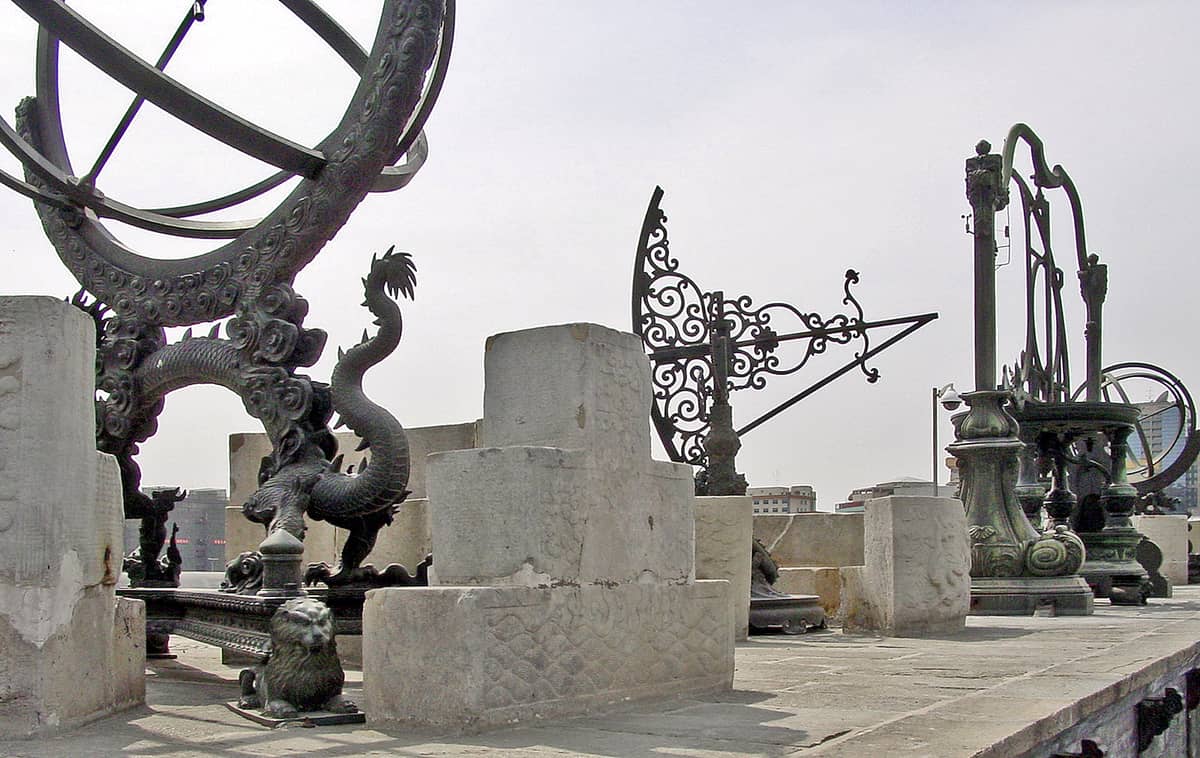
The rooftop platform is the centerpiece of any visit. Eight large bronze astronomical instruments stand here, most of them commissioned by the Kangxi Emperor in the late 17th century and built under the direction of Belgian Jesuit missionaries, particularly Ferdinand Verbiest. The instruments represent a synthesis of European scientific methodology and Chinese imperial craftsmanship: the forms reflect Western Renaissance astronomy, but every surface is cast with elaborate dragons, clouds, and celestial motifs typical of Qing decorative art.
The instruments include an equatorial armillary sphere, an ecliptic armillary sphere, a quadrant, a celestial globe, a sextant, and an altazimuth, among others. Each one is a functional astronomical device scaled to monumental proportions. The rooftop is open to the sky, so on overcast days the instruments take on a more austere quality, their green-bronze patina deepening in flat light.
💡 Local tip
Photography tip: The instruments photograph best in the two hours after opening (09:00–11:00), when low morning light rakes across the bronze surfaces and the platform is largely empty of other visitors. Afternoon light from the west is also workable, but crowds are heavier.
Tickets & tours
Hand-picked options from our booking partner. Prices are indicative; availability and final rates are confirmed when you complete your booking.
Private tour of ancient Nanjing with a local guide
From 296 €Instant confirmationFree cancellationSmall group tour of Tian'anmen Square and the Forbidden City
From 43 €Instant confirmationFree cancellationBeijing Summer Palace Entrance Ticket
From 7 €Instant confirmationFree cancellationMutianyu Great Wall and Summer Palace small-group tour from Beijing
From 171 €Instant confirmationFree cancellation
The Ground-Level Exhibition Halls
Below the platform, within the walled courtyard, several small exhibition halls present the history of Chinese astronomy in more detail. Displays cover astronomical instruments from earlier periods, the role of the observatory in imperial governance, and the Jesuit influence on Chinese science during the Qing dynasty. The exhibits include replica instruments, star charts, and explanatory panels in both Chinese and English.
The English translations in the ground-floor halls are generally clear, though some panels are more thorough than others. For visitors with a serious interest in the history of science, the exhibit contextualizing the relationship between European missionaries and the Qing court is particularly well done. It explains how Verbiest and his Jesuit predecessors navigated the politically sensitive task of introducing Western astronomical models to an imperial system that viewed celestial observation as a matter of state legitimacy, not merely scientific inquiry.
The courtyard itself is planted with old trees that provide shade in summer. On a weekday morning, this lower level is very quiet — often just a handful of visitors moving slowly between the halls. It feels more like a scholarly garden than a major tourist attraction, which suits its character.
How the Experience Changes by Time of Day and Season
Weekday mornings are the optimal time to visit. By around 09:30, the platform holds perhaps a dozen visitors at most, and the quiet is striking given the city noise just outside the walls. By midday on weekends, particularly during spring and autumn, school groups and tour parties arrive and the rooftop can feel crowded around the largest instruments.
Autumn (September through October) offers the clearest skies and the most comfortable temperatures for spending time outdoors on the platform. Spring can bring dust and wind, which affects both comfort and photography. Summer visits are feasible but the rooftop is fully exposed with almost no shade, so heat is a real consideration between 11:00 and 15:00 from June through August. Winter visits have their own reward: the bronze instruments against a cold blue sky, and the platform nearly empty on weekday mornings.
Air quality in Beijing varies considerably by season and weather patterns. On days with poor air quality, the atmospheric haze can reduce visibility and affect outdoor photography. If you're planning to prioritize the observatory's open-air rooftop, it's worth checking current air quality conditions before you go. For help planning your broader schedule around conditions and crowds, the best time to visit Beijing guide has practical seasonal advice.
Historical and Cultural Context
The observatory operated from 1442 until 1929, adapting across Ming and Qing dynastic transitions and surviving the turbulence of the late imperial period. During the early twentieth century, some instruments were removed from China and later returned; consult the official historical account for the documented history of each instrument.
This history of removal and return gives the instruments a particular resonance. They are not replicas. Several Qing-era instruments are associated with Ferdinand Verbiest, whose design and manufacturing supervision are credited for six of the major instruments displayed at the observatory.
The observatory fits into a broader tradition of imperial Beijing as a city designed to reflect cosmological order. The Forbidden City, the Temple of Heaven, and the observatory all served roles in maintaining the ritual and astronomical framework of dynastic legitimacy. For more on how that history shaped the capital's geography and monuments, the Beijing imperial history guide provides useful background.
Getting There and Practical Navigation
Take Line 1 or Line 2 to Jianguomen Station and walk to the observatory's entrance at No. 2 Dongbiaobei Hutong. Check current Beijing transit information for nearby bus routes before traveling.
The main challenge for visitors requiring step-free access is the platform itself. The rooftop — where all eight major bronze instruments are located — is reached by climbing steep historic brick stairs. The official visitor information does not confirm step-free access, lifts, or accessible toilet facilities. Visitors with mobility requirements should contact the site directly at +86 10 65265010 before visiting to confirm what arrangements are available.
The observatory sits in Dongcheng District, within reasonable distance of several other significant sites. Tiananmen Square and the Forbidden City are accessible on the same metro line. The district is one of Beijing's most historically dense, and a half-day itinerary pairing the observatory with a walk through the nearby hutong streets is entirely practical.
Honest Assessment: Is It Worth Your Time?
At the current admission price and under 90 minutes, the Beijing Ancient Observatory punches well above its weight for the right visitor. The rooftop bronze instruments are genuinely impressive objects: monumental in scale, extraordinary in their craft, and loaded with historical significance. There is nothing quite like them elsewhere in Beijing.
That said, this is a small, specialist site. The total area is compact, the exhibits require some intellectual engagement to appreciate, and visitors looking primarily for spectacle may find it underwhelming compared to larger, more theatrical attractions. There are no dramatic views from the platform, no dramatic light shows, and no food vendors inside.
For travelers who enjoy the history of science, astronomy, or the intersection of Eastern and Western knowledge traditions, the observatory is a genuine highlight. For families with younger children, it can work as a short stop, particularly if combined with a visit to the Beijing Planetarium in Haidian, which offers more interactive exhibits designed for younger audiences. The observatory's own atmosphere is contemplative rather than child-focused.
⚠️ What to skip
Who should consider skipping: Visitors with significant mobility limitations will not be able to access the rooftop instruments via the original brick stairways. Confirm accessibility arrangements in advance by calling +86 10 65265010. Also note that the ground-floor exhibits alone — without rooftop access — represent only a partial experience of the site.
Insider Tips
- Arrive at opening time on a weekday to have the rooftop platform almost entirely to yourself. By 10:30 on weekends the space can feel cramped around the most photographed instruments.
- The bronze instruments are outdoors and unprotected. On rainy days the platform can be slippery, and wet bronze loses the depth of color that makes the instruments so photogenic. Overcast days without rain are actually excellent for soft, even lighting on the textured metal surfaces.
- The site is administered by the Beijing Planetarium. If you have a strong interest in astronomy history, check the Beijing Planetarium's website before visiting for current visitor information and any announced programs.
- The observatory is easy to combine with a walk east along Jianguomen Inner Street toward the diplomatic quarter, or west toward Wangfujing. It makes a natural first or last stop on a Dongcheng half-day itinerary rather than a standalone trip.
- Look carefully at the decorative castings on the Qing-era instruments. Each base and ring assembly has different motifs — dragons, clouds, wave patterns — that reflect their individual casting dates and ceremonial functions. This detail is easy to miss if you move through quickly.
Who Is Ancient Observatory (Guguanxiangtai) For?
- History of science enthusiasts and anyone interested in the exchange between European and Chinese intellectual traditions
- Photography travelers seeking unusual subjects: ornate bronze instruments against Beijing's skyline have a visual quality unlike any other site in the city
- Travelers who want a significant historical site without large crowds or long queuing times
- First-time Beijing visitors building an imperial history itinerary across Dongcheng District
- Visitors with limited time who need a genuinely substantive attraction that can be completed in under two hours
Nearby Attractions
Other things to see while in Dongcheng District:
- Bell Tower and Drum Tower
Standing at the northern end of Beijing's ancient central axis, the Bell Tower and Drum Tower have marked time for the city since the Ming dynasty. This guide covers what to see, when to go, how to get there, and whether the climb is worth your while.
- Confucius Temple and Guozijian
The Confucius Temple and Guozijian Museum preserves two of Beijing's most historically significant sites: a Yuan dynasty Confucian temple and the Imperial College that trained China's governing elite for six centuries. Quieter than most major attractions, it rewards visitors who want genuine historical depth alongside calm, tree-shaded courtyards.
- Forbidden City (Palace Museum)
The Forbidden City, officially the Palace Museum, is the world's largest surviving imperial palace complex and Beijing's most significant cultural landmark. Built between 1406 and 1420 under Ming emperor Zhu Di, it served as the ceremonial and political heart of China for nearly five centuries. This guide covers everything you need to visit confidently.
- Guijie Ghost Street
Guijie, officially Dongzhimennei Dajie, is a 1.4-kilometer stretch of more than 100 restaurants in Dongcheng District that comes alive after dark. Known for spicy crawfish, hot pot, and hundreds of red lanterns, it is one of the few places in Beijing where serious eating happens well past midnight. Entry is free.