Tiananmen Square: Beijing's Vast Political and Historical Heart
Tian'anmen Square is one of the largest public squares in the world, covering approximately 440,000 square metres at the centre of Beijing. Free to enter but requiring advance reservation, it sits at the intersection of imperial history and modern China, framed by monuments, mausoleums, and the iconic Gate of Heavenly Peace.
Quick Facts
- Location
- East Chang'an Avenue, Dongcheng District, Beijing
- Getting There
- Tian'anmen East or Tian'anmen West (Line 1)
- Time Needed
- 1 to 2 hours for the square itself; longer if combining with the Forbidden City
- Cost
- Free; real-name advance reservation typically required (1–7 days ahead)
- Best for
- History, photography, understanding modern China, flag-raising ceremony
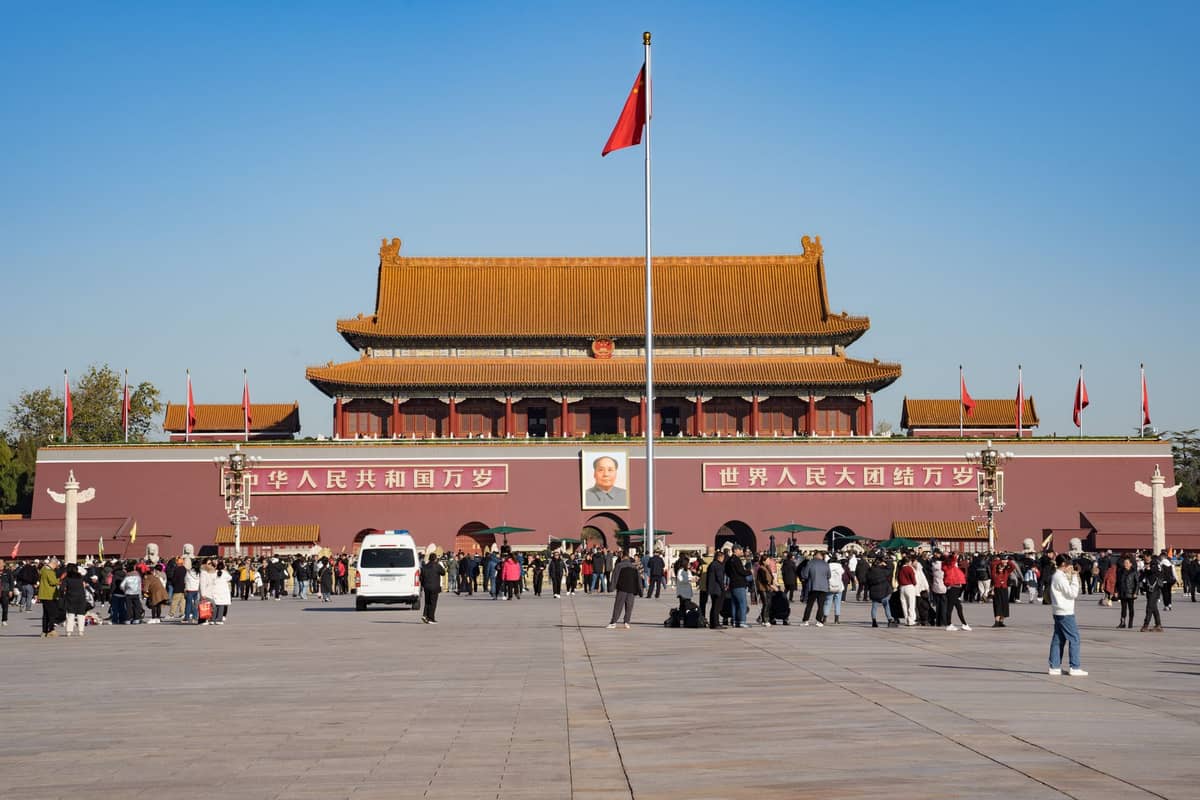
What Tian'anmen Square Actually Is
Tian'anmen Square (天安门广场) is a vast ceremonial and public square occupying the geographic and symbolic centre of Beijing. Stretching 880 metres north to south and 500 metres east to west, it covers roughly 440,000 square metres, making it one of the largest public squares on earth. Walking from one end to the other takes a solid ten minutes at a moderate pace, and first-time visitors are often caught off guard by the sheer scale of the open paving stones under their feet.
The square is ringed by major structures: the Gate of Heavenly Peace (Tian'anmen) to the north, with its famous portrait of Mao Zedong; the Mao Zedong Memorial Hall at the south end; the Monument to the People's Heroes rising from the centre; the Great Hall of the People along the western edge; and the National Museum of China to the east. These buildings collectively frame the square as a stage for national identity rather than a relaxed public park.
ℹ️ Good to know
Reservation required: Visitors generally need to book a visit in advance through the official reservation platform using real-name registration, typically 1 to 7 days ahead. Older visitors, children, and people with disabilities may have a relative make the reservation on their behalf, or request on-site assistance from staff. Verify current requirements before you travel, as procedures can change.
The Historical Weight of the Place
On October 1, 1949, Mao Zedong stood on the rostrum above Tian'anmen Gate and proclaimed the founding of the People's Republic of China. That single moment made this square inseparable from the story of modern China. The square as it exists today, however, is largely a product of the 1950s and 1970s, reshaped and expanded to serve as a backdrop for mass political gatherings and national ceremonies.
The name Tian'anmen, meaning Gate of Heavenly Peace, predates the square by centuries. The gate itself was first constructed in 1420 during the Ming Dynasty as the southern entrance to the Imperial City. The open expanse that now spreads south of it was created by clearing older urban fabric during the mid-20th century, transforming what had been a walled imperial precinct into a deliberately immense public plaza.
Visitors interested in understanding how this fits into Beijing's broader imperial history will find useful context in the Beijing imperial history guide, which traces the city's development from the Mongol Yuan dynasty through to the Qing.
Tickets & tours
Hand-picked options from our booking partner. Prices are indicative; availability and final rates are confirmed when you complete your booking.
Mutianyu Great Wall, Tiananmen Square and Forbidden City Private Tour
From 314 €Instant confirmationFree cancellationTiananmen Square, Forbidden City and Mutianyu Great Wall tour
From 355 €Instant confirmationFree cancellationRegistration service for Tiananmen Square in Beijing
From 4 €Instant confirmationFree cancellationSmall group tour of Tian'anmen Square and the Forbidden City
From 43 €Instant confirmationFree cancellation
The Flag Ceremony: Worth an Early Start
The most choreographed moment at Tian'anmen Square is the daily flag-raising ceremony, which takes place at sunrise. A precision military guard marches from the gate to the flagpole at the centre of the square and raises the national flag at exactly the moment the sun clears the horizon. The timing varies by day of the year and is published in advance on official schedules.
This ceremony draws large crowds, especially on weekends, national holidays, and dates of political significance. Arriving 30 to 45 minutes early is advisable during peak seasons. In the cold predawn of a Beijing winter, temperatures can drop well below zero, so layer up. In summer, the same early start spares you the harshest heat, and the square feels less relentlessly exposed before the sun climbs.
💡 Local tip
The square opens at 05:00 and closes at 22:00. Arriving close to opening time on a clear autumn morning gives you the best combination of soft light, manageable crowds, and comfortable temperatures. Autumn, roughly September to October, is widely considered the most pleasant season for this kind of extended outdoor visit in Beijing.
What the Square Feels Like at Different Hours
Early morning, in the first hour after opening, is when the square most resembles a place of quiet contemplation. The stone pavement catches the low light and the portrait of Mao above the gate is clear against the sky. Domestic tourists, many of whom have traveled long distances specifically for this visit, move slowly and photograph everything. The atmosphere is reverent rather than festive.
By mid-morning, the square fills steadily and the sensory register shifts. Security checkpoints process a continuous flow of visitors, and the paving stones radiate heat under the open sky. There is no shade anywhere in the central square. The smell of sunscreen mixes with the concrete warmth rising from underfoot. School groups in matching caps move in formation. Vendors outside the perimeter sell water and hats.
Midday in summer is genuinely punishing. The square offers no shelter, and surface temperatures on the paving can feel intense underfoot. Visiting between roughly 11:00 and 14:00 in July or August is an endurance exercise rather than a pleasure. By contrast, in winter the square is biting cold but often brilliantly clear, with a quality of light that is hard to find in the hazy summer months. Air quality in Beijing varies significantly by season and weather conditions, so checking a current air quality index before your visit is worthwhile.
Late afternoon light softens the square's severe geometry. The crowds thin somewhat after 16:00 on weekdays, though the flag-lowering ceremony at sunset draws another wave of spectators. By evening, the square takes on a different quality: families stroll, the lighting changes the colour of the stone, and the political grandeur gives way to something closer to an ordinary public space.
Practical Walkthrough: Security, Layout, and Movement
Entry requires passing through a security checkpoint, and visitors should carry identification. Large bags and liquids are subject to screening. Photography is permitted across most of the square, but rules around government buildings and certain areas can be strictly enforced. If in doubt, observe what other visitors are doing or ask a member of staff. Photography restrictions and security protocols around major political venues can change, especially ahead of national holidays or significant dates.
The most logical approach for most visitors is from Tian'anmen East or Tian'anmen West station on Beijing Subway Line 1. Both exits place you immediately adjacent to the northern edge of the square and the gate. The walk from the station to the centre of the square takes just a few minutes, but allow time for security queuing, which can be substantial on busy days.
The Forbidden City sits directly north of the gate and is almost always visited in the same trip. Note that the Forbidden City requires a separate, advance ticket and has its own entry system. Planning both in one day is feasible but requires booking both in advance and pacing yourself, as the Forbidden City alone covers 72 hectares.
For a broader orientation to this part of central Beijing, the getting around Beijing guide covers subway navigation, transit card options, and how to move efficiently between major Dongcheng attractions.
Who Will Get the Most from This Visit — and Who Might Not
Tian'anmen Square rewards visitors who approach it with some historical context. For those who understand its role in 20th-century Chinese history, and the weight that Chinese citizens often attach to this place, the visit carries real meaning. Walking across 440,000 square metres of stone that witnessed some of the defining events of modern China is not the same as touring a pleasant plaza.
That said, the square itself contains relatively little to see in the conventional tourist sense. There are no exhibits, no greenery, no cafes, and no opportunity for the kind of wandering exploration that makes a neighbourhood walk satisfying. Visitors who prefer active, layered, or intimate experiences may find 30 minutes here is plenty before moving on.
Travellers who come primarily for sensory or cultural depth might find more texture in Nanluoguxiang or the hutong neighborhoods nearby. But skipping the square entirely when you're in central Beijing would be an unusual choice; it earns its place on any first-time itinerary simply because of what it represents.
Visitors with limited mobility should be aware that the square is a large, open, flat paved area. There is no seating within the square itself, and distances between entry points and key structures are considerable. The official visitor guidance does not detail accessible entrances or facilities, so travelers with specific accessibility needs should contact the authorities directly or check the official website before visiting.
Photography Tips
The iconic shot of Mao's portrait on the Gate of Heavenly Peace is best captured from the southern end of the square on a clear day, with a wide-angle lens or the widest setting on a phone camera. Morning light from the east illuminates the gate's facade directly. By afternoon, the gate falls into shadow or flat light depending on season.
For a more detailed approach to photography in and around Beijing's major monuments, the Beijing photography guide covers timing, locations, and practical advice for common sites including this square and the surrounding area.
Overcast days, though less dramatic, often produce cleaner, more evenly exposed images of the monuments without the harsh shadows that a bright midday sun creates on the open paving. Haze from air pollution can reduce visibility and colour saturation, particularly in summer, so checking air quality readings before a photography-focused visit is practical, not optional.
Insider Tips
- Book your reservation as early as the system allows (typically up to 7 days ahead) if your visit falls near a national holiday. October 1, National Day, draws enormous crowds and the square operates under heightened logistical controls.
- The Monument to the People's Heroes at the centre of the square is inscribed with text in Mao Zedong's calligraphy on one face and Zhou Enlai's on another. Most visitors walk past without stopping — take a moment to read the inscriptions if you have any knowledge of the revolutionary history referenced.
- Wear comfortable, flat-soled shoes. The paving stones are smooth and cover a long distance. There is nowhere to sit and rest inside the square, so tired feet become a real issue on a longer visit.
- If you plan to visit the Forbidden City on the same day, book its tickets before your trip, not the morning of your visit. Ticket availability for the Forbidden City is limited and frequently sells out days in advance during peak seasons.
- On very clear winter days, the combination of clean air and low-angle sun produces some of the most photogenic conditions of the year. Cold temperatures keep crowds smaller than at any other time.
Who Is Tiananmen Square For?
- First-time visitors to Beijing wanting to understand the country's modern political identity
- History and politics enthusiasts with background knowledge of 20th-century China
- Photographers seeking the iconic Gate of Heavenly Peace composition at sunrise
- Travellers combining a morning at the square with an afternoon at the Forbidden City
- Families with older children who can appreciate the historical significance
Nearby Attractions
Other things to see while in Dongcheng District:
- Ancient Observatory (Guguanxiangtai)
Built in 1442 during the Ming dynasty, it holds a remarkable collection of Qing-era bronze instruments and offers a rare window into imperial Chinese astronomy in central Beijing.
- Bell Tower and Drum Tower
Standing at the northern end of Beijing's ancient central axis, the Bell Tower and Drum Tower have marked time for the city since the Ming dynasty. This guide covers what to see, when to go, how to get there, and whether the climb is worth your while.
- Confucius Temple and Guozijian
The Confucius Temple and Guozijian Museum preserves two of Beijing's most historically significant sites: a Yuan dynasty Confucian temple and the Imperial College that trained China's governing elite for six centuries. Quieter than most major attractions, it rewards visitors who want genuine historical depth alongside calm, tree-shaded courtyards.
- Forbidden City (Palace Museum)
The Forbidden City, officially the Palace Museum, is the world's largest surviving imperial palace complex and Beijing's most significant cultural landmark. Built between 1406 and 1420 under Ming emperor Zhu Di, it served as the ceremonial and political heart of China for nearly five centuries. This guide covers everything you need to visit confidently.