Beijing's Bell Tower and Drum Tower: Imperial Timekeepers on the Central Axis
Standing at the northern end of Beijing's ancient central axis, the Bell Tower and Drum Tower have marked time for the city since the Ming dynasty. This guide covers what to see, when to go, how to get there, and whether the climb is worth your while.
Quick Facts
- Location
- No. 9 Zhonglouwan Hutong, Dongcheng District, Beijing
- Getting There
- Shichahai Station (Line 8), approx. 400 m walk north; buses 5, 60, 82, 107, 124, 135 to Gulou stop
- Time Needed
- 1.5 to 2.5 hours for both towers
- Cost
- Combined ticket CNY 30 (full) / CNY 15 (half); Drum Tower CNY 20 / CNY 10; Bell Tower CNY 15 / CNY 7
- Best for
- History enthusiasts, architecture lovers, rooftop views over hutong neighborhoods
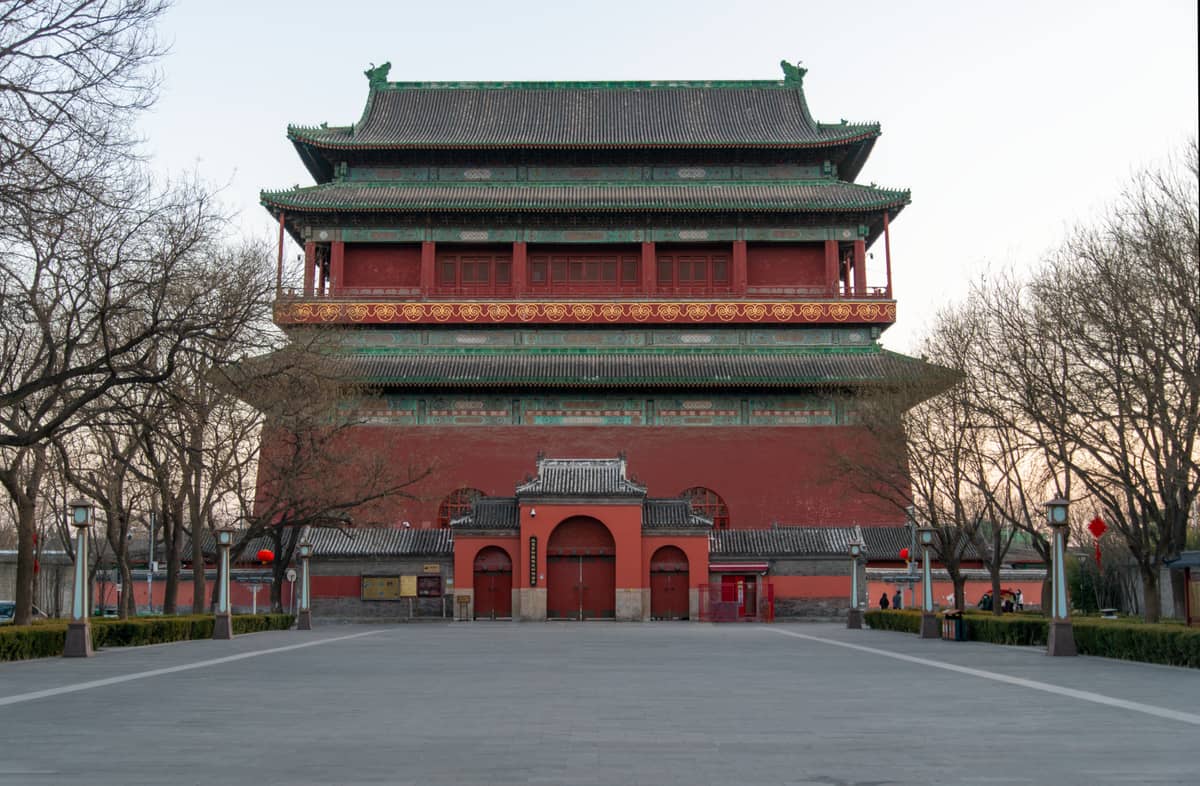
What the Bell Tower and Drum Tower Actually Are
The Bell Tower and Drum Tower (北京钟鼓楼, Běijīng Zhōnggǔlóu) are two separate but paired structures that once served as Beijing's official public timekeepers. For centuries, the drums signaled the hours of the day while the bell marked the night watches, coordinating daily life across a city of millions. They stand at the northern terminus of the imperial central axis, the same invisible spine that runs through the Forbidden City and Tiananmen Square to the south. That axis, stretching roughly 7.8 kilometers, was declared a UNESCO World Heritage Site in 2024, and these towers are among its defining northern anchors.
The present Drum Tower dates to 1539, a Ming dynasty reconstruction of an earlier Yuan-era structure. The Bell Tower, positioned directly north of the Drum Tower at a distance of about 100 meters, has been rebuilt multiple times over the centuries. The present Drum Tower dates to 1539, a Ming dynasty reconstruction of an earlier Yuan-era structure. The Bell Tower, positioned directly north of the Drum Tower at a distance of about 100 meters, has been rebuilt multiple times over the centuries.
ℹ️ Good to know
Opening hours differ by season. Peak season (April 26 to October 25): 09:30–17:30. Off-season (October 26 to April 25): 09:30–16:30. Ticket sales end 30 minutes before closing. The Drum Tower's first-floor exhibition hall is closed on Mondays, except on public holidays.
The Drum Tower: Steep Stairs, Ancient Drums, and a City Laid Out Below
Most visitors start with the Drum Tower, the larger and more visually commanding of the two buildings. The ground floor houses a permanent exhibition tracing the history of timekeeping in imperial China, with reproductions of ancient water clocks, annotated maps of the central axis, and panels explaining how drum beats were coded to transmit different hours. The exhibition has English captions throughout and is genuinely informative rather than decorative.
The climb to the upper level is not casual. A steep, narrow wooden staircase with a gradient closer to a ladder than a typical museum stair rises directly from the first floor. The steps are original and worn smooth by centuries of use, with a rope handrail on one side. Anyone with knee problems, a fear of heights, or difficulty with steep stairs should think carefully before attempting it. Children who are steady on their feet manage it fine, but younger toddlers need to be carried.
At the top, the chamber contains a set of large replica drums arranged around the hall, alongside the single remaining original drum, its surface split and scarred. The replica drums are played by staff at scheduled intervals during the day, and when they strike, the sound is physically felt as much as heard. Arrive a few minutes before a performance if you want a good position. The upper gallery also opens onto a balcony offering a 360-degree view over the gray-tile rooftops of the surrounding hutong neighborhoods, with the Bell Tower directly to the north and the city beyond.
💡 Local tip
Drum performance schedules are posted at the entrance and usually occur several times daily. Confirm the schedule at the ticket window when you arrive, as timing can shift by season or for maintenance.
Tickets & tours
Hand-picked options from our booking partner. Prices are indicative; availability and final rates are confirmed when you complete your booking.
Wuhan private guided tour with Yellow Crane Tower and Hubei Museum
From 319 €Instant confirmationFree cancellationSmall group tour of Tian'anmen Square and the Forbidden City
From 43 €Instant confirmationFree cancellationBeijing Summer Palace Entrance Ticket
From 7 €Instant confirmationFree cancellationMutianyu Great Wall and Summer Palace small-group tour from Beijing
From 171 €Instant confirmationFree cancellation
The Bell Tower: Quieter, Taller, and Worth the Extra Ticket
The Bell Tower stands about 47.9 meters high, making it slightly taller than the Drum Tower, and feels considerably quieter once you are inside. The interior is dominated by the original iron bell, which dates to the Ming dynasty. Its statistics are hard to appreciate until you stand next to it: 7.02 meters high, a base diameter of 3.4 meters, and a weight of 63 tonnes. The bell fills almost the entire ground-floor chamber, and there is barely enough room to walk a full circuit around it.
The staircase in the Bell Tower is equally steep, but the upper level is less crowded than the Drum Tower because fewer visitors make the short walk north from one building to the other. The view from the Bell Tower's upper platform looks back south over the courtyard and the Drum Tower, then continues down toward the axis and the dense urban fabric of Dongcheng beyond. On a clear autumn morning, you can make out the distant outline of the Jingshan hill with the pavilion at its summit.
If you have already visited Jingshan Park earlier in the day, the Bell Tower's southern view will orient you immediately. The central axis becomes legible from up here in a way that no map quite conveys.
How the Experience Changes by Time of Day
Early morning is the most atmospheric time to arrive. Between 09:30 and 10:30, the courtyard between the two towers fills with older residents doing slow exercises or playing cards at the stone tables. The light is low and directional in autumn and winter, catching the gray brickwork and red lacquer columns at an angle that gives both towers real visual weight. Tour groups are largely absent at this hour.
By midday, particularly on weekends and during national holidays, the square becomes noticeably crowded and the staircase queues lengthen. The drum performances attract clusters of visitors, and the balcony at the top of the Drum Tower can feel cramped during peak periods from May to October. If your schedule allows, a Tuesday or Wednesday morning in late September or October hits the best combination of light, temperature, and thin crowds.
Late afternoon has its own appeal. The low western sun turns the brick facades orange-red and the shadows from the eaves lengthen dramatically. By 16:30 in the off-season, most group tours have already left. The square empties out, and it becomes possible to stand at the base of the Drum Tower and look up without a crowd shifting around you. Keep your eye on the closing time, as staff begin clearing the upper galleries thirty minutes before the official cutoff.
Getting There and the Surrounding Neighborhood
The most direct route is Beijing Subway Line 8 to Shichahai Station, then a roughly 400-meter walk north through the lanes. The walk itself is worthwhile: the streets between the station and the towers pass through one of Beijing's better-preserved hutong grids, and you are likely to catch glimpses of courtyard homes, small local restaurants, and the occasional workshop. The broader Shichahai lake area is immediately southwest, making a natural combination for an afternoon visit.
If you prefer buses, routes 5, 60, 82, 107, 124, and 135 stop near Gulou, a short walk from the towers. Taxis and ride-hailing via DiDi work reliably in this area and are a practical option with luggage or young children. The surrounding Dongcheng District is walkable and well-connected, so combining the towers with nearby sites like Nanluoguxiang or the hutong lanes around Yandaixie Street is straightforward without extra transit.
💡 Local tip
If you arrive by subway, consider walking back a different way: the lane running northeast from the Bell Tower toward Guozijian passes through some of the quietest residential hutongs in central Beijing.
Practical Details Worth Knowing Before You Go
The combined ticket at CNY 30 (full price) covers both towers and is the obvious choice for most visitors. There is no compelling reason to buy each ticket separately unless you are certain you want only one building. Half-price tickets are available for eligible groups including seniors and students; bring documentation. People with disabilities qualify for reduced admission under the official pricing schedule, though the site's official listings do not detail step-free access or lift availability, and the internal staircases at both towers are steep and narrow. Visitors with significant mobility limitations should check directly with the venue before visiting.
Photography is permitted throughout both towers and on the exterior terraces. The upper gallery of the Drum Tower is the better photography position: you can frame the Bell Tower to the north with the hutong roofscape behind it, and the courtyard below makes for a clean, uncluttered foreground. A wide-angle lens or a standard smartphone camera handles the space well. Tripods are impractical on the narrow staircases and would block other visitors on the upper platforms.
There are no dedicated cafes or food vendors inside the site. The courtyard has some benches, and there are small restaurants and snack shops in the lanes immediately surrounding the square. Bring water, particularly in summer when the climb in the heat can be tiring. Toilets are available at the base of both towers.
Weather affects the experience significantly. In Beijing's winters, which run roughly from November to February, temperatures can drop to minus five degrees Celsius or lower, and the wind on the upper terraces is biting. Layers and a hat matter. In summer, particularly July and August, the climb in high humidity and heat is uncomfortable, and the wooden stairs hold warmth. The best months for this visit align with Beijing's general travel calendar: see the best time to visit Beijing for a fuller breakdown.
Historical Context: Why These Buildings Still Matter
Beijing's central axis has organized the city's layout since the Yuan dynasty, and the Drum Tower and Bell Tower have stood at its northern end for most of that history. In a city where imperial regulations and collective life were tightly synchronized, the towers were functional infrastructure, not monuments. The drums and bell told residents when to rise, when markets opened, when the city gates closed for the night, and when the palace changed its night watch. The system was precise by pre-industrial standards, calibrated to divisions of day and night that shifted with the seasons.
That system was retired with the fall of the Qing dynasty in 1912, and the towers spent most of the twentieth century in various states of use and neglect. The recent restoration work, completed ahead of the towers' inclusion in the UNESCO central axis heritage listing, has returned both buildings to a condition closer to their Ming and Qing appearance. For visitors following Beijing's imperial history through its surviving structures, these towers are among the most legible and least crowded of the major sites.
Insider Tips
- Buy the combined CNY 30 ticket at the Drum Tower entrance rather than separate tickets: the cashier at the Bell Tower does not always have change for large bills, and the combined ticket is accepted at both entrances without additional queuing.
- The drum performance draws the biggest crowds to the Drum Tower's upper level. If you want uncrowded time on the balcony with an unobstructed view, visit either immediately after the performance ends, when most people head back down, or just before the performance starts, when the crowd has not yet assembled.
- The courtyard between the two towers is a genuine local gathering space, not a tourist recreation of one. On weekday mornings, retired residents play Chinese chess at the stone tables. Watch rather than interrupt, and you get a sense of neighborhood life that the hutong tourist circuit rarely delivers.
- Bring cash. Ticket windows at both towers accept digital payment via WeChat Pay and Alipay, which are linked to Chinese bank accounts, but foreign cards and international contactless payment are not reliably accepted. CNY cash ensures no problems at the gate.
- If you want the clearest rooftop views of the hutong landscape, come in autumn after rain has cleared the air. Beijing's air quality varies considerably by season and weather conditions; a clear October morning after an overnight rain will give you visibility that a hazy July afternoon cannot.
Who Is Bell Tower and Drum Tower For?
- Travelers interested in imperial Chinese history and urban planning who want context beyond the Forbidden City circuit
- Photographers looking for elevated views over Beijing's traditional hutong roofscape without the crowds of Jingshan Park
- Architecture enthusiasts wanting to study large-scale Ming dynasty timber and masonry construction up close
- Visitors combining the towers with a half-day walk through the Shichahai and Nanluoguxiang areas
- Repeat Beijing visitors who have covered the main imperial sites and want to explore the northern axis
Nearby Attractions
Other things to see while in Dongcheng District:
- Ancient Observatory (Guguanxiangtai)
Built in 1442 during the Ming dynasty, it holds a remarkable collection of Qing-era bronze instruments and offers a rare window into imperial Chinese astronomy in central Beijing.
- Confucius Temple and Guozijian
The Confucius Temple and Guozijian Museum preserves two of Beijing's most historically significant sites: a Yuan dynasty Confucian temple and the Imperial College that trained China's governing elite for six centuries. Quieter than most major attractions, it rewards visitors who want genuine historical depth alongside calm, tree-shaded courtyards.
- Forbidden City (Palace Museum)
The Forbidden City, officially the Palace Museum, is the world's largest surviving imperial palace complex and Beijing's most significant cultural landmark. Built between 1406 and 1420 under Ming emperor Zhu Di, it served as the ceremonial and political heart of China for nearly five centuries. This guide covers everything you need to visit confidently.
- Guijie Ghost Street
Guijie, officially Dongzhimennei Dajie, is a 1.4-kilometer stretch of more than 100 restaurants in Dongcheng District that comes alive after dark. Known for spicy crawfish, hot pot, and hundreds of red lanterns, it is one of the few places in Beijing where serious eating happens well past midnight. Entry is free.