Jingshan Park: The Best Panoramic View of the Forbidden City
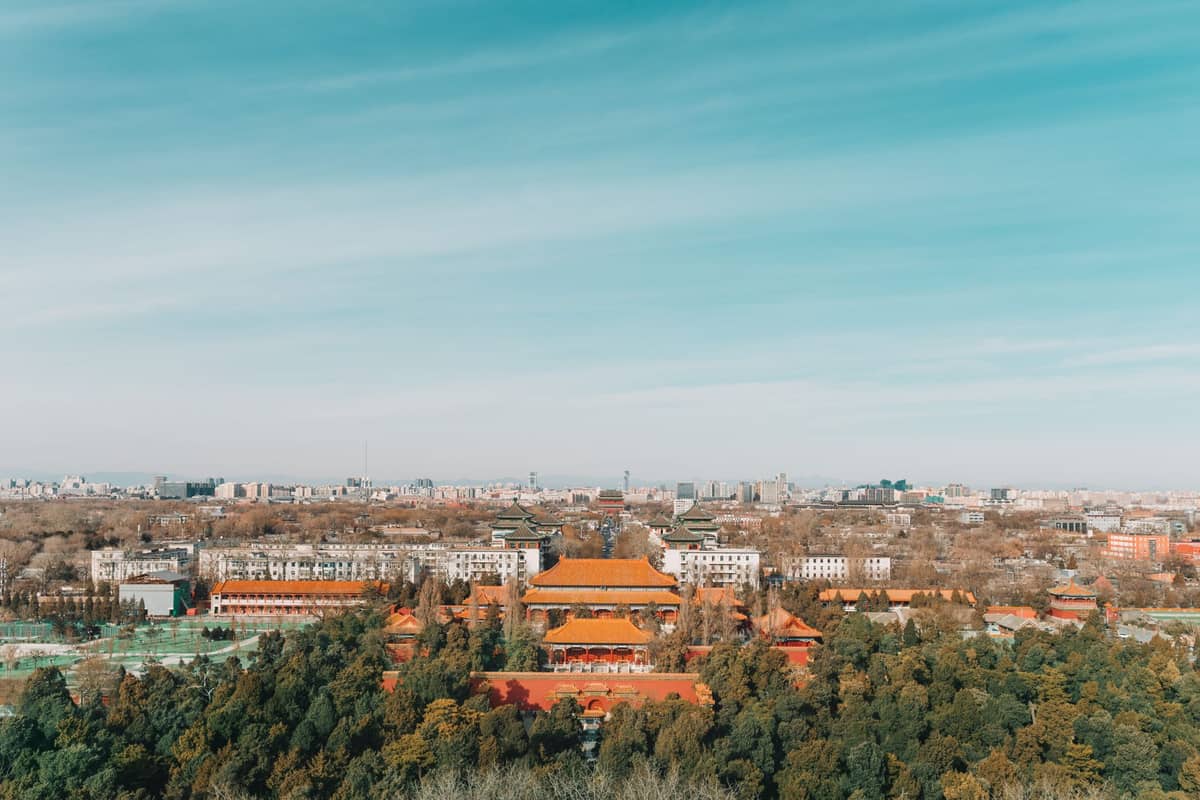
Jingshan Park is a 45.7-metre artificial hill rising directly north of the Forbidden City, built from earth excavated during the palace's construction. For CNY 2, visitors get a widely regarded elevated view of imperial Beijing — the entire Forbidden City laid out symmetrically below, framed by the city axis stretching to Tiananmen. The park is also a working neighbourhood green space, where locals practise tai chi at dawn and ballroom dancing in the late afternoon.
Quick Facts
- Location
- No. 44 Jingshanxi Street, Xicheng District, Beijing — immediately north of the Forbidden City
- Getting There
- Beijing Subway Lines 6 or 8 (Nanluoguxiang or Shichahai stations); also walkable north from Tiananmen
- Time Needed
- 1–2 hours for the hill and gardens; longer if you linger at the summit
- Cost
- CNY 2 standard adult; CNY 1 discount. Exhibition periods: CNY 10 / CNY 5.
- Best for
- Panoramic Forbidden City views, morning tai chi atmosphere, photography, imperial history
What Is Jingshan Park?
Jingshan Park (景山公园, Jǐngshān Gōngyuán) occupies a uniquely engineered piece of Beijing's imperial landscape. The hill at its centre is not natural: it was constructed from earth excavated during the creation of the Forbidden City's moat in the early 15th century, under the Yongle Emperor of the Ming dynasty. At 45.7 metres above its base and a total elevation of 94.2 metres above sea level, it was designed to anchor the northern end of Beijing's central axis and to act as a geomantic shield protecting the palace from malevolent northern energies, according to the principles of feng shui.
The hill has five peaks, each originally topped with a pavilion. Four pavilions survive today. The central and highest pavilion, Wanchun Pavilion (万春亭), is where most visitors aim — and for good reason. From the pavilion's base, the entire layout of the Forbidden City opens below you in one uninterrupted southward view, its golden rooftops arranged along the axis with a precision that no photograph from street level can capture. On clear days the view extends far beyond the palace to Tiananmen Square and the hills framing the southern horizon.
💡 Local tip
Air quality directly affects what you see from the summit. On hazy days the Forbidden City's rooftops are visible but the skyline beyond fades into grey. Check an air quality index before visiting if the panoramic view is your primary reason for coming.
The Climb and the Summit View
The ascent to Wanchun Pavilion takes most visitors around 10 to 15 minutes at a moderate pace. The path is paved and follows a series of broad stone steps — steady but not steep. There are no cable cars or lifts, and the upper section involves narrower steps with a slight incline. Visitors with limited mobility should call the park in advance (+86 10 6403 8098) to discuss current accessible route options, as the official listing does not detail step-free alternatives.
At the top, the sensation is immediate and hard to replicate anywhere else in central Beijing. The Forbidden City's 72-hectare footprint becomes legible all at once: the sequence of gates, courtyards, and ceremonial halls running arrow-straight from Meridian Gate to the northern wall directly below you. The geometry that is invisible from inside the palace becomes obvious from here. Early morning light falls across the golden glazed tiles from the southeast, giving photographers a warm-toned window roughly between 7:00 and 9:00 in spring and autumn.
Turning north from the pavilion, you look down into the park's rear garden and beyond to the Bell Tower and Drum Tower rising above the hutong rooftops of Shichahai. On exceptionally clear days — most common in autumn after rainfall — the western mountains are visible on the horizon. This 360-degree orientation makes the summit useful for understanding how Beijing's imperial centre fits into the wider city.
Tickets & tours
Hand-picked options from our booking partner. Prices are indicative; availability and final rates are confirmed when you complete your booking.
Jingshan Hill, Beihai Park and Old Beijing tour with imperial meal
From 243 €Instant confirmationFree cancellationSmall group tour of Tian'anmen Square and the Forbidden City
From 43 €Instant confirmationFree cancellationBeijing Summer Palace Entrance Ticket
From 7 €Instant confirmationFree cancellationMutianyu Great Wall and Summer Palace small-group tour from Beijing
From 171 €Instant confirmationFree cancellation
Time of Day Makes a Real Difference
The park opens at 06:00 from April through October and at 06:30 from November through March. Arriving within the first hour of opening puts you among the locals rather than the tourist groups. In the lower gardens you will find clusters of people practising tai chi, qigong, and traditional dance — not as a performance, but as a daily routine. The sound is soft percussion and recorded folk music drifting through trees. The smell is fresh-cut grass and occasionally incense from the Shouhuang Palace complex in the northern section of the park.
By mid-morning, particularly between April and October, tour groups arrive in volume. The summit can feel crowded, with queues forming to photograph from the small pavilion terrace. Late afternoon brings a different crowd: retired Beijingers gather in the lower gardens for ballroom dancing, chess, and conversation. The light at this hour falls flat on the Forbidden City's rooftops, less useful for photography but pleasant for simply sitting and watching the city.
Sunset from Wanchun Pavilion is popular and frequently photographed, but check opening hours carefully: the park closes at 21:00 (last entry 20:30) in summer and at 20:00 (last entry 19:30) in winter. Plan your descent to allow enough time before the closing bell, which is announced by staff with some urgency.
ℹ️ Good to know
Opening hours: 1 April–31 October: 06:00–21:00, last entry 20:30. 1 November–31 March: 06:30–20:00, last entry 19:30. Verify before visiting as these are subject to change for public holidays or special events.
The Rest of the Park: Beyond the Hill
Most visitors spend their time on the hill and leave without exploring the surrounding grounds, which is a reasonable choice if you are on a tight schedule. However, the northern section contains Shouhuang Palace (寿皇殿), a substantial ceremonial complex originally built to house imperial ancestral portraits. Restored in recent years, it is now open to visitors and offers a quieter glimpse of imperial ritual architecture without the crowds of the Forbidden City. The complex is worth 20 to 30 minutes if you have them.
The gardens connecting the hill's lower slopes to the park's perimeter contain mature cypress trees, some reportedly dating back several centuries. These give the park a different texture from the open plazas of Tiananmen Square or the formal pathways inside the Forbidden City — it feels, in places, genuinely shaded and cool in summer, which matters on Beijing afternoons when temperatures regularly exceed 30°C.
A Note of Historical Weight
Jingshan is also the site of one of the most documented events in the final days of Ming dynasty rule. In April 1644, as rebel forces led by Li Zicheng entered Beijing, the Chongzhen Emperor is said to have hanged himself from a locust tree on the hill's eastern slope rather than surrender his dynasty. A tree on the site (not the original, which no longer exists) is marked with a plaque. The spot is easy to find and draws a steady trickle of visitors with an interest in Chinese history, though it is not dramatised or commercialised.
This historical context connects naturally to the broader arc of imperial Beijing, covered in depth in the Beijing imperial history guide. Pairing a visit to Jingshan with a few hours inside the Forbidden City creates a logical full-day programme: the palace in the morning, the hill for the elevated perspective in the afternoon.
Getting There and Practical Logistics
The park entrance sits on Jingshanxi Street (景山西街), directly north of the Forbidden City's Shenwu Gate (Gate of Divine Might). If you exit the Forbidden City from its northern gate, you are a short walk across the street from Jingshan's south entrance. This makes the park a natural continuation of a palace visit rather than a separate trip.
By subway, Beijing Subway Line 6 and Line 8 both have stations within walking distance. The walk from either station passes through residential streets and is straightforward, though signage is limited in English. Taxis and ride-hailing via DiDi are simple options; tell the driver 景山公园 (Jǐngshān Gōngyuán) or show the address: 北京市西城区景山西街44号.
Admission is CNY 2 for standard adult entry, which makes Jingshan one of the most underpriced attractions in central Beijing relative to what it offers. During special exhibitions the price rises to CNY 10 full / CNY 5 discount. If you are building a day around this part of the city, the Beijing on a budget guide has more detail on combining low-cost parks and historic sites in one itinerary.
⚠️ What to skip
Photography note: The view from the summit directly overlooks the Forbidden City. Drone flight is prohibited over this area. Standard photography from the pavilion is unrestricted, but commercial filming requires permits. Security is visible throughout the park.
Who Will Get the Most — and Least — from Jingshan
First-time visitors to Beijing who plan to see the Forbidden City will almost certainly find Jingshan worthwhile. The CNY 2 admission is negligible, the climb is accessible to most people, and the view answers the single most common frustration with visiting the palace itself: the inability to see the scale of the place from inside it. Architecture enthusiasts and photographers will find the summit essential.
Travellers who have already seen the Forbidden City on a previous trip and are returning to Beijing with specific neighbourhood or cultural interests might prioritise differently. The park offers less in the way of interactive exhibits or guided content compared to major museum-type attractions. Those focused on contemporary Beijing or art might find the 798 Art District more relevant to their interests. Visitors with significant mobility limitations should contact the park directly before visiting, as the path to the summit involves stairs without elevator alternatives.
Insider Tips
- Arrive in the first 30 minutes after opening on a weekday to have the summit largely to yourself. By 9:00 AM on weekends from April to October, tour groups make the pavilion platform genuinely crowded.
- The east and west flanking pavilions (Guanmiao and Jifang, among others) offer slightly different angles on the Forbidden City's roofline with far fewer people competing for space. These are worth visiting even if the central pavilion is packed.
- Autumn, particularly mid-October to early November, combines the year's clearest air with turning foliage in the park's lower gardens. This is the single best period for both the panoramic view and the in-park atmosphere.
- There are basic refreshment kiosks inside the park, but they are limited. If you plan to spend time in the lower gardens after the climb, bring water, especially in summer when temperatures at the summit are exposed and hot.
- The Shouhuang Palace section in the north of the park is frequently overlooked by visitors who arrive via the south gate, do the hill, and leave the same way. Enter from the north gate on Jingshan Houjie Street to experience the palace complex first, then climb the hill heading south — the reverse of the usual direction.
Who Is Jingshan Park For?
- First-time Beijing visitors who want the definitive aerial view of the Forbidden City
- Photographers seeking early morning or late afternoon light over the imperial palace
- History travellers interested in the Ming-Qing transition and imperial Beijing's urban design
- Travellers on a tight budget who want high-impact sightseeing at minimal cost
- Anyone combining a Forbidden City visit with a full central Beijing day walk
Nearby Attractions
Other things to see while in Xicheng District:
- Beihai Park
Beihai Park is one of Beijing's oldest and best-preserved imperial gardens, covering roughly 69 hectares with more than half the area given over to a large lake. Dating back over a thousand years, it offers a rare mix of imperial architecture, Buddhist monuments, and open green space within walking distance of the Forbidden City.
- Beijing Planetarium
Beijing Planetarium (北京天文馆) is located in Xicheng District near Beijing Zoo. It runs dome theater shows, 3D and 4D screenings, and permanent science exhibitions across two buildings. Here's what a visit actually looks like.
- Beijing Zoo
Beijing Zoo is one of China's oldest and largest zoological parks, covering over 80 hectares in Xicheng District. Home to the city's most accessible giant panda viewing experience, it draws millions of visitors each year. This guide covers what to expect, when to go, and how to make the most of your time there.
- Capital Museum
The Capital Museum (首都博物馆) in Xicheng District is Beijing's premier civic museum, tracing the city's history across three millennia. Admission is free, the permanent galleries are genuinely impressive, and it rarely gets as crowded as the Forbidden City — making it one of the smartest stops in central Beijing.