Capital Museum Beijing: What to See, How to Visit, and Why It Matters
The Capital Museum (首都博物馆) in Xicheng District is Beijing's premier civic museum, tracing the city's history across three millennia. Admission is free, the permanent galleries are genuinely impressive, and it rarely gets as crowded as the Forbidden City — making it one of the smartest stops in central Beijing.
Quick Facts
- Location
- No. 16 Fuxingmenwai Street, Xicheng District, Beijing
- Getting There
- Beijing Subway Line 1 — Muxidi Station, Exit C1 (approx. 500 m from entrance)
- Time Needed
- 2–3 hours for main galleries; 4+ hours for a thorough visit
- Cost
- Free (¥0). Valid ID required at the north entrance. Advance booking may be available; check the official site before visiting.
- Best for
- History enthusiasts, architecture admirers, first-time Beijing visitors wanting context before touring imperial sites
- Official website
- en.capitalmuseum.org.cn
What the Capital Museum Actually Is
The Capital Museum (首都博物馆, Shǒudū Bówùguǎn) stands at No. 16 Fuxingmenwai Street in Xicheng District, Beijing. It is the city's principal civic and cultural history museum, housing a permanent collection of more than 200,000 artifacts that trace Beijing's urban story from prehistoric settlements through the imperial dynasties and into the modern era. The breadth is serious: bronze vessels, ceramics, Buddhist sculpture, lacquerware, folk costumes, old maps of the city, and objects from Beijing's traditional trade and craft culture all appear across its galleries.
The museum opened at its original site in the Confucius Temple on Guozijian Street on 1 October 1981, moving to its purpose-built home on Fuxingmenwai Street in the mid-2000s. The shift mattered: the new building gave curators space to properly display and contextualize the collection, and it gave visitors a different kind of experience — one where architecture and exhibition reinforce each other.
If you are arriving in Beijing without much background in Chinese dynastic history, spending two hours here before visiting the Forbidden City or the Temple of Heaven will sharpen everything you see at those sites. The museum provides the kind of civic, social, and material context that imperial monuments rarely explain on their own.
The Building Itself
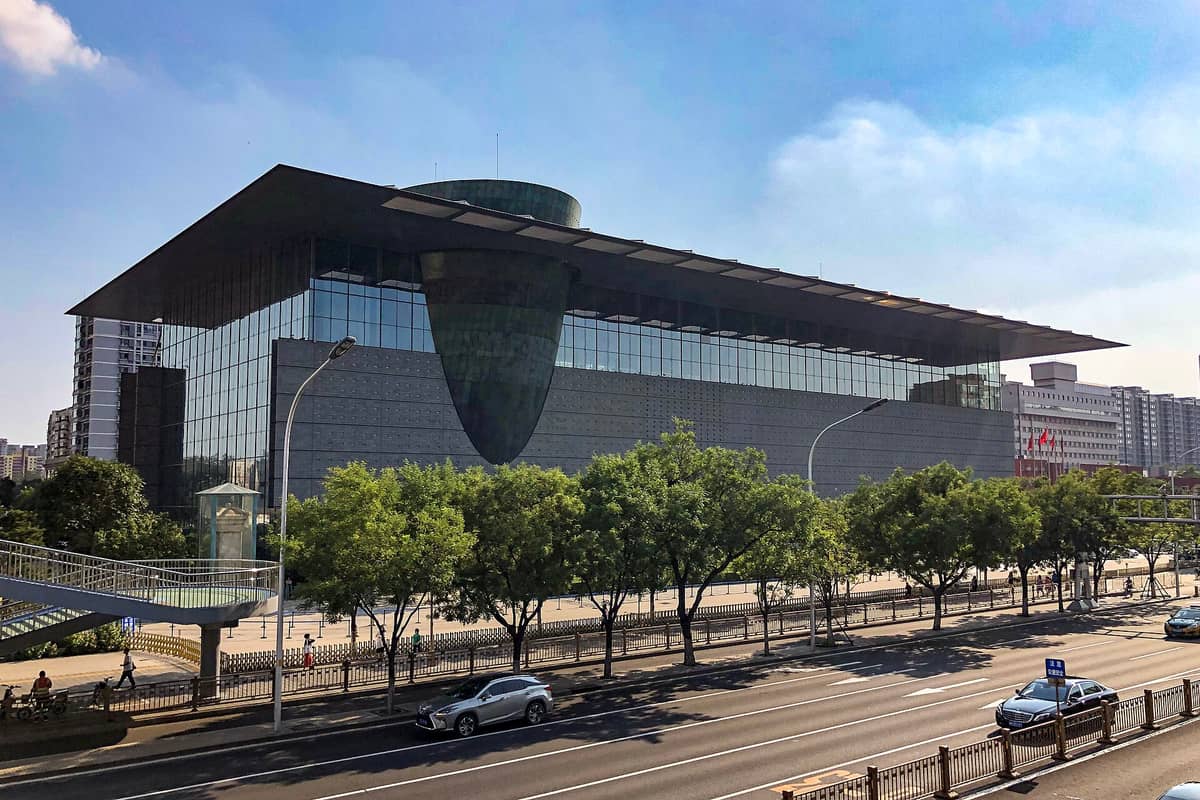
The current museum building, designed by Chinese architect Cui Kai, is one of the more considered examples of civic architecture in Beijing. The main structure combines a rectangular stone-clad outer shell with a distinctive bronze-toned elliptical volume that tilts outward and rises above the main roof. This tilted cylinder houses the ancient capital history section. The effect from the street — especially on a clear morning when the bronze casing catches early light — is arresting without being showy.
Inside, the atrium is genuinely large and well-lit. Natural light enters through a glazed roof section, and the circulation is organized around a central open core that lets visitors orient themselves before committing to a gallery sequence. The materials throughout are high quality: stone flooring, clean exhibition casework, and signage in both Chinese and English. Compared to some of Beijing's older state museums, where English labeling can be sparse or awkwardly translated, the Capital Museum's English content is generally reliable.
💡 Local tip
The main entrance used by visitors is the north entrance. Bring a valid ID (passport for foreign visitors) — it is required for entry registration. Advance booking may be available; check the official site before visiting, particularly during major holidays.
Tickets & tours
Hand-picked options from our booking partner. Prices are indicative; availability and final rates are confirmed when you complete your booking.
Private Transfer from or to Beijing Capital International Airport
From 48 €Instant confirmationFree cancellationSmall group tour of Tian'anmen Square and the Forbidden City
From 43 €Instant confirmationFree cancellationBeijing Summer Palace Entrance Ticket
From 7 €Instant confirmationFree cancellationMutianyu Great Wall and Summer Palace small-group tour from Beijing
From 171 €Instant confirmationFree cancellation
What You Will See Inside
The permanent collection is organized across several galleries on multiple floors. The centerpiece for most visitors is the ancient Beijing history exhibition inside the tilted elliptical hall, which covers the city's development from the Bronze Age settlements at the site of early Ji (蓟), through the Liao, Jin, Yuan, Ming, and Qing dynasties, up to Beijing's role as the capital of the People's Republic. The pacing is thoughtful: the gallery does not rush you through 3,000 years. Objects are given space, and interpretive panels provide enough context to follow the narrative without prior knowledge.
The ceramics and porcelain galleries are among the strongest in the building. The collection covers official kilns from multiple dynasties, and the condition of individual pieces is exceptional. If you have any interest in Chinese decorative arts, budget extra time here. The Buddhist sculpture section, featuring works from the Tang through Ming periods, is quieter and often overlooked by visitors focused on the historical narrative floors.
There are also rotating special exhibitions, which typically occupy the ground-floor and first-floor gallery spaces. These can cover anything from calligraphy and painting to archaeological finds from recent excavations in the Beijing area. The quality is usually high, and they are included in general free admission. Check the official website (en.capitalmuseum.org.cn) before your visit for current exhibition listings.
ℹ️ Good to know
Opening hours vary by season and current exhibition schedule. The official Capital Museum page currently lists 09:00–20:00, with last admission at 19:00, and Tuesday as the regular closure day; verify the official site before visiting.
How the Experience Changes by Time of Day
Arriving at or shortly after opening (09:00) gives you the building at its best. The morning light entering through the atrium glass is clean and even, the galleries are quiet, and the stone floors carry a particular stillness that makes the objects read well. School groups typically arrive between 09:30 and 11:00 on weekdays, so if you want the porcelain and sculpture galleries without competition for display cases, get there early.
Midday from roughly 11:00 to 13:30 is the peak period. The atrium fills up, the café area on the lower level gets busy, and queues can form at the building map and information desk near the entrance. If you arrive during this window, go directly to the upper-floor galleries first — the ancient capital history section in the elliptical hall — because those rooms are larger and absorb crowd density better than the smaller decorative arts spaces.
Afternoons after 14:00 are noticeably quieter as tour groups cycle out. The gallery lighting remains consistent throughout the day (it is artificially controlled throughout the building to protect objects), so the viewing conditions in the afternoon are as good as the morning. Check the official site for the current last-admission and closing times before planning an afternoon visit.
Getting There and the Surrounding Area
The most direct route is Beijing Subway Line 1 to Muxidi Station, Exit C1. The walk east to the north entrance is approximately 500 metres. Line 1 connects directly to major interchange stations including Tiananmen West (for the Tiananmen Square area) and Xidan (Beijing's main commercial strip in Xicheng). The subway is the most reliable option during peak traffic hours and costs a few yuan per trip.
The surrounding Xicheng District neighborhood is worth some attention. Fuxingmenwai Street is a wide arterial road, and the immediate surroundings are governmental and commercial rather than tourist-facing. However, within a 15-minute walk or short taxi ride, you reach the Shichahai lake district to the north and the traditional commercial quarter around Xidan to the east. The museum does not sit inside a particularly atmospheric neighborhood block, but it is well-placed for onward connections across central Beijing.
If you are planning a full day in Xicheng, the Capital Museum pairs well with a later visit to Houhai and Shichahai, or with the imperial garden at Beihai Park to the northeast. Both destinations are reachable by subway or a short taxi ride.
Photography and Accessibility
Photography is permitted throughout most of the permanent galleries using handheld cameras and smartphones. No flash is the standard expectation in artifact-heavy spaces, and tripods are not permitted in the display halls. The building's architecture is itself worth photographing: the atrium, the exterior elliptical volume from the north entrance plaza, and the view looking up through the glazed ceiling of the central hall all produce clean compositional options.
For photographers interested in Beijing's museum architecture more broadly, the Beijing photography guide covers interior shooting considerations at several major civic buildings.
The museum's official visitor information includes accessibility arrangements. The building has lift access between floors and level entry at the north entrance. Visitors with specific accessibility requirements should contact the museum directly in advance at +86 10 6337 0491/0492 to confirm current arrangements and any temporary restrictions.
Who Might Want to Skip This
The Capital Museum is not a spectacle. There are no outdoor spaces, no dramatic natural settings, and the building sits on an ordinary urban street rather than inside a walled imperial complex. Visitors primarily motivated by photogenic outdoor environments, street life, or the physical drama of Beijing's imperial architecture will likely find their time better spent elsewhere in the city.
The collection is also Beijing-specific rather than pan-Chinese. If you are looking for a broad survey of Chinese civilization across all regions, the National Museum of China on Tiananmen Square covers far more geographic and dynastic ground. The Capital Museum's strength is specifically the story of Beijing as a city: its founding, its successive roles as dynastic capital, and the material culture that developed within it.
For travelers trying to prioritize, the best museums in Beijing guide compares the Capital Museum against other major institutions across the city to help you decide what fits your itinerary.
Insider Tips
- The museum café on the lower level is inexpensive and clean by Beijing museum standards — it works well as a midday break point if you are splitting the visit across morning and afternoon gallery blocks.
- The elliptical ancient capital history hall works best when you start at the top floor and descend chronologically. If you enter at ground level and work up, the narrative flow is less intuitive.
- Foreign visitors sometimes miss the basement-level folk culture and traditional craft sections, which are less obviously signposted but contain some of the most unusual objects in the building: Beijing-specific trade goods, festival items, and documentation of the city's old guild economy.
- The museum's official English website (en.capitalmuseum.org.cn) lists current special exhibitions in advance. Checking it two or three days before your visit can reveal a temporary show worth building your timing around.
- If you are visiting during the Chinese New Year period or Golden Week national holidays, confirm opening status on the official site — holiday schedules can override the standard Tuesday-to-Sunday timetable in either direction.
Who Is Capital Museum For?
- First-time Beijing visitors who want historical context before visiting imperial sites
- History and archaeology enthusiasts focused on Chinese dynastic material culture
- Architecture admirers interested in contemporary Chinese civic building design
- Travelers visiting with older children who can engage with museum-format exhibits
- Anyone looking for a substantive free attraction in central Beijing
Nearby Attractions
Other things to see while in Xicheng District:
- Beihai Park
Beihai Park is one of Beijing's oldest and best-preserved imperial gardens, covering roughly 69 hectares with more than half the area given over to a large lake. Dating back over a thousand years, it offers a rare mix of imperial architecture, Buddhist monuments, and open green space within walking distance of the Forbidden City.
- Beijing Planetarium
Beijing Planetarium (北京天文馆) is located in Xicheng District near Beijing Zoo. It runs dome theater shows, 3D and 4D screenings, and permanent science exhibitions across two buildings. Here's what a visit actually looks like.
- Beijing Zoo
Beijing Zoo is one of China's oldest and largest zoological parks, covering over 80 hectares in Xicheng District. Home to the city's most accessible giant panda viewing experience, it draws millions of visitors each year. This guide covers what to expect, when to go, and how to make the most of your time there.
- Fayuan Temple
Founded in 645 CE during the Tang dynasty, Fayuan Temple is the oldest surviving Buddhist temple in Beijing's central districts. 5 RMB to enter, rarely crowded, and steeped in over 1,300 years of religious and literary history, it rewards travelers willing to step off the tourist circuit in Xicheng.