Fayuan Temple: Beijing's Oldest Buddhist Temple and Its Quiet Courtyard World
Founded in 645 CE during the Tang dynasty, Fayuan Temple is the oldest surviving Buddhist temple in Beijing's central districts. 5 RMB to enter, rarely crowded, and steeped in over 1,300 years of religious and literary history, it rewards travelers willing to step off the tourist circuit in Xicheng.
Quick Facts
- Location
- No. 7 Fayuansi Qianjie, Xicheng District, Beijing
- Getting There
- Caishikou Station (Lines 4 or 7); also bus routes 5, 57 (Caishikou West) and 144 (Nanheng Street)
- Time Needed
- 45–90 minutes
- Cost
- ¥5
- Best for
- History enthusiasts, temple photography, quiet mornings away from major tourist sites
Why Fayuan Temple Deserves More Attention Than It Gets
Most first-time visitors to Beijing move between the Forbidden City, the Temple of Heaven, and the Lama Temple in Dongcheng, all of which are worthwhile but increasingly crowded. Fayuan Temple (法源寺, Fayuan Si, 'Temple of the Origin of the Dharma'), tucked into a quiet lane in southern Xicheng, is a genuinely different kind of experience: smaller, calmer, and carrying a historical weight that its size does not immediately reveal.
Founded in 645 CE under Emperor Taizong of the Tang dynasty, originally named Minzhong Temple, the complex has survived over 1,300 years of dynastic change, reconstruction, fire, and repurposing. Its current layout reflects a major Ming dynasty rebuilding during the Zhengtong period (1436–1449). Covering approximately 6,700 square meters across a series of walled courtyards, it is compact by imperial temple standards, which is precisely what makes it approachable. This is not a place that requires two hours of strategic planning. Walk in, slow down, and let the layers of history present themselves.
💡 Local tip
Fayuan Temple costs 5 RMB to enter and opens at 08:30. Arriving within the first hour means you will share the courtyards primarily with monks and elderly worshippers rather than tour groups.
What You See: The Courtyard Sequence
Entering through the main gate on Fayuansi Qianjie, visitors pass into the first of several courtyards arranged along a north-south axis, a layout typical of Tang and Ming Buddhist architecture in northern China. The transition from the street is immediate: street noise drops, replaced by the low tones of recorded sutra chanting and the faint smell of incense drifting from bronze censers.
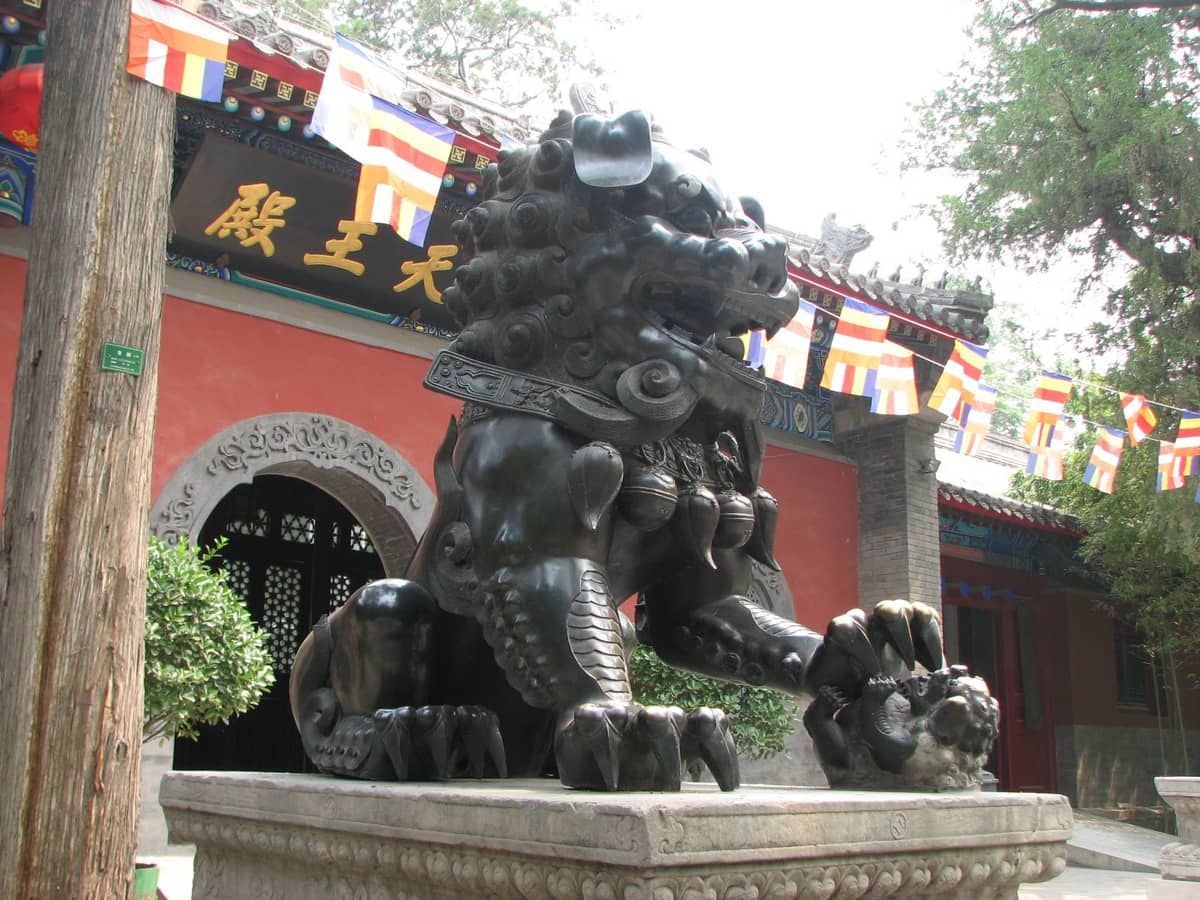
The principal halls include the Heavenly King Hall (Tianwang Dian), the Great Buddha Hall (Daxiong Baodian), the Compassion Hall (Dabei Dian), and the Vairocana Hall at the rear, each containing different sculptural arrangements. The Great Buddha Hall is the architectural centerpiece: a broad, heavy-roofed timber structure housing a large seated Sakyamuni Buddha flanked by Ananda and Kashyapa. The statuary is not the most elaborate you will see in Beijing's temple circuit, but the scale and the quality of light filtering through latticed doors on clear mornings create a genuinely striking atmosphere.
The rear courtyards are quieter and often overlooked by visitors who linger at the main halls. Tall trees shade the paths between buildings, and several stone stelae recording the temple's history stand in covered pavilions. The Chinese Buddhist Academy (Zhongguo Fojiao Xueyuan) was established here and has maintained the site as a functioning religious institution, which keeps it from feeling like a museum set piece.
Tickets & tours
Hand-picked options from our booking partner. Prices are indicative; availability and final rates are confirmed when you complete your booking.
Small group tour of Tian'anmen Square and the Forbidden City
From 43 €Instant confirmationFree cancellationBeijing Summer Palace Entrance Ticket
From 7 €Instant confirmationFree cancellationMutianyu Great Wall and Summer Palace small-group tour from Beijing
From 171 €Instant confirmationFree cancellationPrivate Guided Tour to Temple of Heaven, Panda House and Summer Palace
From 67 €Instant confirmationFree cancellation
The Lilac Season: The One Time the Temple Draws a Crowd
Fayuan Temple is one of Beijing's best-known locations for lilac trees (丁香, dinxiang), which typically bloom in April, often mid-to-late April depending on the year. During peak bloom, the courtyards fill with soft purple clusters and the air carries a noticeable fragrance. This is the one period when the temple does see meaningful visitor numbers, and it is genuinely worth timing a visit around if you are in Beijing in spring.
Photographers specifically make the trip for the contrast between the pale purple flowers and the deep red timber halls. Early morning is the most productive time: the light is soft, the flowers are undisturbed, and the resident monks' morning activity adds quiet life to the scene. By mid-morning on a weekend during peak bloom, the main courtyard can feel noticeably crowded for its size, though it never reaches the density of the city's flagship sites.
ℹ️ Good to know
Lilac bloom timing varies by year and is weather-dependent. Check local Beijing gardening forums or the Beijing Gardening and Greening Bureau reports closer to your visit date for current conditions.
Historical and Literary Significance
Beyond its religious function, Fayuan Temple carries considerable literary weight in Chinese cultural history. It has also been associated with modern Chinese literary discussions, giving the site a secondary resonance for readers familiar with Chinese literature. That association gives the site a secondary resonance for readers familiar with modern Chinese literature.
Historically, the temple has served multiple purposes across dynasties. During the Tang period it was established in honor of soldiers killed in battle. It was rebuilt during the Ming dynasty's Zhengtong era (1436–1449). By the Qing dynasty it had become a major center for Buddhist scholarship, and the Chinese Buddhist Academy was later established here, cementing its role as an educational as well as devotional institution. The academy still trains Buddhist monks, which explains the steady presence of young monks in robes moving quietly between the halls.
For travelers interested in Beijing's imperial religious history, pairing Fayuan Temple with other sites makes the picture clearer. The city's Buddhist and Daoist temple networks each have their own institutional logics, and Fayuan's specifically Tang-dynasty founding sets it apart from the many Ming and Qing constructions that dominate the temple landscape.
For a broader understanding of Beijing's religious architecture, the best temples in Beijing guide places Fayuan alongside the city's other significant Buddhist and Daoist sites and explains how they differ in character and scale.
Getting There and the Surrounding Neighborhood
Fayuan Temple sits in a dense residential block in southern Xicheng, roughly 10 minutes on foot from Caishikou Station on Beijing Subway Lines 4 and 7. The walk itself is informative: you pass through low-rise streets that retain something of their older character, with small food stalls, hardware shops, and residential lanes (hutongs) running off the main road. The contrast with the glass-and-steel corridors near the nearest metro exits is stark and deliberate to notice.
Bus routes 5 and 57 stop at Caishikou West, and route 144 serves the Nanheng Street intersection nearby. Taxis and DiDi can drop directly at the temple gate. There is no significant parking infrastructure in the immediate area, and the lanes around the temple are narrow, so arriving by transit or on foot is the practical choice.
The neighborhood itself is part of Xicheng District, which contains a different mix of historical and governmental sites than the more touristically packaged Dongcheng. Exploring on foot before or after your temple visit reveals details that do not appear on standard itineraries.
Practical Details: Hours, Entry, and What to Bring
Opening hours are generally 08:30 to 16:00, but operating days should be checked before visiting. Entry is 5 RMB. There is no ticket booth, no timed entry reservation, and no queuing infrastructure, which reflects both the site's local character and the fact that it is a functioning religious institution, not primarily a tourist venue. Visitors are expected to behave accordingly: quiet movement, no flash photography during active worship, conservative dress (shoulders and knees covered, though this is not strictly enforced at the gate).
Photography is generally permitted in the courtyards. The interior halls vary: some contain active altar arrangements where monks or worshippers may be present, and it is worth reading the atmosphere before pointing a camera at the statuary during prayer. Natural light inside the main halls is limited, so a camera capable of higher ISO settings will serve you better than relying on flash.
⚠️ What to skip
Accessibility information for Fayuan Temple is not published in verified sources. The site includes steps between courtyards and historic stone surfaces that may present challenges for wheelchair users or visitors with limited mobility. Contact the temple directly before visiting: +86 10 8352 0844 or +86 10 8351 7183.
There are no significant food or drink facilities inside the temple. The surrounding streets have small local restaurants and convenience shops. Plan to eat before visiting or combine the temple with a walk toward the Qianmen or Dashilar areas to the east, where food options are considerably more varied.
If you are building a half-day itinerary in this part of the city, the Dashilar Street area and Liulichang Cultural Street are both within walking distance and add commercial and cultural texture to what is otherwise a quieter, residential-feeling visit.
Who This Temple Is Not For
Fayuan Temple is a rewarding visit for the right traveler, but it is worth being honest about its limitations. The complex is small, and outside of the lilac season there is relatively little visual spectacle in the Western tourism sense. Visitors expecting the scale of the Lama Temple in Dongcheng, the grandeur of the Temple of Heaven, or the density of religious art found at some other Beijing sites may find Fayuan underwhelming.
There is no English-language signage of significance inside the halls. Understanding the iconography or the historical context depends on prior knowledge or a guidebook. Visitors on a tight schedule with only one or two days in Beijing are probably better served by the city's larger signature attractions first. Fayuan rewards those who have already covered the main circuit and are looking for something quieter and more contextual.
If your primary interest is Beijing's imperial Buddhist heritage at scale, the Lama Temple is a more immediately impactful destination. If you want to understand how Buddhism fits into Beijing's broader temple landscape, consider using the Beijing imperial history guide as a framework before you visit either site.
Insider Tips
- Visit on a weekday morning in mid-April to catch lilac bloom before weekend crowds arrive. The bloom typically lasts one to two weeks and the courtyard fragrance is strongest in the first hour after opening.
- The rear courtyards near the Vairocana Hall see fewer visitors and tend to be quieter even during peak bloom periods. Spend time there rather than lingering only at the main hall.
- The Chinese Buddhist Academy presence means you will occasionally encounter monks engaged in study or quiet conversation. A respectful nod is the appropriate greeting; extended interaction is not expected or typical.
- Light inside the main halls is low and comes primarily from doorways. Visit on a clear morning when angled sunlight enters the Heavenly King Hall from the east for the best natural illumination on the statuary.
- The streets immediately surrounding the temple are genuinely old-feeling by Beijing standards. Walking one or two blocks in any direction before or after your visit reveals local daily life that the nearby tourist corridors have mostly erased.
Who Is Fayuan Temple For?
- Travelers who have already visited Beijing's major Buddhist temples and want a quieter, more contextual experience
- Spring visitors who can time their trip for the lilac bloom in mid-to-late April
- Photographers interested in Buddhist architecture, natural light, and temple courtyard composition
- History enthusiasts drawn to Tang dynasty foundations and over 1,300 years of continuous religious use
- Anyone building a half-day walk through southern Xicheng that also takes in Liulichang and Dashilar
Nearby Attractions
Other things to see while in Xicheng District:
- Beihai Park
Beihai Park is one of Beijing's oldest and best-preserved imperial gardens, covering roughly 69 hectares with more than half the area given over to a large lake. Dating back over a thousand years, it offers a rare mix of imperial architecture, Buddhist monuments, and open green space within walking distance of the Forbidden City.
- Beijing Planetarium
Beijing Planetarium (北京天文馆) is located in Xicheng District near Beijing Zoo. It runs dome theater shows, 3D and 4D screenings, and permanent science exhibitions across two buildings. Here's what a visit actually looks like.
- Beijing Zoo
Beijing Zoo is one of China's oldest and largest zoological parks, covering over 80 hectares in Xicheng District. Home to the city's most accessible giant panda viewing experience, it draws millions of visitors each year. This guide covers what to expect, when to go, and how to make the most of your time there.
- Capital Museum
The Capital Museum (首都博物馆) in Xicheng District is Beijing's premier civic museum, tracing the city's history across three millennia. Admission is free, the permanent galleries are genuinely impressive, and it rarely gets as crowded as the Forbidden City — making it one of the smartest stops in central Beijing.