Dashilar Street: Beijing's 500-Year-Old Commercial Lane
Stretching roughly 275 metres west from Qianmen Street, Dashilar Street (大栅栏街) is one of Beijing's oldest continuously operating commercial districts. Free to enter and pedestrianized, it combines century-old brand-name shops with renovated hutong lanes and a history stretching back to the Ming dynasty.
Quick Facts
- Location
- Xicheng District, Beijing — western extension of Qianmen Street
- Getting There
- Line 2 – Qianmen Station (5–10 min walk south); Line 7 – Zhushikou Station (7 min walk north)
- Time Needed
- 1–3 hours for the street; half a day if you explore the surrounding hutong lanes
- Cost
- Free entry to the street; individual shops and restaurants vary
- Best for
- History enthusiasts, shoppers seeking traditional goods, architecture walkers, cultural explorers
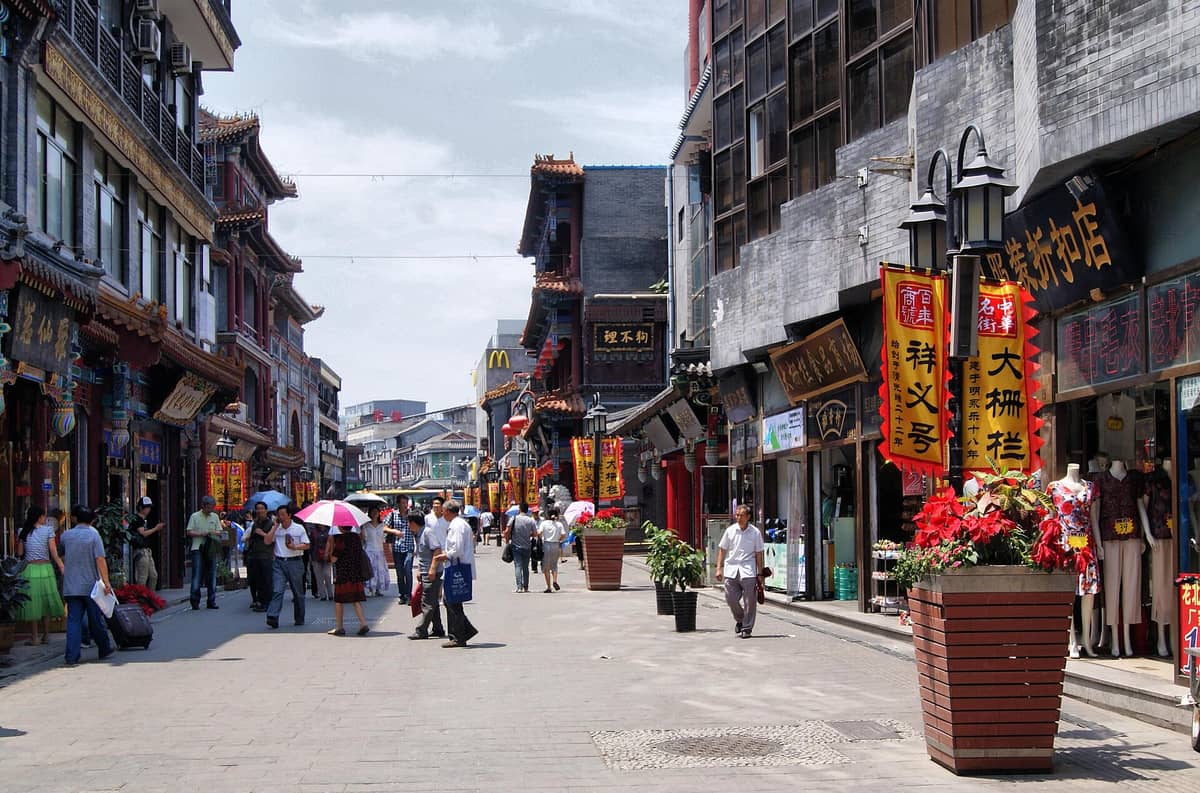
What Dashilar Street Actually Is
Dashilar Street (大栅栏街, pronounced locally as Dàshílànr Jiē) is a pedestrianized commercial lane in Beijing's Xicheng District, running approximately 275–300 metres west from Qianmen Street toward Meishi Street. The street is the central artery of the broader Dashilar Historic and Cultural Area, which covers around 1.15 square kilometres of old Beijing fabric and contains dozens of hutong alleys, courtyard buildings, and some of the city's oldest surviving shop fronts.
The street's origins trace to the Ming dynasty: it was established in 1420, during the Yongle Emperor's reign, and developed into a major commercial street over more than 500 years. The name itself translates roughly as 'big fence rails,' referring to the wooden fences associated with the lane.
Today the lane is free to enter and open all day. Individual shops typically operate from around 08:00 to 22:00, though hours vary by business. The street is fully pedestrianized and closed to motor vehicles and bicycles, which makes the walking experience considerably more relaxed than most of central Beijing's commercial areas.
ℹ️ Good to know
Dashilar Street is free to enter and requires no ticket or reservation. The surrounding hutong lanes are equally accessible at no cost. Budget at least 90 minutes if you plan to walk any of the side alleys.
The Character of the Street: What You'll Actually See
The street is compact — you can walk its full length in under ten minutes at a tourist's pace — but its density of interest is high. The architecture along the main lane mixes late Qing and Republican-era shop fronts, some with layered signboards in traditional Chinese script, alongside more recent renovation work done to preserve surface appearances while updating interiors.
Several of China's longest-operating commercial brands are concentrated here. Tong Ren Tang, the traditional Chinese medicine pharmacy founded in 1669 during the Kangxi period of the Qing dynasty, has a presence in this district. Ruifuxiang, a historic silk and fabric merchant, still operates at No. 5 on the street and is recognizable by its dark wood facade. These are functioning retail businesses with documented historical roots, although the details of individual operating histories should be checked with the businesses themselves.
Beyond the flagship old-brand stores, you'll find tea shops, snack vendors selling traditional Beijing street food, souvenir stalls, small restaurants serving local staples, and a scattering of contemporary design boutiques that have opened in renovated spaces in the adjacent hutong lanes. The mix is uneven — some stretches feel genuinely historic, others more like a managed heritage experience — but the overall texture is richer than what you'd find on nearby Qianmen Street's more tourist-facing corridor.
Tickets & tours
Hand-picked options from our booking partner. Prices are indicative; availability and final rates are confirmed when you complete your booking.
Small group tour of Tian'anmen Square and the Forbidden City
From 43 €Instant confirmationFree cancellationBeijing Summer Palace Entrance Ticket
From 7 €Instant confirmationFree cancellationMutianyu Great Wall and Summer Palace small-group tour from Beijing
From 171 €Instant confirmationFree cancellationPrivate Guided Tour to Temple of Heaven, Panda House and Summer Palace
From 67 €Instant confirmationFree cancellation
How the Experience Changes Through the Day
Early morning, before 09:00, is when the street shows its quietest, most local face. Shopkeepers sweep stoops, delivery tricycles navigate the lane before the pedestrian-only rules fully settle in, and the air smells of sesame and fresh dough from nearby breakfast stalls. This is genuinely the best time to photograph the architecture without crowds obscuring the facades.
By midday on weekends, foot traffic becomes dense. The lane is narrow, and with tour groups, families, and individual visitors all moving at different speeds, the experience can feel compressed. The acoustic character changes too: vendor calls, recorded promotional audio from shops, and the general noise of a crowd replace the relative quiet of the morning. If you have limited time, aim for a weekday visit between 09:00 and 11:00.
Late afternoon, particularly in autumn when the light drops low and warm, the street takes on a different quality. The older shop fronts catch the western light, and the foot traffic begins to thin after about 17:00 as day-trippers return to central stations. This window before evening is a good time to sit in one of the tea shops or small restaurants and observe the lane at a slower pace.
💡 Local tip
Weekday mornings before 10:00 offer the best combination of open shops and manageable crowds. On national holidays and summer weekends, expect the lane to be very crowded by mid-morning.
The Hutong Lanes: What Lies Off the Main Street
The main street is only the beginning. The 1.15-square-kilometre Dashilar area contains a network of hutong alleys that reward exploration. Langfang Ertiao and Yandaixie-adjacent lanes to the northwest, along with alleys like Wudaoying-style renovated corridors within the Dashilar zone, contain independent bookshops, craft studios, and small cafes operating out of converted courtyard spaces. These alleys are quieter, less signposted, and give a clearer sense of what this district looked like before large-scale renovation. The contrast between the curated main lane and the more organic back alleys is itself part of the interest. For a broader sense of Beijing's hutong culture, this guide to Beijing's hutong neighborhoods provides useful context.
Yangmeizhu Oblique Street (杨梅竹斜街), which runs diagonally from the north side of Dashilar West Street toward Liulichang East Street, is a 501-metre historic street connecting the Dashilar and Liulichang areas. Its distinctive diagonal alignment and combination of renovated spaces and established residential life make it a useful extension to a Dashilar visit.
Historical and Cultural Context
Understanding why Dashilar developed where it did requires a brief look at imperial Beijing's geography. The Forbidden City and its surrounding imperial zones occupied the northern and central sections of the city, and commercial activity, theaters, and popular entertainments were largely pushed south of the Qianmen gate — into exactly the area where Dashilar sits. During the Qing dynasty, Dashilar was one of the empire's most commercially significant streets, drawing merchants from across China. The nearby Liulichang Cultural Street, which runs to the southwest, developed in parallel as a centre for scholars, antique dealers, and booksellers — giving this whole southwestern quadrant of old Beijing an unusually rich commercial and cultural history.
The 20th century brought significant disruption, including the 1900 fire that destroyed the street and its subsequent reconstruction. Later renovation and pedestrianization preserved and renewed parts of the historic commercial area. Several old-brand stores in the district have been recognized as China Time-Honored Brands (中华老字号), supporting the area's continuing historical association with traditional commerce.
For travelers with a deeper interest in Beijing's imperial and commercial history, Beijing's imperial history guide covers how the city's spatial hierarchy shaped neighborhoods like this one over centuries.
Practical Walkthrough: Getting There and Getting Around
The most straightforward approach is Beijing Subway Line 2 to Qianmen Station, then a 5–10 minute walk south along Qianmen Street. The entrance to Dashilar Street branches off to the west. Line 7's Zhushikou Station provides an alternative approach from the south, with a 7-minute walk north. Multiple surface bus routes serve the Qianmen and Dashilar stops, though navigating Beijing's bus system without Chinese-language ability requires patience.
The main street's pedestrianized surface is paved and generally level. The hutong alleys branching off it vary in surface quality — some are recently paved, others retain older, uneven stone. Comprehensive step-free or wheelchair accessibility information is not available from official sources, and historic shopfronts may have threshold steps. Visitors with mobility considerations should plan accordingly and may find the main lane more navigable than the side alleys.
Photography is unrestricted on the street itself. The most interesting architectural shots are generally in the morning light, facing east from mid-street, or in the late afternoon from the western end looking back toward Qianmen. The narrow width of the lane makes wide-angle lenses more practical than telephoto. The hutong alleys offer more intimate compositions: doorways, hanging lanterns, worn signage, and the occasional courtyard glimpsed through an open gate.
💡 Local tip
Wear comfortable shoes with flat soles. The hutong alleys around Dashilar include uneven stone surfaces, and the main street involves a lot of standing and slow walking. Layers are useful — the narrow lanes can be significantly cooler than open areas on windy days.
Honest Assessment: What Dashilar Gets Right and Where It Falls Short
Dashilar Street is not a secret, and it is no longer a raw, undiscovered piece of old Beijing. The renovation has smoothed some of the rougher edges that gave the street its character, and parts of the main lane feel more like a curated display than a living commercial district. Visitors expecting something comparable to the unfiltered energy of, say, Nanluoguxiang at its peak, or the genuinely local atmosphere of quieter hutong neighborhoods, may find the main street slightly managed in feel.
That said, the historical credentials here are genuine in a way that many heritage zones are not. The century-old brand stores are real, operational businesses with documented histories. The architecture, while restored, reflects authentic building typologies from the Qing and Republican periods. And the surrounding hutong network, particularly to the northwest, retains enough unrenovated texture to reward explorers willing to leave the main lane.
Travelers who prefer entirely ungentrified, off-the-tourist-trail experiences will likely find the main street underwhelming. Those with a genuine interest in Chinese commercial history, traditional goods, or the architecture of old Beijing will find it worth the visit, particularly if they extend the experience into the surrounding alleys and pair the walk with nearby Liulichang.
⚠️ What to skip
On national holidays (Golden Week in early October, Spring Festival in January or February) this area becomes extremely crowded. The narrow lane can feel uncomfortably congested. If visiting during these periods, arrive early in the morning.
Insider Tips
- Enter Yangmeizhu Oblique Street (杨梅竹斜街) from the northern side of Dashilar and walk its full diagonal length — this is where the most interesting independent shops and studios are concentrated, and it sees far fewer visitors than the main lane.
- Ruifuxiang silk store has a small area near the back where staff can explain the difference between grades of silk. Even if you're not buying, a brief conversation is a window into a trade that has operated on this street for over a century.
- The Dashilar area is best approached as part of a two-stop walk: combine it with Liulichang Cultural Street to the southwest for a complementary historic-commercial experience focused on antiques, ink, and scholarly goods.
- Most of the food worth trying is not on the main street. Walk one block into the surrounding hutongs to find small noodle shops and snack stalls serving local Beijing staples at prices aimed at residents rather than tourists.
- If you want to photograph the main street without people in frame, arrive at opening time on a weekday morning. By 09:30, even on ordinary days, the lane begins to fill with visitors and the clear architectural shots become much harder to get.
Who Is Dashilar Street For?
- Travelers with an interest in Chinese commercial history and traditional brand culture
- Shoppers looking for silk, traditional medicine, tea, and craft goods with genuine historical provenance
- Architecture walkers interested in Qing and Republican-era shopfront typologies
- First-time visitors to Beijing wanting a grounded introduction to hutong-area culture close to the city center
- Photographers working in the early morning when the lane is quiet and the light is favorable
Nearby Attractions
Other things to see while in Qianmen & Dashilar:
- Lao She Teahouse
Lao She Teahouse is one of Beijing's most accessible windows into traditional performing arts and tea culture, combining live Peking Opera, acrobatics, and folk performances with a working teahouse atmosphere. Located steps from Qianmen, it draws both curious first-timers and dedicated culture-seekers looking for something more substantive than a souvenir shop.
- Qianmen Street
Stretching 840 metres south from the iconic Zhengyangmen gate tower, Qianmen Street is a pedestrianized avenue with more than 570 years of commercial history. Free to enter and accessible directly from Qianmen subway station, it mixes rebuilt Qing-era shopfronts with modern retail and some of Beijing's most recognizable restaurants. It rewards visitors who look past the chain stores and explore the lanes branching east and west.