Qianmen Street (前门大街): What to Expect on Beijing's Historic Commercial Avenue
Stretching 840 metres south from the iconic Zhengyangmen gate tower, Qianmen Street is a pedestrianized avenue with more than 570 years of commercial history. Free to enter and accessible directly from Qianmen subway station, it mixes rebuilt Qing-era shopfronts with modern retail and some of Beijing's most recognizable restaurants. It rewards visitors who look past the chain stores and explore the lanes branching east and west.
Quick Facts
- Location
- Qianmen Street, Dongcheng District, Beijing (near Qianmen-Dashilar area)
- Getting There
- Qianmen Station, Beijing Subway Line 2 (southwest or southeast exit)
- Time Needed
- 1–2 hours for the main street; half a day if you explore Dashilar and surrounding hutongs
- Cost
- Free to enter; individual shops and restaurants charge separately
- Best for
- History seekers, architecture enthusiasts, food lovers, first-time Beijing visitors
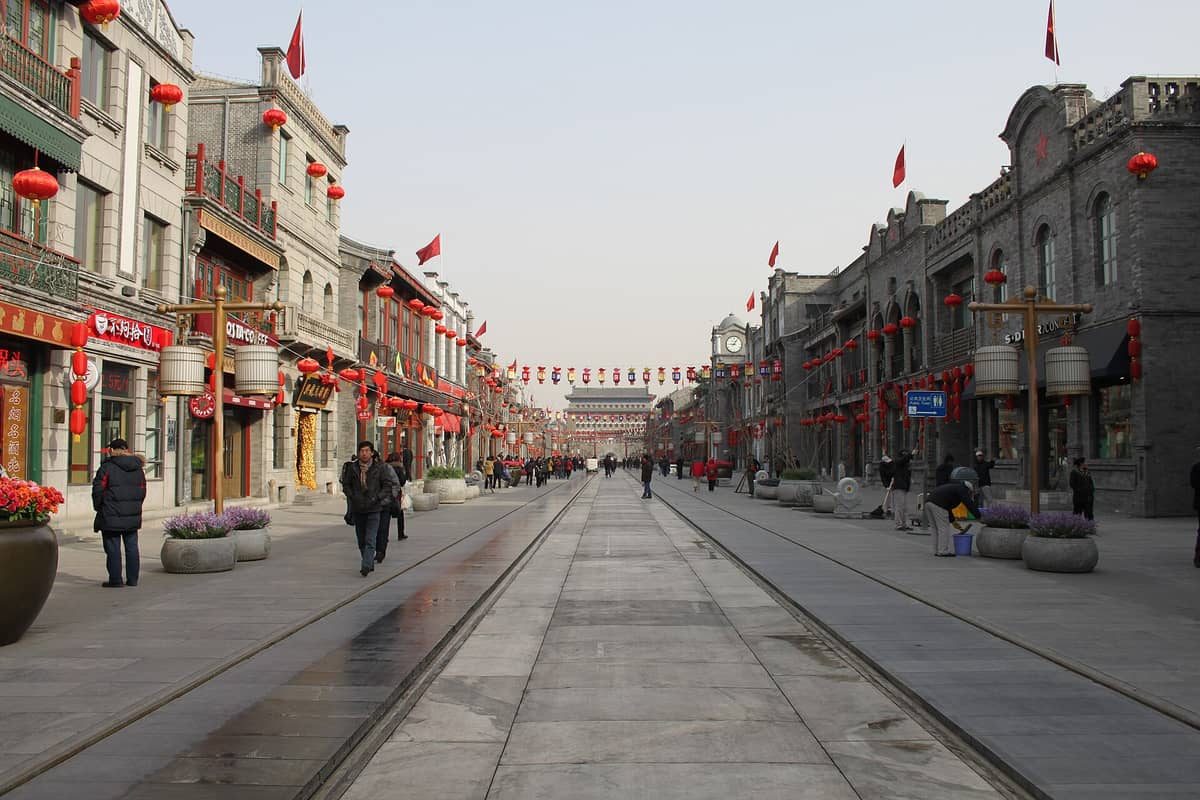
What Qianmen Street Actually Is
Qianmen Street, officially 前门大街 (Qiánmén Dàjiē), is a pedestrianized commercial avenue running approximately 840 metres south from the base of Zhengyangmen, the imposing gate tower that once marked the southern entrance to the Imperial City. At 20 metres wide, it is broad enough to feel like a grand boulevard rather than a shopping lane. Walking its full length from the gate tower to Tianqiao takes less than 15 minutes at a relaxed pace, but few people do it in one clean pass: the street keeps pulling you sideways into alleys, into shop doorways, and into the occasional tea or snack detour.
The avenue's history stretches back nearly 600 years, through the Ming and Qing dynasties when it was known as Zhengyangmen Street and functioned as the principal commercial artery south of the Imperial City. It was where bannermen, merchants, and pilgrims all passed. A significant renovation begun in 2005 and reopened in 2008 rebuilt much of the streetscape in a stylized 1920s–1930s architectural idiom, which is why the facades look simultaneously old and too clean. This is not a preserved historic street in the same sense as an unrenovated hutong. It is a reconstruction, and understanding that distinction shapes how you experience it.
ℹ️ Good to know
Admission to Qianmen Street is free. The street is open all day, year-round. Individual shops and restaurants set their own hours; most retail opens mid-morning and runs until 9 or 10 pm.
The Physical Experience: Walking the Street
The northern anchor of Qianmen Street is the Zhengyangmen gate tower, which you will see rising behind you as you walk south. The structure is substantial: a two-storey grey-brick tower with a green-tiled double-eaved roof, accompanied by the separate Arrow Tower nearby. Together they frame the street's entrance and give the avenue a genuine sense of civic scale that modern commercial streets rarely achieve. The gate towers are visible from the far end of Tiananmen Square, and seeing them from this southern approach gives you a perspective most visitors miss.
Moving south, the shopfronts on both sides present Qing-style grey-brick facades with painted timber details and hanging lanterns. The effect is coherent and photogenic from a distance. Up close, what occupies these heritage-styled shells is a mix: Chinese pharmacies and teahouses share blocks with international footwear brands and fast-food chains. The street does not pretend to be exclusively traditional, and it would be dishonest to claim otherwise. What you are looking at is essentially a heritage-skinned commercial street, which may or may not be what you came to Beijing to find.
The real texture of the area lies in the lanes that branch east and west off the main avenue. To the west, Dashilar Street (大栅栏, Dàshílán) runs roughly perpendicular and is worth at least 30 minutes on its own: narrower, more layered, and with a longer list of century-old shops including the famous Tongrentang traditional medicine hall and Ruifuxiang silk and fabric house, both long-established brands in the neighborhood.
Tickets & tours
Hand-picked options from our booking partner. Prices are indicative; availability and final rates are confirmed when you complete your booking.
Small group tour of Tian'anmen Square and the Forbidden City
From 43 €Instant confirmationFree cancellationBeijing Summer Palace Entrance Ticket
From 7 €Instant confirmationFree cancellationMutianyu Great Wall and Summer Palace small-group tour from Beijing
From 171 €Instant confirmationFree cancellationPrivate Guided Tour to Temple of Heaven, Panda House and Summer Palace
From 67 €Instant confirmationFree cancellation
How the Street Changes Through the Day
In the morning, before 9 am, Qianmen Street is almost quiet. Street cleaners move between the stone paving blocks, shop shutters are rolled up slowly, and the gate tower at the northern end catches whatever early light breaks through Beijing's sky. This is the best time to photograph the architecture without crowds. The air smells faintly of damp stone and, if you walk far enough south, of breakfast stalls beginning to fry.
By late morning the crowd builds steadily. Domestic tourists arrive in groups, often with guides holding flags or colored umbrellas. International visitors increase noticeably around midday. The peak congestion runs roughly from noon to 5 pm, when the main street can feel genuinely packed near the northern entrance and in front of the most recognizable restaurant facades. If you dislike moving at other people's pace, avoid this window or use it as the moment to cut into Dashilar or the residential hutongs further south where the crowds thin quickly.
Evening is underrated. After 7 pm, the lanterns strung between the shopfronts are lit, the light turns warm and softer, and the crowd shifts character: fewer tour groups, more couples and families. Food stalls are more active. The gate towers, floodlit against the night sky, make for excellent long-exposure photographs. If you plan to shoot the street, evening gives you the most atmospheric conditions.
💡 Local tip
Photography tip: Position yourself at the southern end of the gate tower plaza around dusk. Looking north, you get the lit lanterns receding toward Zhengyangmen with the tower framed at the end of the perspective — one of the more reliable compositions on this street.
Historical and Cultural Context
Understanding what Qianmen Street meant historically makes the visit more legible. During the Ming and Qing dynasties, the area south of Zhengyangmen was the commercial district that served the imperial capital. The Inner City to the north was primarily administrative and residential for the ruling class. The Outer City to the south, where Qianmen Street sits, was where the economy actually ran: merchants, artisans, theaters, restaurants, and guild halls clustered here. The street was one of several key commercial spines in what became one of the most commercially dense areas in imperial-era China.
This is also the southern gateway to Beijing’s historic central axis, one of the great urban-planning concepts of the Ming dynasty. That axis runs from the Bell and Drum Towers in the north, through the Forbidden City, Tiananmen, and Zhengyangmen, with Qianmen Street continuing south from the gate. Standing at the northern end of the street and looking back toward Tiananmen Square, you are literally standing on one of the organizing lines of the entire historic city. For more on how this fits into Beijing's imperial history, the Beijing imperial history guide provides useful context.
The renovation was controversial among preservation advocates because it involved substantial rebuilding rather than simple restoration. Official descriptions say the streetscape was reconstructed in a 1920s–1930s style, with most buildings rebuilt according to their former appearance and the remainder slightly modified. The result is a streetscape that performs history as much as it preserves it, which is an important distinction for travelers who value authenticity.
What to Eat and Buy
Qianmen Street is home to two of Beijing's most famous food institutions. Quanjude, one of the oldest Peking duck restaurants in the city, has a prominent location here. Expect queues at peak hours, a large tourist-oriented dining room, and duck that is competent but not necessarily the city's finest. It is worth the experience if you want the historical name attached to your meal. For more nuanced options, the surrounding neighborhood has smaller roast duck restaurants that are not on tour itineraries.
Beyond duck, the street and its branches offer a range of Beijing snacks: sesame-paste flatbreads (芝麻烧饼), candied hawthorn skewers (冰糖葫芦), and various fried and steamed street items sold from carts near Dashilar. For a fuller picture of what Beijing's food culture looks like across the city, the what to eat in Beijing guide covers the range far beyond tourist streets.
Shopping is primarily oriented toward tourists and domestic visitors. You will find traditional Chinese goods: silk scarves, tea sets, chopstick sets, calligraphy materials, traditional medicine shops, and snack brands. A few established shops sell genuinely good quality merchandise; others are selling items that could come from any souvenir market. The century-old Ruifuxiang silk and fabric shop on Dashilar is worth a look even if you are not buying: the interior retains much of its original counter and shelving arrangement.
Getting There and Getting Around
Qianmen Station on Beijing Subway Line 2 is the nearest subway stop for the street’s northern entrance. Use Exit B or C; the southwest or southeast exits are also listed in Beijing tourism guidance. The station is straightforward and well-signed in English. The guide to getting around Beijing has full subway and bus details for the city.
The street is a pedestrian-only zone, which makes it accessible on foot without traffic concerns. The paving is largely level stone. Detailed step-free access information, including accessible toilet locations and mobility-device services, is not confirmed in current official listings, so visitors with specific mobility requirements should verify directly with local tourism authorities before planning a visit. The proximity to Tiananmen Square to the north (roughly a 10-minute walk from the gate tower) makes it natural to combine both on the same visit.
If you plan to extend your time in the area, the Qianmen-Dashilar neighborhood rewards slow exploration. The hutong network west of Dashilar Street still contains residential lanes that feel substantially different from the renovated commercial front. Budget an extra hour if you want to wander without a map.
Honest Assessment: Is It Worth Your Time?
Qianmen Street is not the most authentic Beijing experience available. If you have limited time and want to understand how the city actually lives, a morning walk through a residential hutong like those in Nanluoguxiang or the lanes around Shichahai may give you more. But Qianmen Street serves a different purpose: it is where you grasp the imperial city's spatial logic, understand the historical relationship between commerce and governance, and get a readable introduction to Beijing's traditional commercial culture, even if that culture has been partly reconstructed.
Visitors who expect a preserved historic street will be disappointed. Visitors who approach it as a designed public space with real historical anchors, useful food stops, and a very convenient location relative to other major sights will find it time well spent. At zero admission cost, the calculation is straightforward.
⚠️ What to skip
Avoid Qianmen Street on Chinese national holidays, particularly Golden Week (first week of October) and the Lunar New Year period. Crowd density during these periods is extreme and the experience of the street changes substantially. If your visit coincides with a holiday, arrive before 8:30 am or skip the main street entirely and focus on Dashilar's side lanes.
Insider Tips
- Walk the full length of the street to Tianqiao in the south. Most tourists stop halfway and turn back. The lower portion has fewer crowds, a more local feel, and occasional performance spaces connected to Beijing's old opera culture.
- Dashilar Street to the west is worth as much time as the main avenue. Look for the Ruifuxiang silk shop and the Tongrentang traditional medicine hall, both of which have operated in this neighborhood for well over a century.
- The Zhengyangmen Arrow Tower is the second, more southerly gate structure; check current signage or official notices for visitor access and exhibitions.
- If you want Peking duck at Quanjude without a long wait, go at 11 am when it opens for lunch or after 8 pm when the main dinner rush has passed. Booking in advance online is also possible.
- The street continues Beijing’s historic central axis south from Zhengyangmen. If you stand at the northern entrance and look toward Tiananmen, then turn 180 degrees and look south, you are standing beside a planning line that has organized this city for over 600 years. That orientation is worth taking a moment to absorb before the crowds close in.
Who Is Qianmen Street For?
- First-time visitors to Beijing who want an introduction to the city's commercial and imperial history in one location
- Architecture and urban history enthusiasts interested in how Qing-dynasty commercial districts were organized
- Food travelers looking to tick off historic restaurant names and explore Beijing street snacks in one area
- Photographers who benefit from shooting at dusk when lantern light and the gate tower combine well
- Visitors pairing a morning at Tiananmen Square and the Forbidden City with an afternoon walking south
Nearby Attractions
Other things to see while in Qianmen & Dashilar:
- Dashilar Street
Stretching roughly 275 metres west from Qianmen Street, Dashilar Street (大栅栏街) is one of Beijing's oldest continuously operating commercial districts. Free to enter and pedestrianized, it combines century-old brand-name shops with renovated hutong lanes and a history stretching back to the Ming dynasty.
- Lao She Teahouse
Lao She Teahouse is one of Beijing's most accessible windows into traditional performing arts and tea culture, combining live Peking Opera, acrobatics, and folk performances with a working teahouse atmosphere. Located steps from Qianmen, it draws both curious first-timers and dedicated culture-seekers looking for something more substantive than a souvenir shop.