Beihai Park: Beijing's Ancient Imperial Garden on the Water
Beihai Park is one of Beijing's oldest and best-preserved imperial gardens, covering roughly 69 hectares with more than half the area given over to a large lake. Dating back over a thousand years, it offers a rare mix of imperial architecture, Buddhist monuments, and open green space within walking distance of the Forbidden City.
Quick Facts
- Location
- No. 1 Wenjin Street, Xicheng District, Beijing
- Getting There
- Bus lines 5, 101, 103, 109 (south gate); 13, 42, 105, 107, 111, 118 (north gate). No direct metro stop; nearest stations are Beihai North or Nanluoguxiang on Line 6.
- Time Needed
- 2–3 hours for a relaxed circuit; half a day if you linger on the water or visit multiple halls
- Cost
- High season (Apr–Oct): CNY 10 admission, CNY 20 combined ticket; discounted fares CNY 5 and CNY 10. Low season (Nov–Mar): CNY 5 admission, CNY 15 combined ticket; discounted fares CNY 2.5 and CNY 7.5.
- Best for
- History lovers, landscape photography, families wanting calm outdoor space, early-morning walkers
- Official website
- www.beihaipark.com.cn/english
What Beihai Park Actually Is
Beihai Park (北海公园, Běihǎi Gōngyuán) is a former imperial garden in Xicheng District, immediately northwest of the Forbidden City. For most of its history it was closed to ordinary people, serving as a pleasure ground for emperors from the Liao dynasty onward, more than a thousand years ago. Since opening to the public in 1925, it has become one of the capital's most frequented parks, though it rarely feels as crowded as the major ceremonial sites around Tiananmen.
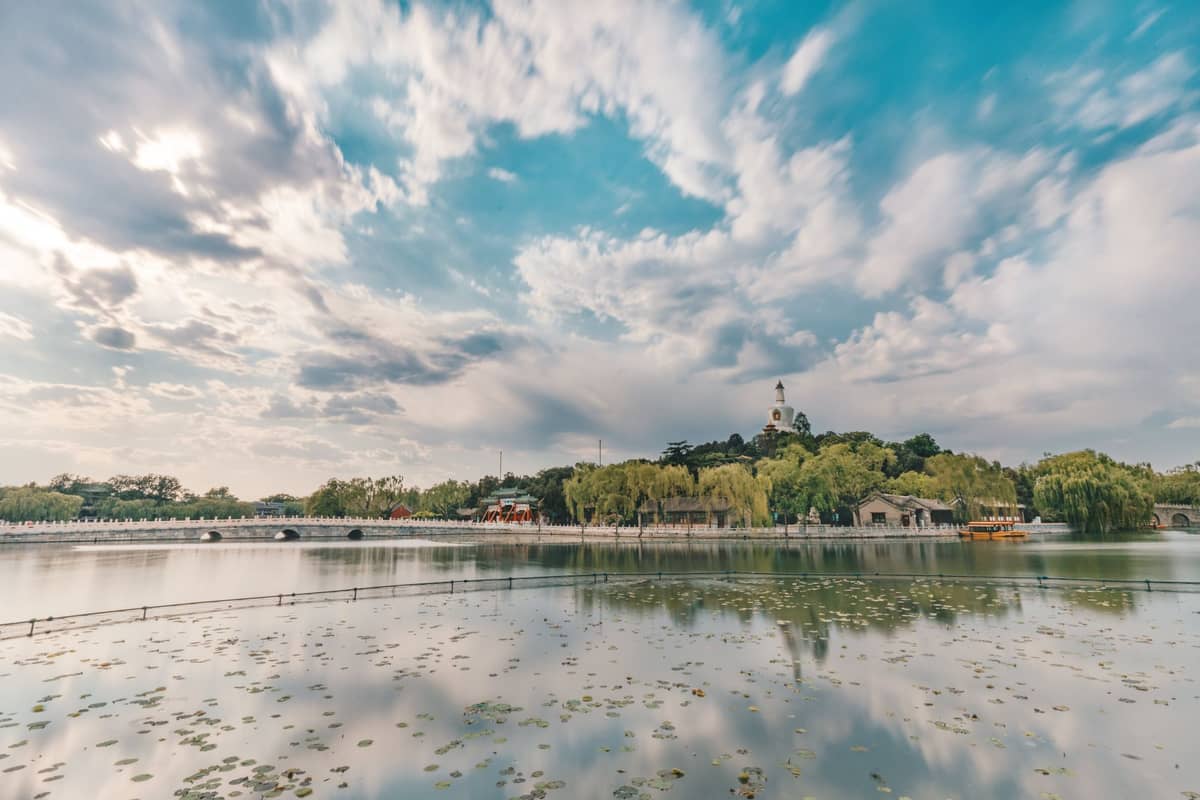
The park's defining feature is Beihai Lake, which accounts for over half of the park's roughly 69 hectares. Qionghua Islet rises from the center of the lake, topped by the White Dagoba, a 36-meter Tibetan-style stupa built in 1651 to mark the first visit of the Fifth Dalai Lama to Beijing. That white spire, visible from several surrounding neighborhoods, is the park's most recognizable landmark and the visual anchor for almost every photograph taken here.
ℹ️ Good to know
Most scenic areas beyond the Round City (Tuancheng) are closed on Mondays, except on statutory public holidays. If you plan to visit the islet or interior halls, avoid Monday visits.
How the Experience Changes Through the Day
Arrive before 8:00 on a weekday and Beihai Park belongs almost entirely to locals. Retired residents practice tai chi on the stone terraces near the south gate, small groups gather around portable speakers for group dance, and fishermen perch along the lake's stone edges in near-silence. The water is still, and the White Dagoba reflects cleanly in it. The smell of willow and lake water is strongest in this early light.
By mid-morning on weekends, particularly in spring and autumn, the south gate area fills quickly. Families with young children take the paddle boats and rowboats available for hire on the lake. The covered walkways along the north shore, known as the Painted Gallery, become a slow promenade. The atmosphere is relaxed rather than rushed, but it is no longer quiet. If solitude matters to you, the northern shore and the Five Dragon Pavilions area stay calmer throughout the day than the islet.
Late afternoon produces the best light for photography. The low sun catches the glazed roof tiles and turns the dagoba a warm amber. On clear autumn days, the contrast between the white stupa and the deep blue sky is exceptional. In winter, when the lake freezes, the park takes on a completely different character: skaters cross the ice and the bare willows frame the dagoba against gray skies. Snow, when it falls, transforms the garden into something that looks lifted from a classical painting. Weather conditions vary considerably year to year, so check forecasts if you are timing a visit around specific conditions.
Tickets & tours
Hand-picked options from our booking partner. Prices are indicative; availability and final rates are confirmed when you complete your booking.
Jingshan Hill, Beihai Park and Old Beijing tour with imperial meal
From 243 €Instant confirmationFree cancellationBeihai Park online reservation for a self-guided tour
From 6 €Instant confirmationFree cancellationBeihai boat ride, imperial cuisine, and Beijing's old part guided tour
From 255 €Instant confirmationFree cancellationSmall group tour of Tian'anmen Square and the Forbidden City
From 43 €Instant confirmationFree cancellation
The Imperial Layers: Over 1,000 Years in One Garden
The site's first imperial garden structures date to the Liao dynasty in the tenth century. The Jin dynasty expanded it substantially in the twelfth century, and by the Yuan dynasty (13th–14th century) it formed part of the imperial capital Khanbaliq, the city Marco Polo described. The enormous jade vessel in the Round City, known as the Dadu Jade Jar and dating to the Yuan period, is one of the oldest surviving imperial artifacts in Beijing.
The Ming and Qing dynasties added most of what visitors see today: pavilions, covered walkways, temple halls, and the formal arrangement of paths on Qionghua Islet. The White Dagoba itself is a Qing structure, added when the Shunzhi Emperor ordered it built to honor the Fifth Dalai Lama's historic visit. Understanding these layers helps make sense of what might otherwise seem like a random collection of buildings. For a broader view of Beijing's imperial landscape, the Beijing imperial history guide provides useful background on how sites like Beihai, the Summer Palace, and the Forbidden City relate to each other.
The Round City (Tuancheng), just inside the south gate, is architecturally distinct from the rest of the park. It sits on a circular elevated platform and contains the Hall of Received Light, which houses a large white jade Buddha statue. This area is open even on Mondays when other sections are closed, making it a viable partial visit if you cannot come any other day.
Walking the Park: A Practical Route
Most visitors enter through the south gate on Wenjin Street, which places you immediately in front of the Round City. From there, the main path leads north across a stone bridge onto Qionghua Islet. The climb to the White Dagoba is steep in places, the stone steps worn smooth by centuries of foot traffic, and the top offers a clear view across the lake to the northern shoreline. On clear days you can also make out the roofline of the Drum Tower to the northeast.
After descending the islet, consider walking counterclockwise around the north shore to reach the Five Dragon Pavilions, a cluster of five interconnected pavilions extending into the water on zigzagging stone causeways. The view back toward the dagoba from here is one of the park's best. The Painted Gallery (Changlang) runs along the northern shore and is particularly pleasant in hot or rainy weather. If you have time and energy, the north gate area near Houhai and Shichahai connects naturally to an afternoon walk through the lake district neighborhoods.
💡 Local tip
Wear shoes with good grip for the islet paths. The stone surfaces become slippery after rain or in humid conditions, and some sections have no handrails.
Getting There and Practical Details
There is no metro station directly at Beihai Park. The most straightforward option is to take Beijing Subway Line 6 to Beihai North station, which puts you near the north gate, or to Nanluoguxiang station for a short walk west. Bus routes 5, 101, 103, and 109 serve the south gate; routes 13, 42, 105, 107, 111, and 118 serve the north gate. Taxis and DiDi drop-offs work well at both gates, and the park is walkable from the Forbidden City's west side in about ten minutes.
The combined ticket (CNY 20 in high season, CNY 15 in low season) covers the main park, Qionghua Islet, and the Round City. The basic admission ticket (CNY 10 in high season, CNY 5 in low season) covers the park grounds but not all interior areas. Boat hire is available separately at the lake dock during operating hours. For those building a full day in the area, the nearby Jingshan Park is a short walk east and offers the famous elevated view over the Forbidden City's rooftops.
High season runs April 1 through October 31, with the park open from 06:00 to 21:00 (last entry 20:30). Low season runs November 1 through March 31, open 06:30 to 20:00 (last entry 19:30). Verify current hours before visiting, as they can change around public holidays.
Photography Conditions and Seasonal Notes
Spring (late March through April) brings willow catkins and occasional lotus bud previews, making the lakeside paths visually rich. Autumn (September through October) is the most photographically rewarding season overall, with clear skies and warm afternoon light. Summer visits are feasible, though July and August are hot and humid, with frequent afternoon thunderstorms. The lotus flowers in the northern section of the lake typically bloom from late June through August, which draws significant crowds on weekends. For more advice on capturing Beijing's parks and monuments, the Beijing photography guide covers equipment choices, restricted zones, and best shooting times across the city.
Air quality affects the experience noticeably in winter and early spring. On hazy days the dagoba loses much of its visual drama, and the far shore of the lake disappears into gray murk. Check real-time air quality readings if your visit date is flexible. When conditions are clear, even in winter, the park can be strikingly beautiful.
Who Should Reconsider This Visit
Travelers with very limited time in Beijing, say two days or fewer, may find that Beihai Park competes awkwardly with the Forbidden City, Temple of Heaven, and the Great Wall for schedule space. It is not a site that delivers a single unforgettable moment in the way those landmarks do. Its value is cumulative: the combination of water, architecture, history, and space. Visitors looking for museums with dense interpretive content will find the on-site English-language signage thin. Children who want active entertainment will likely prefer a destination with more structured activities.
Beihai Park is also not the right choice if you want to understand Beijing's hutong neighborhoods at street level. For that, the lanes around Nanluoguxiang or the hutong district are more immersive. Beihai is a complement to those experiences, not a substitute.
Insider Tips
- Enter through the north gate if you want to reach the Five Dragon Pavilions and the Painted Gallery first, before the main crowds arrive from the south. The north gate area stays quieter for longer on weekend mornings.
- The combined ticket is almost always worth buying if you plan to climb the islet: the basic entry ticket does not cover the Qionghua Islet interior or Round City, and the price difference is small.
- Boat hire at the lake dock operates seasonally and can sell out early on warm weekend afternoons in spring and autumn. If renting a boat matters to you, aim to arrive by 10:00.
- The small teahouse and snack vendors along the north shore sell bagged snacks and hot drinks at reasonable prices. Bringing your own water, however, keeps costs down on a longer visit.
- Weekday mornings between 7:00 and 9:00 offer the most authentic experience of the park as a neighborhood amenity: locals exercising, playing instruments, and socializing in ways that feel entirely unperformed for tourists.
Who Is Beihai Park For?
- Travelers with a genuine interest in Chinese imperial garden design and Buddhist architecture
- Photographers working in Beijing during autumn or winter who want landscape subjects beyond the main ceremonial sites
- Families wanting calm outdoor space with a lake, walkways, and enough visual interest to hold children's attention for a few hours
- Visitors combining Beihai with a half-day in the surrounding Xicheng lake district, including Shichahai and the hutong lanes to the north
- Early risers wanting to see Beijing's park culture at its most genuine before tourist flow picks up
Nearby Attractions
Other things to see while in Xicheng District:
- Beijing Planetarium
Beijing Planetarium (北京天文馆) is located in Xicheng District near Beijing Zoo. It runs dome theater shows, 3D and 4D screenings, and permanent science exhibitions across two buildings. Here's what a visit actually looks like.
- Beijing Zoo
Beijing Zoo is one of China's oldest and largest zoological parks, covering over 80 hectares in Xicheng District. Home to the city's most accessible giant panda viewing experience, it draws millions of visitors each year. This guide covers what to expect, when to go, and how to make the most of your time there.
- Capital Museum
The Capital Museum (首都博物馆) in Xicheng District is Beijing's premier civic museum, tracing the city's history across three millennia. Admission is free, the permanent galleries are genuinely impressive, and it rarely gets as crowded as the Forbidden City — making it one of the smartest stops in central Beijing.
- Fayuan Temple
Founded in 645 CE during the Tang dynasty, Fayuan Temple is the oldest surviving Buddhist temple in Beijing's central districts. 5 RMB to enter, rarely crowded, and steeped in over 1,300 years of religious and literary history, it rewards travelers willing to step off the tourist circuit in Xicheng.