Houhai & Shichahai Lakes: Beijing's Most Lived-In Waterfront
Shichahai is a 146.7-hectare scenic area in Xicheng District made up of three interconnected lakes: Qianhai, Houhai, and Xihai. Free to enter and open all day, it shifts from a quiet morning tai chi retreat to a loud, lantern-lit bar strip after dark. Understanding that contrast is the key to getting the most out of it.
Quick Facts
- Location
- Xicheng District, Beijing (主 address: No. 49 Di'anmen West Street)
- Getting There
- Line 6, Beihai North (北海北) Station, Exit B; buses 5, 60, 107, 108, 111 (Drum Tower / Beihai North Gate area)
- Time Needed
- 2–4 hours for a lakeside walk; a full evening adds another 2–3 hours
- Cost
- Free entry to the scenic area; boat rides, ice skating, and rickshaw tours are priced separately
- Best for
- Slow walkers, photographers, travelers wanting local atmosphere over ticketed sights
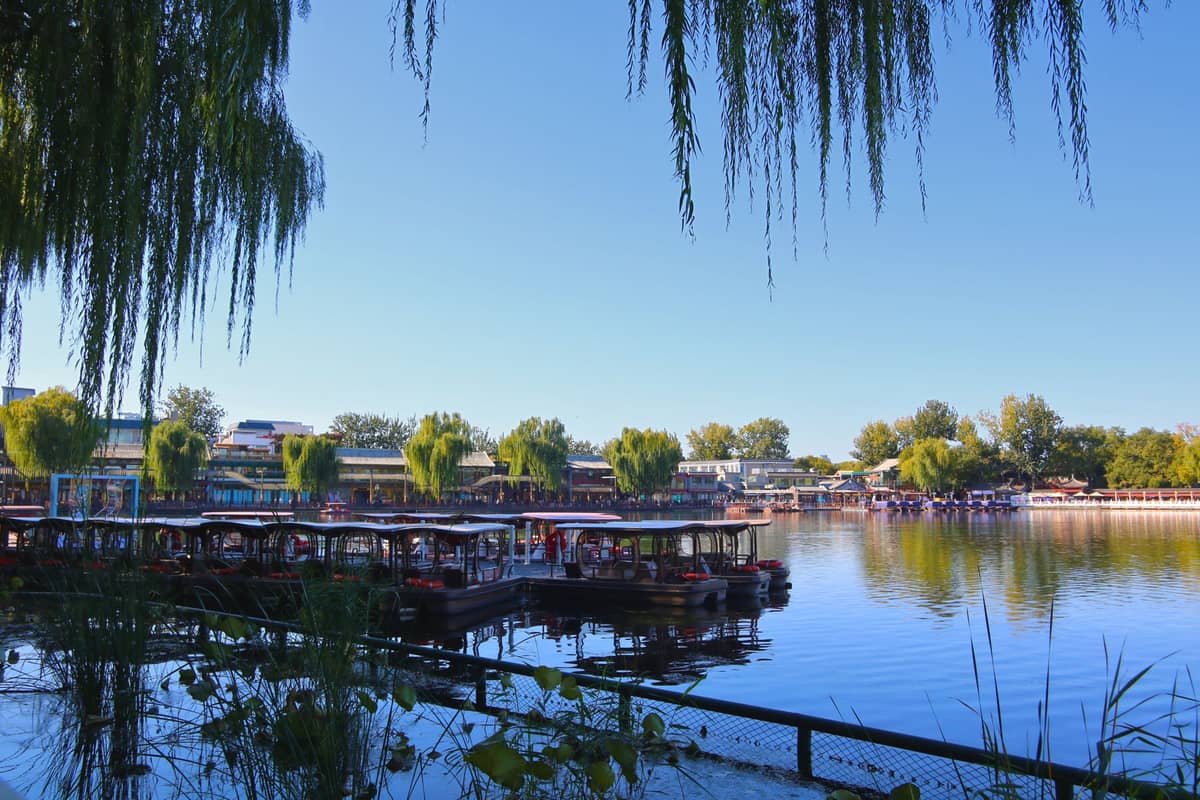
What Shichahai Actually Is
The Shichahai Scenic Area is not a single lake but a chain of three: Qianhai (Front Lake) to the south, Houhai (Back Lake) in the middle, and Xihai (West Lake) to the northwest. Together they cover roughly 146.7 hectares and sit inside Beijing's historic inner city, bounded on three sides by a dense network of hutong lanes. The area's history reaches back to the Yuan dynasty in the 13th century, when it served as the northern terminus of the Grand Canal — grain barges once unloaded here before the city's commercial center shifted south. That trading past left behind a neighborhood of courtyard homes, temples, and shaded embankments that have survived, in reasonably intact form, into the present.
The scenic area sits squarely in Xicheng District, Beijing's historically weighted western half. It is administratively distinct from the hutong corridors to the east, though the two areas blend visually. Travelers who want to understand the full picture of Beijing's preserved street life can pair a Shichahai walk with a deeper dive via a guide to Beijing's hutong neighborhoods.
ℹ️ Good to know
The scenic area is open all day year-round and admission is free (¥0). Individual activities like pedal boats, rowing boats, ice skating (winter only), and cycle rickshaw tours carry separate fees. Verify current prices on-site or by calling the scenic area at +86 10 66127651.
How the Place Changes Through the Day
Early morning at Shichahai is the version most visitors miss entirely. From around 06:00 to 09:00, before the scenic area officially opens for tourist activities, the embankments are the preserve of local residents: older men fishing with long poles from the Yinding Bridge, groups running tai chi sequences in the flat space by Qianhai's southern shore, vendors setting up steamed-bun carts on the side lanes. The light is low and flat, the water is glassy, and the only sounds are birdsong and the occasional bicycle. If photography is a priority, arriving at this hour is worth losing sleep over.
By mid-morning, the mix shifts. Tourist rickshaws begin their loops. Families arrive with children for pedal-boat rides on Qianhai. The snack stalls along Houhai's north bank open, filling the air with the smell of grilled skewers and sugar-glazed hawthorn fruit. The atmosphere is pleasant but no longer quiet. At midday in summer, the southern embankments of Qianhai get direct sun with little shade, which makes a long midday walk uncomfortable. The narrow lanes feeding into the hutong neighborhoods behind Houhai's north bank stay cooler and are worth detours.
After dark, Houhai transforms into something entirely different. The bar strip along the north bank of Houhai, running roughly between Yinding Bridge and the western end of the lake, comes to life around 20:00 and stays loud until well past midnight. Neon signs reflect off the water, amplified pop music bleeds between venues, and touts outside bars pitch to passing pedestrians. This is genuinely lively and has its own appeal, but travelers expecting a tranquil evening stroll should know what they are walking into. The Xihai lake section to the northwest stays quieter well into the evening and is the better choice for a calm night walk.
Tickets & tours
Hand-picked options from our booking partner. Prices are indicative; availability and final rates are confirmed when you complete your booking.
Small group tour of Tian'anmen Square and the Forbidden City
From 43 €Instant confirmationFree cancellationBeijing Summer Palace Entrance Ticket
From 7 €Instant confirmationFree cancellationMutianyu Great Wall and Summer Palace small-group tour from Beijing
From 171 €Instant confirmationFree cancellationPrivate Guided Tour to Temple of Heaven, Panda House and Summer Palace
From 67 €Instant confirmationFree cancellation
The Three Lakes: What to Expect at Each
Qianhai (Front Lake)
Qianhai is the southernmost and most accessible lake, closest to the Di'anmen West Street entrance. In summer it is the busiest, with pedal boats and rowboats available for hire from docks along the south and east shores. The iconic Yinding Bridge (Silver Ingot Bridge) connects Qianhai and Houhai at their narrowest point; on a clear day the bridge offers a framed view westward toward the distant Western Hills, a photograph that has appeared in Beijing travel literature for decades. In winter, portions of Qianhai are used for ice skating and ice cycling when temperatures are cold enough to freeze the surface — an activity that draws significant weekend crowds from local families.
Houhai (Back Lake)
Houhai is the central and most famous section, largely because its north bank is where the bar district developed from the early 2000s onward. The bars range from small courtyard spaces converted into live-music venues to larger commercial operations with outdoor terraces. The quality and price vary significantly; casual browsing before committing to a seat is sensible. Away from the bar strip, the eastern and southern banks of Houhai have quieter walking paths shaded by old willows, and several preserved courtyard homes nearby are significant: Prince Gong's Mansion (Gong Wang Fu), a large aristocratic residence from the Qing dynasty, stands a short walk northwest of Houhai.
Xihai (West Lake)
Xihai is the quietest and least visited of the three. It sits slightly apart from the main tourist circulation and has fewer amenities along its banks. The trade-off is genuine calm. On weekday mornings the paths here can be nearly empty, and the willows and reeds along the western shore give it a more naturalistic feel than the built-up Houhai embankment. For travelers who have already seen the main areas and want to escape the crowd, Xihai rewards a twenty-minute detour.
Historical and Cultural Context
The Shichahai area's Yuan dynasty origins are more than a historical footnote. When Kublai Khan established Khanbaliq (the precursor to Beijing) in the 13th century, the lakes formed a critical node in the city's water supply and transport system. The Grand Canal, which connected Beijing to Hangzhou roughly 1,800 kilometers to the south, effectively terminated near what is now Shichahai's northern boundary. Merchants, grain shipments, and imperial goods passed through this area. The commercial activity that accumulated around the docks left behind a neighborhood structure — lanes, markets, residences — that subsequent Ming and Qing dynasties built upon rather than erased.
By the Qing dynasty, the area around Houhai and the surrounding hutongs had become home to aristocratic mansions and temples. Several of those structures still stand. The broader context of Beijing's imperial history, from the Forbidden City to the lakes district, is worth understanding before arriving; a guide to Beijing's imperial history provides useful background. The nearby Bell Tower and Drum Tower — visible from parts of the Shichahai embankment — marked the northern end of the imperial city's central axis and are a natural addition to a Shichahai visit.
Practical Walkthrough: How to Structure Your Visit
A useful route starts at the Beihai North subway station (Line 6, Exit B), which deposits you near the Beihai Park north gate and a short walk from Qianhai's eastern shore. Walk north along the eastern bank of Qianhai to Yinding Bridge. Cross the bridge and continue west along Houhai's north bank if you want to see the bar district in daylight, then loop back via the southern bank's quieter willow-lined path. From there, a fifteen-minute walk northwest reaches Xihai. The full loop covering all three lakes comfortably takes two hours at a relaxed pace.
The area connects naturally to several nearby attractions. Nanluoguxiang is a short walk to the east through the hutong grid and offers a very different, more commercial version of preserved-lane tourism. To the south, Beihai Park is directly accessible, and its White Dagoba makes a strong visual counterpoint to the lake scenery.
💡 Local tip
Wear comfortable flat shoes. The embankment paths are mostly paved but some sections near Xihai and along the hutong side lanes are uneven stone or brick. The historic character of the area means there is very limited step-free infrastructure; the lanes are navigable but narrow, and some bridges have steps.
Photography, Seasons, and Weather
The Yinding Bridge view toward the Western Hills is the most reproduced image from Shichahai, and it works best on clear autumn mornings when haze is minimal and the light is warm. Summer mornings can also produce good light, but summer afternoons frequently bring haze or high cloud that flatten the view. Winter visits have their own appeal: if temperatures drop far enough to freeze the lakes, the scene changes completely, with skaters moving across Qianhai and a muted, gray-toned palette that looks nothing like the green-and-neon images from warmer months.
Autumn (September to October) is generally the most photogenic season for the entire city. For a broader overview of when atmospheric conditions are most favorable, consult a seasonal guide to Beijing. Photographers specifically should note that the bar strip area along Houhai's north bank is one of the better places in central Beijing for night reflection shots; the neon colors hit the water cleanly and the narrow lanes behind the bars have texture worth exploring.
Beijing's air quality varies significantly by season and weather event. On high-pollution days, distant views including the Western Hills framed from Yinding Bridge will be obscured. There is no way to predict this far in advance; checking a real-time air quality index on the morning of your visit is advisable if atmospheric clarity matters to your plans.
Who Should Manage Expectations
Shichahai is not a pristine heritage site sealed from commercial activity. The Houhai bar strip is loud, aggressively touristy, and in places resembles a theme-park version of old Beijing. Prices at lakeside bars are higher than surrounding neighborhood spots. Rickshaw touts can be persistent near the main embankment entrances. Travelers expecting a contemplative, crowd-free encounter with historic China will find the evening hours on the north bank of Houhai difficult. Those same travelers, arriving at 07:00 on a weekday morning, will find something genuinely closer to what they hoped for.
Visitors with mobility limitations should note that the scenic area's historic character means uneven surfaces, steps on bridges, and narrow lanes are common. The official listings do not specify comprehensive step-free or wheelchair-accessible routes; confirming current arrangements directly with the scenic area administration before visiting is recommended.
Insider Tips
- The Yinding Bridge Western Hills view is almost always photographed from the east side looking west. Walk to the west side of the bridge and look back east for a less familiar angle that includes the bridge arch and Houhai's bar-lit north bank in a single frame.
- Several small noodle and dumpling restaurants sit in the lanes one block north of Houhai's north bank, away from the waterfront. They charge a fraction of the lakeside bar prices for better food. Look for hand-painted menus and plastic stools as a rough quality signal.
- On weekend mornings between roughly November and February, Qianhai sometimes hosts an informal open-air song-and-dance gathering near the southwest shore, where retired residents play traditional instruments and sing Beijing opera or folk songs. It is unscheduled and informal; it happens when it happens.
- The Drum Tower, visible from the eastern embankment of Houhai, closes earlier than the scenic area. If you want to combine a Drum Tower visit with a Shichahai walk, go to the Drum Tower first.
- Cycling rickshaw tours of the hutongs departing from Shichahai are widely available but unregulated in terms of pricing. Agree on the full price in writing (or on a phone calculator) before departure to avoid post-trip disputes.
Who Is Houhai & Shichahai Lakes For?
- Travelers who want a free, walkable experience that captures how urban Beijingers actually use public space
- Photographers seeking early-morning reflection shots, the Western Hills view, or night neon-on-water images
- Visitors combining a hutong walk with a visit to the Bell Tower, Drum Tower, or Beihai Park
- Winter visitors who want to see lake ice culture — skating, ice cycling — in a central city setting
- Travelers on a tight budget who want atmosphere rather than ticketed attractions
Nearby Attractions
Other things to see while in Xicheng District:
- Beihai Park
Beihai Park is one of Beijing's oldest and best-preserved imperial gardens, covering roughly 69 hectares with more than half the area given over to a large lake. Dating back over a thousand years, it offers a rare mix of imperial architecture, Buddhist monuments, and open green space within walking distance of the Forbidden City.
- Beijing Planetarium
Beijing Planetarium (北京天文馆) is located in Xicheng District near Beijing Zoo. It runs dome theater shows, 3D and 4D screenings, and permanent science exhibitions across two buildings. Here's what a visit actually looks like.
- Beijing Zoo
Beijing Zoo is one of China's oldest and largest zoological parks, covering over 80 hectares in Xicheng District. Home to the city's most accessible giant panda viewing experience, it draws millions of visitors each year. This guide covers what to expect, when to go, and how to make the most of your time there.
- Capital Museum
The Capital Museum (首都博物馆) in Xicheng District is Beijing's premier civic museum, tracing the city's history across three millennia. Admission is free, the permanent galleries are genuinely impressive, and it rarely gets as crowded as the Forbidden City — making it one of the smartest stops in central Beijing.