Temple of Heaven (天坛): Beijing's Most Photographed Imperial Ritual Site
The Temple of Heaven is the best-preserved example of Chinese imperial ceremonial architecture in Beijing, set within a 267-hectare park that doubles as a living neighborhood gathering space. Whether you come for the architecture, the history, or the morning spectacle of tai chi and square dancing, it rewards careful timing and a full morning.
Quick Facts
- Location
- No. 1 Tiantan Road, Dongcheng District, Beijing
- Getting There
- Tiantan Dongmen Station (Subway Line 5, East Gate)
- Time Needed
- 2–3 hours for the full complex; 1 hour if focusing on the Hall of Prayer only
- Cost
- Park entry: CNY 15 (peak) / CNY 10 (off-season). Combo ticket for principal attractions: CNY 34 (peak) / CNY 28 (off-season). Prices verified September 2026.
- Best for
- Architecture lovers, history enthusiasts, morning walks, photography
- Official website
- www.tiantanpark.com/english
What the Temple of Heaven Actually Is
The Temple of Heaven (天坛, Tiāntán) is not a single building but a walled complex of ceremonial structures spread across a 267-hectare park in southern Dongcheng District. Construction began during the reign of the Yongle Emperor in the Ming dynasty, the same emperor responsible for the Forbidden City. For nearly five centuries, Ming and Qing emperors traveled here annually to perform rituals honoring Heaven and to pray for good harvests. The site was designated a UNESCO World Heritage Site in 1998.
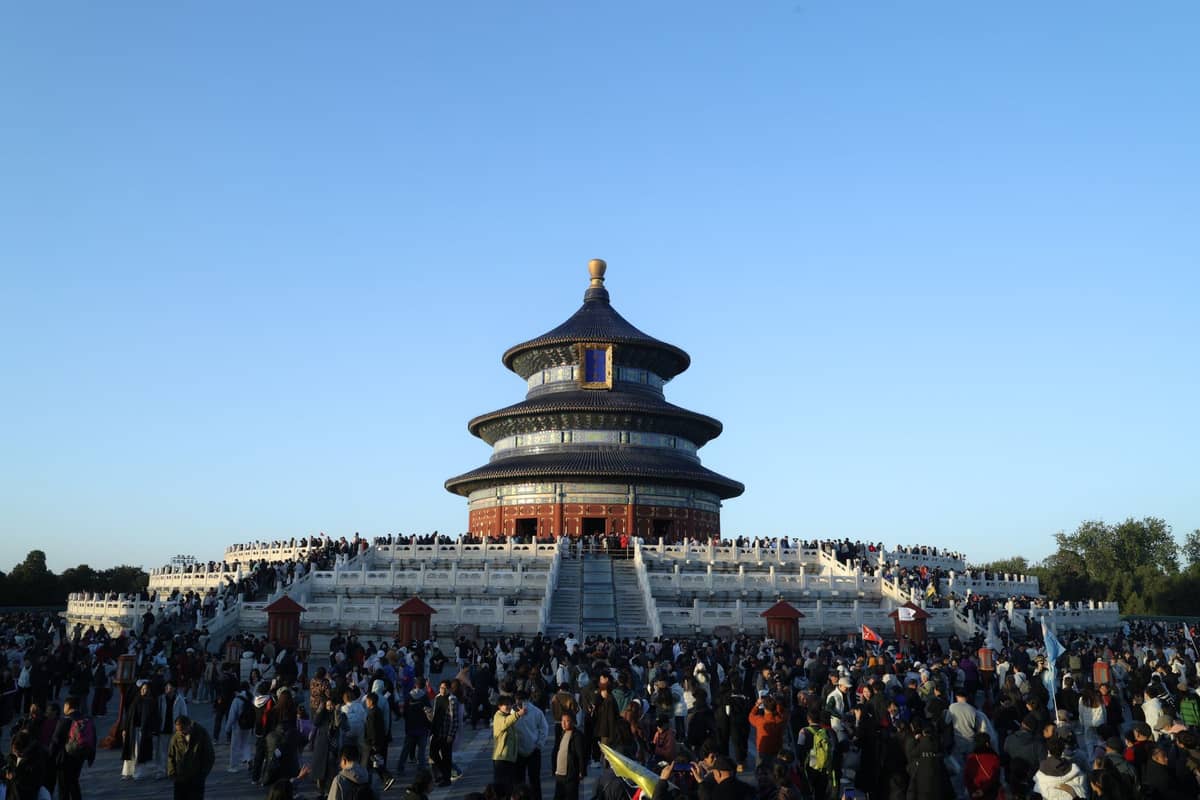
The centrepiece is the Hall of Prayer for Good Harvests (祈年殿, Qíniándìan), a triple-eaved circular hall with a deep blue glazed tile roof sitting atop three concentric marble terraces. It is one of the most recognizable structures in China, and photographs of it struggle to capture how the scale actually feels when you are standing at the base of those terraces, looking up. The geometry is intentional: the building's plan uses circular and square forms to symbolize the relationship between Heaven (round) and Earth (square).
The park surrounding the structures is enormous and genuinely green. Ancient cypress trees, some over 600 years old, line the main ceremonial paths. The grounds function simultaneously as a UNESCO monument and as a public park for the surrounding neighborhood, which means what you encounter here is something you rarely find at major Chinese heritage sites: real, everyday Beijing life happening alongside the architecture.
💡 Local tip
Buy the combo ticket (CNY 34 peak season) rather than the basic park entry. It covers the Hall of Prayer for Good Harvests, the Circular Mound Altar, and the Imperial Vault of Heaven’s Echo Wall. The park itself is walkable with the base ticket, but the principal structures require the add-on. The park itself is walkable for free with the base ticket, but the principal structures require the add-on.
Morning: When the Park Belongs to Beijing Residents
The park opens at 06:00 (06:30 in winter), and for the first two hours before the tourist coaches arrive, the atmosphere is completely different from the midday experience. Under the cypress canopy, retired Beijingers practice tai chi, play erhu, do fan dancing, and gather in loose social clusters. There is something almost surreal about watching square dancing unfold in the shadow of a 15th-century ceremonial altar.
The morning light is also far better for photography. By 08:00, the sun is low enough to cast warm, directional light across the white marble terraces of the Circular Mound Altar. The acoustic effect at the center of the altar's top tier, a circular stone where the Emperor once stood to address Heaven, is noticeable even on a busy day. Sound reflects off the surrounding walls in a way that makes your voice seem amplified. It is a small detail that most visitors walk past.
If you are planning a photography-focused visit, see our Beijing photography guide for specific framing and timing advice around the main structures.
Tickets & tours
Hand-picked options from our booking partner. Prices are indicative; availability and final rates are confirmed when you complete your booking.
Private Guided Tour to Temple of Heaven, Panda House and Summer Palace
From 67 €Instant confirmationFree cancellationTemple of Heaven, Tian'anmen Square and Forbidden City Private Tour
From 70 €Instant confirmationFree cancellationForbidden City, Temple of Heaven and Summer Palace guided tour
From 294 €Instant confirmationFree cancellationBeijing Temple of Heaven Entrance Ticket
From 8 €Instant confirmationFree cancellation
The Architecture: What to Look at and Why
The complex is organized along a north-south axis. The three main structures you should not miss are the Hall of Prayer for Good Harvests (north end), the Imperial Vault of Heaven (center), and the Circular Mound Altar (south end). Walk the entire length of the Danbi Bridge, the broad raised causeway connecting them, to understand how the spatial sequence was choreographed. It is 360 meters long and slightly elevated, which places you above the surrounding trees and gives an unusual perspective.
At the Imperial Vault of Heaven, look at the Echo Wall surrounding the building. In quiet conditions, a whisper spoken while facing the wall can travel along the curve and be heard clearly at the other side. Crowds and ambient noise reduce this effect significantly. It works best very early in the morning, when the tourist density is low.
The Hall of Abstinence (Zhaigong), where emperors fasted and purified before the ceremonies, is often overlooked by visitors focused on the main axis. It is worth the short detour: the building complex is compact, well-preserved, and displays ceremonial objects that put the ritual context into focus.
Practical Walkthrough: How to Navigate the Site
Exit at Tiantan Dongmen Station on Line 5 and enter through the East Gate. This drops you near the Hall of Prayer for Good Harvests, which is the most photographed structure and best seen in the morning before tour groups arrive. From there, walk south along the Danbi Bridge to reach the Circular Mound Altar complex. Exit through the South Gate if you want to connect to the Qianmen area, or back through the East Gate to return to the subway.
The separately ticketed historic sites are closed on Mondays except during statutory holidays. Plan accordingly. The park grounds remain open daily. For route ideas combining this site with nearby attractions, the 3-day Beijing itinerary pairs the Temple of Heaven with a morning and then routes you north to Wangfujing or the Forbidden City area in the afternoon.
- Park hours: 06:00–22:00 (April 1–October 31); 06:30–22:00 (November 1–March 31); last entry 21:00 year-round
- Historic sites within the park: 08:00–18:00 Tuesday–Sunday in peak season (last entry 17:30); 08:00–17:00 Tuesday–Sunday off-season (last entry 16:30); closed Mondays except statutory holidays
- Park entry: CNY 15 peak / CNY 10 off-season; reduced rates available
- Combo ticket: CNY 34 peak / CNY 28 off-season; covers the four principal attractions
- Getting there: Beijing Subway Line 5, Tiantan Dongmen Station (East Gate)
⚠️ What to skip
The park is very large. Comfortable, flat shoes are essential — you will walk on stone and brick paths for the better part of two to three hours. There is minimal shade along the central ceremonial axis at midday in summer, when temperatures can exceed 30°C. Bring water.
Seasonal Conditions and Weather Considerations
April to May and September to October are the most comfortable months to visit, with cooler temperatures and lower rainfall than summer. The ancient cypresses are at their best in these shoulder seasons, and the light is more photogenic. Summer visits (June through August) are possible but the combination of heat, humidity, and peak tourist numbers makes for a less enjoyable experience than at quieter times of year. For broader seasonal planning, see our guide on the best time to visit Beijing.
Winter visits have a different quality: the bare cypress branches against the blue tile roofs can be striking, and crowds are thin. The cold is real (temperatures can drop well below zero during cold waves), and the shorter opening hours for the internal sites mean you have less time inside the structures. But the park in winter, with frost on the marble terraces and almost no tourists, is a legitimate alternative to the peak-season experience.
Beijing's air quality varies considerably by season and daily conditions. On days with poor air visibility, the blue of the glazed roof tiles appears muted and the distant perspectives across the park flatten. Check air quality forecasts before planning photography-focused visits.
Who Should Temper Their Expectations
The Temple of Heaven does not have the density of interior detail or museum content that a site like the Forbidden City offers. The structures are magnificent from the outside but relatively sparse inside. Visitors who feel cheated unless every square meter has an exhibit will find the wide open grounds between buildings less satisfying than expected.
Travelers primarily interested in Qing dynasty court life and interiors should prioritize the Forbidden City and then consider the Temple of Heaven as a secondary stop rather than the main event. Families with young children may find the very long walking distances between structures tiring; the Beijing with kids guide has suggestions for pacing multi-stop days.
Accessibility across the park is uneven. The main paths are manageable, but the historic structures involve steps and raised thresholds that can be difficult for wheelchair users. Contact the park service hotline (+86-10-6702-8866) before visiting if you have specific requirements.
The Broader Context: Dongcheng and the Southern Axis
The Temple of Heaven sits in the southern part of Dongcheng District, about 3 kilometers south of Tiananmen Square. Historically, it stood outside the old Outer City walls, positioned deliberately to the southeast of the Imperial City. The relationship between the Temple of Heaven (southeast), the Temple of Earth (north), the Temple of the Sun (east), and the Temple of the Moon (west) forms a cosmological map across what is now the city.
The neighborhood immediately east of the park's East Gate has some good lunch options within a 10-minute walk, and the area is considerably less touristy than the streets around Wangfujing. The nearby Qianmen Street commercial area is a 15-minute walk north and makes a logical pairing with a Temple of Heaven morning.
Insider Tips
- Arrive through the East Gate before 08:00 to watch the morning exercise and social scene before tour groups enter. The atmosphere shifts noticeably around 09:30 when coaches begin arriving.
- The acoustic effect at the center of the Circular Mound Altar's top tier is subtle and easy to miss. Stand on the central marble stone, speak at normal volume facing outward, and listen for the way the sound reflects back. It works best when the surrounding area is not crowded.
- The Long Corridor (a covered walkway in the park's western section) is where the most animated music and social activity happens in the mornings. It is not on the main tourist circuit and most visitors skip it entirely.
- Combo tickets are required for the individual structures, but the park entry-only ticket lets you walk the grounds, the Danbi Bridge causeway, and the Long Corridor. If budget is the priority, the park-only experience is still worthwhile.
- Audio guides are available at the site in multiple languages and add significant context to what are otherwise fairly sparse interiors. They are worth renting if this is your first visit and you have a genuine interest in the Ming and Qing ritual calendar.
Who Is Temple of Heaven For?
- Architecture and design travelers interested in imperial Chinese spatial planning and symbolic geometry
- Photographers working early mornings, particularly in spring and autumn
- History-focused visitors building a picture of Beijing's imperial ritual landscape
- Travelers who want to see how a major heritage site functions as an active public park for residents
- Anyone following a multi-day Beijing itinerary who has already visited the Forbidden City and wants meaningful contrast
Nearby Attractions
Other things to see while in Dongcheng District:
- Ancient Observatory (Guguanxiangtai)
Built in 1442 during the Ming dynasty, it holds a remarkable collection of Qing-era bronze instruments and offers a rare window into imperial Chinese astronomy in central Beijing.
- Bell Tower and Drum Tower
Standing at the northern end of Beijing's ancient central axis, the Bell Tower and Drum Tower have marked time for the city since the Ming dynasty. This guide covers what to see, when to go, how to get there, and whether the climb is worth your while.
- Confucius Temple and Guozijian
The Confucius Temple and Guozijian Museum preserves two of Beijing's most historically significant sites: a Yuan dynasty Confucian temple and the Imperial College that trained China's governing elite for six centuries. Quieter than most major attractions, it rewards visitors who want genuine historical depth alongside calm, tree-shaded courtyards.
- Forbidden City (Palace Museum)
The Forbidden City, officially the Palace Museum, is the world's largest surviving imperial palace complex and Beijing's most significant cultural landmark. Built between 1406 and 1420 under Ming emperor Zhu Di, it served as the ceremonial and political heart of China for nearly five centuries. This guide covers everything you need to visit confidently.