Forbidden City (Palace Museum): The Complete Visitor Guide
The Forbidden City, officially the Palace Museum, is the world's largest surviving imperial palace complex and Beijing's most significant cultural landmark. Built between 1406 and 1420 under Ming emperor Zhu Di, it served as the ceremonial and political heart of China for nearly five centuries. This guide covers everything you need to visit confidently.
Quick Facts
- Location
- No. 4, Jingshanqian Street, Dongcheng District, Beijing
- Getting There
- Tiananmen East or Tiananmen West stations (Line 1); enter through the Meridian Gate (午门)
- Time Needed
- 3 to 5 hours minimum; a full day for serious visitors
- Cost
- CNY 60 (Apr–Oct) / CNY 40 (Nov–Mar); Treasure Gallery and Gallery of Clocks each CNY 10 extra
- Best for
- History enthusiasts, architecture lovers, first-time Beijing visitors
- Official website
- www.dpm.org.cn
What the Forbidden City Actually Is
The Forbidden City — officially the Palace Museum (故宫博物院, Gùgōng Bówùyuàn) — is a 72-hectare walled complex at the geographic center of Beijing. It served as the imperial palace for 24 emperors across the Ming and Qing dynasties: 14 Ming and 10 Qing rulers were enthroned here over a span of 505 years, from 1420 until the abdication of Puyi in 1912. UNESCO inscribed it as a World Heritage Site, and by the count of its own curators, the complex contains around 9,000 rooms across approximately 980 surviving structures. The scale is genuinely difficult to absorb from street level.
Construction began in 1406 under the Ming emperor Zhu Di, who relocated the imperial capital from Nanjing to Beijing. The complex was completed in 1420, a logistics feat that drew on hundreds of thousands of laborers and craftsmen sourced from across China. The building materials alone tell a story: white marble from quarries near Beijing, timber from forests in Sichuan and Yunnan, and golden-yellow glazed roof tiles fired in kilns south of the city. That warm tile color, which dominates the skyline view from nearby Jingshan Park, was not decorative whim. Yellow was the exclusive color of the emperor.
ℹ️ Good to know
Opening hours: Tuesday to Sunday, 08:30–17:00 (last entry 16:00) from April 1 to October 31; 08:30–16:30 (last entry 15:30) from November 1 to March 31. Closed Mondays, except on national holidays and the eve of Chinese New Year. Hours can change during special events — check the official site before your visit.
Entering Through the Meridian Gate
The standard visitor entry is through the Meridian Gate (午门, Wǔmén), approached from Tiananmen Square across the Golden Water Bridge. The gate is the largest and most ceremonially significant of the Forbidden City's four gates. From a distance, its five-pavilion form — a central tower flanked by two wings that curve forward like arms — gives the impression of the palace embracing the space in front of it. Up close, you notice the sheer height of the red wall base, around ten meters, topped by another story of yellow-roofed halls. The effect is deliberate: the architecture is designed to communicate the absolute power of the throne before you ever cross the threshold.
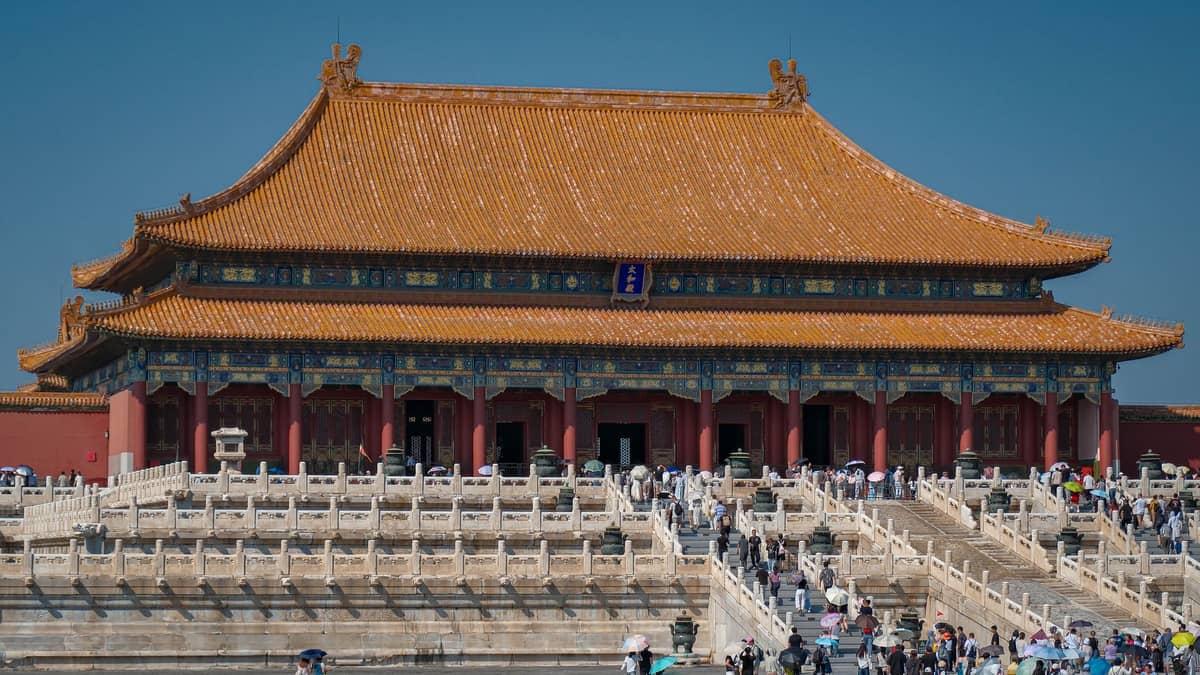
The queue at the Meridian Gate moves faster than it looks, but the security screening before it does not. Bags go through X-ray machines. The entire process adds fifteen to twenty minutes to your arrival time on busy days. Once inside, you pass into the Outer Court, a vast flagstone courtyard that on summer mornings produces a shimmer of heat haze across its surface. In the distance, the Hall of Supreme Harmony (太和殿) sits on a three-tiered marble terrace, its ridgeline decorated with a procession of small ceramic figurines whose number indicates the rank of the building. The Hall of Supreme Harmony has ten, the maximum.
💡 Local tip
Book tickets in advance through the Palace Museum's official website. Tickets are sold online under a daily visitor cap, and popular dates sell out — sometimes weeks ahead during national holidays like Golden Week (early October) and Chinese New Year. Same-day ticket sales are not available.
Tickets & tours
Hand-picked options from our booking partner. Prices are indicative; availability and final rates are confirmed when you complete your booking.
Small group tour of Tian'anmen Square and the Forbidden City
From 43 €Instant confirmationFree cancellationTemple of Heaven, Tian'anmen Square and Forbidden City Private Tour
From 70 €Instant confirmationFree cancellationForbidden City, Temple of Heaven and Summer Palace guided tour
From 294 €Instant confirmationFree cancellationForbidden City guided tour with Royal Icehouse lunch
From 226 €Instant confirmationFree cancellation
The Outer Court: Imperial Ceremony on a Grand Scale
The southern half of the complex, known as the Outer Court, was the formal face of imperial power. It centers on three great halls arranged on a north-south axis: the Hall of Supreme Harmony (太和殿), the Hall of Central Harmony (中和殿), and the Hall of Preserving Harmony (保和殿). The Hall of Supreme Harmony is the largest timber-frame building in China. Emperors held their most significant ceremonies here: accessions, major festivals, military victories. The interior is dim even in full sunlight — thick columns of nanmu wood, lacquered deep red, frame a distant golden throne beneath a coffered ceiling heavy with gilded carvings and painted cloud motifs.
Most visitors crowd the central axis and move through these halls quickly, which means the side galleries and exhibition spaces flanking the main path are far less congested. The Hall of Military Valor (武英殿) to the west and the Hall of Literary Glory (文华殿) to the east now house rotating exhibitions of the museum's collection — calligraphy, bronzes, ceramics, and paintings that span more than two thousand years of Chinese art. These are among the quietest and most rewarding spaces in the entire complex.
The Inner Court: Where the Emperors Actually Lived
Cross the Gate of Heavenly Purity (乾清门) and the atmosphere shifts. The Inner Court is more human in scale, though still carefully hierarchical. The Palace of Heavenly Purity (乾清宫) was the emperor's official residence and later his audience hall; the Hall of Union (交泰殿) housed imperial seals; the Palace of Earthly Tranquility (坤宁宫) was the empress's residence and, in the Qing dynasty, a Shamanist ritual space where animal sacrifices were conducted in the outer room while the imperial wedding chamber occupied a small, low-ceilinged room to the east. The wedding chamber is preserved with its original red-lacquered furniture and gold decoration. It is one of the most intimate and genuinely strange spaces in the complex.
East and west of the main axis extend the Six Eastern Palaces and Six Western Palaces, a grid of smaller courtyards and residential buildings that housed the imperial consorts. These lateral wings are architecturally consistent but the details vary: a different ceramic screen here, a different courtyard tree there. The Western Palaces now include the Treasure Gallery, where the museum displays jade, gold vessels, jeweled headdresses, and the extraordinary collection of clocks acquired by Qing emperors through Jesuit missionaries and European trade. The Gallery of Clocks is one of the most commented-upon rooms in the museum among visitors who take the time to find it.
For visitors with a specific interest in the museum's collection rather than just the architecture, it is worth reading the best museums in Beijing guide before your trip, which explains how the Palace Museum fits into the broader landscape of Beijing's cultural institutions.
Time of Day, Crowds, and Seasons
Arriving at or just before 08:30 makes a measurable difference. In the first hour after opening, the Outer Court courtyards are still cool, the light is low and directional, and the tour groups that define the midday experience have not yet formed their dense human rivers along the central axis. By 10:30 on a weekend in October, the main path between the Meridian Gate and the Imperial Garden can feel genuinely congested. By contrast, the same path at 08:45 on a Tuesday in November is almost meditative: frost on the flagstones, the smell of stone and cold air, the enormous empty courtyards asserting their original purpose.
Spring (April and May) and autumn (September and October) are the most comfortable seasons. Summer brings heat, humidity, and peak crowds; the flagstone courtyards have almost no shade, and the sun reflects hard off the pale stone. Winter visits are cold — temperatures regularly drop below freezing in January — but the combination of thin crowds, bare trees, and occasional snow on the yellow rooftops produces a quality of light photographers specifically travel to capture. Bring warm layers and check the day's forecast; the palace complex offers very little protection from wind.
For detailed seasonal planning across Beijing, the best time to visit Beijing guide covers temperature ranges, rainfall patterns, and the effect of national holidays on crowd levels.
⚠️ What to skip
National holidays — especially Golden Week in early October and the Spring Festival period — bring extraordinary crowds and require tickets booked weeks in advance. Visitor caps apply strictly. If you are visiting during these windows, treat ticket booking as the single most important planning step.
Photography, Accessibility, and Practical Details
Photography is permitted throughout most of the open-air complex and in the majority of exhibition halls. Tripods are generally not allowed inside buildings. The best photography opportunities are from elevated positions: the viewing platform above the Meridian Gate and, separately, the view from Jingshan Park directly north of the palace, which provides the classic aerial perspective across the full complex from the Hill of Ten Thousand Springs. Early morning, particularly in autumn or winter, produces the most dramatic light.
The Beijing photography guide covers the Jingshan viewpoint and other vantage points in detail, including which gates and courtyards catch the best light at different times of day.
On accessibility: visitors with a qualifying disability identification document are admitted free of charge. The official ticket information does not confirm that all historic buildings or circulation routes are fully step-free — the complex includes significant changes of level, high thresholds between rooms, and cobbled surfaces. Visitors who require detailed mobility assistance should contact the museum directly before planning their visit. Strollers and wheelchairs can navigate the main axis and large courtyard areas, but the narrower side pavilions present more challenges.
The complex has several food and rest areas, including a cafe positioned along the moat near the eastern exit that tends to be less crowded than the central outlets. There are toilets distributed throughout the complex; queues at the central ones near the Hall of Supreme Harmony are long by midday. Comfortable, flat shoes are essential — you will walk several kilometers on stone and cobbled surfaces.
Getting There and Booking Tickets
The most direct metro route is Line 1 to Tiananmen East station (天安门东) for the main entrance. Walk north through Tiananmen Gate and across the courtyard to reach the Meridian Gate. Tiananmen West station is also on Line 1 and places you at the western side of Tiananmen Square. The walk from either station to the Meridian Gate is approximately ten to fifteen minutes, longer if Tiananmen Square is crowded or if there are security screenings in place. Taxis and DiDi drop-offs are available on Chang'an Avenue, the major road running along the southern edge of the complex.
Tickets must be purchased on the Palace Museum's official website or through its official booking platform. Bring the booking confirmation on your phone and a valid ID document matching the booking. Foreign visitors should use their passport for both booking and entry. Children aged six and under enter free; eligible visitors aged 60 or older receive half-price admission; eligible students pay CNY 20. The add-on tickets for the Treasure Gallery and Gallery of Clocks (each CNY 10) are worth purchasing in advance at the same time.
For a step-by-step walkthrough of the booking process, including how to navigate the official site as a foreign visitor, the dedicated Forbidden City ticket booking guide covers the full process.
Is It Worth the Hype?
The Forbidden City is not overhyped. It is, by any serious measure, one of the most significant architectural and historical sites on earth. The scale, the coherence of the complex, and the quality of the museum's collection set it apart from most world heritage sites. That said, the midday experience on a summer weekend, surrounded by dense crowds on the central axis, can feel less like a cultural encounter and more like being slowly moved through a very large queue. The site rewards visitors who arrive early, who move off the main axis into the lateral palaces and garden, and who spend time in the exhibition halls rather than simply walking the north-south route and exiting.
Visitors who want architecture and history without crowds would find greater satisfaction on weekday mornings in the low season. Visitors who find large museums and open-air walking tours physically tiring should plan carefully: the complex demands sustained walking on uneven surfaces. Those with only a few hours in Beijing may find it more satisfying to choose two or three specific areas — the Hall of Supreme Harmony, the Treasure Gallery, and the Imperial Garden — rather than attempting to cover the full complex.
If your itinerary is tight, the 3-day Beijing itinerary and the Beijing first-timer guide both show how to sequence the Forbidden City with nearby landmarks like Tiananmen Square and Jingshan Park for maximum efficiency.
Insider Tips
- The Treasure Gallery (珍宝馆) and Gallery of Clocks (钟表馆) are in the eastern section of the Inner Court. Most visitors miss them or arrive too tired. Visit them first — buy the add-on tickets when you book your main admission — then work your way back to the central halls.
- The northern exit through the Gate of Divine Might (神武门) leads directly to the base of Jingshan Park, which charges a small separate admission fee. The hilltop pavilion gives the best overhead view of the Forbidden City's full layout. Visit the palace in the morning, then Jingshan for the panoramic view in the early afternoon.
- The side doors along the red walls of the Outer Court lead into the flanking exhibition halls (Hall of Military Valor to the west, Hall of Literary Glory to the east). These areas hold serious rotating exhibitions from the museum's collection and are almost always less crowded than the central route.
- If you are visiting in winter, the reflected light off the pale stone courtyards is intense. Sunglasses are more useful in January than in summer, when overcast skies are common.
- Audio guides and official museum apps are available in multiple languages and significantly improve the experience. The museum's English-language app allows offline map navigation within the complex, which is useful given that GPS accuracy inside the walls is inconsistent.
Who Is Forbidden City (Palace Museum) For?
- First-time visitors to Beijing seeking the city's defining historical landmark
- Architecture and design enthusiasts interested in classical Chinese imperial building at its largest scale
- Museum visitors with an interest in Chinese decorative arts, jade, ceramics, and imperial collections
- History readers with background knowledge of the Ming and Qing dynasties who want to walk the spaces they have read about
- Photographers targeting architectural and cultural subjects, especially at early morning in autumn or after light snowfall in winter
Nearby Attractions
Other things to see while in Dongcheng District:
- Ancient Observatory (Guguanxiangtai)
Built in 1442 during the Ming dynasty, it holds a remarkable collection of Qing-era bronze instruments and offers a rare window into imperial Chinese astronomy in central Beijing.
- Bell Tower and Drum Tower
Standing at the northern end of Beijing's ancient central axis, the Bell Tower and Drum Tower have marked time for the city since the Ming dynasty. This guide covers what to see, when to go, how to get there, and whether the climb is worth your while.
- Confucius Temple and Guozijian
The Confucius Temple and Guozijian Museum preserves two of Beijing's most historically significant sites: a Yuan dynasty Confucian temple and the Imperial College that trained China's governing elite for six centuries. Quieter than most major attractions, it rewards visitors who want genuine historical depth alongside calm, tree-shaded courtyards.
- Guijie Ghost Street
Guijie, officially Dongzhimennei Dajie, is a 1.4-kilometer stretch of more than 100 restaurants in Dongcheng District that comes alive after dark. Known for spicy crawfish, hot pot, and hundreds of red lanterns, it is one of the few places in Beijing where serious eating happens well past midnight. Entry is free.