798 Art District: Beijing's Industrial Art Zone Explained
The 798 Art District in Chaoyang is Beijing's most concentrated hub for contemporary art, housed in a repurposed 1950s military electronics factory complex. Entry to the district is free, galleries cluster along wide concrete lanes, and the atmosphere shifts dramatically between a quiet Tuesday morning and a packed Saturday afternoon. Here is what to expect, and whether it deserves your time.
Quick Facts
- Location
- Nos. 2 and 4 Jiuxianqiao Road, Chaoyang District, Beijing
- Getting There
- Bus lines 403, 418, 593, 851, or 854 to Dashanzi area; nearby metro access via Gaojiayuan Station on Lines 12 and 14, then walk or take a taxi/DiDi
- Time Needed
- 2–4 hours for a selective visit; a full day if you enter multiple exhibitions
- Cost
- Free to enter the district; individual galleries and exhibitions charge separately (prices vary)
- Best for
- Contemporary art enthusiasts, architecture photography, casual cultural exploration
- Official website
- www.798artdistrict.com.cn
What 798 Art District Actually Is
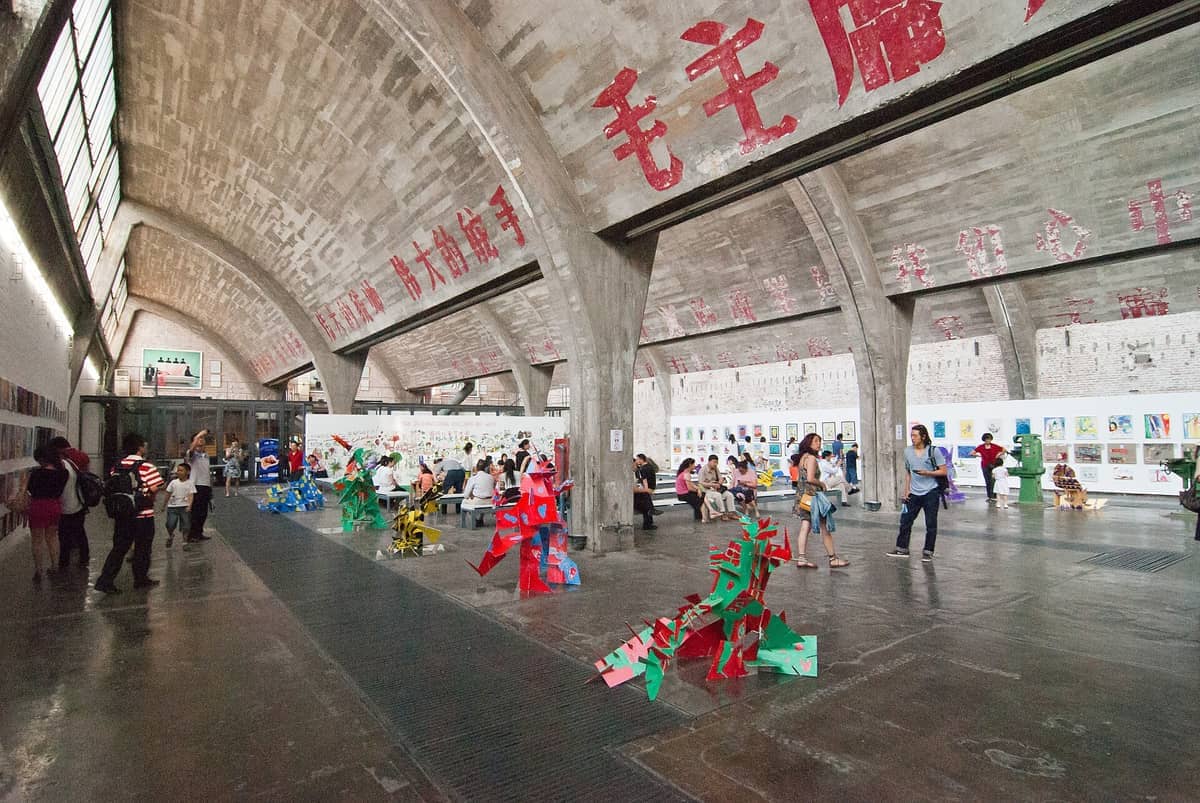
The 798 Art District, officially known as 北京798艺术区, is a large open-air cultural complex in the Dashanzi neighborhood of Chaoyang District, northeast of central Beijing. It takes its name from Factory 798, one of several military electronics manufacturing plants built on this site in the 1950s with technical assistance from East Germany. The complex is laid out across wide concrete lanes lined with Bauhaus-influenced factory buildings: sawtooth skylights, exposed brick, and steel-trussed ceilings that reach 8 to 10 meters in height.
Beginning in the early 2000s, artists and galleries began converting the abandoned factory spaces into studios and exhibition halls. What started as informal occupation became, within a decade, one of the most recognized contemporary art destinations in East Asia. Today the district contains well over 200 galleries, design studios, concept stores, cafes, and arts institutions operating inside those same industrial shells.
The district sits within Chaoyang District, Beijing's largest and most internationally oriented urban district. If you are building a broader Beijing itinerary, the Beijing contemporary art guide provides context on how 798 fits into the city's wider cultural scene.
ℹ️ Good to know
Entry to the 798 Art District itself is free and open around the clock. Individual galleries and ticketed exhibitions charge their own admission fees, which vary widely. The district as a whole does not operate a central box office or combined ticket.
The Architecture: Why the Buildings Matter
The physical fabric of 798 is inseparable from the experience. The factory buildings were designed in a stripped-down Bauhaus style by East German engineers and constructed with Soviet-era industrial precision. Walk through the main lanes and you will notice the long, parallel bays of the original production halls, their north-facing sawtooth roofs engineered to deliver consistent, diffuse natural light to factory floors — a functional decision that has made these spaces extraordinarily well-suited to exhibiting art.
Slogans and political murals from the Maoist era have been preserved on exterior walls throughout the complex, not as irony but as historical record. Some galleries have deliberately incorporated these elements into their interior design, placing contemporary installations directly beneath revolutionary text. The visual collision between those two eras is one of the things that gives 798 a character that newer art districts cannot replicate.
The lanes themselves vary considerably in width and feel. The central avenue around the core Factory 798 space attracts the heaviest foot traffic and the most commercial activity. Narrower side lanes, particularly toward the edges of the district, tend to house smaller independent galleries, design workshops, and working artists' studios where the industrial atmosphere is less diluted by retail.
Tickets & tours
Hand-picked options from our booking partner. Prices are indicative; availability and final rates are confirmed when you complete your booking.
Shilinxia glass platform and 798 Art District or Ming City Wall tour
From 331 €Instant confirmationFree cancellationEarly start guided tour to the Great Wall at Mutianyu
From 355 €Instant confirmationFree cancellationBeijing tour with imperial meal and chartered boat in Summer Palace
From 340 €Instant confirmationFree cancellationBeihai boat ride, imperial cuisine, and Beijing's old part guided tour
From 255 €Instant confirmationFree cancellation
How the Experience Changes by Time of Day
Arriving before 10:00 on a weekday morning means walking an almost empty district. The cafes have not yet opened their outdoor seating, the galleries are locked, and the only people around are cleaning staff and the occasional artist heading to a studio. The exposed-brick lanes and concrete geometry look their most photogenic in the oblique morning light, especially in autumn when shadows are long.
Between 11:00 and 14:00, galleries open progressively and the district reaches a functional pace without becoming crowded on most weekdays. This is the most comfortable window for visiting: good light in the skylighted halls, attentive gallery staff, and room to stand in front of large-format works without competing for space.
Weekend afternoons, particularly Saturday between 13:00 and 16:00, bring substantially larger crowds. The main commercial lanes fill with groups of students, families, young couples, and tour groups. Cafes operate with queues. This is when 798 feels most like a leisure destination and least like a serious art district. If contemporary art is your primary reason for coming, a weekday visit is meaningfully better.
💡 Local tip
Many galleries close on Mondays. If you are visiting specifically to see exhibitions rather than the architecture and outdoor installations, avoid Monday visits unless you have confirmed hours with specific galleries in advance.
Navigating the District: A Practical Walkthrough
The 798 Art District does not have a single main entrance. The most commonly used access points are off Jiuxianqiao Road, which runs along the western edge of the complex. From the street, you pass through gates that are unmanned and open continuously. There is no formal map distributed at the gate, though the official website and some cafes inside the district provide printed floor plans.
A logical approach for first-time visitors is to walk the central spine of the district from south to north, then loop back along the eastern lanes. This circuit covers the largest gallery spaces and the most frequently cited installations in roughly 90 minutes at a walking pace. Budget additional time for any galleries you enter, as the larger exhibition halls can take 30 to 45 minutes each to cover properly.
The district also includes the 751 D-PARK area, an industrial conversion space at No. 4 Jiuxianqiao Road that is oriented more toward design and fashion than fine art. It is part of the combined 798·751 cultural zone and worth including if you have a full afternoon.
💡 Local tip
Wear comfortable flat shoes. The lanes are primarily unpaved concrete or stone, uneven in places, and extend over a considerable area. In wet weather some sections can be slippery.
Getting There: Transit and Logistics
The 798 Art District is in the Dashanzi area of Chaoyang, northeast of the central city. Nearby Beijing Subway access includes Gaojiayuan Station on Lines 12 and 14; bus lines 403, 418, 593, 851, and 854 serve stops near the Jiuxianqiao Road area, and journey times depend on origin and traffic conditions.
For most visitors, a taxi or DiDi ride-hail is the most practical option. From major hotels in Sanlitun, the ride takes roughly 10 to 20 minutes depending on traffic. From the Wangfujing area, expect 25 to 40 minutes. Fares are metered; drivers know the destination by name (七九八艺术区, Qījiǔbā Yìshùqū). On weekends, returning by DiDi from inside the district can take a few minutes longer to arrange, as ride density in the area is lower than in central Chaoyang.
If you are combining 798 with other Chaoyang sights, the Olympic Park and the Sanlitun area are both accessible in the same half-day without returning to the city center.
Photography at 798
The district is one of the most photographed locations in Beijing's contemporary urban landscape, and for good reason. The combination of industrial scale, natural light from the sawtooth roofs, surviving political murals, and large outdoor sculptures creates an unusually varied set of subjects in a compact area. The best outdoor photography light arrives in early morning and in the hour before sunset.
Photography policies inside individual galleries vary. Many allow photography of their spaces but prohibit photography of specific artworks, particularly during commercial exhibitions. Look for posted notices at each gallery entrance and ask staff if you are unsure. The outdoor public areas and architectural elements have no photography restrictions.
For more on capturing Beijing's visual landscape beyond standard tourist images, the Beijing photography guide covers locations, timing, and equipment considerations across the city.
Is 798 Worth Your Time? Honest Assessment
The 798 Art District rewards visitors who approach it with specific intentions. If you are interested in contemporary Chinese and international art, the concentration of serious gallery spaces is genuinely impressive, and the architectural setting gives even mediocre exhibitions a quality of presence that white-cube spaces cannot match. The industrial Bauhaus buildings alone justify a visit for anyone interested in 20th-century architecture.
However, the most commercial central lanes have become increasingly indistinguishable from any upscale leisure district, with souvenir shops, branded cafes, and design-adjacent retail filling spaces that were once occupied by working studios. The depth of the art experience depends heavily on which galleries happen to have strong exhibitions during your visit, and on whether you are prepared to do the research in advance to identify them.
Visitors expecting a curated, museum-like experience with consistent quality across the district will be disappointed. Visitors who arrive with an open itinerary and a willingness to wander will almost certainly find at least two or three exhibition spaces worth their time, along with the architectural and historical interest of the district itself.
⚠️ What to skip
If your Beijing visit is short and you are primarily interested in imperial history, classical culture, or heritage sites, 798 may not be the best use of limited time. The district is oriented almost entirely toward contemporary work and offers little connection to Beijing's dynastic past.
Insider Tips
- Check the 798 Art District official website or social media accounts before visiting to identify which galleries have opened new exhibitions that week. The quality of the experience varies substantially depending on what is currently showing.
- The lanes north and east of the central spine, away from the main commercial strip, tend to house smaller galleries with less foot traffic and more experimental programming. These are worth seeking out specifically.
- Several cafes inside the district occupy former factory spaces with intact industrial ceilings. Sitting inside one of these at midday gives you a sense of the original scale of the production halls without paying gallery admission.
- Air quality in Beijing fluctuates seasonally. On days with high particulate readings, the outdoor lanes lose much of their appeal. Check a reliable air quality index (such as the U.S. Embassy AQI reading) the morning of your visit, particularly in winter and early spring.
- If you are visiting on a weekday and want to speak with gallery staff about the work, mid-morning is the best window. By early afternoon, busier galleries are managing visitor flow rather than conversation.
Who Is 798 Art District For?
- Contemporary art enthusiasts looking for concentrated gallery access in a single location
- Architecture and photography visitors drawn to industrial Bauhaus spaces and surviving Maoist-era murals
- Design and fashion travelers interested in the adjacent 751 D-PARK creative zone
- Travelers with a half-day free who want a cultural experience without fixed admission fees or booking requirements
- Repeat Beijing visitors who have already covered the major imperial and historical sites
Nearby Attractions
Other things to see while in Chaoyang District:
- Beijing National Stadium (Bird's Nest)
The National Stadium, universally known as the Bird's Nest, is Beijing's most recognizable piece of contemporary architecture. Built for the 2008 Summer Olympics, it now operates as a visitor attraction and events venue in the Olympic Park area of Chaoyang District. Here is everything you need to know to decide whether it belongs on your itinerary.
- Olympic Park
Beijing Olympic Park, the remains one of the city's most architecturally striking outdoor spaces. Entry to the park is free, remains one of the city's most architecturally striking outdoor spaces. Entry to the park is free, and the Bird's Nest and Water Cube stadiums stand as permanent landmarks of modern Chinese ambition. This guide covers what to see, when to go, and how to make the most of a half-day visit.
- China National Film Museum
The China National Film Museum in Chaoyang is one of the largest film museums in the world, covering approximately 38,000 square metres across 20 exhibition halls. Admission to the permanent collection is free, and the complex includes working cinema screens for classic and contemporary films. It rewards curious visitors with surprising depth on Chinese film history.
- Chinese Ethnic Culture Park
Spread across roughly 50 hectares in Chaoyang District, the Chinese Ethnic Culture Park reconstructs the architecture, dress, and daily life of China's 56 officially recognized ethnic groups. It is one of the few places in Beijing where you can walk through a Miao stilted house, watch a Tibetan dance, and step inside a Mongolian ger within a single afternoon.