Beijing National Stadium (Bird's Nest): What to Know Before You Visit
The National Stadium, universally known as the Bird's Nest, is Beijing's most recognizable piece of contemporary architecture. Built for the 2008 Summer Olympics, it now operates as a visitor attraction and events venue in the Olympic Park area of Chaoyang District. Here is everything you need to know to decide whether it belongs on your itinerary.
Quick Facts
- Location
- No. 1 National Stadium South Road, Chaoyang District, Beijing
- Getting There
- Beijing Subway Line 8, Olympic Park (奥林匹克公园) station; Olympic Sports Center (奥体中心) station is also nearby
- Time Needed
- 1 to 2 hours for sightseeing; longer if attending an event
- Cost
- ¥40 standard adult admission. Event tickets priced separately. Hours: 10:00–22:00, last admission 21:00. Verify before visiting.
- Best for
- Architecture enthusiasts, first-time Beijing visitors, families, sports history fans
- Official website
- www.n-s.cn
What the Bird's Nest Actually Is
The National Stadium, officially 国家体育场 (Guójiā Tǐyùchǎng) and nicknamed the Bird's Nest, is a steel-lattice stadium in Beijing's Olympic Park that served as the centrepiece of the 2008 Summer Olympics. Construction began on December 24, 2003, and the stadium was completed on June 30, 2008 — a tight five-year build for a structure with approximately 204,000 square metres of area. At capacity during the Games, it held 91,000 spectators, including 11,000 temporary seats.
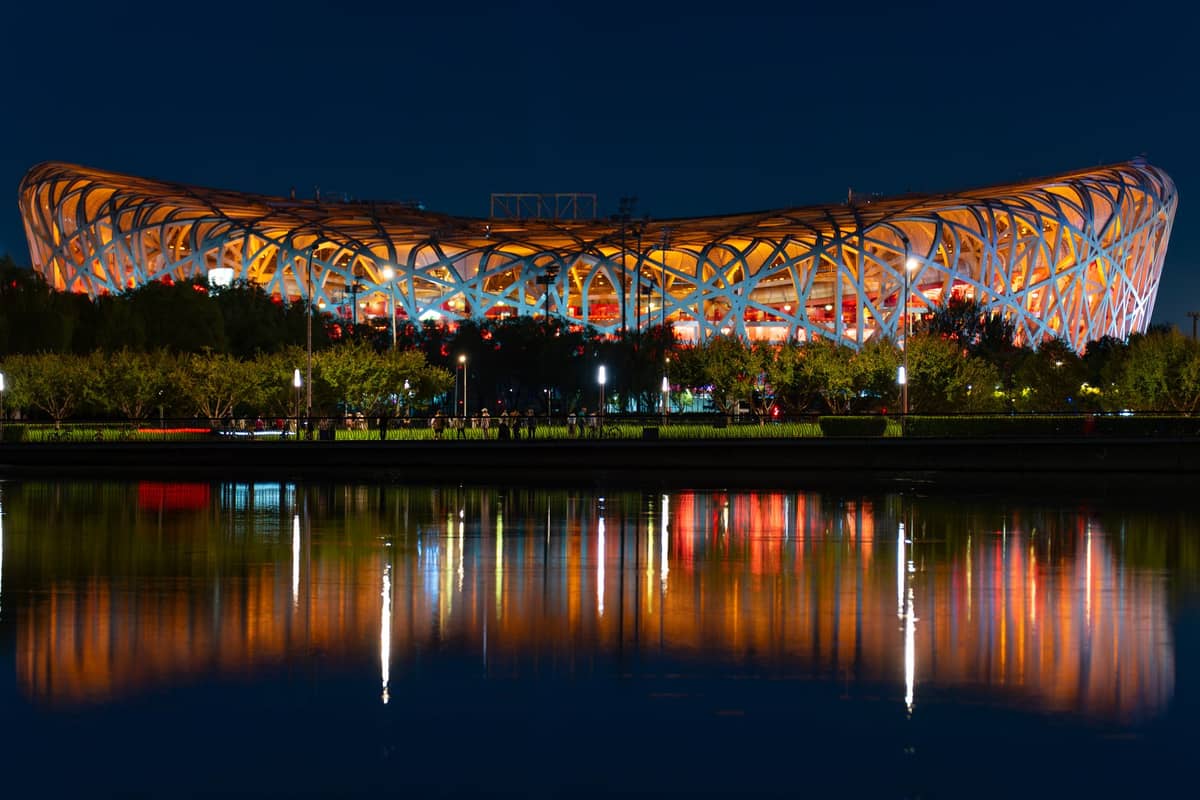
The design, by Swiss architecture firm Herzog and de Meuron in collaboration with Chinese artist Ai Weiwei as artistic consultant, deliberately avoids a conventional facade. Instead, a web of 42,000 tonnes of curved steel beams wraps the concrete bowl in an apparently random pattern that reads, from any angle, like an enormous woven nest. The gaps in the lattice are neither uniform nor decorative — they perform a structural role, distributing load in ways that allowed the architects to reduce the amount of internal supporting columns.
Since 2008 the stadium has operated as a sightseeing attraction and continues to host concerts, winter sports festivals, and international sporting events. It is not a museum in the conventional sense: the main draw is the architecture itself, the interior bowl, and the surrounding Olympic landscape rather than permanent interpretive exhibitions.
ℹ️ Good to know
Opening hours are listed as 10:00 to 22:00, with last admission at 21:00. Hours may change during events or public holidays. Confirm on the official website (www.n-s.cn) or by calling the visitor hotline 400-600-2008 before you travel.
The Experience: Walking Around and Inside
Approaching from Olympic Park station, the stadium announces itself well before you reach the entrance plaza. The steel exterior catches light differently depending on the time of day: in morning sun the grey beams have a cool, industrial sheen; in the hour before sunset they warm to bronze; after dark, the LED lighting system floods the lattice in colour sequences that shift slowly from red to gold to white. The night visit is genuinely impressive and justifies the extended 22:00 closing time.
Inside the bowl, the scale is immediately striking. The seating tiers rise steeply from a grass playing surface, and the lattice roof frames a wide oval of sky. On a clear day in autumn, that oval of blue above the russet steel beams is the image most visitors photograph. On overcast days the structure can feel heavier and greyer, though no less dramatic. What surprises many first-time visitors is how quiet the interior is on ordinary sightseeing days — sound does not carry or echo the way you might expect in a space this large, partly because the open roof prevents reverberation.
The visitor route takes you through the main concourse levels and out onto the field area in some configurations, depending on whether an event is scheduled. Signage throughout the stadium is available in both Mandarin and English.
Tickets & tours
Hand-picked options from our booking partner. Prices are indicative; availability and final rates are confirmed when you complete your booking.
Beijing Summer Palace Entrance Ticket
From 7 €Instant confirmationFree cancellationMutianyu Great Wall and Summer Palace small-group tour from Beijing
From 171 €Instant confirmationFree cancellationPrivate Customized Beijing Tour with Local Guide and Transfer
From 53 €Instant confirmationFree cancellationLama Temple entrance tickets in Beijing
From 6 €Instant confirmationFree cancellation
Best Time to Visit and How Crowds Behave
Weekday mornings between 10:00 and noon are consistently the quietest windows. Groups tend to arrive mid-morning and thin out before lunch. Weekend afternoons, especially in summer and around national holidays including Golden Week in October, can produce considerable queues at the ticket windows and crowded concourses. The Chinese New Year period draws seasonal events that change the atmosphere entirely.
For photography, the best outdoor light falls on the west and south faces of the stadium in the mid to late afternoon. The evening light-and-water-show at the adjacent Water Cube (National Aquatics Centre) makes a logical pairing — see the National Aquatics Center for details on that venue. If you plan to photograph both structures together, position yourself on the central axis north of the stadium around 30 minutes before sunset.
Weather matters more here than at many Beijing attractions because the stadium is largely open to the sky and the surrounding Olympic Park plaza has almost no shade. In summer, temperatures in the plaza regularly exceed 35°C between noon and 15:00. Bring water, sunscreen, and a hat, or plan your visit for early morning or evening. Winter visits are possible — the steel and concrete interior stays very cold — and the stadium occasionally hosts winter sports and ice events during the colder months. For seasonal planning advice, the best time to visit Beijing guide covers temperature and crowd patterns across the year.
Getting There
The most straightforward approach is Beijing Subway Line 8. Olympic Sports Center station (奥体中心) is the station identified for the National Stadium; Olympic Park station (奥林匹克公园) is also nearby. The walk from either station crosses through the Olympic Park grounds, which is a pleasant approach on foot and gives you a sense of the urban planning scale of the site.
Taxis and ride-hailing via DiDi are also straightforward — tell your driver National Stadium South Road (国家体育场南路1号) or simply show the characters 鸟巢. For a broader overview of getting around the city, the getting around Beijing guide covers subway, taxi, and ride-hailing in detail.
💡 Local tip
Buy your ticket at the venue's official windows or via the official website. Be cautious of touts near the entrance plaza who may sell counterfeit or overpriced tickets — a well-documented pattern at major Beijing tourist sites.
Historical and Cultural Context
The 2008 Beijing Olympics represented the largest single public showcase of China's economic and infrastructural transformation in the post-reform era. The Bird's Nest was placed on the city's central north-south axis, the same ancient meridian that runs from Yongding Gate in the south through Tiananmen and the Forbidden City to the Bell and Drum Towers in the north. Its placement was not accidental: the Olympic Park continued that axis into the contemporary city, framing the Games as both a modern event and a continuation of Beijing's centuries-long urban geometry.
The opening and closing ceremonies of the 2008 Games, choreographed by filmmaker Zhang Yimou, drew global television audiences estimated in the hundreds of millions. For many international visitors, the stadium carries the specific memory of those ceremonies. For a broader perspective on Beijing's place in Chinese imperial and modern history, the Beijing imperial history guide provides useful background on the city's urban layers.
The stadium also hosted events during the 2022 Beijing Winter Olympics, making it one of very few venues in the world to have hosted both a Summer and Winter Games. The 2022 opening and closing ceremonies were again held here, giving the structure a second chapter in Olympic history. This dual legacy is referenced in the interpretive materials inside the stadium.
Practical Details: Tickets, Accessibility, and What to Bring
Standard adult admission is ¥40. Special events, concerts, and seasonal exhibitions are priced separately and often require advance booking.
The stadium is a modern purpose-built Olympic facility and is substantially step-free throughout its public areas. Visitors with mobility requirements should confirm accessible entrances, lift locations, and seating arrangements directly with the venue before arrival using the service hotline 400-600-2008. The Chaoyang District location and Olympic Park grounds are generally flat and navigable by wheelchair between transit stations and the stadium entrance.
Photography is permitted throughout the sightseeing areas. No specific restrictions on personal cameras or smartphones have been reported, though restrictions may apply during ticketed events. If photography is a primary goal, the Beijing photography guide includes advice on timing and location for the Olympic Park area.
⚠️ What to skip
All pricing, hours, and operational details at the Bird's Nest are time-sensitive and subject to change, particularly around events. Always verify on the official website (www.n-s.cn) or via the hotline before your visit.
Is It Worth Your Time? An Honest Assessment
The Bird's Nest is genuinely impressive as a piece of engineering and architecture. Up close, the scale and complexity of the steel lattice is something photographs do not fully convey. If architecture, urban history, or the spectacle of large-scale infrastructure interests you, a visit is worthwhile.
If you are primarily interested in Chinese history, culture, or classical art, this attraction will feel thin. There is limited interpretive content compared to Beijing's major museums, and outside of events, the interior can feel somewhat empty. Visitors who have already seen the Forbidden City, the Temple of Heaven, and the Summer Palace and are now looking for something different will find the contrast interesting. Those with only two or three days in Beijing and a focus on imperial heritage should weigh it carefully against the time investment.
Families with children often respond well to the stadium — the open spaces, the dramatic structure, and the Olympic associations tend to engage younger visitors. The adjacent Olympic Park and the National Aquatics Center extend the outing to a half-day without significant additional cost. For ideas on combining this with other family-friendly stops, the Beijing with kids guide offers a useful framework.
Insider Tips
- Visit on a weekday evening between 19:00 and 21:30 for the best combination of lighter crowds and the full LED lighting display on the exterior. The plaza is cooler after dark, and both the Bird's Nest and the adjacent Water Cube are illuminated simultaneously.
- The best elevated views of the Bird's Nest exterior are from the Olympic Park observation tower to the north — the tower gives you a top-down angle on the lattice roof that no ground-level position can match.
- If you want to photograph the stadium's reflection, there is a narrow rectangular pool on the south approach axis that works well in calm conditions, particularly in the 20 minutes after sunset before the sky goes fully dark.
- Bring cash as a backup. While card and mobile payment (WeChat Pay, Alipay) are widely accepted at the ticket windows, foreign bank cards can occasionally fail at unmanned kiosks in the Olympic Park area.
- The stadium hosts winter ice and snow events in December and January — including ski jump demonstrations and ice rinks set up in the main plaza. These seasonal events add genuine atmosphere and are a very different experience from a standard sightseeing visit.
Who Is Beijing National Stadium (Bird's Nest) For?
- Architecture and design enthusiasts who want to see Herzog and de Meuron's steel lattice at close range
- First-time Beijing visitors covering the city's landmark contemporary buildings alongside its historic sites
- Families with older children who have an interest in the Olympics or large-scale engineering
- Evening visitors pairing the Bird's Nest light show with the National Aquatics Center illuminations
- Sports history followers interested in a venue that hosted both the 2008 Summer and 2022 Winter Olympics
Nearby Attractions
Other things to see while in Chaoyang District:
- 798 Art District
The 798 Art District in Chaoyang is Beijing's most concentrated hub for contemporary art, housed in a repurposed 1950s military electronics factory complex. Entry to the district is free, galleries cluster along wide concrete lanes, and the atmosphere shifts dramatically between a quiet Tuesday morning and a packed Saturday afternoon. Here is what to expect, and whether it deserves your time.
- Olympic Park
Beijing Olympic Park, the remains one of the city's most architecturally striking outdoor spaces. Entry to the park is free, remains one of the city's most architecturally striking outdoor spaces. Entry to the park is free, and the Bird's Nest and Water Cube stadiums stand as permanent landmarks of modern Chinese ambition. This guide covers what to see, when to go, and how to make the most of a half-day visit.
- China National Film Museum
The China National Film Museum in Chaoyang is one of the largest film museums in the world, covering approximately 38,000 square metres across 20 exhibition halls. Admission to the permanent collection is free, and the complex includes working cinema screens for classic and contemporary films. It rewards curious visitors with surprising depth on Chinese film history.
- Chinese Ethnic Culture Park
Spread across roughly 50 hectares in Chaoyang District, the Chinese Ethnic Culture Park reconstructs the architecture, dress, and daily life of China's 56 officially recognized ethnic groups. It is one of the few places in Beijing where you can walk through a Miao stilted house, watch a Tibetan dance, and step inside a Mongolian ger within a single afternoon.