National Aquatics Center (Water Cube / Ice Cube): Beijing's Olympic Icon
The National Aquatics Center is one of Beijing's most recognizable Olympic landmarks, famous for its glowing bubble-like facade. Built for the 2008 Summer Olympics and later converted for the 2022 Winter Games, it now serves as both a visitor attraction and public aquatic complex in the heart of Olympic Park.
Quick Facts
- Location
- No. 11 Tianchen East Road, Olympic Park, Chaoyang District, Beijing
- Getting There
- Olympic Sports Center Station, Line 8; Olympic Park Station (Lines 8 and 15) is also nearby
- Time Needed
- 1 to 2 hours for sightseeing; longer if using the water park
- Cost
- General admission RMB 30 (half-price RMB 15); separate tickets for swimming and water park activities. Verify current prices before visiting.
- Best for
- Architecture enthusiasts, Olympic history buffs, families with children, photography
- Official website
- http://www.water-cube.com
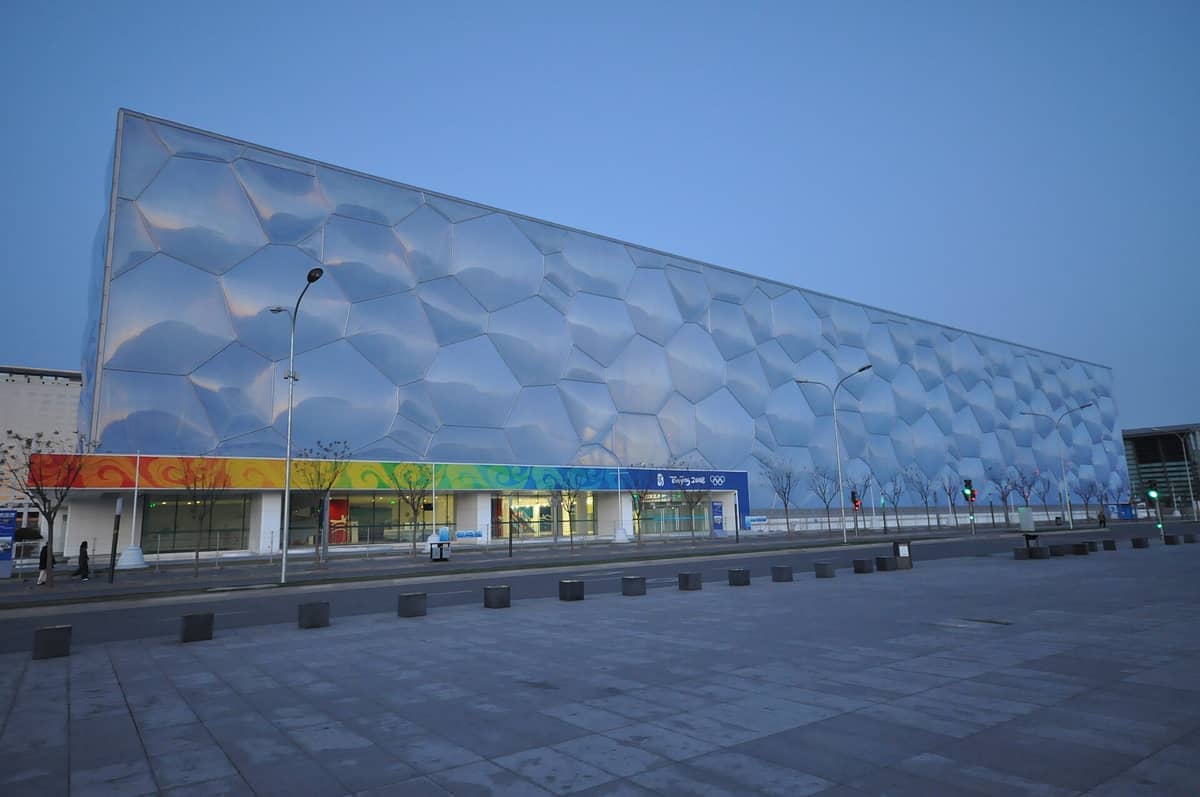
What Is the National Aquatics Center?
The National Aquatics Center, known to most visitors as the Water Cube, is the landmark aquatic venue built for the 2008 Beijing Summer Olympics. Its official Chinese name is 国家游泳中心 (Guójiā Yóuyǒng Zhōngxīn). Officially measuring approximately 177 by 177 by 31 meters, the building's most striking feature is its translucent blue facade made of ethylene tetrafluoroethylene (ETFE) cushions arranged in an irregular geometric pattern inspired by the natural structure of soap bubbles. The result is a building that looks unlike anything else in the world, particularly when illuminated after dark.
Construction began in December 2003 and the center was completed in January 2008, just in time for pre-Olympic testing events. It held 17,000 spectators during the 2008 Games, where it served as the setting for some of the most memorable swimming performances in Olympic history. More than a decade later, the venue was reimagined again for the 2022 Beijing Winter Olympics, when the main hall was converted into an indoor curling arena, earning the building a second nickname: the Ice Cube. This dual identity, summer and winter, water and ice, makes it a genuinely unusual piece of sports architecture.
ℹ️ Good to know
Opening hours vary by season: generally 09:00 to 22:00 during peak season and 09:00 to 19:00 off-season. Temporary adjustments are common around public holidays. Confirm the schedule directly with the venue before making plans.
The Facade Up Close: What the Bubble Structure Actually Looks Like
Most visitors see the Water Cube first from a distance, as they walk south along the Olympic Park's central axis from Olympic Park Station. Approaching on foot, the building sits directly opposite the National Stadium (the Bird's Nest) across a wide pedestrian plaza. The contrast between the two is immediately striking: where the Bird's Nest is a dense, rusted-steel tangle of curves, the Water Cube is a cool, flat-surfaced box of repeating blue-tinted cells. It reads as calm and geometric from far away, and increasingly intricate the closer you get.
Standing directly beneath the facade, the ETFE cushions are larger than most visitors expect, each one filled with air and sealed at the edges. The panels catch and scatter light differently depending on the angle and time of day. In flat winter light, the building looks almost pewter-grey. On bright summer afternoons, the blue saturates noticeably. After dark, internal LED lighting turns the entire structure into a luminous cube of shifting blue and white. If you are planning a photography visit, late afternoon provides the best balance between natural light on the facade and the onset of the illumination, though the full night effect is worth staying for.
💡 Local tip
Photography tip: For the classic shot of both the Water Cube and the Bird's Nest in one frame, position yourself on the central plaza between them, facing north. The best light on both buildings falls in the late afternoon, roughly 90 minutes before sunset.
Tickets & tours
Hand-picked options from our booking partner. Prices are indicative; availability and final rates are confirmed when you complete your booking.
Small group tour of Tian'anmen Square and the Forbidden City
From 43 €Instant confirmationFree cancellationBeijing Summer Palace Entrance Ticket
From 7 €Instant confirmationFree cancellationMutianyu Great Wall and Summer Palace small-group tour from Beijing
From 171 €Instant confirmationFree cancellationPrivate Guided Tour to Temple of Heaven, Panda House and Summer Palace
From 67 €Instant confirmationFree cancellation
Inside the Building: Exhibitions, Water Park, and the Ice Hall
The interior experience depends heavily on what is currently operating. For general admission visitors, the main draw is the building's interior public areas, which include displays on the 2008 and 2022 Olympics, the engineering story behind the ETFE facade, and the transformation of the space between its summer and winter configurations. The scale of the main hall is apparent immediately on entry: the ceiling is high enough that you become aware of the quality of light filtering through the bubble panels above, creating a diffused, slightly blue-tinted atmosphere inside.
A water park with slides and pools operates within part of the facility, aimed primarily at families with children. Access to this requires a separate ticket and is not included in standard sightseeing admission. When the curling ice sheets are in place, parts of the hall are closed off or have limited public access. Before visiting with specific activities in mind, confirm directly with the venue or via official Beijing tourism channels what is currently open to the public.
Visitors interested in the broader story of Beijing's Olympic infrastructure can combine this visit with the National Stadium (Bird's Nest), which is immediately adjacent, or explore the wider Olympic Park on foot.
How the Visit Changes by Time of Day
Mornings are the quietest period. By 9:00 AM, the plaza outside is largely clear of tour groups, and the building's facade picks up the eastern light in a way that shows the bubble structure in sharper relief. This is the best window for exterior photography without crowds in the foreground, and for a calm walk around the perimeter of the building.
Midday and early afternoon bring the biggest tour groups, particularly during national holidays and summer school holidays. The area between the Water Cube and the Bird's Nest becomes genuinely crowded, with organized groups moving through in quick succession. If your goal is the architecture and a brief look inside, midday visits are functional but not pleasant. Weekend afternoons in July and August are the most congested periods.
Evening is when the building is at its most dramatic. The LED illumination begins at dusk, and the entire exterior transforms into a glowing blue cube visible from some distance. The plaza remains open to pedestrians, and the surrounding Olympic Park is a reasonable place for an evening walk. Visitors should note that indoor access is subject to the venue's closing hours, which differ in peak and off-season, so verify before planning an evening entry.
Getting There and Getting Around
The National Aquatics Center sits within Beijing Olympic Park in Chaoyang District, close to the North Fourth Ring Road. The two most practical subway options are Olympic Sports Center Station (Line 8) and Olympic Park Station (Lines 8 and 15), both a short walk from the venue. From Olympic Park Station, the walk south through the park to the Water Cube takes roughly 10 to 15 minutes on foot along a clear pedestrian route.
For general orientation in the district, Beijing's Chaoyang District is large and modern, with the Olympic Park at its northern edge. Taxis and DiDi ride-hailing are straightforward options if you prefer not to use the subway, and the venue's address is easily recognized by drivers.
💡 Local tip
When using a ride-hailing app or taxi, show the driver the Chinese name: 国家游泳中心 (Guójiā Yóuyǒng Zhōngxīn), or simply say 'Water Cube.' Both are widely understood.
If you are planning a full day in this part of Beijing, the Beijing with kids guide covers how to combine Olympic Park with other family-friendly venues in the area.
Historical and Architectural Context
The Water Cube was designed by a joint venture involving Australian architecture firm PTW Architects, Arup engineers, and the China State Construction Engineering Corporation. The decision to use ETFE rather than glass was driven by both aesthetic and functional reasons: the material transmits more sunlight, weighs far less than glass, and has strong thermal properties. The geometric pattern of the cushions is derived from the Weaire-Phelan structure, a mathematical model describing how bubbles pack together with minimum surface area. This is not decorative whimsy. It is applied mathematics rendered in construction at a scale that had not been attempted before.
For the 2022 Winter Olympics, engineers devised a system to convert approximately 8,000 square meters of the venue's interior into curling rinks while preserving the structure's overall character. The conversion was notable enough to attract international attention from sports venue designers, as it demonstrated that a major summer-sport venue could be practically and economically adapted for winter competition without demolition or full reconstruction. The dual-use concept has since influenced discussions about future Olympic venue planning globally.
For travelers interested in the deeper history of Beijing's relationship with international events and imperial legacy, the Beijing imperial history guide provides useful context for understanding how the city has layered eras of large-scale construction across its landscape.
Honest Assessment: Is It Worth Your Time?
For architecture and design travelers, yes, clearly. The building is a genuine engineering achievement, and seeing it in person is qualitatively different from photographs. The scale, the quality of light through the panels, and the contrast with the Bird's Nest across the plaza make the Olympic Park visit worthwhile as a half-day architectural excursion.
For general sightseers, the experience is more situational. The interior exhibits are informative but not extensive enough to anchor a full day. If you are already visiting the Bird's Nest or exploring Olympic Park, adding the Water Cube at RMB 30 for full-price general admission (RMB 15 half-price) is easy to justify. If you are traveling specifically for it from the city center, the exterior can be appreciated without entry, and the evening illumination is free to observe from the plaza.
Travelers who should think carefully before visiting: those with very limited time who are prioritizing imperial Beijing. The Olympic Park is far removed in character and location from the Forbidden City, the Temple of Heaven, and the hutong neighborhoods. It represents a different Beijing entirely, one of concrete plazas, modern infrastructure, and recent history. If your itinerary is tight and you have not yet seen those core sites, consider those first.
⚠️ What to skip
Air quality in Beijing varies significantly by season and weather. On high-pollution days, the haze can visually flatten the exterior and mute the illumination effect at night. Check air quality forecasts before planning an outdoor photography visit. Autumn (September to October) generally offers clearer skies.
For help prioritizing Beijing's major sites in limited time, the 3-day Beijing itinerary outlines a practical sequence for first-time visitors.
Insider Tips
- Visit on a weekday evening rather than a weekend afternoon. The plaza empties out considerably after 6:00 PM on weekdays, and the illuminated exterior is at its most photogenic after dark with far fewer people in frame.
- The subway journey from central Beijing to Olympic Park Station is straightforward on Line 8. From Nanluoguxiang or Drum Tower, a subway connection gets you to the Olympic Park area without navigating surface traffic.
- Walk the full perimeter of the building rather than just viewing the main south facade. The north and east elevations catch different light and show the ETFE structure at different angles, revealing details the standard tourist view misses.
- If you are visiting with children and plan to use the water park, confirm operating status and ticket pricing in advance, as hours and availability for recreational swimming are subject to change based on maintenance schedules and events.
- Combine the Water Cube and Bird's Nest in a single morning visit. Both are within easy walking distance of each other, and arriving before 10:00 AM gives you the plaza largely to yourself before tour groups arrive.
Who Is National Aquatics Center (Water Cube / Ice Cube) For?
- Architecture and design travelers who appreciate large-scale structural innovation
- Olympic history enthusiasts interested in seeing venues from both 2008 and 2022
- Families with children, particularly when the water park is operational
- Photographers seeking Beijing's most visually distinctive modern building, especially at night
- Travelers combining the site with a broader Olympic Park or Chaoyang District visit
Nearby Attractions
Other things to see while in Chaoyang District:
- 798 Art District
The 798 Art District in Chaoyang is Beijing's most concentrated hub for contemporary art, housed in a repurposed 1950s military electronics factory complex. Entry to the district is free, galleries cluster along wide concrete lanes, and the atmosphere shifts dramatically between a quiet Tuesday morning and a packed Saturday afternoon. Here is what to expect, and whether it deserves your time.
- Beijing National Stadium (Bird's Nest)
The National Stadium, universally known as the Bird's Nest, is Beijing's most recognizable piece of contemporary architecture. Built for the 2008 Summer Olympics, it now operates as a visitor attraction and events venue in the Olympic Park area of Chaoyang District. Here is everything you need to know to decide whether it belongs on your itinerary.
- Olympic Park
Beijing Olympic Park, the remains one of the city's most architecturally striking outdoor spaces. Entry to the park is free, remains one of the city's most architecturally striking outdoor spaces. Entry to the park is free, and the Bird's Nest and Water Cube stadiums stand as permanent landmarks of modern Chinese ambition. This guide covers what to see, when to go, and how to make the most of a half-day visit.
- China National Film Museum
The China National Film Museum in Chaoyang is one of the largest film museums in the world, covering approximately 38,000 square metres across 20 exhibition halls. Admission to the permanent collection is free, and the complex includes working cinema screens for classic and contemporary films. It rewards curious visitors with surprising depth on Chinese film history.