Beijing Olympic Park: Icons of the 2008 Games and What to Expect Today
Beijing Olympic Park, the remains one of the city's most architecturally striking outdoor spaces. Entry to the park is free, remains one of the city's most architecturally striking outdoor spaces. Entry to the park is free, and the Bird's Nest and Water Cube stadiums stand as permanent landmarks of modern Chinese ambition. This guide covers what to see, when to go, and how to make the most of a half-day visit.
Quick Facts
- Location
- No. 15 Beichen East Road, Chaoyang District, Beijing
- Getting There
- Olympic Park Station (Line 15); Olympic Sports Center Station (Line 8); Beitucheng Station (Line 10)
- Time Needed
- 2 to 4 hours for the park; half a day if entering stadiums
- Cost
- Park entry free; Bird's Nest ¥50, Water Cube ¥30 (verify locally, prices may change)
- Best for
- Architecture lovers, families, photography, Olympic history fans
What Beijing Olympic Park Actually Is
Beijing Olympic Park, officially 北京奥林匹克公园, covers approximately 11.59 km² in the northern part of Chaoyang District. It was purpose-built for the 2008 Summer Olympics and encompasses not just the Bird's Nest National Stadium and the Water Cube National Aquatics Center, but also a network of wide promenades, landscaped gardens, a central axis extension, and several additional venues. The scale surprises most first-time visitors: this is not a compact stadium complex but a fully walkable urban district.
The park divides broadly into two zones. The southern section is the denser, more photogenic part, where the Bird's Nest and Water Cube face each other across a broad pedestrian plaza. The northern section transitions into forest park and wetland, quieter and less visited but worth exploring if you have time. Entry to the park grounds is free; individual stadiums and venues charge separate admission.
💡 Local tip
Practical note: The park address is No. 15 Beichen East Road, Chaoyang District. The park phone number for accessibility inquiries is 010-84992008. The park grounds are currently reported as open 24 hours, although individual venues and facilities have their own hours. Confirm locally before visiting as access conditions can change.
The Architecture: What You Are Actually Looking At
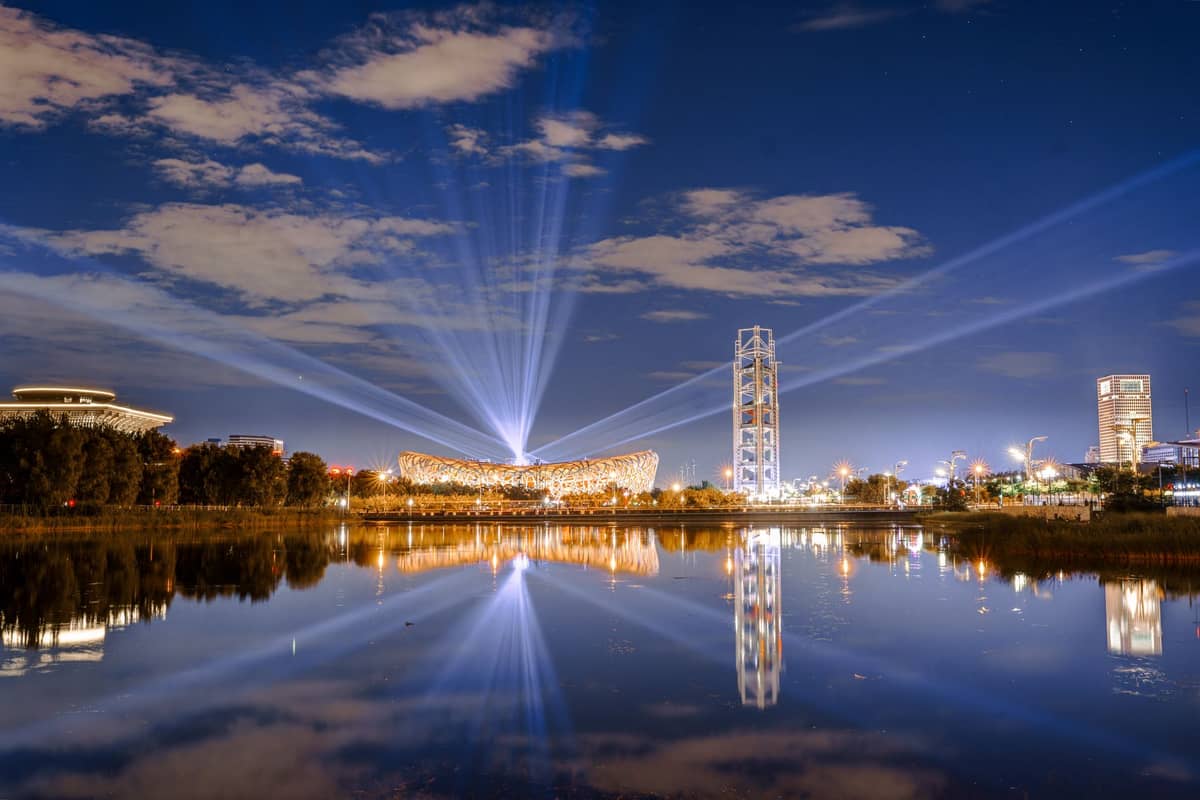
The Bird's Nest, formally the National Stadium (国家体育场), is the structure most associated with the 2008 Games. Designed by architects Herzog and de Meuron in collaboration with artist Ai Weiwei, it seats roughly 91,000 people and takes its nickname from the interlocking steel lattice that wraps the concrete bowl in an irregular, nest-like pattern. Up close, the steel members are enormous, far larger than photographs suggest, and the surface has a rough industrial quality that contrasts with the smoothness of official imagery.
Directly across the central plaza, the Water Cube, now branded the Ice Cube (国家游泳中心) after its conversion to a curling venue for the 2022 Winter Olympics, is clad in ETFE panels that form irregular bubble-like cells inspired by the geometric structure of soap foam. At night, the building is illuminated in blue, and the effect is genuinely arresting: a glowing, translucent box sitting low against the darker mass of the Bird's Nest. The contrast between the two structures, one organic and dark, one geometric and luminous, is more interesting in person than in any photograph.
Both buildings remain active venues. The Bird's Nest hosts concerts, cultural events, and occasional sporting fixtures. The Water Cube, beyond its curling use, contains a waterpark. If you plan to enter either, check current programming before your visit, as the interior experience varies considerably depending on what is scheduled. For a broader sense of Beijing's modern architecture and urban design, the 798 Art District in the same district offers a very different but equally considered built environment.
Tickets & tours
Hand-picked options from our booking partner. Prices are indicative; availability and final rates are confirmed when you complete your booking.
Small group tour of Tian'anmen Square and the Forbidden City
From 43 €Instant confirmationFree cancellationBeijing Summer Palace Entrance Ticket
From 7 €Instant confirmationFree cancellationMutianyu Great Wall and Summer Palace small-group tour from Beijing
From 171 €Instant confirmationFree cancellationPrivate Guided Tour to Temple of Heaven, Panda House and Summer Palace
From 67 €Instant confirmationFree cancellation
The Experience by Time of Day
Early morning, before 09:00, the park has a completely different character from mid-day. Local residents use the wide promenades for tai chi, morning walks, and slow cycling. The air tends to be cooler and, depending on the season and wind direction, clearer. The plaza between the Bird's Nest and the Water Cube is nearly empty, and the scale of the space is easier to absorb without crowds.
Between 10:00 and 15:00, particularly on weekends and public holidays, the area around the two main stadiums becomes significantly busier. Tour groups arrive in organized waves, and the central plaza fills with visitors photographing the facades. This is the least atmospheric window for photography but the most convenient for families with children who need flexibility around schedules.
Late afternoon and evening offer the most visually rewarding conditions. From around 17:00, the light softens and falls at a low angle across the Bird's Nest lattice, picking out shadows in the steel. After dark, both stadiums are illuminated, and the Water Cube's blue glow is at its most photogenic. The promenades stay open until 22:00, and weekend evenings in warmer months bring food stalls, occasional performances, and a generally livelier crowd of locals as well as tourists.
💡 Local tip
Photography tip: For the classic shot of both stadiums in the same frame, position yourself on the central north-south axis, roughly 300 to 400 meters south of the Bird's Nest. A wide-angle lens works well here. At night, a tripod and a 10-30 second exposure captures the Water Cube illumination cleanly. The Beijing Photography Guide has more on shooting iconic city landmarks.
Getting There and Getting Around
The Beijing Subway is the most practical option. Line 15 serves Olympic Park Station, while Line 8 serves Olympic Sports Center Station near the main stadiums. Line 10 serves Beitucheng Station, which is a longer walk to the main venues but useful if you are coming from the city center or the Lama Temple area. The park is large enough that comfortable shoes matter: expect to cover 4 to 8 km of walking if you explore both the southern stadium zone and the northern forest park.
Ride-hailing via DiDi is straightforward for the drop-off, but pick-up from the park area can be slower at peak hours due to road access constraints. Taxis are available but can be in short supply on busy event days. The park itself is fully walkable; rental bicycles are available near some entrances. If you are building a full-day itinerary in northern Beijing, the Bell Tower and Drum Tower are accessible by subway and pair well as a half-day companion to the Olympic Park.
Historical and Cultural Context
The 2008 Beijing Summer Olympics were the first Games hosted by China, and their significance extended well beyond sport. The choice to anchor the Olympic facilities on the northern extension of Beijing's historic central axis, the same axis that runs from Yongdingmen in the south through Tiananmen and the Forbidden City, was deliberate. The Olympic Park continues that axis northward, connecting ancient imperial planning logic to 21st-century national ambition in a single line.
Beijing hosted the Winter Olympics in 2022, making it the first city to host both Summer and Winter Games. The Water Cube's conversion to the Ice Cube for curling events is a physical reminder of that distinction. The broader context of Olympic-era urban development in Beijing is worth understanding: the Games triggered infrastructure investment across the city, including major subway expansion, which is why the metro network now reaches the park so efficiently. For a longer view of how Beijing's urban landscape reflects imperial and modern Chinese history, the Beijing imperial history guide provides useful context.
Practical Walkthrough: What to Actually Do
Most visitors spend their time in the southern zone around the Bird's Nest and Water Cube. Exterior viewing and photography of both buildings is free, and that alone satisfies the majority of visitors. If you want to go inside the Bird's Nest, admission is approximately ¥50; you can walk the concourse levels and access the stadium bowl, which gives a useful sense of the structure's interior geometry. The Water Cube charges approximately ¥30 for general access; the waterpark inside has separate pricing.
North of the main stadiums, the Olympic Village area and the central forest park are less-visited and noticeably quieter. The landscaped wetland areas in the northern section have local birdlife and a genuinely park-like character far removed from the monumental southern zone. If you have young children, the wider paths and open lawns here are considerably more relaxing than the crowded southern plaza.
Food and drink options within the park range from vendors selling bottled water and snacks to sit-down restaurants near the southern entrance. The quality is inconsistent, and prices are higher than average for Beijing. Most visitors grab a meal before arriving or head back into the city center afterward. The Chaoyang District's Sanlitun area is accessible by subway and has a much wider range of dining options for after your visit.
Honest Assessment: Who Should Adjust Their Expectations
The Olympic Park is one of those sites where the architecture justifies the visit but the surrounding experience is thinner than guidebooks suggest. The stadiums are genuinely impressive structures, and the scale of the complex communicates something real about the ambition behind the 2008 Games. But outside of the two main buildings, the park can feel underpopulated and somewhat underused, particularly on weekdays outside of summer.
Visitors who come hoping for a museum experience with exhibits about the Games will be disappointed: this is primarily an architectural and outdoor space, not a sports heritage attraction. Travelers primarily interested in traditional Chinese culture or history will find the park less rewarding than sites like the Temple of Heaven or the hutong neighborhoods.
⚠️ What to skip
Air quality note: Beijing's air quality varies significantly by season and weather conditions. On high-pollution days, the park remains open but visibility is reduced and outdoor exertion is less comfortable. Check real-time AQI data before a long outdoor visit, particularly in winter or during windless weather periods.
If your Beijing itinerary is tight, weigh the Olympic Park against other Chaoyang attractions. The 798 Art District is more compact and offers more varied content per hour. That said, for a first-time visitor to Beijing with a full day, the park is worth the half-day investment. For itinerary ideas that incorporate the park efficiently, the 3-day Beijing itinerary provides a tested framework.
Insider Tips
- Visit on a weekday morning to experience the park at near-empty capacity. Weekend afternoons, especially in summer and during national holidays, bring very large crowds to the southern plaza.
- The best elevated viewpoint of the Bird's Nest exterior is from the pedestrian bridge connecting the northern Olympic Village area, not from ground level at the southern entrance where most visitors stand.
- If you visit in winter, the park is dramatically less crowded and the steel lattice of the Bird's Nest photographs particularly well against a clear winter sky. Bring warm layers: the wide open plazas amplify wind chill.
- The Water Cube's blue illumination runs on a schedule and is not continuous all night. Arriving between 19:30 and 21:00 gives you the best chance of seeing the lighting effects at full intensity before the park closes.
- Subway Line 8 drops you at Olympic Park Station with a very short walk to the main plaza. Line 15 from the east is equally convenient. Avoid driving: parking is limited and pick-up by DiDi can involve a long walk to the designated vehicle zone.
Who Is Olympic Park For?
- Architecture and design enthusiasts interested in landmark 21st-century structures
- Families with children who need open space and easy, flat walking terrain
- Photographers working in both daylight and evening conditions
- Travelers interested in modern Chinese urban planning and the legacy of the 2008 Olympics
- Visitors following the historic central axis of Beijing from south to north
Nearby Attractions
Other things to see while in Chaoyang District:
- 798 Art District
The 798 Art District in Chaoyang is Beijing's most concentrated hub for contemporary art, housed in a repurposed 1950s military electronics factory complex. Entry to the district is free, galleries cluster along wide concrete lanes, and the atmosphere shifts dramatically between a quiet Tuesday morning and a packed Saturday afternoon. Here is what to expect, and whether it deserves your time.
- Beijing National Stadium (Bird's Nest)
The National Stadium, universally known as the Bird's Nest, is Beijing's most recognizable piece of contemporary architecture. Built for the 2008 Summer Olympics, it now operates as a visitor attraction and events venue in the Olympic Park area of Chaoyang District. Here is everything you need to know to decide whether it belongs on your itinerary.
- China National Film Museum
The China National Film Museum in Chaoyang is one of the largest film museums in the world, covering approximately 38,000 square metres across 20 exhibition halls. Admission to the permanent collection is free, and the complex includes working cinema screens for classic and contemporary films. It rewards curious visitors with surprising depth on Chinese film history.
- Chinese Ethnic Culture Park
Spread across roughly 50 hectares in Chaoyang District, the Chinese Ethnic Culture Park reconstructs the architecture, dress, and daily life of China's 56 officially recognized ethnic groups. It is one of the few places in Beijing where you can walk through a Miao stilted house, watch a Tibetan dance, and step inside a Mongolian ger within a single afternoon.