Cretto di Burri: The Concrete Shroud Over a Lost Sicilian Town
The Grande Cretto di Gibellina is one of the largest land art works on Earth: 85,000 square metres of white concrete encasing the ruins of a town destroyed by the 1968 Belice earthquake. Created by Alberto Burri, it is simultaneously a tomb, a monument, and a walk through absence. Entry is free and the site is open-air, but reaching it requires a car.
Quick Facts
- Location
- Old Gibellina ruins, Province of Trapani, Sicily — near SS119, between Santa Ninfa and Salaparuta
- Getting There
- Car only (practical); exit A29 motorway toward Gibellina and follow signs for the Cretto. Public transport is very limited; a car is the practical way to reach it.
- Time Needed
- 1.5 to 2.5 hours, including walking the passages and taking in the view from the surrounding hillside
- Cost
- Free — the Cretto is an open-air site with no admission fee or gate. A nearby interpretation museum exists; check locally for any entry charge.
- Best for
- Architecture enthusiasts, contemporary art lovers, travellers drawn to sombre or meditative experiences, photographers
What Is the Cretto di Burri?
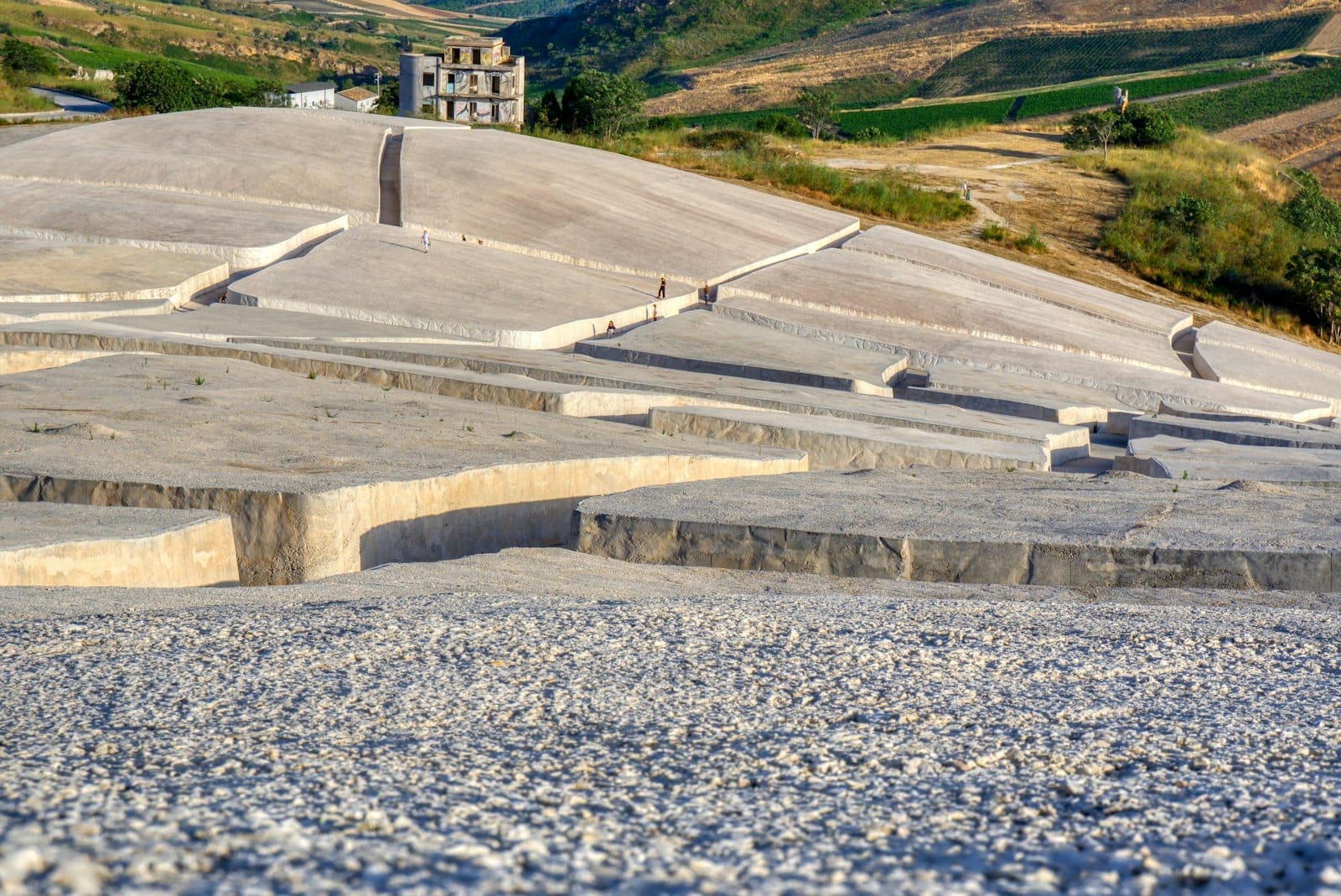
On a dry Sicilian hillside in the province of Trapani, a vast white form spreads across the landscape like a cracked glacier. This is the Grande Cretto di Gibellina, the monumental land art work conceived by the artist Alberto Burri as a memorial to the town of Gibellina, which was obliterated by the Belice earthquake of 15 January 1968. The earthquake killed over 200 people and left an entire valley of communities in ruins.
Burri's response was radical in its simplicity: instead of clearing the rubble and starting over, he poured white concrete over the remains of the old town, preserving the street grid beneath. The narrow passages between the concrete blocks follow the exact layout of the former roads and alleyways, so walking through the Cretto is, in a literal sense, walking the ghost of a vanished city.
The scale defies easy description from photographs. The structure covers approximately 85,000 square metres of hillside, making it one of the largest land art works ever constructed anywhere in the world. The concrete walls rise to around 1.6 metres, just above average eye level, so once inside the passages, the surrounding landscape disappears and you are enclosed by white silence.
The History Behind the Concrete
The Belice Valley earthquake struck in the early hours of the morning, when most residents were asleep. Fourteen municipalities in western Sicily were damaged or destroyed. Gibellina was among the worst affected: the old hilltop town was declared uninhabitable, and its surviving population was eventually relocated to a purpose-built replacement settlement, Gibellina Nuova, constructed about 11 kilometres away on the valley floor.
Gibellina Nuova became an unusual experiment in public art patronage. The mayor at the time commissioned major Italian and international artists to contribute to the new town's architecture and public spaces, resulting in a strange open-air museum of 1970s and 1980s modernism. But it is the old site, left to ruin, that became the location of Burri's most significant work.
Burri conceived the Cretto in 1984 and 1985, and construction began in 1985. Funding shortfalls caused work to stop in 1989 with roughly a third of the planned area incomplete. The project remained unfinished for nearly three decades, a fact that added its own unintended layer of meaning to a memorial about incompleteness and loss. Work finally resumed and the Cretto was completed in 2015, the centenary year of Burri's birth.
ℹ️ Good to know
Alberto Burri (1915–1995) was one of the most significant Italian artists of the twentieth century, known for works made from industrial materials: burlap sacks, tar, plastic, and combusted wood. The Cretto translates this material language into landscape scale, using concrete the way his earlier works used salvaged cloth: to cover, to preserve, and to make absence visible.
Tickets & tours
Hand-picked options from our booking partner. Prices are indicative; availability and final rates are confirmed when you complete your booking.
Etna South Upper Craters Guided Excursion from Taormina
From 42 €Instant confirmationFree cancellationTaormina private tour with an expert guide
From 42 €Instant confirmationFree cancellationIsola Bella boat tour and snorkeling
From 55 €Instant confirmationFree cancellationSyracuse and Ortygia Island guided tour from Taormina
From 65 €Instant confirmationFree cancellation
What the Experience Actually Feels Like
Arriving by car, the Cretto appears from the road as a white mass on the hillside, abstract and disorienting against the dry Sicilian scrubland. From a distance it reads almost like a geological feature, a quarry or an outcrop of pale rock. The scale only registers as you walk closer.
Entering the passages, the atmosphere changes completely. The concrete walls on either side muffle sound and create a hush that feels deliberate. The texture of the concrete is rough and weathered, marked by decades of rain and sun. In summer, the white surfaces radiate heat, and the narrow corridors trap warm air. The effect is physically uncomfortable in a way that seems appropriate: this is not a place designed for ease.
The passages vary in width. Some are broad enough for two people to walk abreast; others narrow to a single body's width. Some end abruptly at a sealed wall. Others open onto small widened spaces that correspond to former piazzas or intersections. If you know to look for them, the logic of the old street grid is legible. If you do not, it reads as a labyrinth.
The ground underfoot is sloped and uneven, following the original hillside terrain. Closed shoes with grip are strongly recommended. The site has no internal signage, no interpretation panels within the Cretto itself, and no staff present. You will likely have it largely to yourself, particularly on weekday mornings.
⚠️ What to skip
Accessibility is very limited. The terrain is outdoor, sloped, and irregular. The passages are narrow with no ramps, railings, or adapted routes. Visitors with reduced mobility, pushchairs, or wheeled luggage will find most of the interior inaccessible.
Best Time to Visit
The Cretto is an open-air site with no admission fee and no gate. Access is available in daylight. Early morning visits in spring and autumn offer the most rewarding experience: the low sun catches the edges of the concrete blocks and throws long shadows across the passages, emphasising the geometry and depth of the work in a way that flat midday light does not.
Summer visits between late June and August require planning. The white concrete amplifies heat significantly, and by midday the passages become uncomfortably hot. Bring water, wear a hat, and consider arriving before 9am or after 5pm. Sunscreen is essential: there is no shade anywhere within the Cretto.
October and November offer stable weather and often dramatic skies, with storm light that suits the sombre character of the place. Spring visits in April and May are pleasant, with the surrounding hillside showing seasonal green before the summer dries everything back to ochre and brown.
If you are planning a broader western Sicily itinerary, the Cretto pairs well with a visit to the Selinunte archaeological park to the south or the salt pans near Trapani to the northwest, both accessible within an hour by car. See our guide to getting around Sicily by car for route planning advice.
Photography and Viewing Points
The most iconic image of the Cretto is the aerial or elevated view that reveals the cracked white surface spreading across the hillside, its fissures tracing the ghost of the old street plan. This view cannot be achieved on foot from within the work itself. To see the Cretto from above, look for viewpoints on the surrounding hillside roads as you approach by car. Some elevated pull-offs along the SS119 offer the perspective that most photographs use.
Within the passages, photography rewards patience. The interaction of light and shadow on the concrete walls shifts dramatically across the day. Wide-angle lenses capture the compression of the narrow corridors. A long passage shot toward a distant opening, with the blue Sicilian sky visible at the end, is one of the more arresting compositions available.
Drone photography is subject to Italian civil aviation authority regulations. Check current rules before bringing a drone; unpermitted flights over cultural heritage sites can result in fines.
The Surrounding Context: Gibellina and the Belice Valley
The Cretto does not exist in isolation. Gibellina Nuova, the replacement town, is a short drive away and worth a brief visit if contemporary public art interests you. It contains works by prominent artists of the era, though the town itself has a somewhat desolate quality, under-populated and architecturally unresolved, which gives it its own accidental poetry.
The wider Belice Valley retains traces of the earthquake's impact across multiple sites. Other affected towns went through different trajectories: some rebuilt in place, some relocated, some remain partially abandoned. The landscape of this corner of western Sicily is shaped by that single night in January 1968 in ways that are still readable if you know where to look.
Travellers with an interest in Sicily's layered cultural landscape may also want to explore the region's other contexts. The broader Sicily travel guide covers the full scope of what the island offers, from ancient Greek temples to baroque hill towns. For western Sicily specifically, Trapani serves as the most practical base for visiting the Cretto.
Who Should Think Twice Before Visiting
The Cretto is not a comfortable or conventionally scenic attraction. It offers no café, no shade, no toilets on site, and no interpretation beyond what you bring with you. Visitors expecting a classical Sicilian heritage experience, or those travelling with young children who need activity and stimulation, may find the experience unrewarding. The site is also genuinely difficult to reach without a car, making it impractical for travellers relying entirely on public transport.
Those who are moved by land art, by architecture that confronts difficult history, or by the specific atmosphere of places built around absence will find the Cretto profound. But it requires an investment of time and effort that not every Sicily itinerary can accommodate.
Insider Tips
- Walk the perimeter of the Cretto before entering the passages. The outer edge gives you a sense of the full scale and helps you understand the internal layout before the walls close around you.
- The surrounding hillside roads offer elevated views that reveal the cracked white surface as a whole, which is impossible to grasp from inside. Drive slowly along the approach road and look for natural pull-off points.
- Bring more water than you think you need, especially in summer. There are no facilities of any kind at the site: no toilets, no vending machines, no shade. The nearest services are in Santa Ninfa or Salaparuta.
- Visit on a weekday morning if possible. The site receives relatively few visitors compared to Sicily's major attractions, but weekend afternoons in summer bring organised tour groups that break the silence the work depends on.
- The nearby Museo del Grande Cretto di Gibellina provides historical and artistic context for the work. Check locally for current opening hours and any admission charge before visiting.
Who Is Cretto di Burri For?
- Contemporary art and land art enthusiasts who understand Burri's wider practice
- Architecture-minded travellers drawn to places where design confronts history
- Photographers seeking stark, graphic compositions and unconventional subjects
- Travellers who find conventional Sicilian tourist sites too crowded and want something genuinely unusual
- Anyone interested in how communities and artists respond to catastrophe and collective trauma
Nearby Attractions
Other things to see while in Trapani & the West:
- Cave di Cusa
Cave di Cusa is a 2-km stretch of open-air ancient quarry in western Sicily where Greek stonemasons abandoned their work mid-cut in 409 BC, leaving colossal column drums embedded in calcarenite rock. Part of the Selinunte Archaeological Park, it is one of the most atmospheric and least crowded ancient sites in Italy.
- Favignana
Favignana, the largest of the Aegadian Islands off western Sicily, is a compact limestone island with crystalline coves, a dramatic tuna-fishing heritage, and terrain flat enough to circle by bicycle in a day. Getting there takes around 30–40 minutes from Trapani by hydrofoil, and there is no entrance fee to the island itself.
- Marettimo
The westernmost of Sicily's Egadi Islands, Marettimo is a car-free island of limestone peaks, sea caves, and water so clear it borders on unreal. Reached only by hydrofoil or ferry from Trapani, it rewards travelers willing to swap convenience for one of Italy's most genuinely uncommercialised island experiences.
- Marsala
Marsala sits at the westernmost tip of Sicily on the cape of Capo Boeo, where Carthaginian history, Arab influence, and Italian unification converge in one walkable town. Beyond the famous wine, visitors find Roman mosaics, a Punic warship, salt pans glowing at sunset, and a piazza life that moves at its own unhurried pace.