Salt Pans of Trapani and Paceco: Sicily's Ancient Wetland in Living Color
The Salt Pans of Trapani and Paceco form a 1,000-hectare nature reserve straddling the coast between Trapani and Marsala. Designated as a nature reserve in 1995 and managed by WWF Italy, and listed as a Ramsar Wetland of International Importance in 2011, this flat, luminous landscape of rose-tinted basins, turning windmills, and foraging flamingos rewards visitors who slow down enough to notice what they're looking at.
Quick Facts
- Location
- Between Trapani and Paceco, along coastal road SP21, approx. 5–6 km south of Trapani city centre
- Getting There
- By car or bicycle along the SP21 (Trapani–Marsala road); organized tours depart from Trapani city centre
- Time Needed
- 1.5–3 hours for a roadside walk or guided tour; longer if cycling the full reserve
- Cost
- Reserve landscape: free. Guided tour (approx. 75 min): around €8–€10 per person — verify with operators before booking
- Best for
- Nature lovers, photographers, slow travelers, families with older children
- Official website
- wwfsalineditrapani.it/?lang=en
What You're Actually Looking At
The Salt Pans of Trapani and Paceco, officially the Riserva Naturale Orientata Saline di Trapani e Paceco, are not a theme park version of salt production. They are a working, living landscape where salt has been harvested continuously since Phoenician times, and where the geometry of shallow basins, low levees, and turning windmill sails has barely changed in centuries. The reserve covers roughly 1,000 hectares, divided between core salt-working basins and surrounding buffer areas. That scale is hard to appreciate until you're standing on one of the earthen paths between basins and the flat horizon seems to go on without interruption.
The color of the water is the first thing that stops visitors mid-step. Depending on salinity levels and the time of year, the basins shift from pale green to coral pink to a deep brick red, caused by salt-tolerant microorganisms called Dunaliella salina and halophilic archaea. In late summer, when evaporation is highest and salinity peaks, the pinks intensify to the point where photographs look oversaturated even without any editing.
💡 Local tip
The color payoff is greatest between July and September, when salt crystallization is in full swing. Come in spring for migratory birds and cooler walking conditions, but don't expect the same chromatic drama.
A Landscape With Deep Roots
Salt from this corner of western Sicily was a strategic commodity for millennia. The Phoenicians recognized that the shallow coastal waters, the reliably dry Mediterranean summer, and the persistent winds off the sea created near-ideal conditions for solar salt evaporation. Arab settlers who arrived in the 9th century improved and expanded the system, introducing the windmill technology that still defines the silhouette of the reserve today. By the medieval period, Trapani salt was being exported across the Mediterranean and as far north as Scandinavia, where it was essential for preserving fish.
The reserve itself is a modern legal structure placed around a very ancient practice. It was established as a nature reserve in 1995 and placed under the management of WWF Italy. In 2011, the Italian Ministry of the Environment proposed the area for inclusion in the Ramsar List of Wetlands of International Importance, recognizing its ecological significance as a staging and wintering site for waterbirds across the Mediterranean flyway. That designation puts it in the same category as wetlands of global consequence, not just regional charm.
The salt pans sit within a broader coastal corridor that includes the Stagnone Lagoon to the south, another protected wetland area that together with these salt pans forms one of western Sicily's most important natural systems.
Tickets & tours
Hand-picked options from our booking partner. Prices are indicative; availability and final rates are confirmed when you complete your booking.
Segesta, Erice and salt pans day-trip from Palermo
From 99 €Instant confirmationFree cancellationShuttle Tour of Favignana and Levanzo Islands from Trapani
From 35 €Instant confirmationFree cancellationFull-day tour to Marettimo island from Trapani
From 112 €Instant confirmationFree cancellationFavignana and Levanzo Boat Trip with Stops from Trapani
From 43 €Instant confirmationFree cancellation
The Experience at Different Hours
The reserve is open-air and accessible along the SP21 coastal road at all hours, with no entrance gate or ticket required for the landscape itself. That said, the quality of what you see changes dramatically depending on when you arrive.
Midday in July is punishing. The coastal road offers almost no shade, temperatures regularly exceed 32°C in summer, and the light is flat and white. The colors of the basins look washed out rather than vivid, and the windmills cast short, uninteresting shadows. Most visitors who arrive at noon are back in their cars within twenty minutes.
The late afternoon is a different calculation entirely. From about 4 PM onward, the sun drops toward the Egadi Islands sitting on the western horizon, and the low-angle light begins doing serious work on the landscape. The salt crystals catch it and sparkle. The windmills project long amber shadows across the pink basins. By the time the sun actually sets, the sky and water are often the same shade of deep orange-red, and the silhouettes of flamingos wading at the basin edges complete a scene that photographers have chased for decades. Arrive by 5 PM in summer to find a decent spot on the roadside levees before other visitors claim them.
⚠️ What to skip
Summer sunset crowds have grown significantly in recent years. The stretch of SP21 near the Mulino Maria Stella windmill becomes congested with parked cars from about 6:30 PM onward on clear days. Arrive earlier or cycle from Trapani to avoid the bottleneck.
Morning visits, especially between April and June, are ideal for birdwatching. The reserve is quieter, the light is clean and directional, and the waterbirds are active before the heat sets in. The smell at dawn is distinctive and worth noting: a sharp mineral tang from the salt combined with the low-tide coastal mud of the buffer zone. It is not unpleasant, but it is specific, and it tells you immediately that this is a functioning natural system, not a landscaped park.
Wildlife: What You Can Realistically Expect to See
The greater flamingo is the signature species of the reserve, and sightings are common but not guaranteed. Flamingos use the salt pans as a feeding and resting site rather than a breeding site, so their presence depends on the season and regional migration patterns. Concentrations are typically largest from late summer into autumn, when birds stage here after breeding in other Mediterranean wetlands. Seeing a few dozen flamingos wading through a pink basin with the Egadi Islands as backdrop is a legitimate wildlife experience, not a managed spectacle.
Beyond flamingos, the reserve records a substantial variety of waders and waterbirds. Avocets, black-winged stilts, kentish plovers, little egrets, and various tern species are present at different times of year. The spring migration window, roughly March through May, brings the greatest diversity. Serious birders should bring a scope; the basins are wide enough that even good binoculars will leave some birds as small dots at maximum zoom.
ℹ️ Good to know
The WWF reserve team runs guided birdwatching visits with advance booking. These are worth considering if wildlife observation is your primary reason for visiting, as guides know which basins are active and can get you closer to key viewpoints than roadside stopping alone allows.
The Salt Museum and Windmills
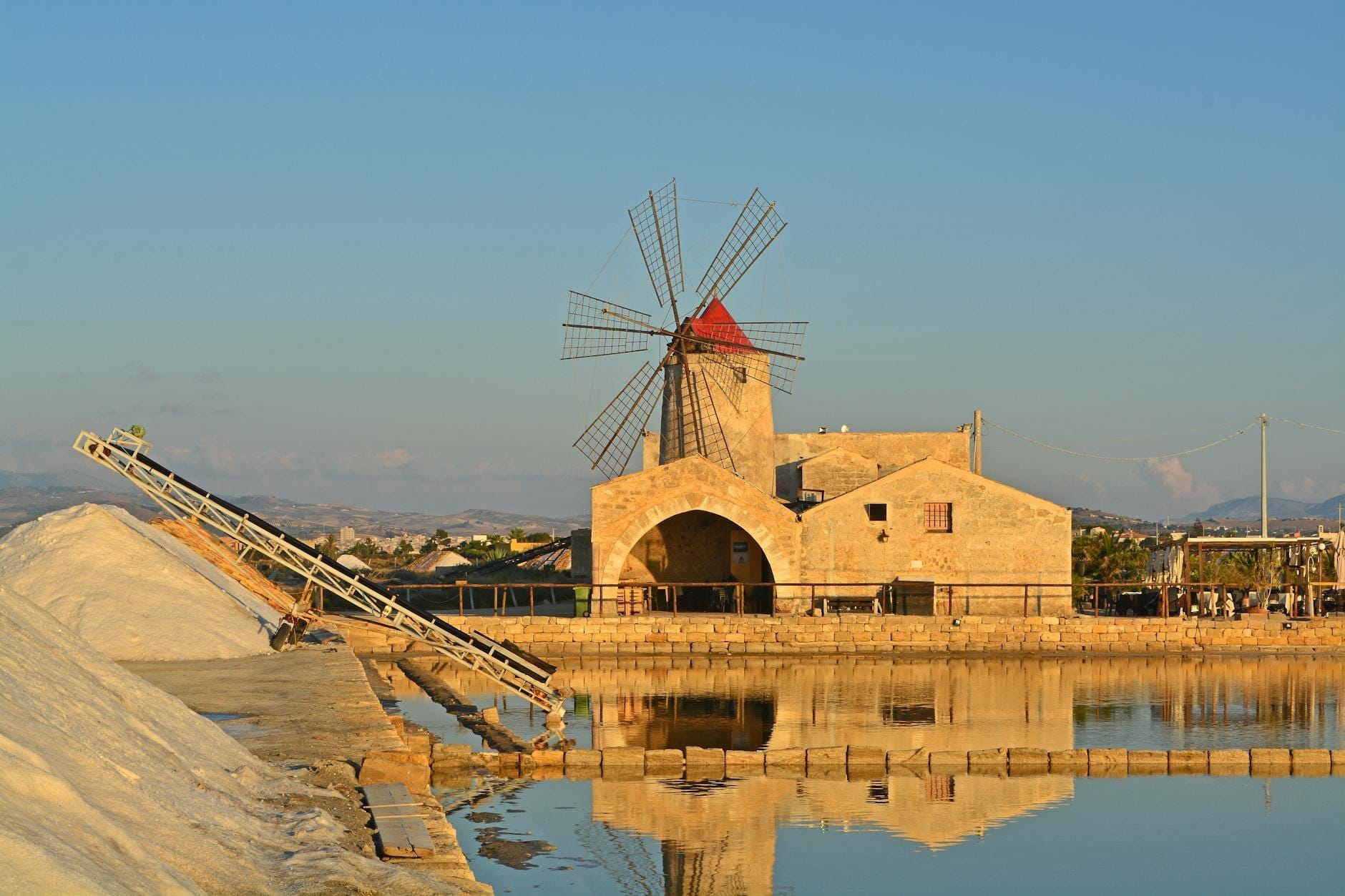
Several traditional windmills are preserved within the reserve, the most visited being the Mulino Maria Stella, which has been restored and functions as both a landmark and a visitor reference point. These are not decorative: the mill design, with canvas sails turning Archimedean screw pumps, was the standard technology for moving water between basins at different elevations throughout the salt production process. Watching one turn against a sunset sky is the image most associated with this stretch of coastline.
The reserve operates a Salt Museum (Museo del Sale) that presents the history and mechanics of solar salt production. Opening days and hours vary by season and are subject to change, so confirm directly with the WWF reserve team or check the official website before planning your visit around it. The museum is modest in size but well-focused, and the physical tools and equipment on display give meaningful context to the landscape you see outside.
How to Get There and What to Bring
The reserve extends along the SP21 coastal road between Trapani and Marsala, with the northern section closest to Trapani being the most visited. By car from Trapani city centre, the drive takes around 10 minutes. There is roadside parking along various stretches of the SP21, though the most scenic spots fill quickly in the late afternoon during summer. Trapani airport (IATA: TPS) is approximately 15 km south of the city, and car rental from the airport is a practical option for reaching the reserve.
Cycling the SP21 from Trapani is a genuinely good option for fit travelers: the terrain is flat, the road is manageable outside peak hours, and cycling allows you to stop at viewpoints that cars cannot safely access. Trapani itself is worth exploring before or after the reserve visit — the Marsala historic centre lies about 25 km to the south along the same coastal road if you want to extend the trip.
What to bring: sun protection is non-negotiable from May through September. There is no shade along the earthen paths between basins. Water, a hat, and sunscreen are the basic checklist. Mosquitoes are present near the wetland edges in warm months, particularly in the early morning and at dusk, so repellent is useful. For photography, a polarizing filter helps manage reflections off the water and intensifies the color contrast between the basins and the sky.
Footwear matters more than most visitors anticipate. The levee paths between basins are firm but uneven, with coarse salt crystals underfoot in active sections. Closed-toe shoes or light hiking sandals with grip are more comfortable than flip-flops for anyone planning to walk more than a few hundred metres from the road.
If western Sicily is your base, the salt pans pair naturally with a visit to the Tonnara di Scopello to the north or a half-day at Zingaro Nature Reserve. The day trips from Palermo guide covers how to combine the Trapani coast with a Palermo base.
An Honest Assessment: Is It Worth Your Time?
The salt pans are not an attraction in the conventional sense. There is no dramatic structure to walk through, no single reveal moment, no audio guide telling you where to stand. What they offer is a rare example of a working industrial landscape that is also ecologically significant and visually extraordinary, and that combination is hard to find anywhere in Europe at this scale and in this state of preservation.
Visitors who arrive expecting a quick photo stop and then move on often report mild disappointment, because the landscape reveals itself slowly. Visitors who come with an hour to spare, who walk rather than just park and look, and who arrive at the right time of day consistently describe the experience as one of the most memorable in Sicily. The difference is almost entirely in how you approach it.
If you are building a western Sicily itinerary, the best time to visit Sicily guide can help you align your timing with both the salt harvesting season and favorable conditions for flamingo sightings.
Who should skip it: travelers who are primarily interested in archaeology, Baroque architecture, or beach time will find the salt pans peripheral to their interests. The reserve is flat, exposed, and requires patience. In midsummer midday heat, it is genuinely uncomfortable. If you are visiting Trapani with only a few hours before a ferry to the Egadi Islands and need to prioritize, the city's historic centre will probably serve you better.
Insider Tips
- The elevated section of the SP21 just north of the Mulino Maria Stella gives you an unobstructed view across multiple basins simultaneously — it is the best single vantage point in the reserve and is accessible directly from the road without any walking.
- Salt harvesting in the active pans typically runs from June through September. Visiting during this period means you may see workers operating traditional tools and the salt being piled into white mounds along the basin edges, which adds a layer of human scale to the landscape.
- The Egadi Islands on the western horizon serve as a natural depth element in sunset photography. Position yourself with a windmill in the mid-ground and the islands on the skyline for the classic composition that defines this location.
- WWF-guided tours are available with advance booking and are led in Italian with varying availability in English — confirm language options when booking. The tours access sections of the reserve that roadside visitors cannot reach and include entry to the Salt Museum.
- Binoculars are worth the bag space even if you are not a committed birdwatcher. The flamingos are often 200–400 metres into the basins, and watching them feed is considerably more engaging at magnification than as pink dots in the middle distance.
Who Is Salt Pans of Trapani and Paceco For?
- Nature and wildlife enthusiasts, particularly those interested in Mediterranean wetland birds
- Photographers chasing sunset landscapes with authentic, non-staged subjects
- Cyclists looking for a flat, scenic half-day route from Trapani city along the coast
- Travelers interested in the deep agricultural and trade history of western Sicily
- Families with older children who can handle an unshaded outdoor walk and have a genuine curiosity about how salt is made
Nearby Attractions
Other things to see while in Trapani & the West:
- Cave di Cusa
Cave di Cusa is a 2-km stretch of open-air ancient quarry in western Sicily where Greek stonemasons abandoned their work mid-cut in 409 BC, leaving colossal column drums embedded in calcarenite rock. Part of the Selinunte Archaeological Park, it is one of the most atmospheric and least crowded ancient sites in Italy.
- Cretto di Burri
The Grande Cretto di Gibellina is one of the largest land art works on Earth: 85,000 square metres of white concrete encasing the ruins of a town destroyed by the 1968 Belice earthquake. Created by Alberto Burri, it is simultaneously a tomb, a monument, and a walk through absence. Entry is free and the site is open-air, but reaching it requires a car.
- Favignana
Favignana, the largest of the Aegadian Islands off western Sicily, is a compact limestone island with crystalline coves, a dramatic tuna-fishing heritage, and terrain flat enough to circle by bicycle in a day. Getting there takes around 30–40 minutes from Trapani by hydrofoil, and there is no entrance fee to the island itself.
- Marettimo
The westernmost of Sicily's Egadi Islands, Marettimo is a car-free island of limestone peaks, sea caves, and water so clear it borders on unreal. Reached only by hydrofoil or ferry from Trapani, it rewards travelers willing to swap convenience for one of Italy's most genuinely uncommercialised island experiences.