Cave di Cusa: The Ancient Greek Quarry Frozen in Time
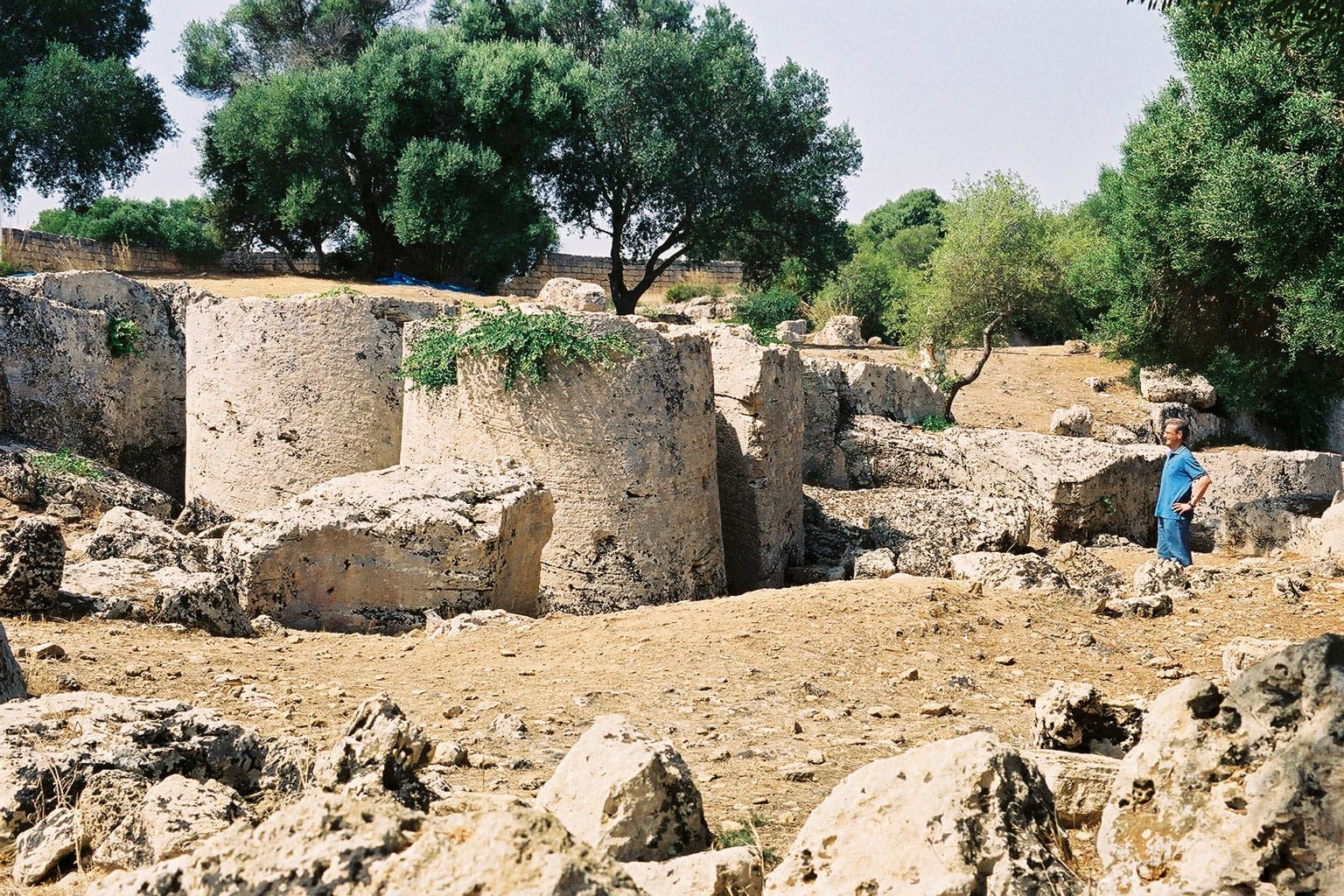
Cave di Cusa is a 2-km stretch of open-air ancient quarry in western Sicily where Greek stonemasons abandoned their work mid-cut in 409 BC, leaving colossal column drums embedded in calcarenite rock. Part of the Selinunte Archaeological Park, it is one of the most atmospheric and least crowded ancient sites in Italy.
Quick Facts
- Location
- Campobello di Mazara (TP), about 17 km northwest of Selinunte, western Sicily
- Getting There
- Car or organized tour from Selinunte or Castelvetrano; no regular public bus service to the site
- Time Needed
- 1 to 1.5 hours for a thorough walk
- Cost
- Included in the combined Selinunte Archaeological Park ticket; verify current prices at coopculture.it
- Best for
- History enthusiasts, archaeology lovers, photographers, and anyone who wants ancient ruins without the crowds
What Makes Cave di Cusa Extraordinary
Most ancient ruins show you what survived. Cave di Cusa shows you what was left behind. Stretching nearly two kilometres along a low calcarenite ridge about three kilometres southwest of Campobello di Mazara, this open-air quarry is where Greek craftsmen cut the enormous column drums and capitals intended for the temples of Selinunte. Then, in 409 BC, the Carthaginian army destroyed the city in a single brutal campaign, and every mason walked away without finishing a cut. The stone has not moved since.
The result is something almost impossible to find anywhere else in the ancient Mediterranean world: a quarry frozen mid-production. Drums still half-detached from the bedrock sit alongside finished cylinders that were never loaded onto carts. Trenches cut by iron tools are still crisp to the touch. Olive trees have grown up between the blocks over the centuries, their roots threading through the same calcarenite, and on a quiet morning the site feels less like a monument and more like an archaeological accident that nobody cleaned up. That is precisely its value.
ℹ️ Good to know
Cave di Cusa is administered as part of the Selinunte Archaeological Park (Parco Archeologico di Selinunte e Cave di Cusa 'Vincenzo Tusa'). Access is by reservation through CoopCulture, and the site lies about 17 km by road from the main Selinunte visitor centre. A car is essentially required unless you join an organized tour. Confirm opening hours and reservation requirements at coopculture.it before your visit, as seasonal hours and access procedures are updated regularly.
The History Behind the Silence
Selinunte, founded by Greek colonists from Megara Hyblaea in the mid-7th century BC, grew into one of the largest and wealthiest Greek cities in Sicily. Its ambition was architectural: the city's builders planned temples on a scale that rivalled anything in mainland Greece. Temple G, sometimes called the Temple of Zeus, would have been among the largest Greek temples ever constructed, with columns rising to around 30 metres. The stone for those columns came from Cave di Cusa.
Calcarenite, the soft fossiliferous limestone that forms the ridge at Cusa, was quarried from at least the first half of the 6th century BC. Workers cut around each drum using iron chisels, leaving a neck of stone still connecting it to the bedrock, then fractured that neck to free the block. You can see this process at every stage across the site: the circular trenches around drums still attached, the rectangular extraction pits, the finished drums waiting to be transported. Some weigh tens of tonnes. Getting them to Selinunte, about 13 kilometres away, would have required wooden sledges, ropes, and hundreds of workers.
In 409 BC, a Carthaginian force reportedly numbering in the tens of thousands attacked Selinunte and destroyed it within nine days. Work at Cave di Cusa stopped immediately and permanently. No subsequent civilization chose to resume the quarrying or to clear the site. That historical accident is the reason the quarry survives as a document of ancient construction technique rather than an empty hole in the ground.
If you want to see what became of the stone that did reach its destination, the Selinunte Archaeological Park is a short drive southeast and should ideally be combined with a visit to Cave di Cusa on the same day. The contrast between the finished columns at Selinunte and the half-cut drums at Cusa is one of the most instructive juxtapositions in Sicilian archaeology.
Tickets & tours
Hand-picked options from our booking partner. Prices are indicative; availability and final rates are confirmed when you complete your booking.
Siracusa 1-hour boat tour around Ortigia and sea caves adventure
From 25 €Instant confirmationFree cancellationPrivate 90-minute boat tour, Ortigia Island and its sea caves
From 95 €Instant confirmationFree cancellationFull-Day Siracusa and Ortigia Guided Tour from Taormina
From 55 €Instant confirmationFree cancellationPasta and Tiramisu Cooking Class in Siracusa
From 135 €Instant confirmationFree cancellation
Walking the Site: What You Actually See
The quarry extends along a narrow ridge for roughly 1.8 kilometres, and a path runs its length. There is no fixed itinerary; you simply walk and look. The largest drums are immediately legible, even if you have never visited an ancient site before. They are roughly cylindrical, some over two metres in diameter, and they protrude from the pale rock at various angles depending on how far the cutting had progressed.
The most immediately striking section is near the centre of the ridge, where a concentration of large drums sits at ground level or just below it, surrounded by olive and carob trees. The circular trenches cut around them are deep enough to step into. Running your fingers along the tool marks in the stone gives a physical sense of the work involved that no photograph or museum model can replicate.
Further along, you encounter the rectangular extraction zones where column capitals and other architectural elements were being roughed out. Some drums were cracked during extraction and left behind for that reason; you can see the split lines where the stone gave way unexpectedly. The ground between the outcrops is uneven, with patches of wild herbs that release a sharp herbal scent when you brush against them. In spring, the grass between the stones is green and soft; in July or August, it turns straw-yellow and crackles underfoot.
💡 Local tip
Wear closed shoes with a grip. The calcarenite surface is uneven and some of the extraction trenches have no barriers. The path is informal and partly unpaved. There is no shade over much of the route, so a hat and water are important from May through September.
Best Time to Visit and How the Site Changes Through the Day
Morning visits, particularly in the first hour after opening, offer the site almost entirely to yourself. The light at that hour is low and raking, which throws the tool marks and surface textures of the stone into sharp relief and makes photography considerably more rewarding than at midday. The olive trees cast long shadows across the drums, and the surrounding agricultural landscape, with its vineyards and wheat fields, is often wrapped in a slight haze.
By late morning, especially on weekends in April, May, and October, small groups may arrive, but the site is long enough that crowding is rarely a problem. Midday in summer should be avoided for comfort reasons: there is almost no shade, the pale limestone reflects heat intensely, and the site offers no snack facilities or water points. Late afternoon light is also beautiful but leaves less time before closing.
The western Sicily interior is best visited between late March and early June, or in September and October. Summer is perfectly workable if you start early. For broader seasonal guidance across the island, the best time to visit Sicily guide covers climate patterns in detail.
Getting There and Practical Logistics
Cave di Cusa sits in the territory of Campobello di Mazara, in the province of Trapani. There is no regular public bus service to the site itself. The practical options are a rental car, a taxi from Castelvetrano or Marinella di Selinunte, or a guided tour that combines Selinunte and Cave di Cusa in a single itinerary. Driving from Selinunte takes around 20 minutes along provincial roads through farmland.
Access is managed through the Selinunte Archaeological Park system, and a reservation is required. Tickets are handled by CoopCulture and are sold as a combined pass covering Selinunte and Cave di Cusa. The main Selinunte visitor centre is at Piazzale Iole Bovio Marconi 1, Marinella di Selinunte, Castelvetrano. Verify current ticket prices, opening hours, and reservation requirements directly at coopculture.it before your visit, as these are updated seasonally.
Trapani, roughly an hour's drive north, makes a reasonable base for exploring western Sicily. If you are planning a wider circuit of the region, the day trips from Palermo guide includes options in the western interior that pair well with a visit here.
⚠️ What to skip
There are no facilities at Cave di Cusa: no café, no toilets, no parking attendant, and no visitor centre on site. Bring water, food if needed, and make sure your reservation is confirmed before you drive out here. Arriving without a booking may mean being turned away.
Photography, Accessibility, and Who Should Skip This
For photographers, Cave di Cusa rewards patience and timing. The texture of the pale calcarenite is best captured in side-lit conditions, meaning early morning or late afternoon. Wide shots with a drum in the foreground and the olive trees behind work well compositionally. The absence of signage, barriers, and crowds makes it unusually easy to frame clean images. A polarising filter helps manage the reflective surface of the stone in full sunlight.
On accessibility: the site is an open-air archaeological area on natural terrain. The path is informal, the ground is uneven, and some sections involve stepping over rocks or navigating extraction trenches with no handrails. No official statement on wheelchair accessibility is published by the managing authority. Visitors with significant mobility limitations should contact the park directly before planning a visit.
Cave di Cusa is genuinely not for everyone. If ancient ruins leave you cold unless they include intact columns, mosaics, or guided interpretation, the site may feel underwhelming: it is, at its core, a field of unfinished rocks. Visitors who need café stops, shade structures, or audioguide technology will find none of these here. But for anyone with a genuine interest in ancient construction, classical archaeology, or simply the texture of historical silence, this is one of the most affecting places in Sicily.
Western Sicily has several other sites worth pairing on a longer trip. The Doric temple at Segesta offers a different kind of unfinished grandeur: a nearly complete peristyle temple that was also abandoned before its construction was complete, roughly contemporary with the catastrophe at Selinunte.
Insider Tips
- Combine Cave di Cusa with Selinunte in a single day: visit the quarry first in the morning, then drive to the main park. You will see the stone at its source and then see (partially) where it was headed, which dramatically sharpens the experience of both sites.
- The site is surrounded by working farmland and olive groves. In late spring, when the wheat fields around the quarry are green and the wild fennel is flowering, the contrast between the ancient stone and the living landscape is particularly striking and worth factoring into your timing.
- The carved circular trenches around the half-extracted drums are deep enough to photograph from inside if you are careful. Getting down to stone level produces a perspective that conveys the scale of the drums far more powerfully than standing above them.
- Campobello di Mazara, just 3 km north, has bars and a small market. Stop there for breakfast before visiting the quarry rather than relying on anything at the site itself.
- If you read Italian, the on-site information panels, while sparse, reference the work of archaeologist Vincenzo Tusa, after whom the park is formally named. His excavations in the 1960s and 1970s documented the site systematically for the first time; looking up his findings before you visit gives the stones considerably more context.
Who Is Cave di Cusa For?
- Archaeology and ancient history enthusiasts who want more than polished museum displays
- Photographers looking for textured, crowd-free ancient subjects in early morning light
- Travellers combining a full day in western Sicily with a visit to Selinunte
- People who enjoy walking slowly through landscapes where something significant once happened
- Families with older children who are curious about how ancient buildings were actually made
Nearby Attractions
Other things to see while in Trapani & the West:
- Cretto di Burri
The Grande Cretto di Gibellina is one of the largest land art works on Earth: 85,000 square metres of white concrete encasing the ruins of a town destroyed by the 1968 Belice earthquake. Created by Alberto Burri, it is simultaneously a tomb, a monument, and a walk through absence. Entry is free and the site is open-air, but reaching it requires a car.
- Favignana
Favignana, the largest of the Aegadian Islands off western Sicily, is a compact limestone island with crystalline coves, a dramatic tuna-fishing heritage, and terrain flat enough to circle by bicycle in a day. Getting there takes around 30–40 minutes from Trapani by hydrofoil, and there is no entrance fee to the island itself.
- Marettimo
The westernmost of Sicily's Egadi Islands, Marettimo is a car-free island of limestone peaks, sea caves, and water so clear it borders on unreal. Reached only by hydrofoil or ferry from Trapani, it rewards travelers willing to swap convenience for one of Italy's most genuinely uncommercialised island experiences.
- Marsala
Marsala sits at the westernmost tip of Sicily on the cape of Capo Boeo, where Carthaginian history, Arab influence, and Italian unification converge in one walkable town. Beyond the famous wine, visitors find Roman mosaics, a Punic warship, salt pans glowing at sunset, and a piazza life that moves at its own unhurried pace.