Segesta Archaeological Park: Sicily's Most Commanding Ancient Site
Rising from a fold in the hills of western Sicily, Segesta Archaeological Park preserves one of the best-surviving Doric temples in the Mediterranean alongside a Greek theatre with panoramic views toward the sea. The site spans Elymian, Greek, Roman, Arab, and Norman layers of history, making it far more than a single monument.
Quick Facts
- Location
- Contrada Barbaro, Calatafimi-Segesta, Province of Trapani, Sicily, Italy
- Getting There
- By car: A29 Palermo–Trapani motorway, exit Segesta/Calatafimi. By bus: regional services connect Palermo and Trapani with Calatafimi-Segesta and the archaeological site; Tarantola Bus operates local routes in the area
- Time Needed
- 2 to 3 hours for the full site; 1–1.5 hours if visiting only the temple
- Cost
- Full ticket €12, reduced €7. Free on the first Sunday of the month. Combined ticket with Pianto Romano Museum available. Verify current prices before visiting.
- Best for
- Ancient history, photography, archaeology, day trips from Palermo or Trapani
What Is Segesta Archaeological Park?
Segesta Archaeological Park occupies Monte Barbaro, a broad hill about 35 kilometres southeast of Trapani in the interior of western Sicily. The park's official Italian name is Parco Archeologico di Segesta, administered under the Regione Siciliana. It preserves the ruins of ancient Segesta, an Elymian city that traces continuous occupation back to the Bronze Age and accumulated new layers through Greek, Roman, late antique, Byzantine, Arab, and Norman-Swabian periods before its eventual abandonment.
Two monuments draw most visitors: a near-perfectly preserved Doric temple from the late 5th century BC sitting in open countryside at the base of the hill, and a Hellenistic theatre perched at the summit with views that, on a clear day, extend toward the coast. The contrast between the two structures, in scale, position, and atmosphere, is part of what makes the site worth more than a single hour.
ℹ️ Good to know
Opening hours vary by season. The park opens daily at 09:00. Closing times: November to February 17:00; March and October around 17:00–17:30; April to September 18:30. Last admission is one hour before closing. Always verify on the official site before your visit.
The Doric Temple: Famously Unfinished
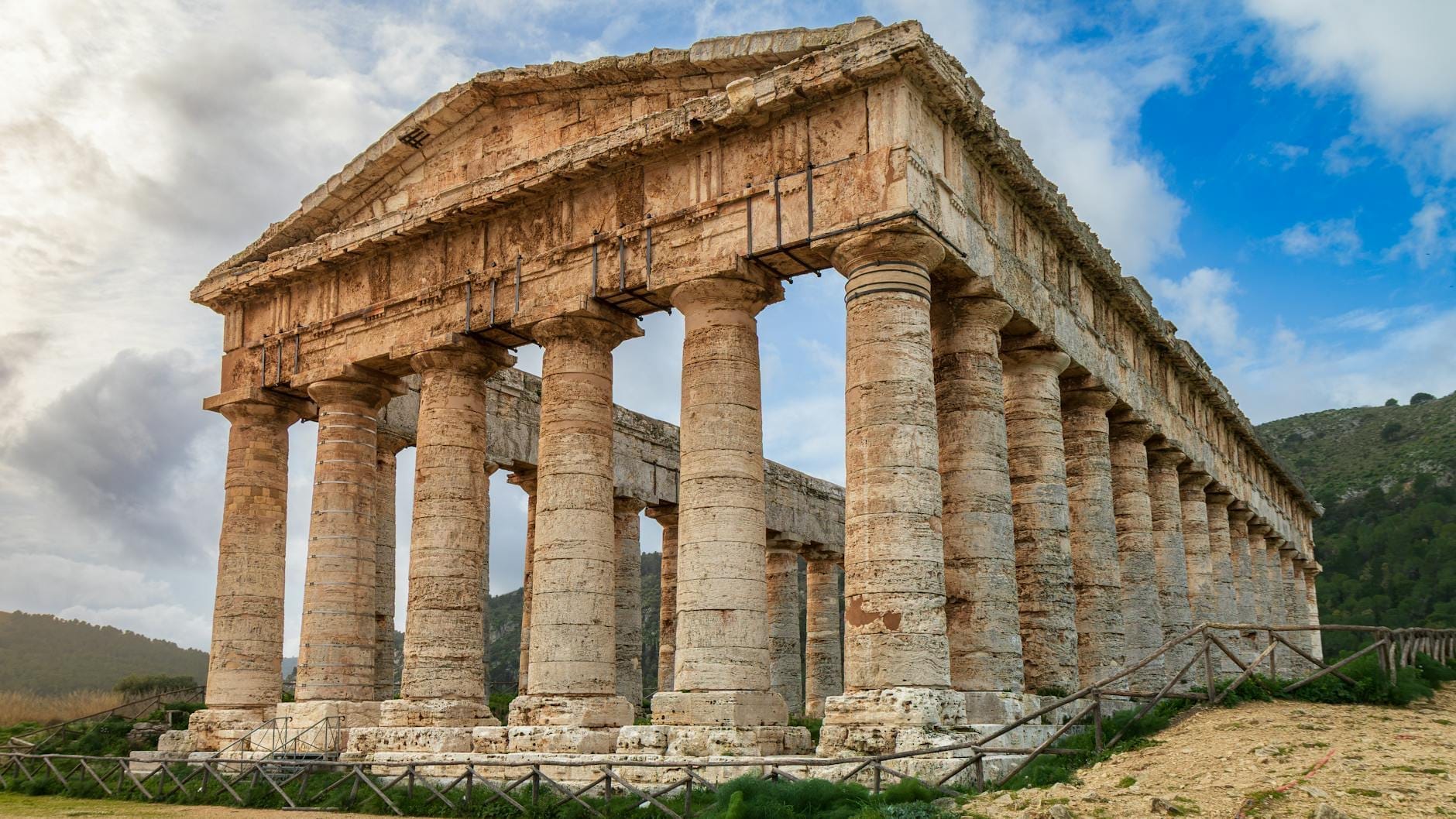
The Doric temple is the first structure visitors reach after entering the park. It stands in a shallow valley of dry grass and scrub oak, the columns rising to their original height on all four sides, the entablature largely intact. The effect is striking precisely because there is nothing around it competing for attention. No city walls, no later buildings, no street furniture. The temple sits alone in the landscape as if it arrived there by geological process.
Built around 420 BC, the temple is peripteral hexastyle: six columns across each short end, fourteen along each long side, for a total of thirty-six columns. What makes it architecturally unusual is its unfinished state. The column drums were never fluted, the floor of the cella was never laid, and there is no evidence that a roof was ever added. Scholars have proposed various explanations, including that construction was halted by the outbreak of war between Segesta and Selinus around 416 BC. The lack of fluting, paradoxically, means you can read the construction sequence written directly into the stone.
In the early morning, before tour coaches arrive, the light comes in low from the east and the limestone glows warm amber. The air smells of wild fennel and sun-warmed stone. By midday in summer the site is fully exposed and temperatures climb sharply; a hat and water are essential. Late afternoon light, especially in spring and autumn, turns the columns gold-orange and is favoured by photographers.
💡 Local tip
Arrive at opening time (09:00) if you want the temple to yourself. Tour groups from Palermo typically begin arriving from 10:30 onward. Morning also gives you cooler temperatures and better light on the columns from the east.
Tickets & tours
Hand-picked options from our booking partner. Prices are indicative; availability and final rates are confirmed when you complete your booking.
Segesta half-day trip from Palermo
From 75 €Instant confirmationFree cancellationSegesta, Erice and salt pans day-trip from Palermo
From 99 €Instant confirmationFree cancellationEtna South Upper Craters Guided Excursion from Taormina
From 42 €Instant confirmationFree cancellationTaormina private tour with an expert guide
From 42 €Instant confirmationFree cancellation
The Theatre and the Summit of Monte Barbaro
A shuttle bus connects the lower car park and temple area with the hilltop theatre. Tickets for the shuttle are sold separately on site and cost a small additional fee. The bus ride takes a few minutes but saves considerable uphill walking on an exposed path. That said, visitors who walk up gain a clearer sense of the hill's scale and pass through the excavated area of the ancient city, where ongoing archaeological work has uncovered residential quarters, a Norman castle, and the foundations of a mosque from the Arab period.
The theatre dates to the mid-2nd century BC and is carved directly into the northern slope of Monte Barbaro. It seats roughly four thousand spectators and faces north and northwest, framing a view across the valley toward the distant shimmer of the Gulf of Castellammare. On a day with good visibility, you can see the outline of the coastline. The cavea is largely intact, the seating cut from local limestone worn smooth by centuries of weather.
The theatre is still used for performances during the summer season, typically classical drama and opera staged against that backdrop. If you visit when a production is scheduled, the atmosphere is exceptional, but book well ahead as popular nights sell out. On a standard visiting day the theatre is quieter than the temple below, and the views alone justify the climb.
The Elymians and the Longer History of Segesta
Most visitors know Segesta as a Greek site, but the city was not Greek in origin. It was built and initially inhabited by the Elymians, a people of uncertain origin who occupied western Sicily and whose settlements at Segesta, Eryx, and Entella shared cultural traits distinct from both the Greek colonies of the east coast and the Phoenician settlements of the far west. The Elymians built in the Greek architectural style and maintained complex political relationships with Athens, Carthage, and the Greek city of Selinus, which Segesta famously helped destroy by soliciting Athenian intervention in 415 BC.
The city reached its greatest extent between the 2nd and 1st centuries BC under Roman rule, after which it gradually declined. The summit of Monte Barbaro was later occupied by an Arab settlement, during which a mosque was constructed, and then by a Norman castle after the 11th-century Norman conquest of Sicily. A church was founded on the site in 1442. All of this layering is visible to attentive walkers who take the path through the upper excavations.
If Segesta prompts an interest in Sicily's Arab-Norman heritage, the Arab-Norman Sicily guide covers the broader architectural and historical context across the island, from Palermo to Cefalù and Monreale.
Planning Your Visit: Practicalities
Segesta sits in open countryside with no village immediately adjacent. There is a café and small gift shop at the site entrance, but no restaurant or nearby alternatives. Bring snacks and at least one litre of water per person, more in summer. The site itself involves a moderate amount of walking on uneven ground; sturdy flat shoes are appropriate, and the path to the theatre is steep in places.
By car, the park is well signed from the A29 motorway. Exit at Segesta/Calatafimi and follow the provincial road SP 68 to the entrance. The drive from Palermo takes around 60 minutes; from Trapani about 30 minutes. Parking is available at the site. By bus, Tarantola Bus operates regional services from both Palermo and Trapani to Calatafimi-Segesta with stops for the archaeological park; check current timetables before travel, as frequency is limited.
Segesta works well as part of a broader western Sicily itinerary. The day trips from Palermo guide includes practical logistics for combining Segesta with other sites in the province.
⚠️ What to skip
The park is fully exposed to sun and wind. In summer, temperatures at the temple regularly exceed 35°C by midday. Shade is scarce. Bring sun protection, a hat, and more water than you think you need. In winter, the hilltop theatre area can be cold and windy even on a clear day.
Photography and Seasonal Conditions
The Doric temple photographs exceptionally well from the northeast corner in morning light, where the columns align and catch directional shadow. In spring, wild grasses and poppies grow in the field around the base of the temple, adding foreground colour. In summer the grass is bleached pale gold, which suits the warm tone of the limestone. Overcast days can actually improve temple photographs by removing harsh shadows from the column drums.
The theatre is best photographed from the upper seating rows looking back across the cavea toward the valley view. The combination of ancient stone seating and distant landscape is more interesting than a straight-on shot of the stage. Drone photography requires prior authorization from park management; check before arrival.
For broader guidance on when to visit Sicily for the best combination of weather, crowds, and site conditions, the best time to visit Sicily guide covers all seasons with specific recommendations.
Accessibility
The park is listed as wheelchair accessible, and persons with reduced mobility accompanied by a companion may be admitted free with prior reservation and authorization. Visitors with reduced mobility may request access by private vehicle to both the temple area and the theatre, bypassing the standard shuttle arrangements. Contact the park in advance to arrange this. The ground around the temple is largely level compressed earth and stone; the path to the theatre involves steeper gradients that the shuttle bypasses.
Is It Worth It? Honest Assessment
Segesta is not overhyped. The temple is genuinely among the best-preserved Doric structures anywhere in the Mediterranean, and the combination of the temple, theatre, and partially excavated city gives the visit real depth for anyone curious about ancient history. The site is not crowded by the standards of Agrigento or the Greek theatre at Taormina, though summer mornings do attract coach groups.
Visitors primarily interested in beach days or urban culture may find two to three hours at an archaeological site tiring rather than rewarding; if that describes your travel style, one focused hour at the temple is enough. Those with a serious interest in Greek and pre-Greek Sicily should consider pairing Segesta with the Selinunte Archaeological Park, which lies about 50 kilometres to the south and represents the rival city Segesta conspired to destroy.
Western Sicily has more to offer beyond ancient ruins. The salt pans near Trapani and the Zingaro Nature Reserve make logical companions on a longer itinerary through the Trapani province.
Insider Tips
- The first Sunday of each month, admission is free for all visitors. This is worth planning around, though it does attract larger crowds than a typical weekday.
- Walk up to the theatre rather than taking the shuttle at least one way. The path through the upper excavations passes remains of Arab-period buildings and the Norman castle foundations that most visitors miss entirely.
- The combined ticket with the Pianto Romano Museum costs only a few euros more than standard admission and adds meaningful context to Segesta's later history.
- If the summer theatre season is running, check the schedule before booking your visit. Evening performances use the ancient cavea with the real landscape as a backdrop, which is a qualitatively different experience from a daytime visit.
- Parking directly outside the entrance fills quickly in peak season. Arriving at 09:00 when the site opens almost guarantees a space and gives you 90 minutes before the first significant wave of coach arrivals.
Who Is Segesta Archaeological Park For?
- Travellers with an interest in ancient Greek and pre-Greek Sicilian history
- Photographers looking for dramatic classical architecture in a natural landscape setting
- Day-trippers from Palermo wanting a single compelling destination about 60 minutes from the city
- Couples or small groups who want space and quiet, which is easier to find here than at more heavily visited sites
- Anyone combining western Sicily with Trapani, Marsala, or the Egadi Islands ferry port
Nearby Attractions
Other things to see while in Trapani & the West:
- Cave di Cusa
Cave di Cusa is a 2-km stretch of open-air ancient quarry in western Sicily where Greek stonemasons abandoned their work mid-cut in 409 BC, leaving colossal column drums embedded in calcarenite rock. Part of the Selinunte Archaeological Park, it is one of the most atmospheric and least crowded ancient sites in Italy.
- Cretto di Burri
The Grande Cretto di Gibellina is one of the largest land art works on Earth: 85,000 square metres of white concrete encasing the ruins of a town destroyed by the 1968 Belice earthquake. Created by Alberto Burri, it is simultaneously a tomb, a monument, and a walk through absence. Entry is free and the site is open-air, but reaching it requires a car.
- Favignana
Favignana, the largest of the Aegadian Islands off western Sicily, is a compact limestone island with crystalline coves, a dramatic tuna-fishing heritage, and terrain flat enough to circle by bicycle in a day. Getting there takes around 30–40 minutes from Trapani by hydrofoil, and there is no entrance fee to the island itself.
- Marettimo
The westernmost of Sicily's Egadi Islands, Marettimo is a car-free island of limestone peaks, sea caves, and water so clear it borders on unreal. Reached only by hydrofoil or ferry from Trapani, it rewards travelers willing to swap convenience for one of Italy's most genuinely uncommercialised island experiences.