Marsala Historic Centre: Ancient Ports, Famous Wine, and the Edge of Sicily
Marsala sits at the westernmost tip of Sicily on the cape of Capo Boeo, where Carthaginian history, Arab influence, and Italian unification converge in one walkable town. Beyond the famous wine, visitors find Roman mosaics, a Punic warship, salt pans glowing at sunset, and a piazza life that moves at its own unhurried pace.
Quick Facts
- Location
- Marsala (TP), western tip of Sicily, approx. 30 km south of Trapani
- Getting There
- Regional Trenitalia train from Trapani or Palermo to Marsala station; by car via SS115 from Trapani; nearest airport: Trapani-Birgi (TPS), reachable by taxi or bus
- Time Needed
- Half day for the historic centre and a museum; full day if you include a winery and the salt pans
- Cost
- Free to walk the historic centre; individual museums, wineries, and the island of Mozia charge separate admission (verify current prices with each venue)
- Best for
- History enthusiasts, wine lovers, slow travellers, and photographers chasing the salt pan sunset
- Official website
- www.comune.marsala.tp.it
What Marsala Actually Is
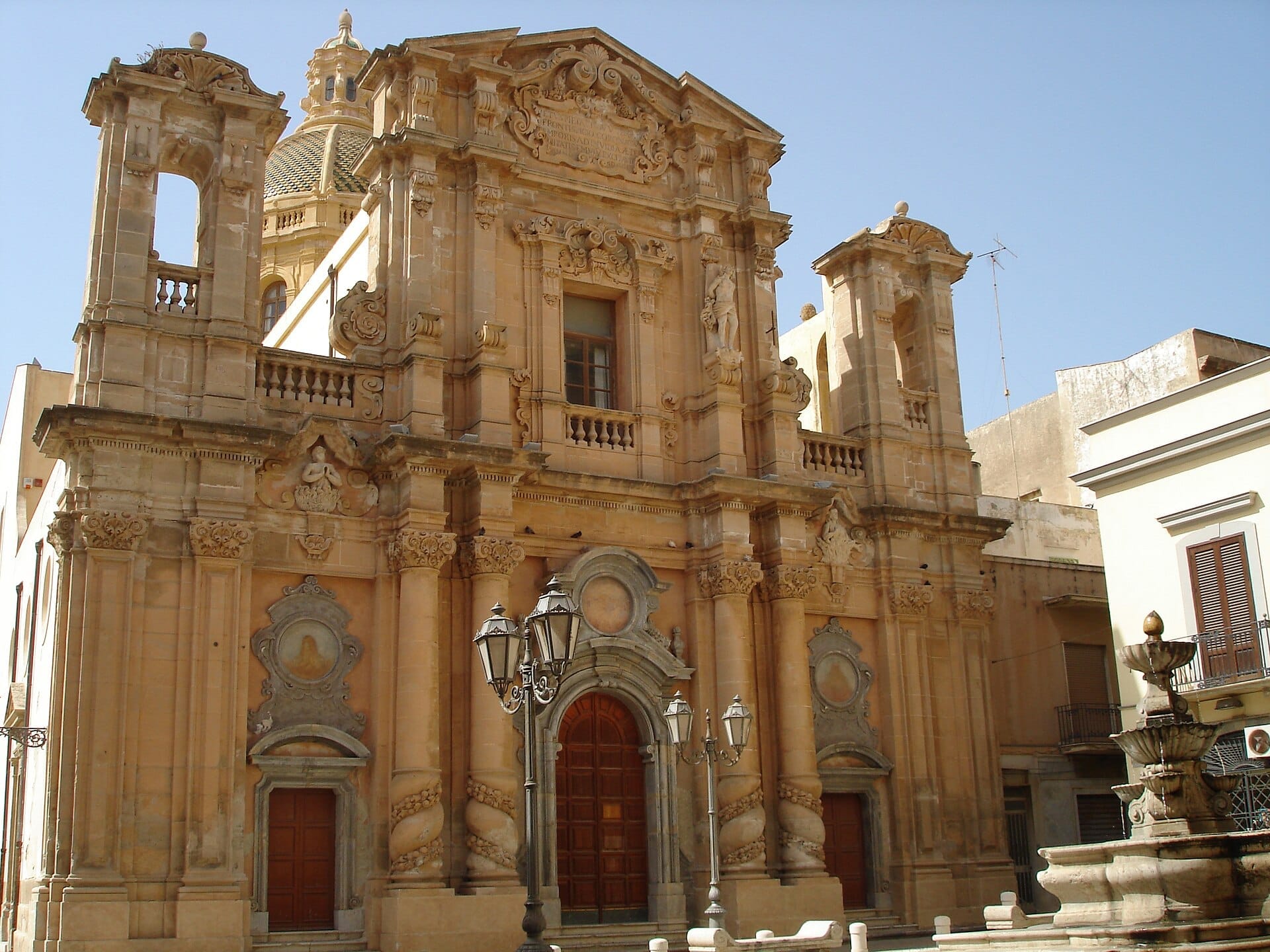
Marsala is a working Sicilian city of nearly 80,000 people, not a curated tourist attraction with a ticket booth. Its historic centre occupies the headland of Capo Boeo, one of the westernmost points of Sicily, and almost everything worth seeing is within comfortable walking distance from the central Piazza della Repubblica. The streets are wide for a Sicilian town, the baroque facades are well-kept without being over-restored, and the pace of life is noticeably slower than in Trapani or Palermo.
Most visitors pass through Marsala quickly, treat it as a footnote on a wine tour, and miss the point entirely. The town rewards those who stay long enough to notice how many layers of history are compressed into a few city blocks: Carthaginian foundations beneath Roman streets, Arab place names on Norman buildings, and a harbour where Garibaldi changed the course of Italian history.
ℹ️ Good to know
There is no admission fee to enter or walk Marsala's historic centre. Individual attractions inside the city, including the Museo Archeologico Baglio Anselmi, local wineries, and the island of Mozia (Motya), each have their own separate ticket prices and opening hours. Always check directly with each venue before visiting, as hours and fees change seasonally.
The History Beneath Your Feet
Modern Marsala stands on or near the site of ancient Lilybaeum, a Carthaginian city founded in 397–396 BC after the destruction of Motya, the Phoenician island settlement just offshore. Lilybaeum became one of the most heavily fortified ports in the western Mediterranean and resisted Roman siege for decades before eventually falling. The Romans expanded it into a major naval base, and the layers from both civilizations are still being excavated today.
The city's name tells the next chapter. It derives from the Arabic phrase often rendered as "Marsà Alì" or "Marsa Allah," meaning roughly "port of Ali" or "port of God," a name given during the period of Arab rule that began in the 9th century. That Arabic influence shaped not just the name but the street grid, the agricultural landscape around the city, and the winemaking traditions that would eventually produce Marsala wine.
Then, on 11 May 1860, Giuseppe Garibaldi landed at Marsala with approximately 1,000 volunteer soldiers, the famous Spedizione dei Mille, beginning the military campaign that would unite southern Italy under the House of Savoy. The landing is commemorated across the city, and it remains one of the defining moments of the Risorgimento. If you are interested in this period, the salt pans between Marsala and Trapani preserve a landscape that would have been recognizable to Garibaldi's soldiers as they approached the coast.
Tickets & tours
Hand-picked options from our booking partner. Prices are indicative; availability and final rates are confirmed when you complete your booking.
Erice and Marsala full-day tour from Palermo with lunch
From 169 €Instant confirmationFree cancellationHistoric Market Tour and Cooking Class in the Heart of Catania
From 185 €Instant confirmationFree cancellationCaltagirone's Historic Mill Guided Tour and Optional Tasting
From 16 €Instant confirmationFree cancellationMarsala Oenological Tour With Food and Wine Tasting
From 22 €Instant confirmationFree cancellation
Walking the Historic Centre: What You Will Actually See
The centro storico is organized around two main axes. Via XI Maggio, the principal pedestrian street, runs through the heart of the old town and is lined with baroque palazzi, small shops, and cafes. At its western end, Piazza della Repubblica opens onto the Cathedral of San Tommaso di Canterbury, whose 18th-century facade faces the Palazzo Senatorio, also known as the Loggia. The square is broad and relatively uncluttered, which makes it easy to photograph and comfortable to sit in during the cooler hours of the day.
Keep walking west and the streets narrow as you approach the cape. The Insula Romana, a partially excavated Roman residential complex with well-preserved mosaic floors, sits near the tip of Capo Boeo and is one of the most tangible connections to the ancient city of Lilybaeum. The mosaics are geometric rather than figurative, but the state of preservation is striking for something exposed to the elements. A short distance away, the ruins of a Roman thermal bath complex reinforce just how substantial the Roman presence here was.
The waterfront promenade along the cape gives views west toward Tunisia, which lies significantly closer to Marsala than Rome does. On a clear morning, the sea is a saturated blue that photographers tend to underexpose, trying to get the color right. By midday the light is harsh and the glare off the water is intense. Come at dusk if the view is your priority.
💡 Local tip
The Insula Romana and nearby Baglio Anselmi museum are clustered at the western end of the historic centre, near the cape. Plan to visit these before walking back through the main shopping street, rather than backtracking. It makes the natural flow of a half-day visit much more logical.
The Punic Warship: Marsala's Most Remarkable Artifact
Inside the Museo Archeologico Baglio Anselmi, set within a converted 19th-century wine warehouse on the waterfront, is a reconstruction of a Punic warship hull recovered from the seafloor near the Egadi Islands. It is believed to be a vessel from the Battle of the Egadi Islands (241 BC), the naval engagement that ended the First Punic War and established Roman dominance in the western Mediterranean. The ship is displayed in a long, climate-controlled room, and even in its incomplete state, the scale of it is genuinely impressive.
The museum also holds archaeological finds from Lilybaeum and the surrounding area, including ceramics, amphorae, and material recovered from the seabed. The building itself, a baglio (a traditional enclosed Sicilian farm-warehouse complex), adds to the atmosphere without feeling staged. The warship alone justifies the visit for anyone with even a passing interest in ancient history or maritime archaeology. Check current opening hours and admission fees directly with the museum before visiting, as they are subject to seasonal changes.
Marsala Wine: What the Town Actually Tastes Like
Marsala wine, a fortified wine produced in and around the city under a DOC designation, is not something to skip simply because it is also used in cooking. The dry and semi-dry versions, in particular vergine and superiore styles, are serious wines with complex, oxidative character that bear little resemblance to the sweet marsala used in European kitchens. Several historic wine producers maintain cellars and visitor centres in Marsala, including Florio, one of the oldest and most architecturally impressive. Winery visits typically require advance booking. For broader context on Sicilian wine culture, see our guide to Sicilian wine.
The wine was first commercialized by the English merchant John Woodhouse, who arrived in Marsala in 1796 and recognized that fortifying the local wine with grape spirit would allow it to survive long sea voyages. The Royal Navy became an early customer. That commercial origin story, very different from most Italian wine traditions, is part of what makes Marsala wine historically interesting rather than just gastronomically interesting.
The Salt Pans and Mozia: Beyond the City Limits
North of Marsala, the coastal road toward Trapani passes through a landscape of working salt pans, windmills, and shallow lagoons that turn extraordinary shades of pink and orange as the sun drops toward Tunisia. This area, part of the Stagnone Lagoon nature reserve, is one of the most visually distinctive stretches of western Sicily, and it is most easily accessed from Marsala rather than Trapani. The light here in the late afternoon has a quality that explains why photographers drive from Palermo specifically for this shot.
Within the Stagnone lagoon lies the island of Mozia (Motya), the ancient Phoenician settlement that preceded Lilybaeum. The island is reachable by a short boat crossing and contains substantial archaeological remains, including a Phoenician tophet and a museum housing the famous Giovinetto di Mozia statue, a 5th-century BC marble figure of exceptional quality. Mozia is a separate excursion from the Marsala historic centre but is the logical complement to a visit. For context on the wider region, Trapani makes a practical base for exploring both.
When to Visit and How the Town Changes by Hour
Marsala in August is warm, occasionally very warm, and the town fills with Italian summer holidaymakers. The piazza and the pedestrian streets are lively in the evenings but quieter during the midday heat, when most locals disappear for several hours. Spring and early autumn are the most comfortable months for walking the historic centre for extended periods. For general guidance on the best time to travel, our seasonal overview for Sicily covers the tradeoffs in detail.
In the early morning, the city belongs to its residents. Bars open around 7am, and the smell of espresso and warm cornetti drifts onto the pedestrian streets. The Roman ruins at the cape are quiet at this hour, and the light on the sea is soft and easy to photograph. By 10am the day-trippers from Trapani and the cruise passengers begin to arrive. The midafternoon lull is real and noticeable; many shops and some smaller museums close between roughly 1pm and 4pm. The evening passeggiata on Via XI Maggio is genuinely pleasant, unhurried, and has none of the performative quality of more tourist-heavy Sicilian towns.
⚠️ What to skip
Weather affects the salt pan experience significantly. Overcast days flatten the color of the lagoon and the pans entirely. The famous pink and orange reflections depend on direct sunlight at a low angle, which means clear skies in the late afternoon are essential. If the sky is cloudy by 3pm, consider adjusting your schedule to visit the historic centre instead and saving the lagoon for another day.
Practical Walkthrough: Getting Here and Getting Around
Marsala station receives regional Trenitalia trains from both Trapani (roughly 30 minutes) and Palermo (approximately 2 hours, with changes possible). The station is about a 10-15 minute walk from the historic centre. By car from Trapani, the SS115 coastal road is the most direct route, about 30 km, and parking is available on the edges of the centro storico. The nearest airport is Trapani-Birgi (IATA: TPS), located between the two cities; taxis and some bus services connect the airport to Marsala, but confirm current schedules directly with the airport.
Within the historic centre, everything is walkable. The distance from the main piazza to the tip of Capo Boeo is less than a kilometre. Cobblestones are present on some of the older streets and may be uneven; visitors with mobility limitations should be aware that step-free access is not guaranteed at all sites, particularly the older archaeological areas and some historic buildings. The main pedestrian axis is relatively smooth.
Marsala works well as a day trip from Trapani, or as a standalone overnight stop if you want to include both the city and the lagoon without rushing. It also sits naturally on a western Sicily road trip itinerary. See our Sicily road trip guide for how it fits into a broader western circuit.
Insider Tips
- Walk to Capo Boeo at dawn before the tour groups arrive. The Roman ruins near the lighthouse are practically deserted and the sea light is at its best. By 10am the area becomes noticeably more crowded.
- Book winery visits at Florio or similar historic producers at least a day in advance. Walk-in availability exists but is not guaranteed, particularly in summer, and the full cellar tours fill up faster than the basic tastings.
- The boat crossing to Mozia runs on a short schedule and the last return crossing can be earlier than you expect. Check the current ferry times before you start exploring the island, not after.
- For the salt pan sunset, position yourself north of Marsala on the road toward Trapani, near the windmills at Saline di Marsala. The most photographed angle faces northwest, with a windmill in the foreground and the pans behind it. Arrive at least 30 minutes before sunset to find a good spot.
- Via XI Maggio has several excellent alimentari and specialty food shops selling local capers, dried tuna bottarga, and Marsala wine in small bottles. These make more interesting souvenirs than anything sold at the tourist-facing shops near the piazza.
Who Is Marsala For?
- History travellers who want Carthaginian, Roman, Arab, and Risorgimento layers in a single, walkable city
- Wine enthusiasts seeking to understand Marsala DOC beyond its culinary reputation
- Photographers targeting the Stagnone salt pan sunset, one of western Sicily's most distinctive images
- Slow travellers who want a working Sicilian city rather than a tourism-polished showcase
- Day-trippers from Trapani looking for a half-day itinerary with genuine historical depth
Nearby Attractions
Other things to see while in Trapani & the West:
- Cave di Cusa
Cave di Cusa is a 2-km stretch of open-air ancient quarry in western Sicily where Greek stonemasons abandoned their work mid-cut in 409 BC, leaving colossal column drums embedded in calcarenite rock. Part of the Selinunte Archaeological Park, it is one of the most atmospheric and least crowded ancient sites in Italy.
- Cretto di Burri
The Grande Cretto di Gibellina is one of the largest land art works on Earth: 85,000 square metres of white concrete encasing the ruins of a town destroyed by the 1968 Belice earthquake. Created by Alberto Burri, it is simultaneously a tomb, a monument, and a walk through absence. Entry is free and the site is open-air, but reaching it requires a car.
- Favignana
Favignana, the largest of the Aegadian Islands off western Sicily, is a compact limestone island with crystalline coves, a dramatic tuna-fishing heritage, and terrain flat enough to circle by bicycle in a day. Getting there takes around 30–40 minutes from Trapani by hydrofoil, and there is no entrance fee to the island itself.
- Marettimo
The westernmost of Sicily's Egadi Islands, Marettimo is a car-free island of limestone peaks, sea caves, and water so clear it borders on unreal. Reached only by hydrofoil or ferry from Trapani, it rewards travelers willing to swap convenience for one of Italy's most genuinely uncommercialised island experiences.