Tonnara di Scopello: Where Sicily's Tuna-Fishing Past Meets the Sea
Perched on a rocky inlet near Castellammare del Golfo, the Tonnara di Scopello is one of Sicily's most atmospheric coastal heritage sites. A working tuna fishery for centuries, it now opens its stone-walled courtyards, rusted machinery, and ancient drying racks to visitors seeking something far off the typical Sicilian trail.
Quick Facts
- Location
- Largo Tonnara, 91014 Scopello (TP), Sicily, Italy — roughly 55 km from Palermo Falcone–Borsellino Airport and about 50 km from Trapani–Birgi Airport
- Getting There
- By car via A29 motorway (Palermo–Mazara del Vallo), exit Castellammare del Golfo, then SS 187 toward Trapani approx. 4 km to the Scopello junction. No direct public transit to the site; a car is strongly recommended.
- Time Needed
- 1.5 to 2.5 hours including the guided museum visit (approx. 30 min) and exploring the external areas and coastline
- Cost
- Paid entry; ticket includes guided museum visit and access to common external areas. Check tonnaradiscopello.it/biglietti for current prices in EUR — rates are updated seasonally.
- Best for
- History lovers, photographers, coastal walkers, and anyone combining a visit with the nearby Zingaro Nature Reserve
- Official website
- www.tonnaradiscopello.it
What Is the Tonnara di Scopello?
The Tonnara di Scopello is a historic tuna fishery complex on the northwest coast of Sicily, situated at the foot of a rocky promontory just outside the small village of Scopello, in the province of Trapani. It is widely considered one of the most important and ancient tuna fisheries in Sicily, with origins traditionally traced back to the 13th century. Over the following centuries, the complex was substantially expanded by the San Clemente (Sanclemente) family during the 15th and 16th centuries, before passing through the hands of the Jesuit order and eventually the influential Florio family, the Sicilian industrial dynasty whose name is still attached to wine, shipping, and maritime heritage across the island.
Today the site operates as an open-air heritage complex and museum. The guided visit covers the processing buildings, the ancient equipment used in the mattanza (the traditional tuna hunt), and the storerooms and towers that once served both industrial and defensive functions. Access to the surrounding exterior areas, including the stone quays and the dramatic shoreline, is included with the ticket.
ℹ️ Good to know
Daily visitor numbers are capped to preserve the site. In peak season, same-day access is not guaranteed. Book tickets in advance at tonnaradiscopello.it/biglietti to avoid disappointment.
The Setting: What You'll See When You Arrive
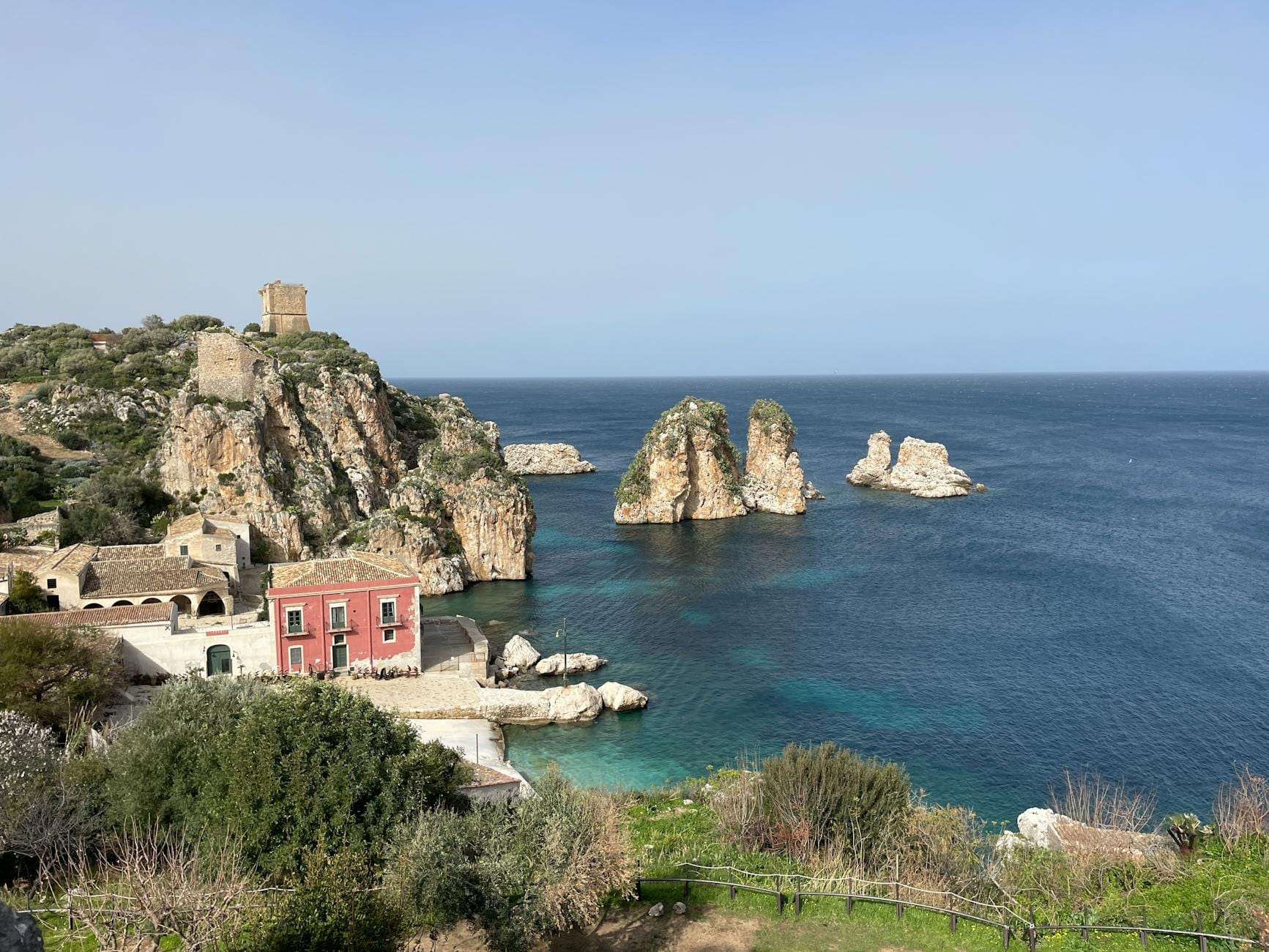
The approach to the Tonnara is part of the experience. The road from Scopello village winds steeply downhill through limestone scrub, and the complex only reveals itself as you reach the waterfront. What greets you is striking: a cluster of sand-coloured stone buildings pressed against the base of a cliff, flanked by two tall sea stacks called faraglioni that rise directly from the water. The sea between them is a deep, transparent blue-green, sheltered enough that you can often see the bottom.
The buildings themselves carry the weight of centuries without any attempt at cosmetic restoration. Rusted iron pulleys, coils of thick rope, and wooden handling equipment are left in situ. The smell of salt air and aged timber is persistent. The courtyards are paved in irregular stone, worn smooth by generations of fishermen, and the walls are thick enough to keep the interiors noticeably cool even in July.
In the morning, when light comes from the east and catches the pale rock faces of the faraglioni, the site takes on an almost theatrical quality. By mid-afternoon the light flattens and the stone turns more ochre. Either hour has its merits for photography, but early arrival also means fewer visitors in the courtyards and more breathing room during the guided tour.
Tickets & tours
Hand-picked options from our booking partner. Prices are indicative; availability and final rates are confirmed when you complete your booking.
Etna South Upper Craters Guided Excursion from Taormina
From 42 €Instant confirmationFree cancellationTaormina private tour with an expert guide
From 42 €Instant confirmationFree cancellationIsola Bella boat tour and snorkeling
From 55 €Instant confirmationFree cancellationSyracuse and Ortygia Island guided tour from Taormina
From 65 €Instant confirmationFree cancellation
The History: Centuries of the Mattanza
The word tonnara refers specifically to the elaborate fixed-net system used to trap Atlantic bluefin tuna during their annual spring migration through the Strait of Sicily. The mattanza, the ritual slaughter at the end of the trapping process, was one of the most demanding and codified forms of collective labour in Mediterranean fishing culture. At its height, the Tonnara di Scopello employed dozens of men and produced significant quantities of preserved tuna, which was packed in salt or oil and shipped across Sicily and beyond.
The Florio family, who dominated Sicilian commerce in the 19th century, operated several tonnaras across western Sicily, including this one. Their industrial ambitions modernised parts of the operation but did not fundamentally alter the ancient rhythm of the seasonal hunt. Commercial tuna fishing using the mattanza method has ceased at Scopello, as it has at most Sicilian tonnaras, due to regulatory changes and the decline of traditional mattanza-based fisheries in Sicily. The last active catches here took place in the 1980s. What remains is the architecture, the equipment, and the guided interpretation.
For context on how tuna fishing fits into the broader story of western Sicily's economy and identity, the Trapani province as a whole offers several related sites, including the Trapani salt pans, another example of an ancient extraction industry that shaped the coastal landscape.
The Guided Visit: What the Tour Covers
The included guided museum visit runs approximately 30 minutes and takes in the principal buildings of the complex. Guides explain the mechanics of the mattanza in detail, including how the net chambers were arranged in sequence to funnel and trap the tuna. The equipment on display, including harpoons, net weights, and large wooden tubs for processing, is original and dates to the active period of the fishery.
After the guided portion, visitors are free to explore the external areas, which include the stone piers, the waterfront, and the base of the faraglioni. Swimming from the rocks is not part of the standard visit, and the site is not a beach, so do not expect sunbathing infrastructure. What you get instead is direct access to one of the most photographed coastal scenes in northwestern Sicily, without the beach-season crowds.
💡 Local tip
Wear rubber-soled shoes. The stone quays and coastal paths around the complex are uneven and can be slippery when wet or when sea spray is present. Sandals are fine for the courtyards but not ideal for the waterfront.
Getting There and Planning Your Visit
A car is the only practical way to reach the Tonnara di Scopello independently. From the A29 Palermo-Mazara del Vallo motorway, take the exit for Castellammare del Golfo, then follow the SS 187 toward Trapani for approximately 4 kilometres until you reach the signed junction for Scopello. From there, local signs point to the tonnara, which sits below the village at sea level. Palermo Falcone–Borsellino Airport is roughly 55 kilometres away and Trapani–Birgi Airport around 50 kilometres away, making this a manageable day trip from either city.
The site is most logically combined with a visit to the Zingaro Nature Reserve, whose northern entrance is just a few kilometres away. If you are planning a broader western Sicily itinerary, the day trips from Palermo guide maps out how to combine Scopello with other destinations in the province.
Opening hours generally start at 10:30, with closing times varying by day between mid-afternoon and early evening, though the official site notes that closing times can be brought forward on certain days. The site operates seasonally; ticket reservations open from late January for the upcoming season. Always confirm current hours and availability directly at tonnaradiscopello.it before travelling.
⚠️ What to skip
Parking near the tonnara is limited, especially in July and August. Arriving before 11:00 gives you the best chance of a parking spot and a quieter start to your visit. The road down to the site is narrow; larger vehicles should proceed carefully.
Photography, Light, and the Faraglioni
The Tonnara di Scopello's faraglioni are among the most photographed coastal features in northwestern Sicily. These sea stacks, which rise sharply from the water just offshore, frame the entire waterfront of the complex in almost every direction. Early morning light, arriving from the northeast, catches the east faces of the stacks and the pale facade of the main building simultaneously. Late afternoon shifts the palette toward warmer tones as the sun drops behind the headland.
For interior shots inside the processing buildings, a wide-angle lens handles the low ceilings and tight doorways well. The rusted iron details and stacked nets photograph best in the even, diffused light of midday inside the shaded rooms. Outside, the contrast between the white limestone and the turquoise water is highest between 10:00 and 12:00.
Who Will Enjoy It Most, and Who Might Not
The Tonnara di Scopello rewards visitors with genuine curiosity about maritime history, industrial heritage, and the ecological story behind the decline of the mattanza. It also appeals to anyone interested in Sicily's layered social history, from the feudal landholders and religious orders that owned the complex to the Florio family's 19th-century empire. If you are already following Sicily's Arab-Norman heritage trail, or exploring western Sicily by car, this site fits naturally into the narrative arc.
Visitors expecting a beach day should know upfront that the tonnara is not a swimming or sunbathing destination in the conventional sense. The water is there, and it is beautiful, but the experience is fundamentally about the buildings and their history. Families with young children can enjoy the visit, though the guided portion requires some sustained attention and the terrain around the waterfront needs supervision. Travellers with significant mobility limitations should contact the site before visiting, as detailed accessibility information is not published on the official site.
Anyone who finds industrial heritage unengaging and is primarily in the area for beaches would be better served heading directly to nearby San Vito Lo Capo or the Zingaro coastline. The tonnara is worth a deliberate visit, not a reluctant one.
Insider Tips
- Reserve tickets online as soon as you know your travel dates, particularly for visits between June and September. The daily cap on visitors is enforced, and the site can sell out by mid-morning on busy summer weekends.
- The village of Scopello, just above the tonnara, has a small square with a fountain and a few cafes. Arrive early, visit the tonnara, then walk up to the village for lunch. The combination makes for a full and unhurried half-day.
- If you are arriving by boat or anchoring nearby, the tonnara management offers a transfer service to visit the site. Contact them directly via the details on the Contatti page of the official website.
- The late-afternoon light between 15:30 and 17:00, just before closing, is excellent for photographing the faraglioni from the waterfront when most day-trippers have already left. The quieter atmosphere at that hour also makes it easier to absorb the site without distraction.
- Combine the visit with the northern entrance of the Zingaro Nature Reserve, roughly 3 kilometres away by car. The two sites together give a complete picture of the natural and human history of this stretch of coast, and neither individually fills a full day.
Who Is Tonnara di Scopello For?
- History and heritage travellers interested in pre-industrial maritime culture and the Sicilian tuna-fishing tradition
- Photographers seeking dramatic coastal scenery with architectural interest beyond the standard beach-and-cliff composition
- Drivers on a western Sicily road trip combining Palermo day trips with the Trapani coast
- Couples or small groups who want a quiet, contemplative coastal experience away from crowded resort areas
- Travellers pairing the visit with the Zingaro Nature Reserve for a full day in northwest Sicily
Nearby Attractions
Other things to see while in Trapani & the West:
- Cave di Cusa
Cave di Cusa is a 2-km stretch of open-air ancient quarry in western Sicily where Greek stonemasons abandoned their work mid-cut in 409 BC, leaving colossal column drums embedded in calcarenite rock. Part of the Selinunte Archaeological Park, it is one of the most atmospheric and least crowded ancient sites in Italy.
- Cretto di Burri
The Grande Cretto di Gibellina is one of the largest land art works on Earth: 85,000 square metres of white concrete encasing the ruins of a town destroyed by the 1968 Belice earthquake. Created by Alberto Burri, it is simultaneously a tomb, a monument, and a walk through absence. Entry is free and the site is open-air, but reaching it requires a car.
- Favignana
Favignana, the largest of the Aegadian Islands off western Sicily, is a compact limestone island with crystalline coves, a dramatic tuna-fishing heritage, and terrain flat enough to circle by bicycle in a day. Getting there takes around 30–40 minutes from Trapani by hydrofoil, and there is no entrance fee to the island itself.
- Marettimo
The westernmost of Sicily's Egadi Islands, Marettimo is a car-free island of limestone peaks, sea caves, and water so clear it borders on unreal. Reached only by hydrofoil or ferry from Trapani, it rewards travelers willing to swap convenience for one of Italy's most genuinely uncommercialised island experiences.