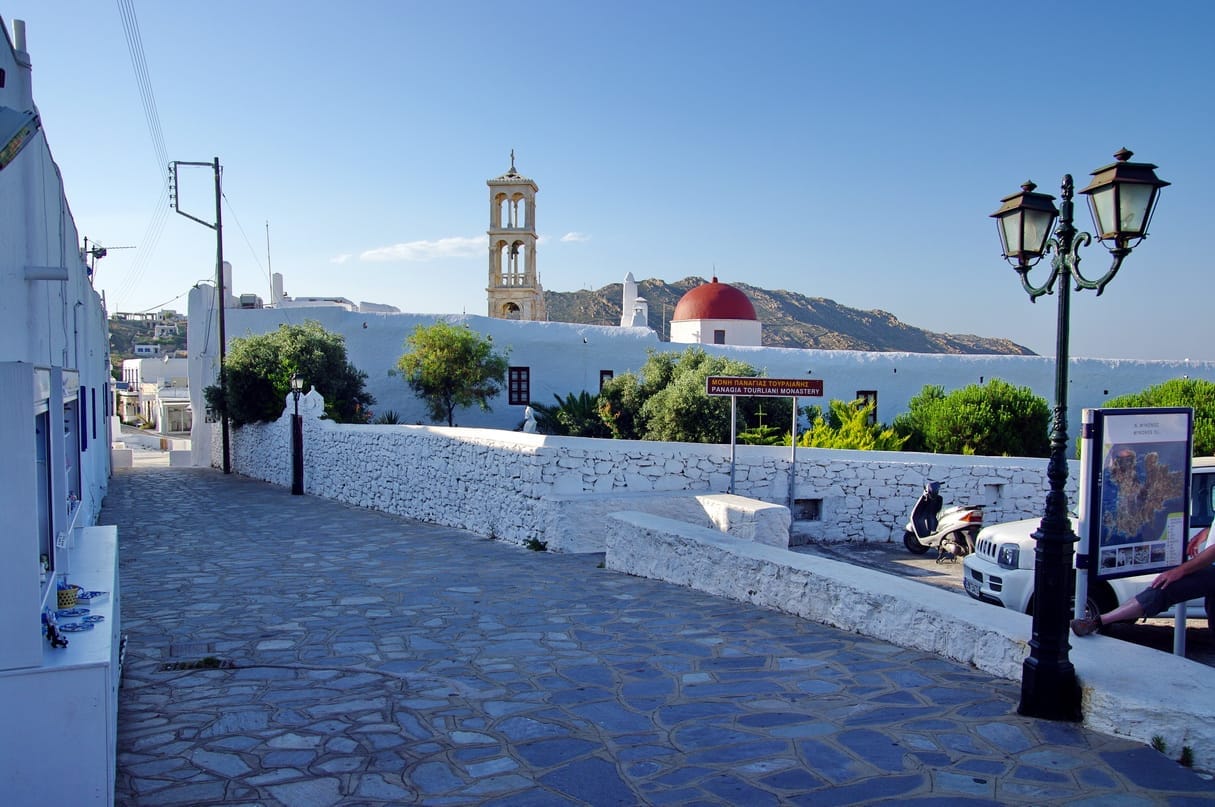
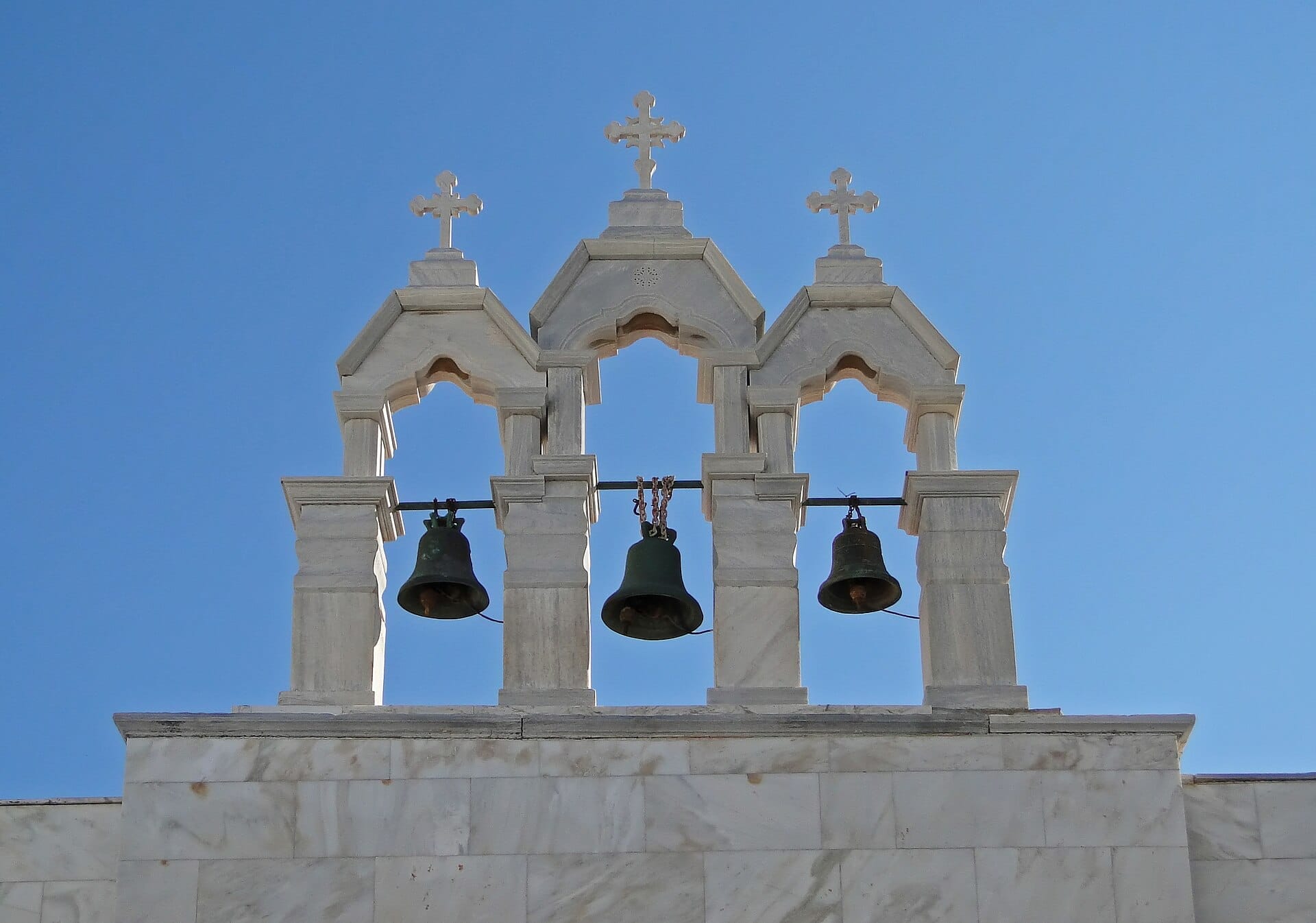
Ano Mera sits at the geographic center of Mykonos, about 8 kilometers east of the main town, and represents the island's most intact traditional village. Built around the 16th-century Monastery of Panagia Tourliani, it offers whitewashed architecture, a genuine central square, and straightforward access to the quieter eastern beaches without the noise and crowds of Chora.
Ano Mera is the only place on Mykonos where you can sit in a square that feels genuinely Greek rather than staged for tourists. It is the island's second-largest settlement, a working village organized around a centuries-old monastery, and the most logical base for reaching the wilder eastern coastline.
Orientation
Ano Mera occupies the approximate center of Mykonos island, positioned on a low inland plateau roughly 8 kilometers east of Mykonos Town and about 7 kilometers from the eastern coast. The main road that crosses the island from Chora toward the beaches of Elia, Kalafatis, and Kalo Livadi passes directly through the village, making Ano Mera an unavoidable crossroads rather than a detour.
The village is compact and walkable at its core. The central plateia (village square) is the functional heart, flanked by the Monastery of Panagia Tourliani to the north and a row of tavernas and kafeneions facing the square on three sides. A parking area sits adjacent to the monastery, and most visitors who arrive by bus, taxi, or car orient themselves immediately from this square. The surrounding streets are narrow, largely residential, and quiet within a five-minute walk in any direction from the plateia.
In terms of island geography, Ano Mera serves as the gateway to several of Mykonos's less-developed beaches. The road south and east from the village leads to Elia Beach and Kalafatis Beach, both reachable within ten to fifteen minutes by vehicle. This inland position, away from the coastal tourist strips, explains why Ano Mera has retained its character when so much of the island's coastline has been transformed.
Character and Atmosphere
Early morning in Ano Mera belongs almost entirely to locals. Kafeneion chairs scrape across stone as the first coffee orders go in, old men settle in for the morning, and the square is calm in a way that Mykonos Town never quite manages even at dawn. The light comes in low and golden from the east, throwing long shadows across the monastery's Baroque marble bell tower. There is no sound of beach club bass from here, no clatter of rolling suitcases on cobblestone.
By mid-morning, the atmosphere shifts slightly as day-trippers begin to arrive, mostly in rental cars and mopeds making their way toward the eastern beaches, many stopping briefly to photograph the monastery's exterior or have a coffee before continuing. The village handles this flow without becoming overwhelmed. The square absorbs visitors easily because it is genuinely large, designed for community gatherings rather than constructed as a tourist photo opportunity.
Afternoons in summer are hot and quiet. The semi-arid landscape around the village, scrubby hills with dry stone walls and sparse vegetation, shimmers in the heat. Most visitors are at the beach by this point, and the square returns to its slower rhythm. This is actually the most appealing time to be in Ano Mera if you want to understand it as a place where people live rather than as a heritage exhibit.
Evenings bring the best version of the village for visitors. Taverna tables spill out onto the square, candles appear, and the pace is unhurried in a way that feels earned rather than performed. The contrast with Mykonos Town at the same hour, where every restaurant competes for attention and prices reflect the pressure of real estate, is significant. Dinner in Ano Mera costs less and tends to arrive without theater.
ℹ️ Good to know
Ano Mera has a genuine year-round population, which means the village functions in winter in a way that coastal Mykonos does not. If you visit outside peak season, between October and April, Ano Mera is one of the few places on the island where you will find open cafés and daily local life.
What to See and Do
The Monastery of Panagia Tourliani is the reason Ano Mera exists in its current form, and it remains the village's most significant site. Founded in 1542 and substantially rebuilt in 1767, the monastery is built in a fortified Cycladic style with whitewashed walls enclosing a courtyard centered on the church of the Virgin Mary. The interior houses a carved marble iconostasis of considerable craftsmanship, along with embroidered vestments and religious artifacts collected over centuries. Entry is permitted to respectfully dressed visitors, and the monastery is still an active religious site, not a museum.
On a hill visible from the village lies the Monastery of Paleokastro, a second religious complex associated with the remains of a Byzantine-era fortification. The site also shows evidence of ancient occupation, including Geometric-period graves, making it a layered historical landmark for anyone interested in Mykonos beyond its modern reputation. The walk or short drive between the two monasteries gives a sense of the island's interior landscape, which is genuinely different from the coastal postcard version.
The village square itself is worth spending time in without any agenda. It functions as a genuine community space, and the contrast with the constructed charm of Mykonos Town's shopping alleys is instructive. Sitting here for an hour gives a more accurate picture of how the island actually lives than most of what is available to visitors along the waterfront in Chora.
Monastery of Panagia Tourliani: 16th-century monastery with ornate marble iconostasis; modest dress required (shoulders and knees covered)
Monastery of Paleokastro: hilltop complex with Byzantine fortification remains and ancient burial traces
Ano Mera central plateia: large village square for authentic local life, especially mornings and evenings
Eastern beach circuit: use Ano Mera as the crossroads for day trips to Elia, Kalafatis, Kalo Livadi, and Agia Anna beaches
Rural landscape walking: the dry stone walls, windmills, and scrubland around the village offer context for the island's agricultural history
💡 Local tip
The Monastery of Panagia Tourliani is most atmospheric on August 15th, the Feast of the Assumption of the Virgin Mary, when the village hosts one of Mykonos's most important religious celebrations. If your visit coincides with this date, the festival brings the square to life with music, food, and ceremony that represents genuine island tradition.
Eating and Drinking
The food scene in Ano Mera is straightforward Greek taverna cooking, and that is exactly its appeal. Several tavernas face directly onto the central square, serving grilled meats, fresh fish, Greek salads, and the kind of mezedes that work well with a carafe of house wine in the early evening. Prices are consistently lower than comparable food in Mykonos Town, and portions tend to be more generous. For a broader picture of what to eat across the island, the Mykonos food guide covers local specialties worth seeking out.
The kafeneions around the square serve Greek coffee, freddo espresso, and cold drinks throughout the day. These are places where locals actually sit, and a coffee here in the morning costs roughly what a coffee should cost rather than what a tourist markup allows. For visitors staying in Ano Mera or passing through in the late afternoon, the square is a useful place to regroup before deciding on the evening.
Ano Mera does not have the restaurant diversity of Mykonos Town. There are no sushi bars, no rooftop cocktail lounges, no celebrity chef outposts. What it has is honest cooking from a short menu of Greek classics, served by people who have been doing this for years. If you are spending most of your time at the beach and want one good dinner without drama or expense, this is an underrated option.
⚠️ What to skip
Most tavernas in Ano Mera operate seasonally and may close or keep limited hours outside the June to September peak. If you are visiting in shoulder season, it is worth confirming opening times locally rather than assuming the square will be fully operational.
Getting There and Around
Ano Mera is connected to Mykonos Town by public bus, with services departing from the Fabrika bus station in Chora and from the Old Port area. The journey takes approximately 15 to 20 minutes depending on the route and time of day. Bus frequency increases significantly during the summer season. For a full overview of how to move around the island, including bus routes and taxi logistics, the getting around Mykonos guide is the most practical reference.
Taxis from Mykonos Town to Ano Mera cover the 8 kilometers in around 15 minutes, though taxi availability during peak summer can require advance booking or patience at the taxi rank near Manto Mavrogenous Square in Chora. Uber availability on Mykonos is limited compared to mainland Greece, and conventional taxis remain the primary option.
Renting a scooter or small car is the most flexible option for using Ano Mera as a base for the eastern beaches. The roads between Ano Mera and the coast are narrow in places and require attention, particularly on the bends approaching Kalafatis and Kalo Livadi. Driving is straightforward in dry summer conditions but demands care on the single-track sections.
Mykonos International Airport (JMK) is located approximately 3 to 4 kilometers southeast of Mykonos Town, placing it roughly 5 to 6 kilometers from Ano Mera by road. There is no regular direct airport-to-Ano Mera bus service; the practical options are taxi, pre-booked transfer, or travel via Chora first.
Where to Stay
Accommodation in Ano Mera is limited compared to the main town or the beach zones, which is precisely why it attracts the type of traveler who wants to be on Mykonos without being in the middle of Mykonos's nightlife and crowd patterns. Small hotels and guesthouses operate in and around the village, oriented toward couples, families, and independent travelers who plan to spend their days at the eastern beaches rather than at the clubs. For a comprehensive look at accommodation options across the island, the where to stay in Mykonos guide covers all areas in detail.
Staying in Ano Mera makes most sense if your priorities are lower accommodation costs, genuine quiet at night, easy access to the eastern coast, and a daily rhythm that is not driven by beach club timetables. The trade-off is distance from Mykonos Town's attractions, the Old Port, and Little Venice. If you plan to spend significant time in Chora each day, the commute adds up and a more central base makes better practical sense.
For travelers focused on the south and east beaches such as Elia Beach or Kalafatis Beach, Ano Mera is the most logical inland base, cutting driving time to those spots significantly compared to departing from Chora each morning. Honeymooners or luxury travelers are generally better served by the seafront properties on the south coast, as covered in the Mykonos honeymoon guide.
Is Ano Mera Worth the Trip?
As a half-day excursion from Mykonos Town, Ano Mera is one of the more rewarding inland detours on any Greek island. The monastery alone is worth the 15-minute bus ride, and combining it with lunch on the square before continuing to a beach adds genuine dimension to a Mykonos itinerary that might otherwise consist entirely of coastline. For ideas on how to structure your time, the things to do in Mykonos guide and the 3-day Mykonos itinerary both include context for fitting Ano Mera into a broader visit.
The village will disappoint visitors looking for nightlife, luxury retail, or the kind of scenographic waterfront that Mykonos Town delivers. It is not that kind of place. But for anyone who has spent two or three days in Chora and wants to understand what the island looks like when it is not performing for tourists, the interior plateau around Ano Mera offers a genuinely different register.
TL;DR
Ano Mera is Mykonos's most intact traditional village, built around the 16th-century Monastery of Panagia Tourliani, about 8 km east of Mykonos Town.
Best suited to travelers who want lower prices, genuine quiet, and easy access to the eastern beaches, particularly Elia, Kalafatis, and Kalo Livadi.
The central square and monastery make a worthwhile half-day excursion from Chora, especially when combined with a beach stop on the eastern coast.
Not the right base for travelers prioritizing nightlife, proximity to Little Venice, or the main southern beach clubs.
Reachable by public bus from Fabrika station in Mykonos Town in around 15 to 20 minutes; most convenient with a rental vehicle for accessing surrounding beaches independently.
Three days is exactly enough time to cover Mykonos properly — the labyrinthine alleys of Chora, the UNESCO ruins of Delos, the south-coast beach scene, and a genuine taste of the island's nightlife. This day-by-day itinerary gives you the structure, the practical details, and the honest advice to make it work.
Mykonos has a beach for every type of traveler. This guide covers the 12 best beaches on the island, from the legendary party scene at Paradise to the car-free calm of Agios Sostis, so you can find exactly the day you're looking for.
Mykonos rewards travelers who time their visit carefully. This guide breaks down every season by weather, crowd levels, prices, and what's actually open, so you can decide when the island works best for your trip.
Delos is one of Greece's most extraordinary archaeological sites, and it sits just 30 minutes by boat from Mykonos. This guide covers ferry schedules, entry fees, the best ruins to prioritize, and whether a guided tour is worth the extra cost.
Mykonos is a small island with a surprisingly complex transport puzzle. From the KTEL bus network and south-coast caiques to the island's notoriously scarce taxis and rental vehicles, this guide breaks down every way to get around — with real prices, practical tips, and honest warnings about what doesn't work as well as you'd hope.
Mykonos has a reputation that precedes it: luxury prices, wall-to-wall tourists, and beach clubs that run until dawn. But the island is more layered than that. This guide cuts through the hype to tell you exactly who Mykonos is worth visiting for — and who should skip it.
Mykonos has some of the world's most famous beach clubs, from full-day party venues at Paradise Beach to bohemian sunset gatherings at Scorpios. This guide breaks down where to go, what to expect, what things actually cost, and how to book before peak season fills up.
Mykonos is far more than a party island. For couples, it offers sunset cocktails at Little Venice, private-pool suites above the Aegean, quiet beaches with turquoise water, and a day trip to the ancient ruins of Delos. This guide covers the best romantic experiences, when to go, where to stay, and how to avoid the crowds.
Mykonos is Greece's most polished luxury destination, combining world-class hotels, private beach clubs, superyacht culture, and some of the Aegean's best dining. This guide cuts through the hype with specific advice on when to go, where to stay, how to get around, and what actually justifies the price tag.
Mykonos has one of Europe's most legendary party scenes, from clifftop superclubs to sun-soaked beach raves and intimate cocktail bars in Chora's whitewashed alleys. This guide covers the best venues, realistic prices, seasonal timing, and the honest trade-offs so you can plan a night out that actually matches your expectations.
Mykonos has a reputation as one of Greece's most expensive islands, and that reputation is mostly earned. But visiting without hemorrhaging money is entirely possible if you understand how pricing works, when to go, and where to spend versus save. This guide breaks it all down honestly.
Everything you need to plan the trip from Mykonos to Santorini: which ferry operators run the route, how long the crossing takes, what fares to expect by season, whether flying makes sense, and how to fit in stops at Paros or Naxos along the way.
Both islands dominate Cyclades itineraries, but they deliver completely different experiences. This guide breaks down the real differences between Mykonos and Santorini across scenery, beaches, nightlife, budget, and logistics so you can choose the right one — or plan both smartly.
Mykonos delivers more than beach clubs and late nights. This guide covers the top things to do in Mykonos, Greece — from ancient ruins on Delos and windswept Cycladic lanes to family beaches and genuine local culture — with practical logistics for every type of traveler.
Mykonos has a distinct culinary identity that goes far beyond generic Greek salads and souvlaki. This guide covers the island's signature foods, honest price expectations, where to eat well on any budget, and the restaurants worth planning your day around.
Choosing where to stay in Mykonos shapes your entire trip. This guide breaks down every key area, from the lively lanes of Chora to the family-friendly shores of Ornos, with honest advice on prices, logistics, and who each neighborhood actually suits.