Mykonos vs Santorini: Which Greek Island Should You Actually Visit?
Both islands dominate Cyclades itineraries, but they deliver completely different experiences. This guide breaks down the real differences between Mykonos and Santorini across scenery, beaches, nightlife, budget, and logistics so you can choose the right one — or plan both smartly.
Tickets & tours
Live prices and dates from our booking partner. If you book, we may earn a commission at no extra cost to you.
TL;DR
- Mykonos is the better choice for beaches, nightlife, and a lively social scene. Santorini wins on dramatic scenery, sunsets, and romantic atmosphere.
- Both islands are expensive in peak season (June–August). Neither is a budget destination — see how to visit Mykonos on a budget if cost is a priority.
- Fast ferries connect the two islands in around 2 hours of sailing time, but door-to-door travel is closer to 3–4 hours. A day trip between them is not practical.
- Most itineraries work best with 3–4 days per island. You need at least 5–7 days combined to do both justice.
- If you can only pick one: choose Mykonos for energy and flexibility, Santorini for a once-in-a-lifetime visual experience. Read the Mykonos to Santorini ferry guide if you're planning to visit both.
The Core Difference: What Each Island Actually Offers
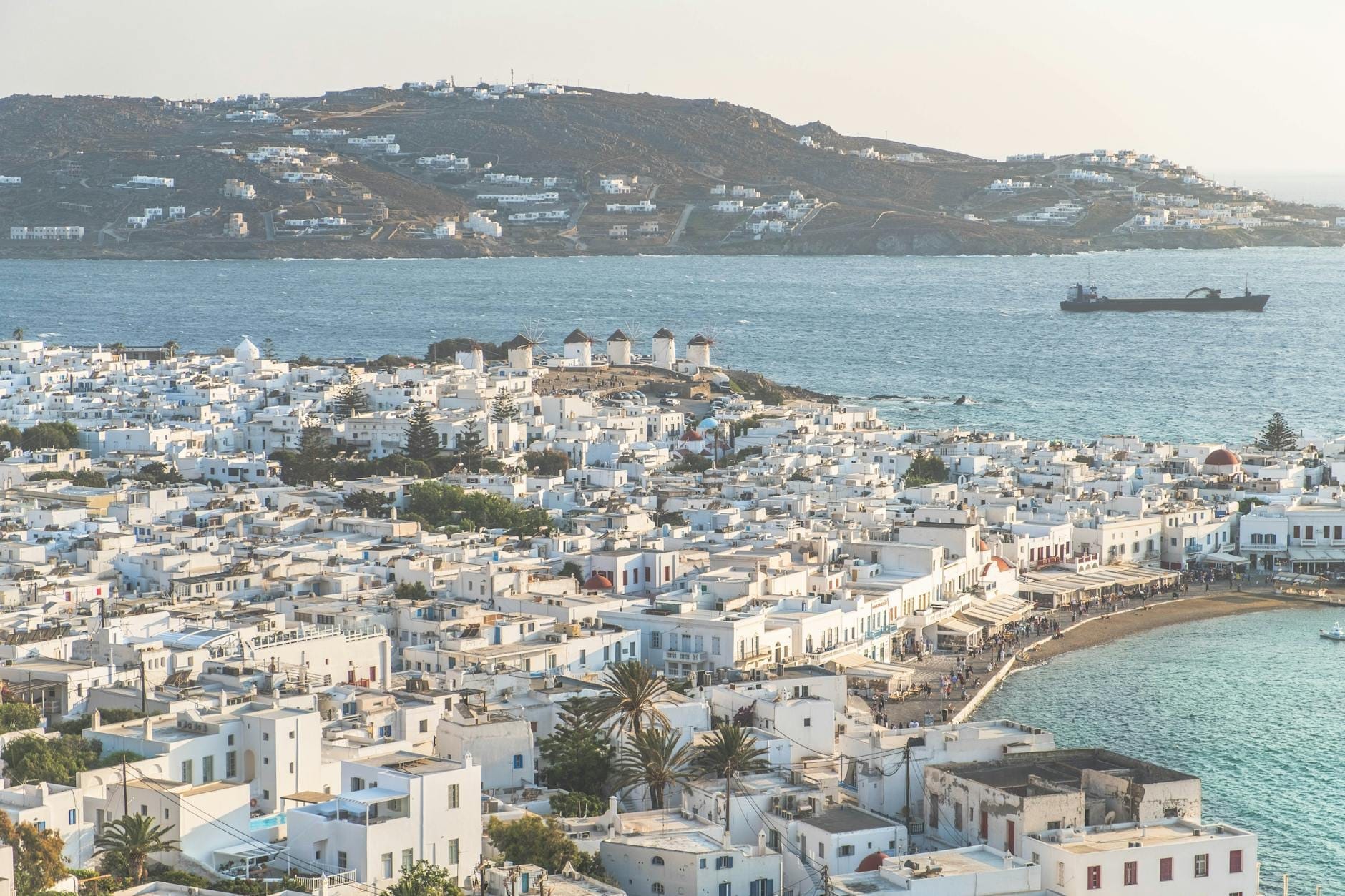
The debate around Mykonos vs Santorini often gets reduced to 'party island vs romantic island,' which is an oversimplification that leads people to book the wrong trip. Mykonos is compact, flat, and built around beach-hopping, nightlife, and a social scene that runs nearly 24 hours in July and August. Santorini is a volcanic caldera with clifftop villages, world-famous sunsets over the sea, and a landscape that genuinely has no equivalent in Greece. These are not interchangeable destinations.
Mykonos has around 25–30 named beaches within a small island of 85–86 km², most reachable in under 30 minutes from Mykonos Town. Santorini's beaches are fewer, often covered in black or red volcanic sand, and the island's steep caldera topography means that getting around takes longer and involves more effort. On Santorini, a transfer between Fira and Oia — two of the most visited villages — takes 20–30 minutes by road despite being only about 11 km apart, because the roads wind along the caldera rim.
ℹ️ Good to know
Both islands sit in the Cyclades group of the South Aegean, roughly 200 km from Athens. Mykonos is further north; Santorini lies near the southern edge of the Cyclades. Flying between them takes about 40–50 minutes of flight time. The high-speed ferry route typically takes about 2–3 hours of actual sailing time, depending on operator and stops.
Scenery and Atmosphere: A Genuine Contrast
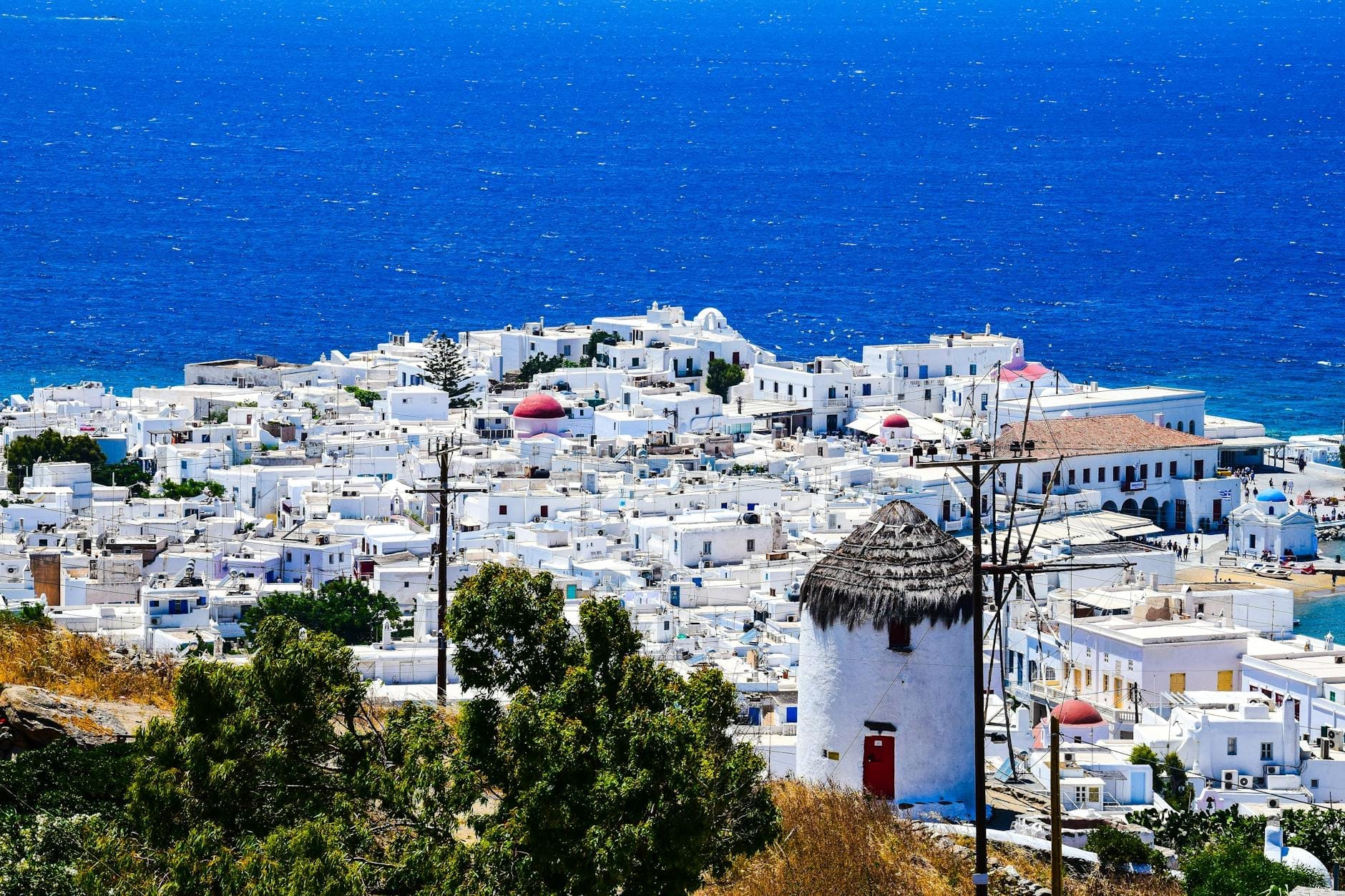
Mykonos Town — also called Chora — is built in the Cycladic style: narrow whitewashed lanes, blue-domed churches, flower-covered doorways, and the iconic Kato Milli windmills overlooking the sea. It's undeniably photogenic, but the scenery is horizontal. The island is mostly flat and semi-arid, with rolling golden hills behind the coastline. In August, it can feel more like a well-designed resort than a traditional Greek village.
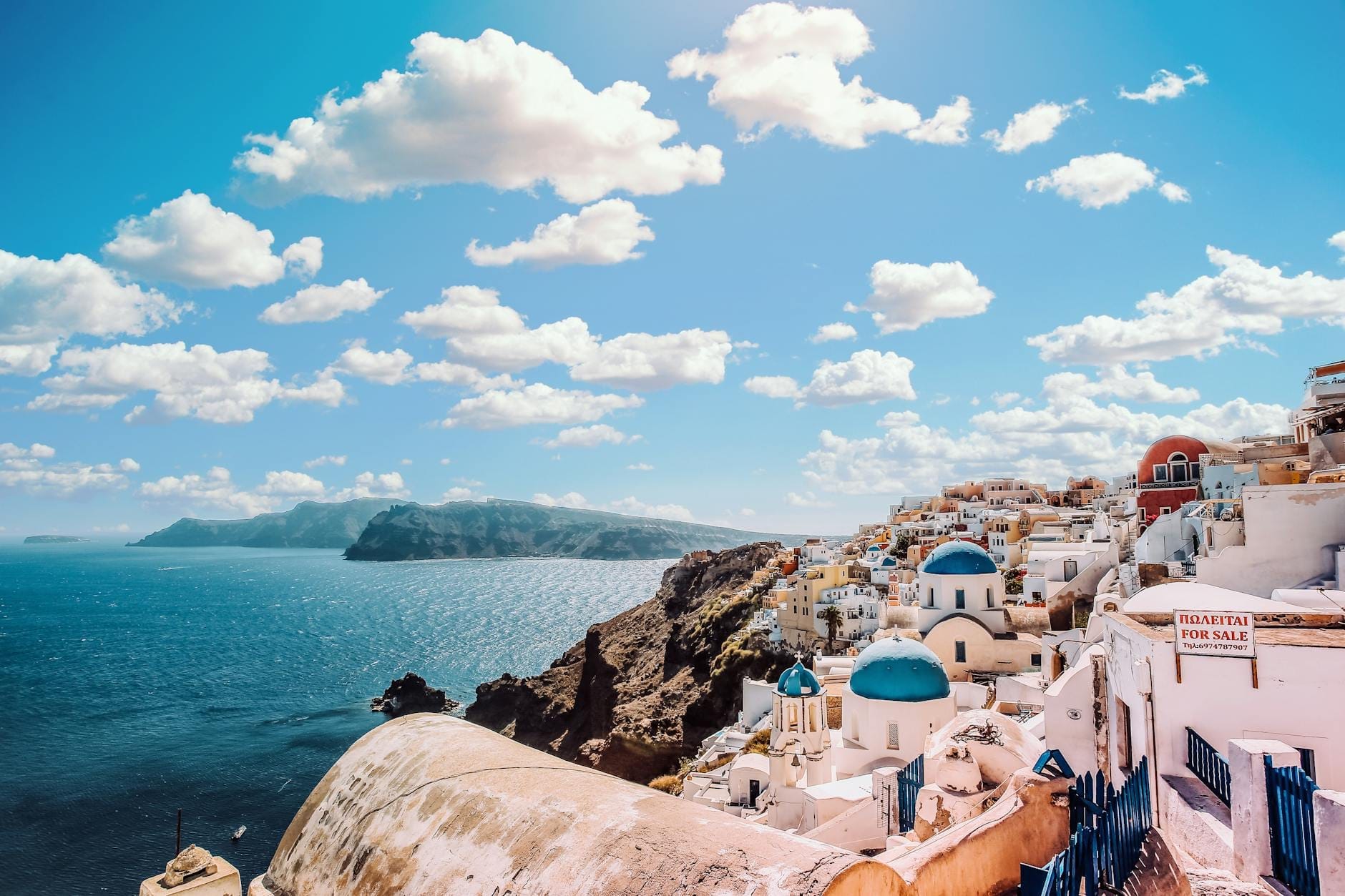
Santorini's landscape is in a different category. The caldera was formed by one of the largest volcanic eruptions in recorded history, and the result is a crescent of cliffs dropping roughly 260–300 meters into the sea. Villages like Oia and Imerovigli are perched directly on this rim. The sunset from Oia is the kind of image that becomes a cliché precisely because it is that striking. If dramatic, almost otherworldly scenery is the primary reason you're traveling to Greece, Santorini is the clearer choice.
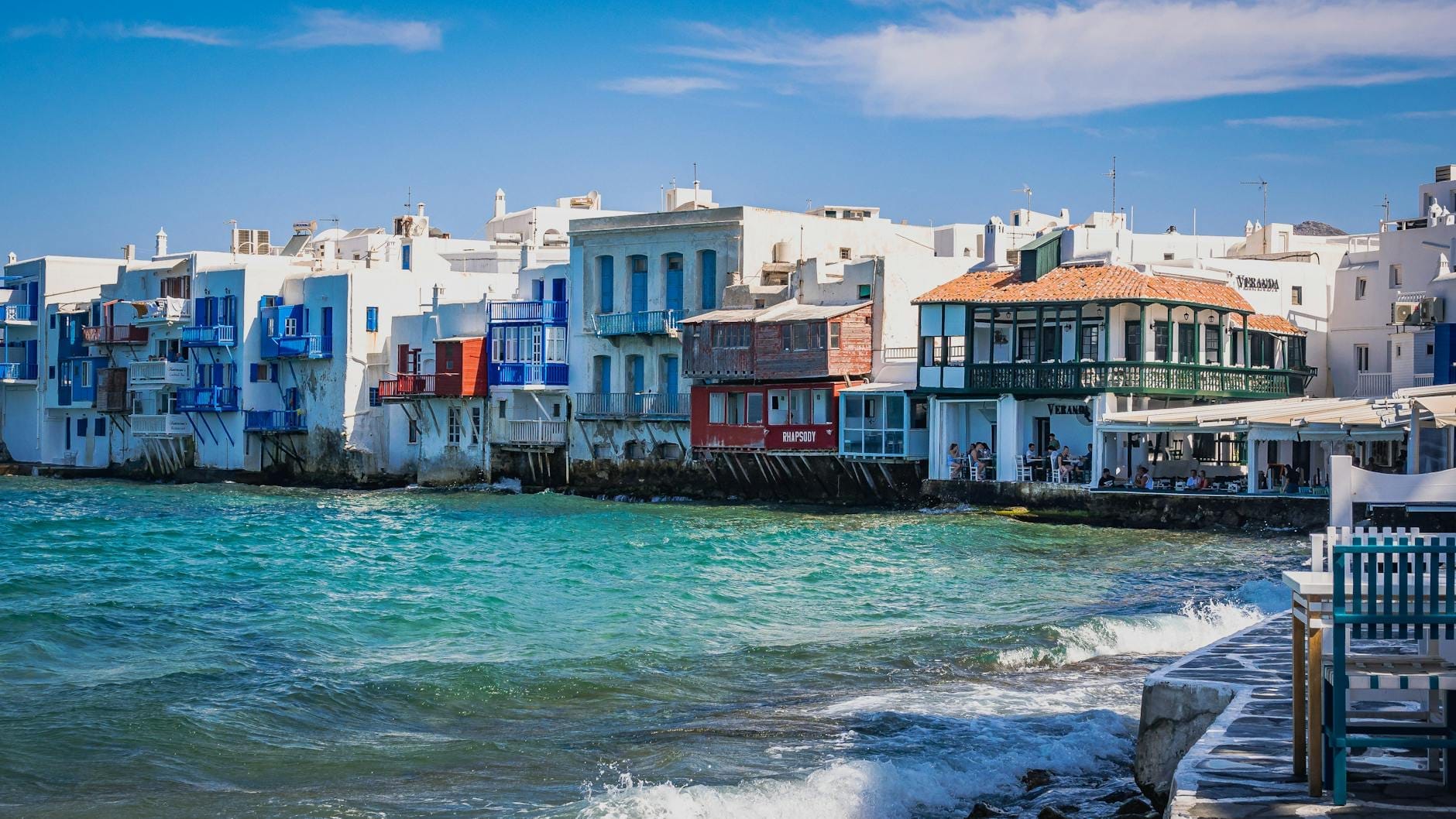
That said, Mykonos has its own atmospheric pockets. Little Venice — a row of 17th-century sea captains' houses built directly above the water — catches the light beautifully at sunset. The Panagia Paraportiani church, a cluster of five interconnected chapels near the waterfront, is one of the most photographed buildings in Greece. The difference is that these are moments within a broader landscape that is pleasant but not dramatic. Santorini is dramatic by default.
Beaches: Mykonos Has the Clear Advantage
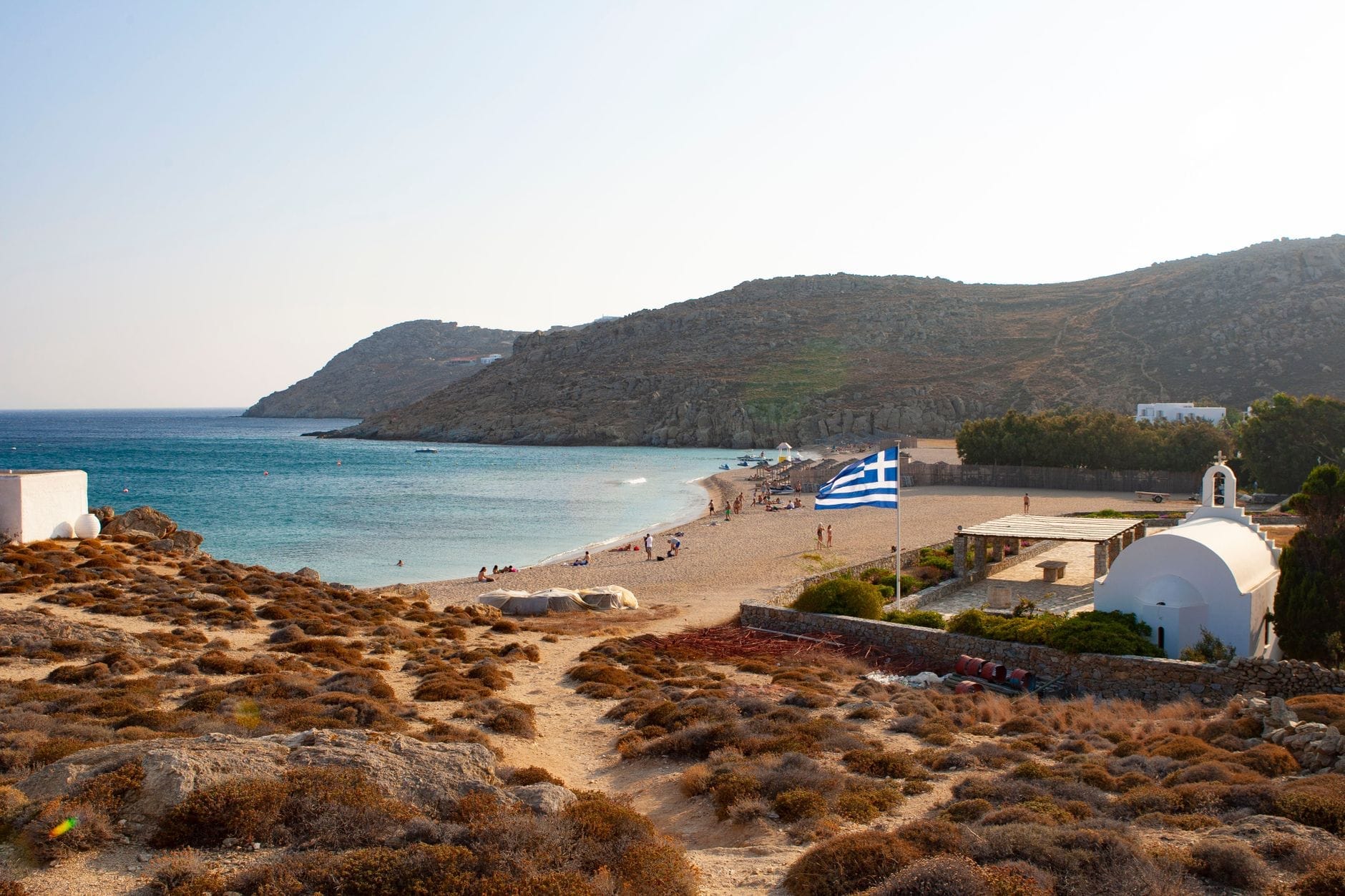
If beaches are a priority, Mykonos wins without much debate. The island offers a genuinely diverse range — from the organised beach club scene at Paradise Beach and Super Paradise Beach to the quieter sandy coves at Agios Sostis and Panormos in the north. The water is clear and turquoise, and most south-coast beaches are sheltered from the meltemi wind that can disrupt the Aegean in July and August.
- Paradise Beach South coast, fully organised with beach clubs and sunbeds. Peak-season crowds are intense from late morning onwards. Best for those who want the full Mykonos party-beach experience.
- Psarou Beach Exclusive and calm, with upscale beach clubs and a clientele that tends toward the quieter end. Often listed among the best beaches for a premium day out.
- Agios Sostis Beach North coast, no sunbeds, no beach bars, minimal facilities. The trade-off is genuine tranquility and natural scenery that's hard to find on the south coast in high season.
- Elia Beach One of the longest beaches on the island, about 8 km from Mykonos Town, with a mix of organised and open sections. Less crowded than the south-coast party beaches.
- Platis Gialos Beach Convenient, sheltered, and well-served by transport. A solid all-rounder and a good base for water taxis to further beaches along the coast.
Santorini's beaches are interesting but limited. The black sand beaches at Perissa and Perivolos absorb heat aggressively — the sand can become uncomfortably hot by midday in summer. The Red Beach near Akrotiri is visually striking but small and often overcrowded. For serious beach days, most visitors are better served by Mykonos.
💡 Local tip
On Mykonos, the south-coast beaches (Paradise, Super Paradise, Psarou) get crowded by 11am in July and August. Arrive before 10am for sunbed availability, or visit the northern beaches like Agios Sostis and Panormos where demand is much lower throughout the day.
Nightlife and Social Scene: No Contest
Mykonos has one of the most developed nightlife scenes in the Mediterranean. The concentration of bars along Matogianni Street and the waterfront in Mykonos Town, combined with beach clubs like Cavo Paradiso at Paradise Beach, means that the social calendar runs from late afternoon well into the following morning throughout peak season. If nightlife is a significant factor in your travel plans, Mykonos is the correct choice.
Santorini has bars and restaurants with exceptional views, particularly in Oia and Fira, and there's a genuine evening scene centred around sunset cocktails and wine. But it operates on a fundamentally different rhythm — winding down rather than ramping up as the night progresses. Comparing Santorini's nightlife to Mykonos is like comparing a good dinner party to a festival.
Worth noting: Mykonos's nightlife reputation can work against it for some travelers. In peak season, the town can feel overwhelmingly crowded and noisy after 11pm. If you want evenings out but also need sleep before 3am, consider staying outside Mykonos Town itself — areas like Psarou and Platis Gialos offer accommodation with easier access to nightlife without being in the centre of it. The full Mykonos nightlife guide covers timing, venues, and what to skip.
Cost Comparison: Both Are Expensive — Here's the Nuance
A common misconception is that Santorini is always more expensive than Mykonos. In practice, both islands rank among the most costly destinations in Greece, and the price gap is narrower than most people expect. In July and August, a standard double room in a mid-range hotel on either island can easily exceed €200 per night in peak season. A meal for two at a decent restaurant in Mykonos Town or Fira will typically run €60–100 without wine.
Where Santorini genuinely commands a premium is in caldera-view accommodation. Hotels with direct caldera views in Oia or Imerovigli operate in a different pricing bracket entirely — €400–700 per night or more in peak season is not unusual for a suite with a private plunge pool. Mykonos has luxury properties too, but the scenery premium is less extreme because the island doesn't have an equivalent natural feature to look out over.
- Ferry from Mykonos to Santorini (high-speed): approximately €50–90 one way in high season, depending on operator and seat class. Book early — prices rise and availability drops as summer approaches.
- Budget accommodation (hostel dorms, cheaper rooms outside town): more available on Mykonos than Santorini, where the budget tier is thin.
- Beach clubs on Mykonos charge sunbed fees of around €20–40 per person at standard spots; premium clubs can run higher and may require minimum spend.
- Food costs are similar on both islands. Eating at tavernas away from the main tourist strips cuts costs significantly on Mykonos.
- Shoulder season (May or late September) cuts accommodation prices by 30–50% on both islands and reduces crowds substantially.
⚠️ What to skip
Don't assume you can negotiate sunbed prices at major Mykonos beach clubs in peak season — availability is sometimes sold out by late morning and prices are fixed. At quieter north-coast beaches, there are no sunbeds at all, which means no fees but also no shade.
Getting Between the Islands: Ferry Logistics
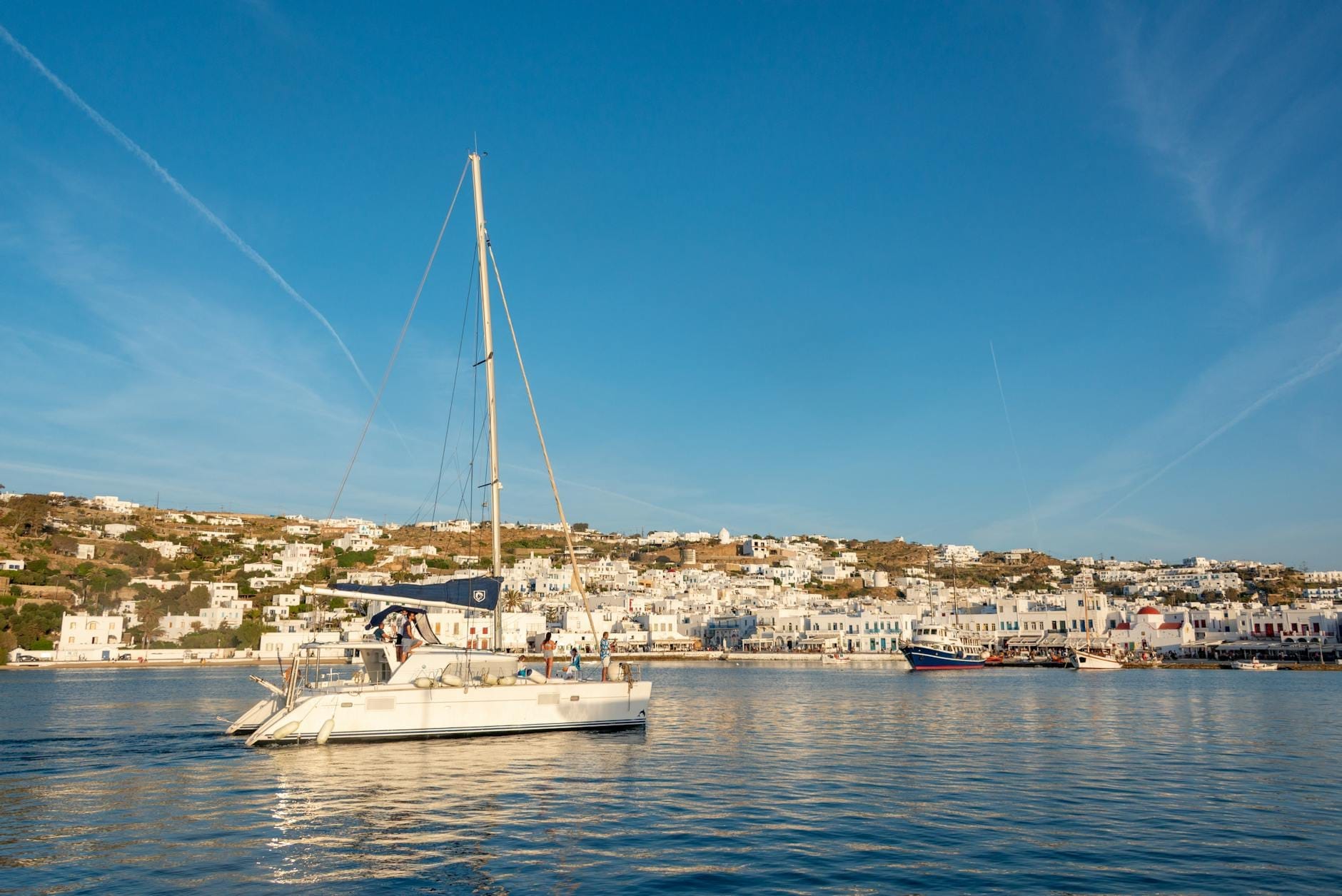
The Mykonos to Santorini ferry route is one of the most travelled in the Cyclades. High-speed catamarans operated by companies like Seajets and Golden Star Ferries cover the route in approximately 2–3 hours of sailing. Factor in transfer time to the port (Mykonos New Port is about 2.5–3 km north of Mykonos Town), boarding time, and the transfer from Santorini's port at Athinios to your accommodation, and you're typically looking at 3–4 hours total travel time door-to-door.
This is why a day trip between the islands isn't practical. By the time you arrive, you have a few hours before you need to head back — and ferry schedules don't always align conveniently. If you want to experience both islands properly, plan for a minimum of 3 nights each. Most 7–10 day Greece itineraries that include both islands work well with 3–4 nights on Mykonos and 3–4 nights on Santorini, connecting by ferry or by a short 30-minute flight.
Booking ferries in advance is strongly recommended for travel between June and August. Popular sailings — especially morning departures — can sell out weeks ahead. FerryHopper and Direct Ferries are reliable aggregators for comparing times and prices across operators. Blue Star Ferries also runs a slower conventional ferry on this route, which typically takes around 4.5–6 hours but is significantly cheaper and can be a pleasant way to travel if you're not rushed.
Which Island Should You Choose?
The honest answer is that these islands suit different travel styles, and the choice becomes straightforward once you're clear about what you want from the trip.
- Choose Mykonos if: You prioritize beaches, want an active social scene, plan to cover a lot of ground in a short time (the flat terrain and compact size help), or are traveling with a group that wants flexibility across different types of days.
- Choose Santorini if: You want dramatic, photogenic scenery as the centerpiece of your trip, are traveling as a couple looking for a romantic atmosphere, or you've already done beach-focused islands and want something architecturally and visually distinctive.
- Choose both if: You have at least 7 days available and want contrasting experiences. Many travelers find that the two islands complement each other well — Mykonos for energy and beaches, Santorini for scenery and slowing down. The ferry connection makes combining them logistically straightforward.
- Consider alternatives if: Budget is a major constraint. Both islands are expensive relative to other Greek destinations. Paros, Naxos, and Crete offer similar Cycladic character at a lower price point.
If Mykonos is the confirmed destination, the next step is planning what to actually do there. The complete guide to things to do in Mykonos covers the full range beyond beaches and nightlife — including the archaeological day trip to the sacred island of Delos, which is one of the most underrated experiences in the entire Aegean and sits just 20 minutes by boat from Mykonos Town.
✨ Pro tip
If you're combining both islands and flying into Greece, consider flying into one and out of the other rather than backtracking. Athens to Mykonos (JMK) or Athens to Santorini (JTR) are both well-served routes. Flying in via Mykonos, taking the ferry south to Santorini, then flying home from Santorini (or vice versa) avoids doubling back and gives your itinerary a cleaner flow.
FAQ
Is Mykonos or Santorini better for couples?
Santorini has a stronger reputation for romance, largely due to the caldera views, clifftop sunsets, and intimate village atmosphere in Oia and Imerovigli. Mykonos can be equally enjoyable for couples who want beaches and a more social atmosphere, but it skews younger and more group-oriented during peak season. For a honeymoon or anniversary trip, most couples find Santorini the more atmospheric choice.
How long does the ferry from Mykonos to Santorini take?
High-speed ferries (catamarans operated by Seajets and similar companies) take approximately 2 hours of sailing time. With port transfers at both ends, allow 3–4 hours total. Conventional ferries run slower at around 4.5–6 hours but are cheaper. Book in advance for summer travel, as popular morning sailings fill up weeks ahead.
Which island is more expensive, Mykonos or Santorini?
Both are among the most expensive destinations in Greece. The difference is smaller than most people expect. Santorini commands a significant premium for caldera-view accommodation, particularly in Oia. Mykonos can match or exceed Santorini prices at top-end beach clubs and luxury hotels in July and August. Budget and mid-range options exist on both islands but require early booking.
Can you do a day trip from Mykonos to Santorini?
Technically possible but not worth it. Door-to-door travel takes 3–4 hours each way, which leaves you minimal time at the destination and a long, tiring day of logistics. If you want to experience Santorini properly, plan for at least 2–3 nights. A short 30-minute flight between the islands is the fastest option if you're pressed for time.
When is the best time to visit Mykonos or Santorini?
May and September offer the best balance of good weather, lower prices, and manageable crowds on both islands. July and August are peak season: hot, crowded, and expensive, but with the most ferry options and the fullest range of beach clubs and services open. Both islands are highly seasonal — many hotels and some ferry routes reduce or suspend service from November through March.
Tickets & tours
Live prices and dates from our booking partner. If you book, we may earn a commission at no extra cost to you.
Planning a trip? Discover personalized activities with the Nomado app.