Panagia Paraportiani: Mykonos's Most Iconic Church
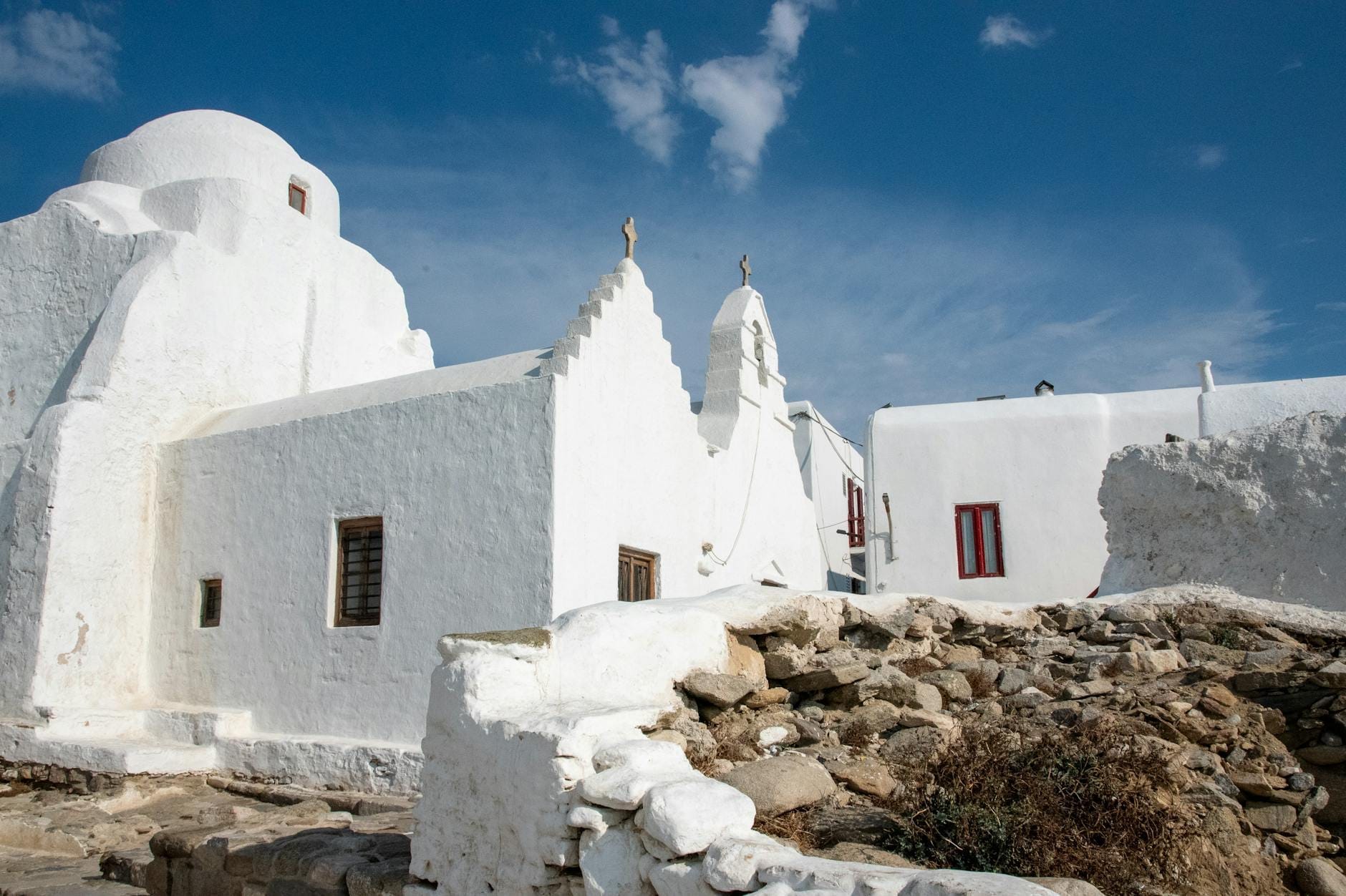
A complex of five chapels fused into one asymmetric white mass over two centuries of construction, Panagia Paraportiani sits at the edge of the Kastro neighborhood between the Old Port and Little Venice. The interior is closed to visitors, but the whitewashed exterior is one of the most photographed architectural subjects in the entire Aegean.
Quick Facts
- Location
- Kastro neighborhood, Mykonos Town (Chora), between the Old Port and Little Venice
- Getting There
- Walk along the waterfront from the Old Port toward Little Venice; 5-10 minutes on foot from most of Chora
- Time Needed
- 15-30 minutes to photograph and take in the exterior; longer if you linger at dawn or sunset
- Cost
- Free — no ticket required for exterior viewing
- Best for
- Architecture enthusiasts, photographers, history buffs, and anyone doing a morning walk through Chora
What You're Actually Looking At
Panagia Paraportiani is not a single church. It is a cluster of five distinct chapels that were built, expanded, and merged together over several centuries, beginning in 1425 and reaching its current form in the 17th century. The result is one of the most photographed ecclesiastical structures in Greece: an organic, asymmetric composition of domes, arched doorways, and whitewashed walls that appear to have grown rather than been designed. There are no sharp angles, no uniform surfaces, and no two photographs of it that look quite the same depending on the light.
The name comes from its original location beside the paraporti, the side gate of the medieval Kastro (castle) of Mykonos, which has long since been demolished. Four of the five chapels form the base of the structure at ground level; the fifth sits on top, elevated above the others. The whitewash is applied thickly over the centuries of accumulated stonework, softening every edge and giving the whole structure that almost liquid quality that makes it so visually compelling.
ℹ️ Good to know
The interior of Panagia Paraportiani is rarely open to visitors, most often remaining closed except for occasional services or feast days. You are visiting for the exterior. Plan accordingly, and do not assume you will be able to enter.
How the Experience Changes by Time of Day
Early morning, roughly 6:30 to 8:30 in summer, is when the church belongs almost entirely to you. The cobblestones around the Kastro are still damp from overnight air, the light comes in from the east at a low angle across the water, and the whitewash glows with a warmth it loses by midday. Swallows nest in the crevices of the old walls nearby and are audible before they are visible. The sound of the Aegean is close here; the church sits just meters from the water's edge.
By 9:30 or 10:00, particularly in July and August, the first groups arrive, often led by local guides. By midday, the area around the church can be genuinely congested. The whitewash in direct summer sun is extremely bright, almost harsh on clear days, and the surrounding narrow lanes fill with people trying to frame a photograph without other tourists in it. This is, realistically, a losing battle between June and September unless you are there at dawn.
The hour before sunset is the second-best window. The light turns golden and hits the rounded surfaces of the upper chapel from the west, deepening the shadows in the carved doorframes and softening the harsh white of midday. This is when the church looks most like the photographs that made it famous. That said, it is also when the area is at peak foot traffic, so you are trading ideal light for a crowd.
💡 Local tip
For photography: arrive within 30 minutes of sunrise. The soft directional light, empty lanes, and the faint pink tones on the plaster are worth the early alarm. Bring a wide-angle lens if you have one; the church is close to surrounding buildings and there is limited room to step back.
Tickets & tours
Live prices and dates from our booking partner. If you book, we may earn a commission at no extra cost to you.
Mykonos South Coast Cruise on a Traditional Caique
From 93 €Instant confirmationFree cancellationMykonos yacht cruise to Rhenia Island and guided tour of Delos
From 120 €Instant confirmationFree cancellationSunset sailing to Rhenia with Delos self-guided virtual tour
From 110 €Instant confirmationFree cancellationHalf-Day Mykonos, Delos and Rhenia Catamaran Cruise with Lunch
From 150 €Instant confirmationFree cancellation
The Architecture and Its Context
The church sits within the Kastro district, the oldest surviving part of Mykonos Town. The Kastro was the original fortified settlement built on the rocky promontory above the harbor, and many of the narrow alleys and low doorways in this quarter date from the medieval period. Walking to Panagia Paraportiani from the main waterfront means passing through lanes where the buildings press in from both sides and the sky appears only as a narrow strip above.
Architecturally, the church complex represents a vernacular Cycladic building tradition rather than any formally trained ecclesiastical design. There are no grand colonnades or ornate facades. The chapels were added incrementally by local craftsmen working in the same whitewashed cubic style that defines the entire town. This is precisely what makes it unusual: the five-chapel aggregate looks like something that happened to a building over time, and that quality gives it an authenticity that purpose-built monuments often lack.
Panagia Paraportiani is located between the Mykonos Old Port to the north and Little Venice to the south. These two landmarks together with the church form the most-photographed stretch of Mykonos Town's waterfront. Many visitors cover all three in a single morning or evening walk along the coast.
Getting There and Finding It
The church is easy to reach on foot from anywhere in Mykonos Town. From the Old Port, follow the waterfront southwest; the Kastro neighborhood rises above you on the right, and Panagia Paraportiani is at its base, visible from the water. From the main square or Matoyianni Street, walk toward the sea and bear right along the coastal path. There are no buses needed and no taxis worth taking for this particular visit.
If you are arriving from the New Port at Tourlos by ferry, take a taxi or local bus into Mykonos Town, and then walk to the Kastro on foot. From the island's southern beaches, the same applies: get into Chora first, then walk. The church is not signposted prominently, but any local asked for Paraportiani will point you in the right direction immediately.
⚠️ What to skip
Accessibility is limited. The surrounding lanes are cobbled, uneven, and include steps. There is no flat, step-free approach to the church. Wheelchair users and those with significant mobility restrictions will find this area genuinely difficult to navigate.
What to Expect When You Arrive
The first thing most visitors notice is how small and low the church sits relative to the hill above it. The scale is intimate rather than monumental. You can walk around the entire complex in three or four minutes. The plastered walls have a slight texture from repeated whitewashing over centuries, and the doorways are framed with simple carved stone surrounds painted white along with everything else. In high summer, there are usually bougainvillea plants nearby adding a note of color against the white, though this changes seasonally.
The smell of the area in early morning is sea air and faintly damp stone. Later in the day, when the lanes fill with people, that freshness is replaced by sunscreen and the occasional waft of coffee from a nearby cafe. The church itself has no vendors, no entry kiosks, and no staff managing the exterior space. You simply arrive, look, photograph, and leave whenever you are ready.
It is worth spending a few minutes walking around the full perimeter rather than just photographing from the standard frontal angle. The rear and side views of the complex, where the different chapel volumes stack and overlap, reveal the structural complexity that makes the building architecturally significant. Most visitors photograph the west facade and leave; the north and east sides are quieter and equally interesting.
Honest Assessment: Is It Worth Your Time?
Panagia Paraportiani is one of those places that can feel either transcendent or underwhelming depending entirely on when you visit and what you expect. If you arrive at 11:00 in August expecting a peaceful moment with an ancient church, you will find a crowd of people all trying to take the same photograph. The church is small, the interior is closed, and the surrounding lanes will be filled with tour groups. That is the honest reality of peak season.
If you arrive at sunrise, or in the shoulder season of late May or early October, the experience is genuinely different. The building has real presence in good light, and the Kastro neighborhood around it gives authentic context that is hard to find in other parts of Mykonos Town. It is not a church you can enter and explore, but as an architectural subject and a piece of living history at the edge of an ancient harbor, it earns its reputation.
Travelers who are primarily interested in beaches, nightlife, or island-hopping logistics may find it a brief ten-minute detour rather than a destination. For those building a broader picture of what the island offers culturally, it pairs well with a visit to the Aegean Maritime Museum and a walk along Matoyianni Street, both within easy walking distance. For a deeper dive into Cycladic history, the Mykonos Archaeological Museum is a short walk from the Old Port.
If your Mykonos visit also includes a day trip, note that the sacred island of Delos, a UNESCO World Heritage Site with one of the most significant archaeological sites in the ancient Greek world, departs from the Old Port nearby. The day trip to Delos from Mykonos is a natural complement for anyone drawn to the historical and religious heritage of the Aegean.
Insider Tips
- Come within 30 minutes of sunrise. The church is deserted, the light is directional and warm, and you will get photographs that look nothing like the blown-out midday shots that dominate social media. It takes discipline to set the alarm, but no other tip will improve your experience as much.
- Walk around the entire perimeter. The front facade is what everyone photographs, but the back of the complex shows how the five individual chapels stack and lean against each other. It is architecturally more interesting and almost always empty of other visitors.
- Check whether the church is open before assuming it is closed. The interior is almost always shut due to structural concerns, but it does occasionally open for specific feast days. If you are in Mykonos in mid-August, ask locally whether any religious events are scheduled around the Dormition of the Virgin (August 15), a major feast day in the Greek Orthodox calendar.
- Combine the visit with the Kastro neighborhood itself. The lanes immediately surrounding the church, including the surviving remnants of the medieval settlement, are worth fifteen minutes of wandering. Most visitors rush through on their way to or from Little Venice and miss them entirely.
- In shoulder season (May, early June, September, October), the midday crowd problem largely disappears. If your Mykonos trip falls outside July and August, you can visit at any time and have a much more relaxed experience.
Who Is Panagia Paraportiani Church For?
- Architecture and design enthusiasts who appreciate vernacular building traditions and want to understand how the Cycladic style evolved organically over centuries
- Photographers, especially those willing to time a sunrise visit for unobstructed shots of one of the most visually distinctive religious structures in Greece
- History and culture travelers looking for tangible connections to Mykonos's medieval past within the broader context of Chora's old town
- Travelers on a walking tour of Mykonos Town combining the Old Port, Kastro, Panagia Paraportiani, and Little Venice in a single coastal loop
- Visitors who want to see what makes Mykonos architecturally significant beyond its beaches, in a short, low-effort detour that costs nothing
Nearby Attractions
Other things to see while in Mykonos Town (Chora):
- Aegean Maritime Museum
Tucked inside a 19th-century Cycladic building in the Tria Pigadia quarter of Mykonos Town, the Aegean Maritime Museum offers a focused, well-curated look at centuries of Aegean maritime history. It is small enough to do in under an hour, and genuinely informative for anyone curious about the sea culture that shaped these islands.
- Agios Stefanos Beach
Agios Stefanos Beach sits just 3.5 km north of Mykonos Town, relatively sheltered from the island's notorious winds and backed by a whitewashed chapel with a red roof. It draws families, couples on a quieter budget, and anyone who finds the party beaches on the south coast too much. Sandy underfoot, shallow at the waterline, and served by a regular bus from Chora.
- Armenistis Lighthouse
Perched on the rocky northwest tip of Mykonos at roughly 180–184 metres above sea level, Armenistis Lighthouse is a 19th-century navigation beacon with one of the island's most panoramic viewpoints. Built in 1891 after a fatal shipwreck, it rewards visitors willing to venture beyond the town with open Aegean horizons and a quieter side of the island.
- Manto Mavrogenous Square
Manto Mavrogenous Square sits at the center of Mykonos Town, honoring the island's most celebrated heroine of the Greek War of Independence. Effectively always accessible as a public space, it serves as both a landmark orientation point and a quiet pause within the frenetic energy of Chora.
Planning a trip? Discover personalized activities with the Nomado app.