Mykonos Archaeological Museum: Ancient Aegean History in the Heart of Chora
The Archaeological Museum of Mykonos preserves centuries of Cycladic and Delian history in a neoclassical building near the Old Port. From a dramatic 7th-century BC pithos relief to grave goods from the sacred island of Delos, it offers genuine archaeological depth at a price that won't strain any budget.
Quick Facts
- Location
- Chora of Mykonos (near the Old Port), Mykonos Town, 84600
- Getting There
- Walk from Mykonos Town center (approx. 5–10 min on foot from Manto Mavrogenous Square). Taxis available from the Old Port.
- Time Needed
- 45–90 minutes
- Cost
- €5 full price / €3 reduced. Closed Tuesdays year-round.
- Best for
- History enthusiasts, Delos day-trippers, travelers seeking a cool midday refuge
- Official website
- odysseus.culture.gr/h/1/eh155.jsp?obj_id=3301
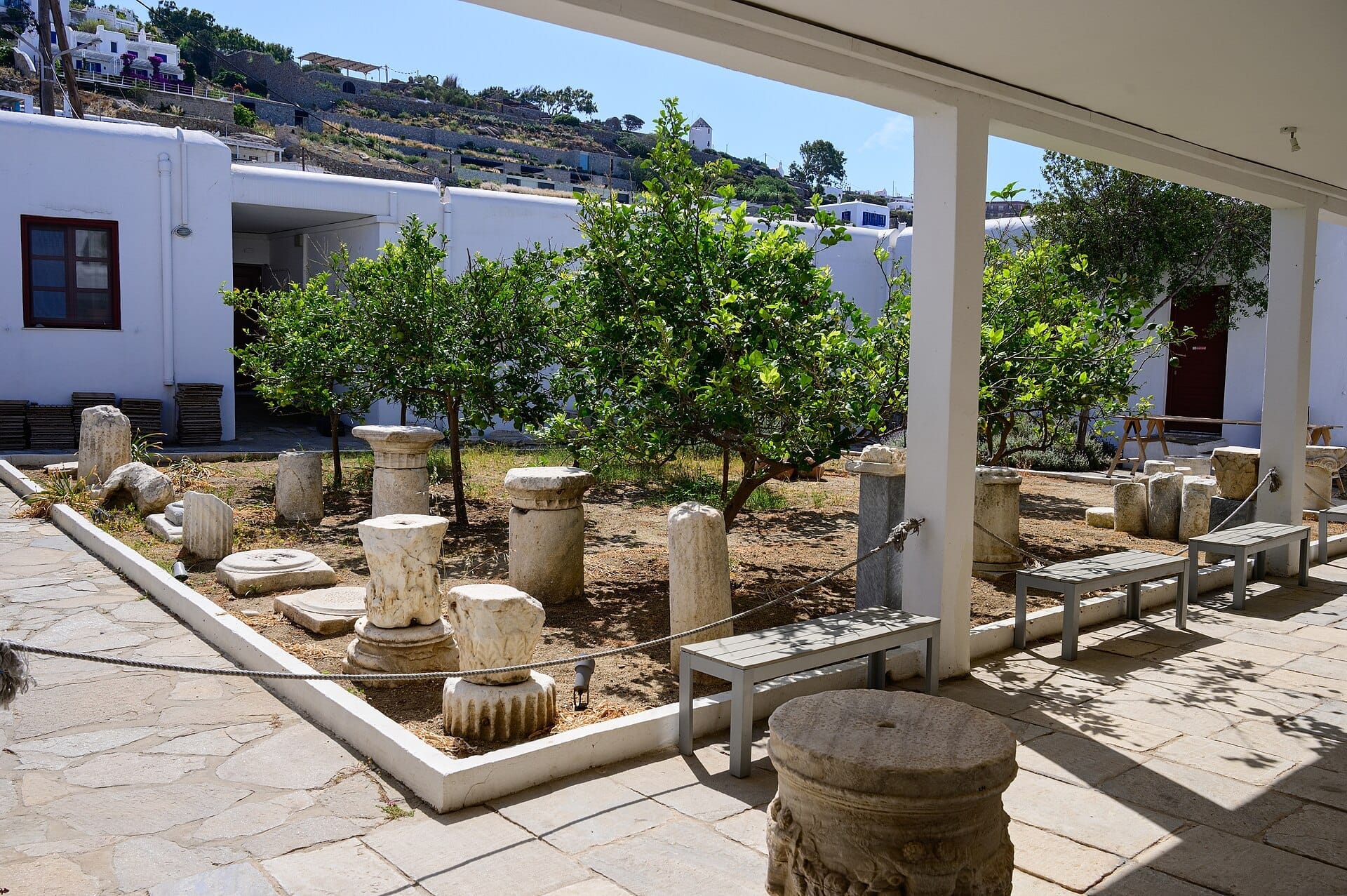
What the Mykonos Archaeological Museum Actually Is
The Archaeological Museum of Mykonos, officially the Αρχαιολογικό Μουσείο Μυκόνου, sits in a compact neoclassical building near the northern entrance of Mykonos Town, just a short walk from the Old Port waterfront. Established in 1902 and housed in a 1905 neoclassical building that was modified in 1934, the building itself is a quiet statement of order amid the chaotic whitewash and Instagram-ready alleyways of Chora. From the outside, it reads as sober and institutional. Inside, it earns that restraint.
The collection focuses primarily on finds from the island of Delos, the tiny island about 3.5 km southwest of Mykonos that served as one of the most important religious and commercial centers of the ancient Aegean world. Mykonos functioned historically as the gateway community to Delos, and the museum reflects that geographic relationship directly. Many of the objects on display were excavated from Delian sanctuaries and cemeteries and transferred here for safekeeping.
💡 Local tip
The museum is closed on Tuesdays year-round. If you're planning a Delos day trip, consider visiting the museum the day before or after — it adds essential context to what you'll see on the sacred island.
The Collection: What You Will Actually See
The centerpiece of the museum is a large 7th-century BC pithos — a massive storage jar — decorated with one of the earliest known narrative relief depictions of the Trojan Horse. The scene is rendered in a register-style frieze: warriors emerge from the hollow horse, figures appear in various postures of combat and flight. For anyone with even a passing interest in ancient Greek visual culture, standing in front of this object is worth the entrance fee alone. It is not a reproduction. It is not behind thick glass with filtered lighting. It is simply there, in a room, at roughly the height it would have stood originally.
Beyond the pithos, the galleries contain grave stelae, pottery, jewelry, terracotta figurines, and sculpture fragments, most dating from the Archaic through Hellenistic periods. The funerary objects are particularly well-represented, reflecting the ancient Athenian decree that banned burials on the sacred ground of Delos itself — all burial activity was relocated to the nearby island of Rineia, and some of those finds eventually made their way into this collection. There is also a display of jewelry and small objects that rewards slow, close attention: the craftsmanship of small gold ornaments from the 3rd and 2nd centuries BC is remarkable even at modest display scale.
The labels are in Greek and English, though some older display cases use text that is minimal by modern museum standards. This is not a hands-on, multimedia experience. It is a traditional collection in a traditional setting, which is either a charm or a limitation depending on your expectations.
Tickets & tours
Live prices and dates from our booking partner. If you book, we may earn a commission at no extra cost to you.
Mykonos South Coast Cruise on a Traditional Caique
From 93 €Instant confirmationFree cancellationMykonos yacht cruise to Rhenia Island and guided tour of Delos
From 120 €Instant confirmationFree cancellationHalf-Day Mykonos, Delos and Rhenia Catamaran Cruise with Lunch
From 150 €Instant confirmationFree cancellationMykonos Old Town Historic and Cultural Walking Tour
From 60 €Instant confirmationFree cancellation
Historical Context: Why Mykonos Has This Collection
Mykonos's archaeological story is inseparable from Delos. During antiquity, Delos was considered the birthplace of Apollo and Artemis, and its sanctuary drew pilgrims and traders from across the Mediterranean. The island's population and commercial significance peaked during the Hellenistic period, particularly after 166 BC when Rome declared it a free port and placed it under Athenian administration. Mykonos, positioned as the nearest inhabited island, served as a provisioning and residential community for people connected to Delian commerce. For a fuller understanding of what Delos meant to the ancient world, the Sanctuary of Apollo on Delos and the Archaeological Museum of Delos are the essential companion sites to visit.
When systematic excavation of Delos began under the French School of Athens in the late 19th century, the sheer volume of finds required a regional holding institution. The Mykonos Archaeological Museum was established in 1902 partly to serve this purpose, receiving objects that were either excavated locally on Mykonos or transferred from the Delian digs. This is why the collection feels richer and more varied than you might expect from a small island museum.
Visiting: Time of Day, Crowds, and Atmosphere
The museum opens at 09:00 during the summer season (1 April–31 October), with extended hours on Saturdays until 21:00 and closure on Tuesdays. Winter hours (1 November–31 March) run 08:30–15:30, with Tuesday closed. The building stays relatively cool even in the peak of July and August, making it an effective midday retreat when the cobblestone lanes of Chora become genuinely uncomfortable. Locals and longer-stay visitors tend to arrive in the late morning, around 10:00–11:00. Early arrivals, within the first thirty minutes of opening, often have the gallery with the Trojan Horse pithos almost entirely to themselves.
The Saturday evening hours deserve a specific mention. Visiting between 18:00 and 20:00 in summer combines well with the golden-hour light that comes through the building's windows, and the foot traffic is noticeably lower than midday. If you are staying on the island for more than two nights, this is the quietest and most atmospheric window.
The museum rarely develops the queuing problems seen at the windmills or Little Venice. That said, on days when a large cruise ship docks at the new port in Tourlos, organized tour groups do pass through in the late morning. These groups move relatively quickly and clear out within 30–40 minutes. Patience for a brief window pays off.
ℹ️ Good to know
Photography is generally permitted in the galleries without flash. Confirm current policy at the entrance, as this can change for specific objects or temporary displays.
Getting There and Practical Logistics
The museum is located in Mykonos Town, close to the Old Port area at the northern edge of Chora. On foot from Manto Mavrogenous Square, the walk takes roughly 5–10 minutes, following the waterfront road northward. Taxis can drop you at the port area, from which the building is visible. There is no dedicated parking lot, but the proximity to the port means taxis are easy to find for the return journey.
Admission is €5 for a full-price ticket and €3 for reduced (when reduced pricing applies) (applicable categories typically include EU students, seniors, and certain other groups — confirm current eligibility at the ticket desk, as these categories can be updated). There is currently no standard combined ticket with other Mykonos Town sites, though a combined ticket for Delos archaeological sites exists separately and is purchased on Delos itself.
Accessibility information is not published in the museum's official listings. The neoclassical building dates from the early 20th century and may present challenges for visitors with limited mobility. Contact the museum directly or check with the Greek Ministry of Culture before visiting if accessibility is a requirement.
Honest Assessment: Is It Worth Your Time?
The Mykonos Archaeological Museum is a genuine collection with one extraordinary object — the 7th-century BC Trojan Horse pithos — and a broader display that rewards people who already have some interest in Cycladic archaeology, Delian history, or ancient Greek funerary practice. If you arrive expecting an immersive, multimedia-rich experience, you will be underwhelmed. The signage is serviceable rather than explanatory, and the building's layout is straightforward to the point of austerity.
For travelers who are planning or have completed a day trip to Delos, this museum functions as an essential bookend. The objects here, stripped from their original context and placed in a building, become legible again once you have stood inside the Sanctuary of Apollo or walked the Sacred Way. The reverse is also true: visiting the museum first gives you a mental map of what to look for on the island itself.
Travelers who have no interest in archaeology and are visiting Mykonos primarily for its beaches or nightlife will find very little here to hold their attention. This is not a criticism of the museum — it is simply an honest calibration of expectations. The museum does what a regional archaeological museum should do: it preserves, displays, and contextualizes objects that would otherwise be inaccessible or lost.
⚠️ What to skip
The museum is closed every Tuesday, year-round. Double-check this before adjusting your itinerary around a visit, particularly if you're on the island for only one or two nights.
Photography Tips
The Trojan Horse pithos is the obvious subject, but the funerary sculpture and grave stelae in adjacent rooms photograph well in the diffuse natural light that enters from the upper windows during morning hours. Avoid using flash — beyond any policy reasons, flash on aged ceramic surfaces flattens the relief detail that makes these objects interesting. A mid-range lens or phone camera with a portrait mode setting handles the low-contrast lighting adequately. The exterior neoclassical facade photographs best in morning light, before the street in front fills with passing foot traffic.
Insider Tips
- Visit within the first 30 minutes of opening to see the Trojan Horse pithos in near-solitude. By 10:30 in summer, guided tour groups begin cycling through.
- Saturday evenings in summer (the museum stays open until 21:00) are dramatically quieter than daytime visits and catch the last of the natural light through the gallery windows.
- The museum is genuinely cool inside during summer — plan it as a deliberate midday break from the heat rather than trying to squeeze it in during peak beach hours.
- Pick up any available printed materials at the entrance desk. The museum does not always have detailed English-language brochures, but when they do, the contextual information on the Delos finds significantly improves the experience.
- Combine the museum visit with a walk along the waterfront toward the Old Port afterward — the transition from archaeological stillness to the noise of the harbor is a sharp and interesting contrast.
Who Is Mykonos Archaeological Museum For?
- Travelers making or returning from a Delos day trip who want archaeological context
- History and classics enthusiasts with an interest in Cycladic or Hellenistic antiquity
- Visitors looking for a meaningful and inexpensive indoor activity during midday heat
- Couples or solo travelers who prefer quieter, contemplative attractions to beach clubs
- Anyone curious about the ancient Aegean world beyond what's visible in Mykonos Town's commercial center
Nearby Attractions
Other things to see while in Mykonos Town (Chora):
- Aegean Maritime Museum
Tucked inside a 19th-century Cycladic building in the Tria Pigadia quarter of Mykonos Town, the Aegean Maritime Museum offers a focused, well-curated look at centuries of Aegean maritime history. It is small enough to do in under an hour, and genuinely informative for anyone curious about the sea culture that shaped these islands.
- Agios Stefanos Beach
Agios Stefanos Beach sits just 3.5 km north of Mykonos Town, relatively sheltered from the island's notorious winds and backed by a whitewashed chapel with a red roof. It draws families, couples on a quieter budget, and anyone who finds the party beaches on the south coast too much. Sandy underfoot, shallow at the waterline, and served by a regular bus from Chora.
- Armenistis Lighthouse
Perched on the rocky northwest tip of Mykonos at roughly 180–184 metres above sea level, Armenistis Lighthouse is a 19th-century navigation beacon with one of the island's most panoramic viewpoints. Built in 1891 after a fatal shipwreck, it rewards visitors willing to venture beyond the town with open Aegean horizons and a quieter side of the island.
- Manto Mavrogenous Square
Manto Mavrogenous Square sits at the center of Mykonos Town, honoring the island's most celebrated heroine of the Greek War of Independence. Effectively always accessible as a public space, it serves as both a landmark orientation point and a quiet pause within the frenetic energy of Chora.
Planning a trip? Discover personalized activities with the Nomado app.